Tuesday, February 28, 2012

McGill Fills the Bill


Opening from Man in a Suitcase. Theme by Ron Grainer.

It’s funny how one’s curiosity about a subject can sometimes be quickly and serendipitously fulfilled.

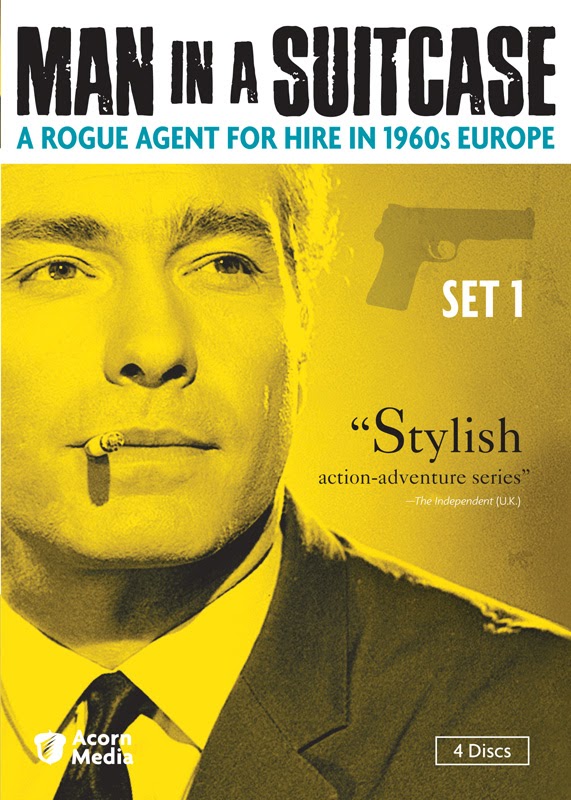
Just the other day, I mentioned on this page that Mysterical-E columnist Jim Doherty had included in his recent rundown of the “10 best private eyes created specifically for TV” a disgraced U.S. Intelligence agent turned P.I. by the name of McGill, who was played by American actor Richard Bradford in the UK drama Man in a Suitcase. Of Doherty’s 10 picks, McGill was the only one with whom I had no experience. In fact, I knew little about Bradford’s 1967-1968 series.

I was therefore well primed to notice a new post in the blog Classic Film and TV Café titled “Man in a Suitcase: The Best Spy TV Series You May Have Never Heard Of.” Contributor Rick29 acquaints us with the series’ premise:
Branded a traitor by U.S. intelligence, McGill makes a living doing free-lance work in Europe and Africa--dealing with blackmailers, protecting stool pigeons, finding kidnapped victims, recovering lost art treasures, etc. He charges $300 to $500 a week, depending on the job, plus expenses. When a potential client gripes about the high fee for a “disgraced American agent with a gun for hire,” McGill quips: “I’m expensive ... I call it my self-respect bonus.”

McGill's back story is revealed in the series’ sixth episode (originally intended as the first and best viewed that way). It explains that his government superiors framed him as a traitor to protect a mole behind the Iron Curtain. Proving his innocence is not an option--McGill recognizes that his false disgrace is a price that must be paid. These kinds of difficult decisions and realistic conclusions elevate Man in a Suitcase above its more conventional rivals. It’s not unusual for clients being guarded by McGill to be murdered anyway. And in one episode, after McGill fails to secure blackmail evidence, the victim sacrifices his ethics to protect his reputation.
You can read Rick29’s full article here. And it appears that Man in a Suitcase can be purchased in two DVD sets (here and here).

So now I come before The Rap Sheet’s highly discriminating audience with a simple question: Is it worth buying or else renting Man in a Suitcase on DVD? Comments are welcomed below.

READ MORE:TV on DVD: Man in a Suitcase: Set 1, by Scott Malchus (Pop Dose); “Man in a Suitcase,” by Jason Whiton (Spy Vibe); “Man in a Suitcase,” by Johnny Swoonara (Fanderson Forum); “Scorpio Rooms: Victor Canning on TV,” by Tise Vahimagi (Mystery*File).

“Give the Kid a Chance”

With just a couple more weeks left now before the release of his third novel, The Girl Next Door, former newspaperman Brad Parks is busy drumming up publicity. The evidence of that push can be found in today’s posting of “The Nightgown,” Parks’ 6,319-word short story about how his protagonist, Carter Ross, first won a reporter’s job with the Newark Eagle-Examiner, “New Jersey’s largest and most respected news-disseminating organization.” It makes clear that, like any newsie worthy of a byline, Ross can smell a good tale--and an opportunity--from a mile away.

Click here to read “The Nightgown.” Yes, it requires your registering with Criminal Element first. But if you’ve never sampled Parks’ fast-paced and often funny work before, this story provides a good introduction to his style.

“Grift” Wraps

Iowa editor and author John Kenyon announced last September that he was creating a new, thrice-yearly print magazine called Grift, to premiere early in 2012. As he explained, Grift would feature “crime fiction, reviews, interviews, and more.”

Although he didn’t quite make his anticipated February release date (creating a periodical isn’t nearly so easy as some people may think), Kenyon reports that “We’re putting the finishing touches on the issue now, and I would expect it to be available starting in early to mid-March.” Among that edition’s contents will be short stories by Ken Bruen, Chris F. Holm, Craig McDonald, Keith Rawson, and Todd Robinson; Scott Phillips’ essay on Derek Raymond’s Factory novels; a piece by Ray Banks about the various film adaptations of Charles Willeford’s books; and interviews with authors Julie Morrigan and Chris Offutt. In other words, a pretty fine line-up.

Kenyon promises to post ordering information here soon.

READ MORE:New and Exciting Grift Magazine,” by Ed Gorman.

Monday, February 27, 2012

Pierce’s Picks: “Holy City”

A weekly alert for followers of crime, mystery, and thriller fiction.

Holy City, by Guillermo Orsi (MacLehose Press/Quercus UK):
Argentine journalist-author Orsi won Spain’s Dashiell Hammett Prize in 2010 for this thriller set amid the Buenos Aires underworld. Now translated into English by Nick Caistor (who performed the same duty on Orsi’s previous novel, No-one Loves a Policeman), Holy City begins with the grounding of a cruise ship on the banks of the Río de la Plata. Passengers seeking refuge in Buenos Aires are targeted by that capital’s most unholy and opportunistic criminals. A Colombian drug kingpin and his girlfriend, along with a trio of foreign businessmen, are soon kidnapped. Summoned to straighten out all the confusion is weary Deputy Inspector Walter Carroza of the federal police, who finds himself occupied as well with a beauty queen whose suitors are turning up dead--and headless. The investigation that Carroza and his confidante, crusading attorney Verónica Berutti, embark on will propel them deep into Buenos Aires’ layers of corruption and toward a dangerous rendezvous at a theme park based on ancient Palestine.

* * *

Another promising novel due out this week is Children of Wrath (St. Martin’s Press), by Paul Grossman, a prequel to his much-applauded 2010 historical mystery, The Sleepwalkers. Like the previous work, Children of Wrath stars Berlin police detective Willi Kraus, a World War I hero who’s since come under suspicion because of his Jewish heritage. On the day in 1929 that New York’s stock market collapses, a burlap sack is pulled from Berlin’s sewer system, filled with the gnawed-on bones of young boys. Although his superiors deny Kraus supervision of this case, instead assigning him to get to the bottom of a tainted-meat scare, he can’t help but become involved in efforts to bring down the killer soon dubbed Kinderfresser, or the Child-Eater--even if it means risking his own life.

Sunday, February 26, 2012

Of Fests, Ferraris, and Film Fare

• In Reference to Murder’s B.V. Lawson reminds us that this week “the popular Sleuthfest opens in Orlando, Florida, and runs March 1-4. The guests of honor include Charlaine Harris (Sookie Stackhouse novels), Jeffery Deaver (Lincoln Rhyme series) and Chris Grabenstein (John Ceepak books), but many other authors will be on hand for panels and signings. Plus, this year the event features its first-ever dinner mystery theater.” To stir up interest, the Orlando Sentinel conducts a pre-festival interview with author Harris.

• The Winter 2011-2012 edition of Mysterical-E has been posted here. Among the contents are short stories by John M. Floyd, Rosemary Mild, and Richard Hart; Gerald So’s post-Christmas gift-buying suggestions; and Jim Doherty’s rundown of what he says are the “10 best private eyes created especially for TV” (including Peter Gunn, Miles C. Banyon, Harry Orwell, and Man in a Suitcase’s McGill).

• Eric Beetner laments the loss of “cool cars” from TV crime dramas. “With the rise of pure procedural,” he writes in Criminal Element, “the cars have become unnecessary. When much, if not most, of your action takes place in a lab, why bother with a snazzy car?”

• OK, so it isn’t a mystery or thriller novel. But how can you not love the front and back cover art on this 1967 edition of Tom O’Brien’s “adults only novel,” Hippie Harlot?

• As a tie-in to tonight’s Oscars presentations, Mystery Fanfare’s Janet Rudolph looks back fondly on the decades-long list of “Academy Award-winning and -nominated crime movies,” including In the Heat of the Night (1967), The French Connection (1971), The Godfather (1972), Chinatown (1974), and Fargo (1996).

• Speaking of crime-focused movie fare, The Mysterious Press’ blog has been slowly “recounting the films chosen by Otto Penzler for his now out-of-print 2000 collection, 101 Great Films of Mystery & Suspense.” The latest write-up--No. 45--covering Dirty Harry (1971) follows entries about Little Caesar (1930), The Big Heat (1953), And Then There Were None (1945), Detective Story (1951), and more.

• Crime Watch’s Craig Sisterson notes that “New Zealand actor Marton Csokas has been tapped to play Spanish chief inspector Javier Falcón in a [British] television adaptation of the novels by Robert Wilson.” The first book in Wilson’s series was The Blind Man of Seville, which I chose as one of January Magazine’s favorite books of 2003. Let’s hope this series someday makes it to America.

• Lenny Picker of Publishers Weekly interviews Paul Grossman, author of the World War I-era detective thriller Children of Wrath (a sequel to The Sleepwalkers), due out later this week.

• Meanwhile, Walter Mosley talks with the Chicago Sun-Times about his wide range of novels and his resurrection of series sleuth Easy Rawlins, whose first new adventure since Blonde Faith (2007) should be released by Doubleday next year.

• And Downton Abbey fans, in particular, should be pleased to receive this news: The writer of that popular British historical drama, Julian Fellowes, has a new miniseries about the 1912 sinking of the Titanic prepared for broadcasting this coming April--the 100th anniversary of the luxury liner’s destruction in the north Atlantic. The potentially bad news is that U.S. viewers may not be allowed to see Fellowes’ new project until May.

Thursday, February 23, 2012

Path Back to “War”

Following one abrupt cancellation by British network ITV (in 2007), a subsequent resurrection (brought about by viewer demand), and then a seeming conclusion to this TV series in 2010, Foyle’s War has won a brand-new season, which will offer a trio of two-hour episodes. Crime Time Preview’s Robin Jarossi reports today that
The setting for the much-loved period detective drama will shift from the war years to 1946-47, with Foyle in a new role of Senior Intelligence Officer on the trail of various traitors. The three stories--two written by author Anthony Horowitz, one by David Kane--will include Foyle [Michael Kitchen] tracking down atomic spies and a true tale of government corruption. “I have returned to Foyle’s War because there are still some amazing stories I want to tell,” says screenwriter and novelist Anthony. “The war may be over but Foyle’s career goes on.’ Honeysuckle Weeks should return as Samantha Stewart, who is now married.
An article posted on The Daily Mail’s Web page suggests that ITV’s willingness to invest in additional installments of Foyle’s War might be attributed, in part, to the remarkable success--on both sides of the Atlantic--of that network’s newer historical drama, Downton Abbey; ITV might be hoping, by bringing back the Kitchen show, to burnish its reputation for presenting high-quality period series. However, the revivification of Foyle’s War might have to do, as well, with the recent renown enjoyed by its creator, Horowitz, whose 2010 Sherlock Holmes novel, House of Silk, won numerous plaudits.

In any event, Jarossi says this new run of Foyle’s War will begin production in London this coming September. There’s no word yet on when the episodes might air, but we hope it will be soon.

READ MORE:Foyle’s War Returns with Three New Films Slated for 2013,” by Robert Lloyd (Los Angeles Times); “Foyle’s War Returns ... and Transitions Into a Full-on Spy Show,” by Tanner (Double O Section).

Wednesday, February 22, 2012

Working the Web

• Crime Factory Publications, known best for its quarterly e-zine, is preparing to launch a “new book line with an Australian-exclusive, print-only edition of the anthology The First Shift ($13.99), which includes some of the most acclaimed voices, both established and upcoming, in the world of crime fiction.” This new publishing venture will be kicked off by an event to be held on March 5 in Melbourne, Australia, attended by wordsmiths Megan Abbott, Adrian McKinty, David Whish-Wilson, and Leigh Redhead. “All attending authors,” reads a press release, “will read selections from their work, in the loose, fun format of acclaimed Noir at the Bar events held in St. Louis and Los Angeles. Fresh from Adelaide Writer’s Week, Megan Abbott will be reading from her forthcoming novel, Dare Me, for the very first time publicly. Live jazz from After Dark, My Sweet will score the evening and books will be for sale.” Sounds like fun.

• Today would’ve been the 87th birthday of Edward Gorey, the Chicago-born illustrator and author familiar for his macabre artwork. Although Gorey died way back in 2000, the Los Angeles Times’ Jacket Copy blog notes that “His work lives on, as do the fur coats--A.N. Devers bought one at auction--that Gorey used to wear to the ballet, along with Converse sneakers.”

• This is likely to put a chill on the possibility of anymore sequels to Mario Puzo’s The Godfather being published in the near future. As The New York Times explains today,
Paramount [Pictures] has sued Anthony Puzo, a son of the novelist, seeking to stop publication of a new “Godfather” novel called “The Family Corleone” ...The studio says that it gave permission for a 2004 sequel, “The Godfather Returns,” written by Mark Winegardner and published by Random House, but not for a 2006 follow-up, “The Godfather’s Revenge,” also by Mr. Winegardner and published by Putnam.
The Family Corleone is currently set for release on May 8.

• Really? A Hannibal Lecter TV series? Really?

This collection of cinematic lip-locks would’ve been totally appropriate for last week’s Valentine’s Day. Instead, it’s part of the Moviefone site’s pre-Oscars celebration.

• Again in the lead up to this Sunday’s night Academy Awards presentations, Entertainment Weekly spoke with Tim Miller, creative director of the studio responsible for the opening sequence of the U.S. film version of The Girl with the Dragon Tattoo. That sequence and a link to the EW piece can be found here.

• Yes, it’s true: Two and a half years after the popular TV series Monk disappeared from USA Network’s weekly schedule, “obsessive, compulsive detective” Adrian Monk (Tony Shalhoub) will soon return to the small screen in a two-hour movie, according to the show’s creator, Andy Breckman. Let’s hope the fetching Traylor Howard can be convinced to reprise her role as his aide, Natalie Teeger.

• I haven’t yet handled a copy of Chris F. Holm’s debut novel, Dead Harvest (the first in a succession of “Collector” books), but I’m already in love with the cover, which captures nicely the style of Penguin’s classic crime-paperback fronts.

• The late Howard Hopkins is the winner of this year’s Pulp Ark Lifetime Achievement Award. “The award,” reports All Pulp, “will be given to Howard’s wife, Dominique, on her husband’s behalf.” That ceremony will take place during the Pulp Ark convention, to be held in Batesville, Arkansas, from April 20 to 22.

• The Los Angeles Review of Books, a new online literary and cultural arts publication, sent me a notice, explaining that it will launch its full Web site on Wednesday, April 18. That notice adds: “The complete LARB Web site is specifically designed to take full advantage of evolving technologies of the Web, offering an immersive, interactive online literary experience, with reviews and essays, video and audio of author interviews and events, reader forums, a comprehensive searchable database of books, authors and their publishers, and much more.” Funny. Here I thought the present LARB site was perfectly adequate. I guess my expectations weren’t high enough ...

• In an all-too-brief interview, California writer Deborah Harter Williams reintroduces us to Thomas B. Sawyer, one of the early screenwriters for Murder, She Wrote.

• Jewish mystery writers will be honored during an event to be held on Sunday, March 4, at the Peninsula Jewish Community Center in Foster City, California (south of San Francisco). Mystery Fanfare provides the necessary specifics.

• Crime novelist Max Allan Collins lists his 16 favorite movies. Surprisingly, not all of them have to do with malfeasance and murder.

Another novel I haven’t yet read. Darn!

• This movie has potential:Elliott Chaze’s 1953 noir classic, Black Wings Has My Angel--one of only two crime novels he wrote--is being adapted for film,” reports Omnimystery News. “Anna Paquin (True Blood), Elijah Wood, and Tom Hiddleston (Wallander) are set to star in a screenplay by Barry Gifford (City of Ghosts). The storyline follows escaped convict Tim Sunblade (expected to be played by Hiddleston), who teams up with a call girl named Virginia (Paquin) in a backwoods Mississippi motel, where they plan a daring heist.”

• And I couldn’t be happier about this! Warner Home Video has announced it will finally release in DVD format all 27 episodes from the first season (1957-1958) of the often light-hearted TV Western Maverick, which starred James Garner and (beginning with the eighth episode) Jack Kelly, both playing gambler brothers adrift in the 19th-century American West. I already have on my shelves a “best episodes” DVD from that series, but I look forward to owning the complete first season, due out on May 29. As my Maverick-loving old pappy might have said, this is a must-have for Garner fans.

Tuesday, February 21, 2012

Prize Fight in L.A.

Five finalists in each of 10 categories have been selected to compete in this year’s Los Angeles Times Book Prize competition. The contenders in the Mystery/Thriller category are:

Started Early, Took My Dog, by Kate Atkinson (Reagan Arthur)
Plugged, by Eoin Colfer (Overlook Press)
11/22/63, by Stephen King (Scribner)
Snowdrops, by A.D. Miller (Doubleday)
The End of the Wasp Season, by Denise Mina (Reagan Arthur)

You’ll find the complete inventory of Book Prize finalists here. Winners will be announced during a ceremony on Friday, April 20, the night before the opening of that weekend’s Festival of Books, to be held at the University of Southern California. Tickets for the Book Prizes presentation can be purchased, beginning on March 26.

Megalomaniac with a Mustache

My column this week for Kirkus Reviews looks at Titan Books’ ambitious plan to bring all 13 of Sax Rohmer’s classic Dr. Fu-Manchu novels (plus an anthology of Fu-Manchu short stories) back into print, in handsome trade paperback editions. You’ll find the piece here.

Monday, February 20, 2012

Pierce’s Picks: “The Technologists”

A weekly alert for followers of crime, mystery, and thriller fiction.

The Technologists, by Matthew Pearl (Random House):
Like his 2003 debut work, The Dante Club, Pearl’s new, fourth novel is set in 1860s Boston. The story here focuses on the Massachusetts Institute of Technology’s inaugural class of graduates and, in particular, on a gifted subset of those young scholars, who hope to employ their scientific expertise to solve a succession of frightening local disturbances--one of which led to sudden instrument malfunctioning among ships in Boston Harbor, another that resulted in the glass in windows and doors throughout the city’s financial district suddenly melting. The methods employed by these “technologists,” though, are vigorously opposed by the too-frequently sensationalistic press, the “traditionalists” at rival Harvard, and a diabolical agitator bent on bringing New England’s largest city to its knees.

* * *

Also new this week is an old but never-before-published Donald E. Westlake novel, The Comedy Is Finished (Hard Case Crime). Written and set in the late 1970s--and rediscovered not so long ago by author Max Allan Collins--Westlake’s tale focuses on an aging, tediously patriotic comedian, Koo Davis, who is kidnapped by a waning militant group hoping to reignite its revolutionary cause. There are funny scenes here, but this yarn is also dark and hopeless at times, reflecting a period in U.S. history that Westlake evidently found disillusioning. As the back story goes, the author didn’t publish The Comedy Is Finished during his lifetime, because he thought it was overly similar to the premise of Martin Scorsese’s 1983 film, The King of Comedy.

Are You Among the Lucky Winners?

One week ago today, The Rap Sheet announced its very first book-giveaway competition of 2012. The prizes were three copies of Hilary Davidson’s brand-new novel, The Next One to Fall (Forge). Since that time, we’ve received dozens of e-mail notes from people wanting their names to be included in the drawing, and now we have our three winners, chosen completely at random. They are:

• Larry Maddox of Pasadena, California
• Liz Veronis of Annapolis, Maryland
• Kevin Ladd of Wallisville, Texas

Congratulations to all of these Rap Sheet readers. Your free copies of The Next to Fall will be sent out directly from the Forge offices in New York City, and should reach your mailboxes shortly.

And thanks again to everyone who entered this drawing. We wish that you could all walk away with prizes, but life doesn’t offer such assurances. Just stay tuned for more giveaways in the near future.

Round and Round He Goes

As the fine blog Television Obscurities notes, it was 50 years ago today that astronaut John Glenn’s spacecraft, Friendship 7, blasted off from Cape Canaveral in Florida as part of the United States’ Project Mercury. That launch resulted in the first successful attempt by NASA to put an astronaut in orbit.
At least 60 million viewers were glued to their television set, according to Broadcasting. Some 135 million would watch at least some of the network coverage that day. The three networks spent at least $3 million on the mission, a figure that included the costs incurred by a number of delays. The expensive delays forced ABC to withdraw from broadcasting “A Tour of the White House with Mrs. John F. Kennedy” earlier in the month. The coverage began three hours prior to lift-off, at 6:30 a.m., and continued for 11.5 hours. Both CBS and NBC also pre-empted portions of their evening schedule to air specials on Glenn’s flight: CBS aired a half-hour special from 9:30-10 p.m., while NBC’s special ran from 10 [to] 11 p.m.
Television Obscurities’ post includes “footage of the countdown and launch of Friendship 7, with commentary by Walter Cronkite ...”

By the way, John Glenn--who went on from being an astronaut to become a popular Democratic U.S. senator from Ohio (1974-1999)--will celebrate his 91st birthday in July. However, network TV news programs will probably pay closer attention to him today.

READ MORE:50 Years On: The Smithsonian’s Five Weirdest Items from John Glenn’s Flight,” by Richard Connelly (Houston Press); “To the Moon, Neil! To the Moon!,” by J. Kingston Pierce (The Rap Sheet).

Sunday, February 19, 2012

Bullet Points: Pre-Presidents’ Day Edition

• There’s just over a week left now before the closing of “Bullets Across the Bay: The San Francisco Bay Area in Crime Fiction,” an exhibit that opened in September 2011 at the University of California, Berkeley’s Doe Memorial Library. So if you haven’t yet visited that popular display, be sure to get in there by Wednesday, February 29. Meanwhile, this coming Friday, February 24, will offer a concluding reception in the Morrison Library (inside Doe Library) from 6 to 8 p.m. A news release explains that the evening’s program will feature five local mystery writers--Mark Coggins, Janet Dawson, Diana Orgain, Sheldon Siegel, and Simon Wood--“reading selections from their favorite Bay Area crime and detective novels, followed by an opportunity for audience members to engage the readers and exhibit curators in Questions and Answers.” The reception flyer is here (PDF). All guests are welcome.

• Tomorrow is Presidents’ Day in America. Janet Rudolph marks the occasion with a long list of presidential mystery novels.

• Anybody want to buy a bookstore? Mystery Lovers Bookshop in Oakmont, Pennsylvania, is for sale after 21 years in business.

• As part of my continuing series on The NBC Mystery Movie, I wrote at length about Dennis Weaver’s fish-out-of-water 1970s crime drama, McCloud, back in October. But just last week, Stephen Bowie of The Classic TV History Blog offered his own take on that series.

• Critic and former crime-fiction blogger Sarah Weinman brings the news that she “will be editing an anthology of domestic suspense stories, all reprints, for Penguin. The working title is The Dark Side of Dinner Dishes, Laundry, and Child Care, and if all goes according to plan it should be on bookshelves and available at your local and national e-tailer in fall 2013.” Good for you, Sarah!

• Tonight at 10 p.m. ET/PT will be broadcast the season (let’s hope it’s not also the series) finale of ABC-TV’s period drama, Pan Am. Showrunner Steven Maeda talks about that program’s past and future in the Los Angeles Times’ Show Tracker blog.

• Sadly in competition with that show is the 90-minute final installment of Downton Abbey, season two, which begins at 9 p.m. ET/PT. Take it from somebody who’s had the privilege of watching this episode already: It’s filled with wonderful, dramatic turns.

• Linda L. Richards, who edits January Magazine and contributes to The Rap Sheet, in addition to writing novels, tells me that she’ll be talking about electronic books in a special workshop scheduled during the third annual Galiano Literary Festival. That event is to be held on Galiano Island, one of British Columbia’s Southern Gulf Islands, from Friday, February 24, through Sunday the 26th. Although she concedes that electronic books have created new opportunities for writers, Richards explains, “I’m still very much a dead tree kind of girl. I love books and everything about them: the way they feel, the heft in the hand. Even the way they smell.” Her presentation at the Galiano fest will take place early this coming Saturday afternoon.

• In case you’ve wondered what distinguishes a “courtroom drama” from a “legal thriller,” blogger José Ignacio offers some ideas.

• Finding spots in ShortList’s rundown of “The 50 Coolest TV Shows Ever” are Dragnet, The Avengers, Starsky & Hutch, The Man from U.N.C.L.E., Life on Mars (the British version), Miami Vice, and several other familiar crime dramas.

Lawrence Block talked recently with Pornokitsch about last year’s release of Getting Off, a “sexy-sinister” novel that marked the “triumphant return of Jill Emerson, one of your earliest pen names.”

• Oh, and congratulations to Pornokitsch on its nomination for a British Science Fiction Association Award in the non-fiction category. The BSFA prizes are scheduled for presentation in mid-April.

• Omnimystery News lets us know that “Production has begun in Toronto on the upcoming BBC America crime drama Copper. Ten one-hour episodes are being filmed. Set in 1860s New York City, Copper stars Tom Weston-Jones as Kevin Corcoran, an intense, rugged Irish-American cop working the city’s notorious Five Points neighborhood. Corcoran is struggling to maintain his moral compass in a turbulent world, while on an emotional and relentless quest to learn the truth about the disappearance of his wife and the death of his daughter.” The show should premiere in the States this coming summer.

• Writer and graphic designer Christopher Mills previews a handsome series of covers he has created for half a dozen of Robert J. Randisi’s Miles Jacoby private-eye novels, which will be released in trade paperback in June by Perfect Crime.

• Seamus Scanlon, an award-winning Irish writer, in addition to being a librarian and professor at The City College of New York, and an occasional contributor to The Rap Sheet, will see a one-act play of his creation performed at Manhattan’s Cell Theater (338 West 23rd Street) on Saturday, March 3. More information is available here.

R.I.P., Writers’ Journal.

• Was Mission: Impossible’s sixth-season, 1971 episodeEncore,” which guest-starred William Shatner, really the most incredible installment of that series? Marty McKee certainly thinks so. “‘Encore,” he writes, “asks you to not only check your suspension of disbelief at the door, but to give it cab fare and send it home for the evening.” Hmm. I’ll have to go back and rewatch that episode now.

• And I’ve written several times in The Rap Sheet about the 1973-1974 NBC-TV series, The Magician, which starred Bill Bixby as a wealthy, trouble-shooting master of illusion. But whenever I do so, I am reminded that many of this blog’s readers have never seen that under-appreciated show. Therefore, I’m pleased to note that several full episodes of The Magician recently popped up on YouTube. Since the program isn’t yet available in DVD format, this might be your only chance to sample it in the near future. But do so quickly, because YouTube is notorious for taking down such TV segments. You might start your Magician watching with “Illusion in Terror,” an October 1973 episode that guest-starred Bixby’s wife, Brenda Benet. Part I of “Illusion” can be found here, along with links to other episodes such as “Ovation to Murder,” “Lady in a Trap,” and “Lightning on a Dry Day.”

Friday, February 17, 2012

Are You in the Running?

If you haven’t already entered The Rap Sheet’s contest to win one of three free copies of Hilary Davidson’s new novel, The Next One to Fall, you’d better get cracking. Entries to this drawing will be accepted only until midnight this coming Sunday, February 19.

All you need do to enter this competition is e-mail your name and postal address to jpwrites@wordcuts.org. And please write “Hilary Davidson Contest” in the subject line.

We’re sorry, but this contest is open only to U.S. residents.

Good luck to everyone!

Space Babe to Radio Guest

This last Wednesday, I wrote a post commemorating the 70th birthday of Idaho-born actress Sherry Jackson, who might be best remembered for her role as an android on Star Trek, but went on from there to guest star in crime dramas such as The Rockford Files, Switch, Matt Helm, and The Streets of San Francisco.

Well, tonight Jackson will be the opening guest on the two-hour radio program TV Confidential, hosted by Ed Robertson. The show will begin at 7 p.m. ET/PT on Share-a-Vision Radio, but can also be heard on other stations throughout the next week before becoming available for listening on the TV Confidential Archives page.

Robertson says his conversation with Jackson will cover “her stepfather, [television screenwriter] Montgomery Pittman, plus some of her favorite film and TV roles.”

FOLLOW-UP: At least part of Ed Robertson’s extensive interview with star Sherry Jackson is available on Goodpods.

Thursday, February 16, 2012

Forsyth Takes a Dagger

Britain’s Crime Writers’ Association announced this morning that 73-year-old thriller writer Frederick Forsyth, whose best-selling works include The Day of the Jackal (1971) and The Dogs of War (1974), will receive its 2012 Diamond Dagger Award.

“Frederick Forsyth is a hugely deserving recipient and The Day of the Jackal remains one of the greatest thrillers of our times,” says CWA chair Peter James. “He has set a new standard of research-based authenticity with his writing, which has had a major influence both on my work and on many of my contemporaries in the crime and thriller field. We are very thrilled that he has accepted this award.”

Previous Diamond Dagger recipients include Val McDermid, Andrew Taylor, Sue Grafton, John Harvey, and last year’s winner, Lindsey Davis.

Wednesday, February 15, 2012

Vying for the Agathas

Earlier today, Malice Domestic announced its nominees for this year’s Agatha Awards, which honor “traditional mysteries” in all their manifestations. Here are the six categories of contenders:

Best Novel:
The Real Macaw, by Donna Andrews (Minotaur)
The Diva Haunts the House, by Krista Davis (Berkley)
Wicked Autumn, by G.M. Malliet (Minotaur)
Three-Day Town, by Margaret Maron (Grand Central Publishing)
A Trick of the Light, by Louise Penny (Minotaur)

Best First Novel:
Dire Threads, by Janet Bolin (Berkley)
Choke, by Kaye George (Mainly Murder Press)
Learning to Swim, by Sara J. Henry (Broadway)
Who Do, Voodoo?, by Rochelle Staab (Berkley)
Tempest in the Tea Leaves, by Kari Lee Townsend (Berkley)

Best Non-fiction:
Books, Crooks and Counselors: How to Write Accurately About Criminal Law and Courtroom Procedure, by Leslie Budewitz
(Linden Publishing)
Agatha Christie: Murder in the Making: More Stories and Secrets from Her Notebooks, by John Curran (Harper)
On Conan Doyle: Or, The Whole Art of Storytelling, by Michael Dirda (Princeton University Press)
Wilkie Collins, Vera Caspary and the Evolution of the Casebook Novel, by A.B. Emrys (McFarland)
The Sookie Stackhouse Companion, by Charlaine Harris (Ace)

Best Short Story:
• “Disarming,” by Dana Cameron (Ellery Queen Mystery Magazine)
• “Dead Eye Gravy,” by Krista Davis (from Fish Tales: The Guppy Anthology, edited by Ramona DeFelice Long; Wildside Press)
• “Palace by the Lake,” by Daryl Wood Gerber (from Fish Tales: The Guppy Anthology)
• “Truth and Consequences,” by Barb Goffman (from Mystery Times Ten, edited by MaryChris Bradley; Buddhapuss Ink)
• “The Itinerary,” by Roberta Isleib (from Mystery Writers of America Presents The Rich and the Dead, edited by Nelson DeMille; Grand Central Publishing)

Best Children’s/Young Adult:
Shelter, by Harlan Coben (Putnam Juvenile)
The Black Heart Crypt, by Chris Grabenstein (Random House Books for Young Readers)
Icefall, by Matthew J. Kirby (Scholastic Press)
The Wizard of Dark Street, by Shawn Thomas Odyssey (EgmontUSA)
The Code Busters Club, Case #1: The Secret of the Skeleton Key, by Penny Warner (EgmontUSA)

Best Historical Novel:
Naughty in Nice, by Rhys Bowen (Berkley)
Murder Your Darlings, by J.J. Murphy (Signet)
Mercury’s Rise, by Ann Parker (Poisoned Pen Press)
Troubled Bones, by Jeri Westerson (Minotaur)
A Lesson in Secrets, by Jacqueline Winspear (Harper)

The winners will be declared on Saturday, April 28, during the Malice Domestic conference in Bethesda, Maryland. Three other awards presentations will also be made at that time:

Lifetime Achievement Award -- Simon Brett
Poirot Award -- Lee Goldberg
Amelia Award -- Elizabeth Peters

(Hat tip to Classic Mysteries.)

The Age of Jackson

It’s not strictly crime fiction, but I have posted in one of my other blogs a 70th-birthday tribute to Sherry Jackson. The Idaho-born actress went on from a particularly sexy role in the original Star Trek (she played the android Andrea) to make guest appearances in such shows as 77 Sunset Strip, Perry Mason, The Rockford Files, Matt Helm, and The Streets of San Francisco. You’ll find my piece here.

Tuesday, February 14, 2012

Pucker Up and Die, Baby

Happy Valentine’s Day, everyone! By way of celebration, I’m showcasing more than two dozen memorable (and often sexy) book fronts--all from works with “kiss” in the title--in The Rap Sheet’s sister blog, Killer Covers. Check them out when you get a chance.

READ MORE:Valentine’s Day Mysteries,” by Janet Rudolph (Mystery Fanfare); “The Bloody, Sexy Beginnings of Valentine’s Day,” by Richard Connelly (Houston Press); “The Economics of Valentine’s Day,” by Suzy Khimm (The Washington Post); “The Top 100 Most Strange, Odd, Perplexing and Unintentionally Funny Vintage Valentine Cards EVER!,” by Mitch O’Connell.

The Doctor Is In

Master criminal Dr. Fu-Manchu, who became famous in a series of novels by Sax Rohmer, published between 1913 and 1959, is making his long-overdue return in a new set of paperback reissues from Titan Books. Read more about it here.

Monday, February 13, 2012

Pierce’s Picks: “The Next One to Fall”

A weekly alert for followers of crime, mystery, and thriller fiction.

The Next One to Fall, by Hilary Davidson (Forge):
Drawing on knowledge and interests developed through her other life as a travel journalist, Hilary Davidson offers up this much-twisted new tale about Lily Moore, the trouble-attracting travel writer she introduced in her Anthony Award-winning first novel, last year’s The Damage Done. In The Next One to Fall, we find Lily going with her photographer friend, Jesse Robb, to visit the 15th-century Inca ruins of Machu Picchu, in Peru. But while there, they discover a woman who calls herself Trista, hanging on desperately to the lower end of a stone staircase. Before she dies, Trista tells them that she’s been murdered--and by whom. But Lily’s subsequent efforts to persuade police that Trista was right in this matter come to naught. So she pursues her own investigation, in the course of which she learns Trista wasn’t the only woman to die at the hands of the person she accused of doing her in. Expect plenty of suspense and polished atmospherics in Davidson’s sophomore novel.

* * *

A handful of lucky readers will soon have the opportunity to judge The Next One to Fall for themselves. Davidson’s publisher, Forge, has supplied The Rap Sheet with three copies of this book, which we’re going to give away for free. If you’d like to win one of these copies, all you need do is e-mail your name and postal address to jpwrites@wordcuts.org. And please write “Hilary Davidson Contest” in the subject line. Contest entries will be accepted between now and midnight on Sunday, February 19. The winners will be selected at random and their names announced on this page the next day.

We’re sorry, but this contest is open only to U.S. residents.

Good luck to everybody who enters this drawing! It is our first such giveaway for 2012, so we’re hoping for an abundant response.

READ MORE:The Ones Who Didn’t Get Away,” by Hilary Davidson (Musings of an All Purpose Monkey).

Sunday, February 12, 2012

Recommended Rivalries

Jen Forbus sure does love those crime-fiction bracket tournaments. In 2010, she conducted an online poll to determine the “World’s Favorite Detective,” which resulted in a win for Michael Connelly’s Harry Bosch. And last year, she asked readers to select the “World’s Favorite Amateur Sleuth”--a contest in which Brad Parks’ Carter Ross finally took home top honors.

This time, Forbus’ focus is on “Heroes and Villains.” So, she explains, “the corresponding bracket tourney will be protagonists versus antagonists. The tourney will run a tad bit different as all the antagonists (aka villains) will face off against each other while all the protagonists (aka heroes) will face off against each other, and then the lone remaining one on each side of the bracket will face off in the final week--during the theme week: Top Hero vs. Top Villain.”

She’s currently soliciting names of characters that readers think ought to be included--32 heroes and 32 villains, from either series or standalone novels. “You may nominate as many characters as you like as often as you like through March 4th,” writes Forbus. “Then I will tally all of the nominations, build the bracket and announce our competitors on March 7th.”

Click here to recommend contestants in this match-up.

Friday, February 10, 2012

Barry Special Favors

Earlier today, the editors of Deadly Pleasures Mystery Magazine announced their nominees for the 2012 Barry Awards in half a dozen categories. All of the works to be judged were published in English during 2011. The contenders are:

Best Novel:
The Keeper of Lost Causes (aka Mercy), by Jussi Adler-Olsen (Dutton)
The Accident, by Linwood Barclay (Bantam)
The Hurt Machine, by Reed Farrel Coleman (Tyrus)
Iron House, by John Hart (Minotaur)
Hell Is Empty, by Craig Johnson (Viking)
The Troubled Man, by Henning Mankell (Knopf)

Best First Novel:
Learning to Swim, by Sara Henry (Crown)
The Devotion of Suspect X, by Keigo Higashino (Minotaur)
The Boy in the Suitcase, by Lene Kaaberbøl and Agnete Friis
(Soho Crime)
Turn of Mind, by Alice LaPlante (Atlantic Monthly)
The Informationist, by Taylor Stevens (Crown)
Before I Go to Sleep, by S.J. Watson (Harper)

Best British Novel:
Now You See Me, by S.J. Bolton (Bantam Press)
Hell’s Bells, (aka The Infernals), by John Connolly
(Hodder & Stoughton)
Bad Signs, by R.J. Ellory (Orion) -- one of January Magazine’s favorite crime novels of 2011
The House at Sea’s End, by Elly Griffiths (Quercus)
Outrage, by Arnaldur Indriðason (Harvill Secker)
Dead Man’s Grip, by Peter James (Macmillan)

Best Paperback Original:
The Silenced, by Brett Battles (Dell)
The Hangman’s Daughter, by Oliver Pötzsch (Mariner Books)
A Double Death on the Black Isle, by A.D. Scott (Atria)
Death of the Mantis, by Michael Stanley (Harper Perennial)
Fun and Games, by Duane Swierczynski (Mulholland)
Two for Sorrow, by Nicola Upson (Harper Perennial)

Best Thriller:
Carver, by Tom Cain (Bantam Press)
Coup D’Etat, by Ben Coes (St. Martin’s)
Spycatcher (aka Spartan), by Matthew Dunn (Morrow)
Ballistic, by Mark Greaney (Berkley)
House Divided, by Mike Lawson (Atlantic Monthly)
The Informant, by Thomas Perry (Houghton Mifflin)

Best Short Story:
“Thicker Than Blood,” by Doug Allyn (Alfred Hitchcock Mystery Magazine [AHMM], September 2011)
“The Gun Also Rises, by Jeffrey Cohen (AHMM,
January-February 2011)
“Whiz Bang,” by Mike Cooper (Ellery Queen Mystery Magazine [EQMM], September-October 2011)
“Facts Exhibiting Wantonness,” by Trina Corey (EQMM,
November 2011)
“Last Laugh in Floogle Park,” by James Powell (EQMM, July 2011)
“Purge,” by Eric Rutter (AHMM, December 2011)

Winners will receive their prizes at the Rock & Roll Hall of Fame on October 4, 2012, during the opening ceremonies of this year’s Bouchercon in Cleveland, Ohio.

Thursday, February 09, 2012

Love Has Its Rewards

Since The Rap Sheet has recently brought you rundowns of the crime-fiction nominees for the Minnesota Book Awards, the contenders for four different commendations to be dispensed during next month’s Left Coast Crime convention, the five finalists for the 2012 Dilys Awards, and the rivals for this year’s Hammett Prize, it seems only right to mention the winners of the 2012 Lovey Awards.

The Loveys were given out during last weekend’s Love Is Murder conference in Chicago, but only this morning did Omnimystery News post a list of the recipients, as follows:

• Best First Novel:
Basic Black, by Scott Doornbosch (CreateSpace)

• Best Traditional/Amateur Sleuth:
Murder, She Wrote: The Fine Art of Murder, by Donald Bain (NAL)

• Best P.I./Police Procedural:
The Towman’s Daughters, by David J. Walker (Severn House)

• Best Thriller: Northwest Angle, by William Kent Krueger (Atria)

• Best Historical:
Terror at the Fair, by Robert Goldsborough (Echelon Press)

• Best Romantic Suspense:
A Lot Like Love, by Julie James (Berkley)

• Best Suspense:
ToxiCity, by Libby Fischer Hellmann (Red Herrings)

• Best Paranormal/Sci-Fi/Horror:
Homefront: The Voice of Freedom, by John Milius and Raymond
Benson (Del Rey)

• Best Series:
“The White House Chef,” by Julie Hyzy

• Best Short Story:
“Diamonds Aren’t Forever,” by Mary Welk (from Dark Things II: Cat Crimes, edited by Patty G. Anderson; CreateSpace)

So Long, Seersucker

Since we’d been led to believe, only recently, that It Couldn’t Happen Here ...”--the terrific blog devoted to that 1970s cult-TV series, Kolchak: The Night Stalker--would continue to offer new material for “a few more weeks,” we’re surprised by today’s announcement that it’s already shutting down, though not disappearing.

Over the last week, the blog has added posts about three never-filmed Kolchak episodes (“Eve of Terror, “The Get of Belial,” and “The Executioner”), as well as Mark Dawidziak’s look back at the books and graphic novels that either starred monster-hunting, seersucker-wearing reporter Carl Kolchak, or analyzed the original ABC-TV series. And today, David J. Schow recalls the very short-lived, 2005-2006 series reboot, The Night Stalker, which he notes “was cancelled right in the middle of a two-part episode, with four episodes unbroadcast until the series was re-run on the Sci Fi Channel in 2006.”

We’re sorry to see It Couldn’t Happen Here ... disappear into the night, but a link to it has been installed from The Rap Sheet’s page of archive sites, so it can be relocated easily the next time you want to remember one of American television’s most remarkable, if underappreciated, prime-time programs.

UPDATE: An index to all of the offerings in It Couldn’t Happen Here ..., complete with links, has now been established here.

READ MORE:Still Stalking Kolchak,” by Amber Keller (Criminal Element).

Tuesday, February 07, 2012

What the Dickens?

It seems not to have passed too many people by, that had he not perished way back in 1870, English author Charles Dickens would today be celebrating 200 years of life (though how cheerful a 200-year-old man might really be is anybody’s guess).

I had thought to write a colorful defense on this page of Dickens as a mystery and suspense novelist--which he unquestionably was, though not exclusively--perhaps peppering into my argument a few choice passages from Bleak House (1853) and The Mystery of Edwin Drood (still uncompleted at the time of his death), and adding others from his 1865 work, Our Mutual Friend, which I am only now reading for the first time. Of course, I would also have found a way to name-drop Dickens’ famous protégé, Wilkie Collins, who is remembered these days mostly for his mystery fiction (having penned 1860’s The Woman in White and The Moonstone, 1868).

But there have been so many posts devoted to Dickens’ birthday today, that I shall simply mention four I think are worth your attention:

• “The Dark Side of Dickens,” in which fiction writer and reviewer David Abrams--while applauding Dickens’ books--recalls the author’s sometimes disagreeable personality. “It is a truth universally acknowledged that Charles Dickens the Writer was a genius,” Abrams begins, “but Charles Dickens the Man was an asshole.”

• “Charles Dickens, Crime Writer,” which has Criminal Intent contributor Terry Farley Moran making the argument I had thought to put forth, and making it well. “Charles Dickens,” she explains, “didn’t become famous as a writer of mystery/detective fiction, as it was not a commonly defined genre during his lifetime. But as we look back, he was definitely a master of the craft.” I couldn’t agree more.

• “Charles Dickens at 200: Still the Great British ‘Idol.’” As reluctant as I am to recommend anything from USA Today (the most white-bread and dull of American newspapers), reporter Bob Minzesheimer does offer a fairly good overview of Dickens’ continuing influence on our entertainment media.

• “Charles Dickens’ Birthday and the Age of Verbosity,” in which Washington Post writer Alexandra Petri proffers a spirited tribute to Dickens’ persistent long-windedness. “Dickens ... took an awfully long time to say whatever it was he was going to say,” she notes. “And he had an incentive to do it. He published his books in installments, in the pulp form of the serial--cheaper than full-bore novels, and far more addictive. On the bright side, this makes his books useful for stopping doors and ironing recalcitrant skirts. On the downside, you really feel, upon emerging, that you know everything that can possibly be said on the subject of allegorical knitting.”

Elsewhere on the Web today, you’ll find lists of “The 10 Best Charles Dickens Characters of All Time” and “Five Myths About Charles Dickens,” as well as The Guardian’s “fiendishly difficult” Dickens birthday quiz and search engine Google’s nod to the Victorian Age’s greatest novelist in the form of a page-top “doodle”.

(Hat tips to Mystery Fanfare and Bill Crider’s Pop Culture Magazine.)

READ MORE:Charles in Charge,” by Kent Jones (The Maddow Blog); “The 200th Anniversary of Charles Dickens’ Birth,” by Mercurie (A Shroud of Thoughts).

No Rest for the Defense

In my column this week for Kirkus Reviews, I offer a critique of William Landay’s new mystery/legal thriller, Defending Jacob. It’s a very fine book in most respects, but also, as I write, “an emotional roller-coaster ride of a tale that examines the extremes to which parents might go out of love for their children.” After I finally closed the novel on its last page, I had to wonder whether I was happy to know how the story turned out. I’m still not sure.

You can read the Kirkus piece here.

Monday, February 06, 2012

Pierce’s Picks: “The Bedlam Detective”

A weekly alert for followers of crime, mystery, and thriller fiction.

The Bedlam Detective, by Stephen Gallagher (Crown):
British author Stephen Gallagher, who has contributed scripts to BBC-TV’s Doctor Who as well as the short-lived CBS-TV drama Eleventh Hour, wrote one of the most extraordinary novels I read in 2007: The Kingdom of Bones, a supernatural historical thriller. Now he’s back with this whodunit, set in England in 1912, that introduces Sebastian Becker, an ex-Pinkerton agent hired to investigate crimes that involve “men of property” whose sanity is in question. In these pages he takes on the mystery of Sir Owain Lancaster, who’s recently returned from South America, where his wife and son were killed. Lancaster blames their deaths on seemingly prehistoric creatures--which he believes have trailed him back to Europe and were recently responsible for killing a pair of young girls. That seems hard to credit ... except there are local legends of a beast haunting the moor, and Becker’s seen too many odd things in his time to dismiss the absurd as impossible.

Happy Birthday, John Steed!

That is, let us all rise in applause for veteran English actor Patrick Macnee, who starred as suave Steed in the 1961-1969 UK TV series The Avengers, during three years of which he played opposite the captivating (and oft-catsuited) Diana Rigg.

Macnee--who turns 90 years old today--went on to feature in a short-lived revival of The Avengers, do a fine turn as Doctor John Watson in the 1976 teleflick Sherlock Holmes in New York (with Roger Moore portraying Holmes), appear beside Robert Urich in the TV crime-adventure drama Gavilan, act in the 1985 James Bond film A View to a Kill (again billed with Roger Moore) as Agent 007’s ally Sir Godfrey Tibbett, guest-star in an unusual episode of Columbo, accept a less-than-career-making role in Dennis Weaver’s The Return of Sam McCloud, live to regret his involvement in the Hulk Hogan action-adventure series Thunder in Paradise, and ... well, let’s just say that his résumé runs to more than a mere page or two.

Wherever you are, Mr. Macnee, we wish you the best today.

Mark Your Calendars

2012 is still barely out of diapers, and last year’s Bouchercon in St. Louis seems like it took place just yesterday. But already the Web seems filled with reminders of conventions soon to come.

Editor-organizer Janet Rudolph does her best, in a Mystery Fanfare post, to encourage attendance at the 2012 Left Coast Crime convention, which is slated to take place in Sacramento, California, during the weekend of March 29-April 1.

Meanwhile, Mystery*File’s Steve Lewis touts PulpFest, “now entering its 41st year.” The latter conference will swell the population of Columbus, Ohio, from August 9 to 12.

If you’re interested in attending either of these events, you might want to start your planning in the near future.

Saturday, February 04, 2012

Gilman and Gazzara — Gone

New Jersey-born author Dorothy Gilman, who’s best remembered for creating the character of grandmother-spy Emily Pollifax, died on Thursday at age 88 from complications of Alzheimer’s disease. As her son Jonathan Butters remarked in a note to the Mrs. Pollifax Fan Blog, she had suffered from Alzheimer’s “for the past nine years so her death is both sad and a relief.”

Gilman, who received the Mystery Writers of America’s Grand Master Award in 2010, attended the Pennsylvania Academy of the Fine Arts from 1940 to 1945, and shortly thereafter witnessed the publication of her first novel, a children’s book titled Enchanted Caravan (1949). It wasn’t until seven years later that The Unexpected Mrs. Pollifax, the first entry in what would eventually become a 14-book series, saw print. The Mrs. Pollifax Fan Blog offers this plot synopsis:
Mrs. Virgil (Emily) Pollifax of New Brunswick, New Jersey, was a widow with grown, married children. She was tired of attending her garden club meetings. She wanted to do something for her country. So, naturally, she became a CIA agent. She takes on a “job” in Mexico City. The assignment doesn’t sound dangerous at first, but then, as often happens, something goes wrong. Now our dear Mrs. Pollifax finds herself embroiled in quite a cold war--and her country’s enemies find themselves entangled with one unbelievably feisty lady.
The Mrs. Pollifax espionage tales transported their protagonist (as well as Gilman’s readers) to far-flung corners of the globe and into all sorts of trouble, but never found their heroine lacking in resourcefulness. “Clever, lucky and naïvely intrepid,” The New York Times recalls in its obituary of Gilman, “Mrs. Pollifax employs common sense and a little karate to rescue the kidnapped; aid the resistance (when you are a suburban lady spy, a fashionable hat is ideal for concealing forged passports); and engage in all manner of cheery deception (when doing business with a malefactor who is expecting a can of plutonium, a can of peaches makes an excellent if short-term substitute).” The series’ final installment, Mrs. Pollifax Unveiled (2000), found Gilman’s ripened protagonist in the Middle East, looking to find a missing American woman--and avoid an international crisis.

Until I started poking around the Web for more information about Gilman today, I hadn’t realized that The Unexpected Mrs. Pollifax was adapted twice by Hollywood. A 1971 big-screen picture, Mrs. Pollifax—Spy, starred Rosalind Russell and Darren McGavin. (You can watch a delightful behind-the-scenes video associated with that movie here.) And in 1999, Angela Lansbury of Murder, She Wrote fame starred in what many critics describe as a mediocre CBS-TV film, The Unexpected Mrs. Pollifax.

But for most fans of Dorothy Gilman’s series, the Mrs. Pollifax who resides in their imagination can’t be replaced. And will not be forgotten, even after the death of her creator.

* * *

Meanwhile, we must also report that 81-year-old film and TV actor Ben Gazzara passed away on Friday in Manhattan as a result of pancreatic cancer. Born in New York City to Italian immigrants, Gazzara (originally Biagio Anthony Gazzarra) first came to widespread attention in a mid-1950s Broadway production of Cat on a Hot Tin Roof. He subsequently appeared as a soldier being tried for the murder of his wife’s rapist in the 1959 film Anatomy of a Murder, which was headlined by Jimmy Stewart and based on Robert Traver’s popular 1958 novel of the same name.

Gazzara’s first serious leap into series television came in 1963, when he starred with Chuck Connors in a short-lived 90-minute ABC series called Arrest and Trial, the format of which was similar to the later NBC-TV hit, Law & Order. Soon afterwards, he accepted the lead in the Roy Huggins drama Run for Your Life (1965-1968), playing a lawyer who’s informed that he has no more than 18 more months to live, and so embarks on a cross-country journey, trying to make the most of whatever time he has remaining. Gazarra went on to star in the 1974 TV miniseries QB VII, based on Leon Uris’ 1970 novel, as well as the theatrical releases The Killing of a Chinese Bookie (1976) and Opening Night (1977). He even did turns in The Big Lebowski (1998), portraying a porno-movie producer, and was cast as private-equity tycoon Thomas Crown’s attorney in the 1999 remake of The Thomas Crown Affair. In addition, Gazarra directed two episodes of the NBC Mystery Movie series Columbo in the mid-’70s.

Because whenever I think of Ben Gazarra I always think of Run for Your Life, I’ve decided to post the opening and closing sequences from that series (with theme music by Pete Rugolo) below. Enjoy.


READ MORE:Ben Gazzara (1930-2012),” by Edward Copeland (Edward Copeland on Film ... and More); “Ben and Zal,” by Stephen Bowie (The Classic TV History Blog); “The Late, Great Ben Gazarra,” by Mercurie (A Shroud of Thoughts).

Thursday, February 02, 2012

Bullet Points: Quiet Thursday Edition

• Last month, I wrote in The Rap Sheet about the short-lived, 1968-1969 NBC-TV series The Outsider, which starred Darren McGavin as a Los Angeles private investigator very much in the Jim Rockford mold (it was no coincidence that The Outsider and The Rockford Files were both created by Roy Huggins). More recently, Michael Shonk has written in the Mystery*File blog about the 1967 pilot for McGavin’s series and the 26 one-hour episodes of The Outsider that made it onto the air. Although this program doesn’t sound perfect, I would be very pleased to see it released in a DVD set.

• Critic and blogger Vince Keenan was lucky enough to be on hand for last month’s 10th San Francisco Film Noir Festival, and has been writing about it over the last couple of days. His report on the fest’s first two days is here. He recalls day three here. And I’m expecting to see his recollections of day four pop up sometime tomorrow. UPDATE: Keenan’s report from the final day of this year’s Noir City Film Festival can now be enjoyed here.

• Meanwhile, San Francisco historian and old-time radio broadcast authority Christine A. Miller shares a few remarks of her own about that film festival here, here, and here.

• Author Bill Crider points me toward a blog called Do the Math, in which a regrettably uncredited author offers an excellent essay about 20th-century novelist Ross Thomas that includes a survey of his work. Titled “Ah, Treachery,” the piece is a must-read for Thomas enthusiasts, or others wanting an introduction to his witty thrillers.

• In the limited-run blog It Couldn’t Happen Here ..., Peter Enfantino and John Scoleri (with guest essayist Mark Dawidziak) wrap up their episode-by-episode analyses of the 1970s cult-TV series Kolchak: The Night Stalker with comments about that ABC show’s 20th and final installment, “The Sentry” (see here and here). They also pick their favorite Kolchak teleflicks and series entries. But they add that their blog still has a great deal more in the offing: “First up, over the next several days [David J. Schow] provides us with the scripts for three unfilmed episodes (and check in this Saturday for a surprise extra!). Then, Mark Dawidziak will offer a look at Carl Kolchak’s career in prose. David J. Schow will explore the TV offspring of Kolchak: The Night Stalker, and then we launch into a full episode-a-day review of the [2005-2006] revival series. That’s right. Stay tuned to find out how it stacks up against the original.”

• This coming weekend’s dedication of the new Warner Bros. Theater at the Smithsonian Institution in Washington, D.C., will include “a Humphrey Bogart festival,” explains In Reference to Murder blogger B.V. Lawson, “with Friday night’s showing of Casablanca and a Q&A following with Stephen Bogart, son of Humphrey Bogart and Lauren Bacall. Saturday features the classic adaptation of Dashiell Hammett’s novel, The Maltese Falcon, with NPR film commentator Murray Horwitz leading a pre-screening discussion highlighting historical tidbits and things to look and listen for in this classic Hollywood movie. On Sunday, the three-day affair winds down with The Big Sleep, the Howard Hawks directed film version of Raymond Chandler's first novel.” It’s unfortunate that I won’t be in D.C. this weekend.

• The 13th annual Love Is Murder conference will open tomorrow in Chicago and continue through Sunday, February 5. Click here for complete registration information.

• This is also the weekend for the Cape Fear Festival at the New Hanover Library in Wilmington, North Carolina. Details here.

• Did you know there’s a series of Modesty Blaise graphic novels?

• I have, and am currently reading, the U.S. edition of George Pelecanos’ new Derek Strange novel, What It Was. But the front of that paperback book isn’t nearly as interesting as UK publisher Orion’s blaxploitation cover. Can you dig it?

• To celebrate the paperback release of Lawrence Block’s A Drop of the Hard Stuff, the author recalls--in the Mulholland Books blog--what led him to write that 17th Matthew Scudder novel.

• For the blog Criminal Element, William I. Lengeman III has put together “an informal survey of the many appearances of [magician-escapologist] Harry Houdini in the annals of mystery fiction.” Huh. I thought I’d read most such books (including 1992’s Believe, by William Shatner and Michael Tobias), but I’ve obviously missed several. Clickety-clack here to locate Lengeman’s post.

• Finally, Spinetingler Magazine features the first review I’ve spotted of Christa Faust’s new Butch Fatale “Dyke Dick” novel, Double-D Double Cross. “Faust lets you know right quick what you’re in for with this beast,” observes Peter Dragovich (aka Nerd of Noir), “namely hot graphic lesbian sex and classic pulp private dick stuff with a brilliant fucking twist.” You will find his write-up here.

Wednesday, February 01, 2012

The Story Behind the Story:
“Hope Road,” by John Barlow

(Editor’s note: This 30th entry in our “Story Behind the Story” series welcomes to The Rap Sheet prize-winning British wordsmith John Barlow. Among other things, he’s the author of Hope Road, a recently released electronic novel and the first installment in his LS9 crime series, “about criminals, their families, and their victims.” Below, Barlow recalls how discoveries about a relative, plus several coincidences, persuaded him to pen his first serious crime novel.)

I’ve always written about crime. There are three unpublished manuscripts under my bed, all full of dead bodies. Yet despite being a jobbing writer by trade, I’d never published any crime fiction. By the time I hit my 40s, I’d published literary fiction, long and short, a travel book, food journalism, and as a ghost writer I’d done children’s fiction, humorous fiction, and a financial thriller (of which more below). It seemed as if crime was about the only genre I hadn’t written professionally.

Then three things happened at once:

1. I discovered that my uncle John was an international arms dealer.
2. I got to meet a money counterfeiter.
3. The West Yorkshire Police lent me a detective.

Suddenly, it seemed that I really should write a crime novel. So I did. This is how it happened …

Uncle John Sells Guns
There are one or two dodgy characters in my family. My great-great-great grandfather once stole a mutant “winged” cat from some gypsies and exhibited it at local fairs, and he was later sent to Wakefield Gaol for the ridiculous crime of stealing a golden weather cock. That same man was also notorious for having beaten a horse to death with a table leg.

I know stories like these because Frank Barlow, my uncle, has spent the last 50 years researching our family history (which includes French Huguenots and the illegitimate son of a scullery maid, in case you’re asking). About a year ago Frank was showing me the family tree. His finger hovered for a second over the name John Lord (b. 1948, d. 1984). “And that’s John, of course,” he said. “Murdered by Gaddafi.”

WHAT?!

It’s funny how the most significant stories in a family’s past are often deemed unmentionable, as if by mutual consent the entire clan refuses to talk about some dark secret that they all share. No one had ever mentioned John Lord to me. And now it turns out that Colonel Muammar Gaddafi had him killed.

John Lord was actually a half-uncle on my father’s side, and his family were all a bit strange. His granddad invented SPIK in the 1940s (long before political correctness), a powder that cleaned carpets. He also had a hat shop in Leeds with a small pigsty behind it. My dad’s aunt Jean used to work in the shop as a teenager, and one day she discovered 20 crates of army-issue rifles in an outbuilding next to the pigs. Yes, that side of the family certainly have form.

Now fast-forward two generations. My uncle John was an arms dealer based in Leeds, England. He was licensed to carry guns, and back in the late 1970s and early ’80s, before airports were like Fort Knox, he used to take firearms on business trips with him, carrying them in a specially designed attaché case which he had to hand over to the captain when he boarded a flight.

In the world of arms dealers, though, he was small fry. As a novelist, this is where I find it interesting: because he was an international arms dealer, yet he also dealt in military memorabilia. So, he’d sell you a commemorative teaspoon from the Battle of Waterloo, or a crate of land mines. When he died he left a young wife and two daughters, aged 8 and 2, in a small suburban house. It seems extraordinary to me that someone who peddles the instruments of death can construct such a “normal” life around himself. It’s almost more shocking than if he’d been a mobster.

John had made various trips to Libya. Why does an arms dealer go to Tripoli in the early ’80s? Your guess is an good as mine. His wife would later claim that he’d been in contact with someone about working undercover, though she didn’t know who. Whatever the truth, on the last leg of one such trip home he was found dead in the plane’s toilet, his throat slit. An apparent suicide, which his wife didn’t believe. She vowed to get to the truth, taking the case to the coroner and speaking to the press, the whole media thing.

It was then discovered that he’d been dealing in munitions stolen from the British Army. Not a great legacy to leave behind, then, spy or not. By this time the family had stopped talking about John Lord. No one so much as rang his father on the day of the funeral.

The case then surfaced in an intelligence report, in connection with possible paramilitary organizations in Northern Ireland. The final nail in the coffin: John might have been supplying the IRA with arms filched from the British Army. As they say, you don’t choose your family ...

(Left) Author John Barlow

What really fascinates me, and forms the basis of Hope Road, is the fact that real-life criminality is often drawn not in black and white, but in shades of gray. People sometimes walk a thin line between criminality and the law-abiding life. Indeed, criminals often have legitimate businesses, lead respectable lives, and sometimes find themselves involved in crime almost by accident. This is certainly the case with the next person ...

The Alchemist
I’m currently ghost-writing a financial thriller called Headless, which is part of a broader exploration of international finance by the Swedish conceptual artists Goldin+Senneby. I met up with those artists in Paris last year to discuss this project. By chance, I’d been reading Stephen Jory’s autobiography, Funny Money. I’ve been interested in counterfeiting for years, and Jory was the UK’s most successful counterfeiter. He started his career making fake perfumes, and moved on to banknotes after getting involved in printing perfume boxes (the most important thing to get right, apparently, is the fake box).

“Jory?” one of my Swedish collaborators said. “Ah, yes, I met him not long before he died. I was in London researching a project about money …”

This was Stephen Jory, the British counterfeiter of the 1980s and ’90s. At one point his bogus notes were thought to represent two-thirds of all British fakes in circulation. It was an amazing connection to have. And although it was too late to meet him, I did manage to get the name of someone who, in turn, put me in touch with someone else … a guy who was still printing phony currency.

We met in a coffee shop in Walthamstow (East London) and he explained how it works. You want to know the secret? Apart from the printing process itself, which he wouldn’t talk about at all, the key thing is not to produce too much. Keep your workforce down to a minimum, prefer lower returns over higher risk … OK, it’s not rocket science.

But two things struck me about this guy. First, although he was understandably vague about how he passed his fake notes off, he admitted that he was absolutely obsessive about getting the details right every time, making it very difficult for the notes to be traced back to him. Second, he got into the counterfeiting racket by accident, through working in a printing shop, and he had (and still has) no involvement in any other kind of crime. In fact, he had some bullshit theory about how he was helping the government by increasing the money supply and effectively stimulating the economy! I had approached my meeting with him full of nerves (I almost vomited as I sat and waited in the café), but ended up liking his honesty and practical approach. He also referred to alchemy several times, as if he fancied himself as some sort of latter-day magician, turning worthless paper into hard cash.

By this time I was working on the plot of a novel that involved a counterfeit-money operation. However, when I offered to explain the plot he wasn’t at all receptive (I have a great method of passing off the funny money!). Keep it to yourself, he said, as if I shouldn’t spill the beans. But I do, in the novel.

An Inspector Calls
As the plot for this book about counterfeit money took shape, I realized that I simply didn’t know enough about police procedures to get the basics right. At this point the work was going to be a general, mainstream novel. But I still needed to get the police details right. So I wrote to the West Yorkshire Police to ask if I could put an advertisement in their in-house magazine, looking for a detective who might be interested in helping me out. Instead of running the ad, they assigned me a detective inspector from CID (serious crimes) to whom I was given special access.

Shortly after meeting him, it became clear that the plot for my novel, Hope Road, interested him more than I’d expected. He was impressed by my plan for passing off fake banknotes, and together we went through every plot point until they were all smooth and convincing. I’ve since discovered that cops love talking about crimes, especially ones they’ve been involved in. And as we discussed my proposed novel, I soon realized that so did I. As Truman Capote said, there’s only one way to tell any story. Hope Road was a crime novel, pure and simple. It had just taken me some time to work it out.

So that’s the story behind the story of my latest book, which is now the first of a nine-book series of crime mysteries. I have drawn on my own family’s murky past to create the central family in the novel, and I’ve had invaluable insight into the counterfeiting business. Finally, I was given an inside line on the very police department that I’m writing about. It would have been stupid not to turn to crime fiction.

Finally, Why an E-book?
Well, there will be a paperback available on Amazon soon. But Hope Road is an e-book to start with. Before this, I’d published books in the United States with HarperCollins and Farrar, Straus & Giroux. Both are massive houses and both were wonderful to work with. But even as I was writing Hope Road, the book industry was changing dramatically. E-books, especially self-published ones, and especially genres such as crime (think John Locke, Joe Konrath, Kerry Wilkinson … even Lawrence Block), were making real waves in the industry. 2012 was set to be a huge year for electronic books, and I wanted to be a part of the revolution. So I made the decision, and I jumped. My agent was unsure. But I wasn’t; I actually wanted to self-publish (imagine a published author saying that 10 years ago!).

Will it pay off? I dunno. It’s a leap in the dark. Let’s see.