Showing posts with label Seamus Scanlon. Show all posts

Monday, December 14, 2015

Favorite Crime Fiction of 2015,
Part VI: Anthony Rainone and Seamus Scanlon

Anthony Rainone is a contributor to January Magazine and The Rap Sheet. He lives in Brooklyn, where he writes screenplays.

The Cartel, by Don Winslow (Knopf):
Art Keller is a tragic figure. He has been fighting the war on drugs for four decades on behalf of the Drug Enforcement Administration (DEA). He has been the de facto American warlord on drugs in Mexico. In particular, he has waged a personal battle against Adán Berrera, the head of the El Federación cartel. It has cost Keller his family and his partner, and at the beginning of this novel, it seems it has cost him his will to live as well. The Cartel is about so much more than Keller, however. It takes in everything swirling around the drug trade like a twister ripping the ground apart. It is about the violent forces interlocking the cartels against each other with unspeakable brutality (men are burned alive in oil barrels). It is about the market forces of supply (Mexico) and demand (the United States) that make Adán and Keller puppets in a Machiavellian clash of law and order and money. Adán can no more turn away from what he has built and what he has become, than Keller can lay down his gun and stop hunting the man who has forced him to live in cheap motels and look constantly over his shoulder. The Cartel is more than a saga: it is folklore, history, and socio-economic forces all backdropped by the context of fragile human life. Everyone is affected by the kind of choices made in this yarn, from the man and woman on the street trying (literally) to make one dollar, to the cowboy-dressed millionaire narcos hiding out in hilltop mansions that could withstand an invasion from Seal Team Six. Winslow is a master novelist, and there is good reason why his book spans more than 600 pages and demands considerable attention from readers. Three-quarters of the way through, you lose sense of who belongs to which cartel, who is fighting against whom, which plazas (drug territories) are vital and which are not. It is the same logistical maze that law enforcement faces when confronting the constantly shifting sands of drug alliances and wars. The violence here is unrelenting: burnings, throat slashings, redundant deaths by semiautomatic rifle. This maelstrom of bloodshed beats like an unending drum rhythm, because it brings the reader face-to-face with the true nature of narcotics-dealing. Keller is up against a tsunami. The immense fortitude and, perhaps, lunacy necessary for someone to remain committed to this drug war is enough to make your stomach churn. This is realism at its best. In the pas de deux between Berrera and Keller we see mirror images of the lengths to which each man will go. Berrera is barbaric: men, women, and children are endlessly executed on his orders. Meanwhile, Keller is coldly objective: he turns a blind eye to the Mexican military assassination squads he assists. In the end, almost nobody is left alive, though one could argue that they weren’t really living to being with. Keller has again lost those he loved, but perhaps he has gained, too. Maybe he isn’t really all that tragic a figure. Maybe he realizes that the best you can hope for is the victory today and the single life you can save from the bullet.

Seamus Scanlon is a librarian, a professor at The City College of New York, and the award-winning Irish author of As Close as You’ll Ever Be.

Dark City Lights: New York Stories, edited by Lawrence Block
(Three Rooms Press):

Science fiction, crime, horror, tour guides, squeegees, movie locations, struggling artists, ambulance chasers, Marilyn Monroe, the garment industry, subways, Shakespeare in the Park, wilding, a corrupt bedside manner--all of those genres and topics, plus more, are included in this fine collection of New York City stories, along with a succinct and witty introduction by Lawrence Block. His own story in this collection, “Keller the Dog Killer,” I had read previously, but it is always a pleasure to reread tales featuring Keller, the antihero assassin-for-hire with a penchant for guns, stamps, and getting rid of loose ends. “The Big Snip,” by Thomas Pluck, made me wince in a good way. “The Garmento and the Movie Star,” by Jonathan Santlofer, is a magnificent story about Marilyn Monroe. “The Dead Client,” by Parnell Hall, has great energy, dialogue, and humor. Erin Mitchell’s “Old Hands” is written with aplomb and bleak humor. S.J. Rozan’s “Wet Dog on a Rainy Day” is a sobering, despair-filled story of lost love. This anthology offers great stories in the great city of New York, where anything can happen and usually does. Highly recommended.

Saturday, February 19, 2011

Brothers in Arms

(Editor’s note: The following review comes from Seamus Scanlon, a librarian, professor at The City College of New York, and award-winning writer who last commented in The Rap Sheet on Arthur Nash’s photographic work, New York City Gangland.)

Harold Schechter is a professor of American literature and culture at the City University of New York’s Queen’s College. He’s also the editor of the Library of America’s True Crime: An American Anthology and the author of many popular non-fiction books, such as Deviant: The Shocking True Story of Ed Gein, the Original Psycho, Fatal: The Poisonous Life of a Female Serial Killer, and The Whole Death Catalog: A Lively Guide to the Bitter End. As you can see, Schechter has an aptitude for creating catchy titles and subtitles, potent combinations of information and humor that take a bit of the edge off his yarns’ luridness.

His latest work, last year’s Killer Colt: Murder, Disgrace, and the Making of an American Legend (Ballantine), encompasses not only the history of Colt revolvers as instruments of killing, invented by Samuel Colt, but also the murder committed in 1841 by Colt’s brother, accountant and author John C. Colt. The volume’s subtitle, Murder, Disgrace, and the Making of an American Legend, encapsulates all the elements of this impressive book.

The story recounted in Killer Colt was made to measure for Schechter, who can turn what might have been dry, dusty history into dramatic storytelling. This tale has the added benefit of starring one of the high priests of American entrepreneurship, Samuel Colt, whose fascination with weaponry contributed greatly to the history and legends of America’s Wild West. Colt’s interest in developing guns of his own dated from his early teenage years, though his attention was diverted during the early 19th century toward creating “submarine explosives” to protect U.S. harbors against possible British invasion. He even held a spectacular show-and-tell in New York harbor by blowing up decommissioned ships. There were four such demonstrations in all, and each one surpassed the last in terms of tonnage destroyed.

Meanwhile, Colt’s brother John was a genius in his own professional realm: the science of accounting and double-entry book-keeping. He was a prodigious worker who had penned first-class textbooks and practical workbooks on his obscure area of interest. Couple that small renown with his family’s reputation, and its no wonder that John Colt’s killing on September 17, 1841, of a printer, Samuel Adams, to whom he owed money, became a sensation. The details of that homicide added to its notoriety: Adams was killed with a hammer at Colt’s office, in a fit of rage; Colt then stuffed the man’s corpse into one of the crates he used to send his famous textbooks, and afterward returned home to see his pregnant girlfriend, Caroline Henshaw (another shocking particular, which came to the public’s attention months after the crime). Colt did not happen to mention this murderous encounter to Henshaw, but left for work early the next morning, manhandled Adams’ crated body down the staircase of his office building, loaded it into a horse-drawn cab, and sent it off to the nearest dockyards, with instructions that it should be shipped post haste to New Orleans. Unfortunately for Colt, the steamer that was supposed to take that crate on its long journey was seriously delayed from departing due to a storm. While it languished in the ship’s hold, Adams’ decomposing body started to smell, the police were called in to investigate, and John Colt was consequently arrested.

The oscillating court case that followed, beginning in 1842, is outlined in thrilling detail in Killer Colt, as is John Colt’s surprising fate. I won’t elaborate on the nuances and revelations any further, as you’ll certainly want to buy the book to learn more.

As Schechter recalls, John Colt’s heavily reported trial fed the dark imagination of Edgar Allan Poe and outraged poet Walt Whitman. (It was also immortalized by a mention in Herman Melville’s 1853 novella, Bartleby, the Scrivener.) Samuel Colt’s dash to help his incarcerated sibling is poignant, and there’s plenty of intrigue here revolving around the gun maker’s subsequent adoption of John’s son, Sam Colt Jr. Both Colts come off in these pages as dynamic, intelligent, and driven. And though Samuel Colt’s story lacks the shocking drama of his brother’s, it still boasts plenty of fascinating components, including the fact of his near illiteracy, his showmanship and efforts at self-promotion, and his fleeting business relationship with inventor Samuel Morse (they hoped to provide early ticker-tape information to Wall Street). Samuel Colt’s courage and drive in supplying his new repeater revolvers to Americans fighting Plains Indians and Mexicans in the West cannot be doubted.

Killer Colt is Schechter’s second work of “narrative non-fiction,” following The Devil’s Gentleman: Privilege, Poison, and the Trial That Ushered in the Twentieth Century (2007), a remarkable historical record of a major crime in late-1890s Manhattan and the concomitant rise of the tabloid “yellow journalism” empires founded by William Randolph Hearst and Joseph Pulitzer. (Given some of the antics he pulled in the course of selling newspapers and making a fortune, it’s hardly surprising that Pulitzer should have wished to make amends by using some of his money to establish the Pulitzer Prize for reporting. If you think Fox “News” is bad today, what the early tabloids did will really make you squirm!)

I first encountered Schechter when he read from his work at the Cell Theater in New York City back in 2009. For somebody who turns out such well-researched and witty books--scholarly and populist at the same time--he’s remarkably humble and self-effacing. Killer Colt, with its 50 pages of notes and Schechter’s usual aplomb at delivering a poignant story in a brilliant manner, doesn’t disappoint.

Thursday, February 10, 2011

Our Gangs

(Editor’s note: The following review comes from Seamus Scanlon, a librarian and professor at The City College of New York, who writes occasionally for both The Rap Sheet and January Magazine. He was a finalist in the 2009 New Irish Writing Awards, and won the 2010 Over the Edge New Writer of the Year Award and a 2009 Carnegie Corporation/New York Times Award for librarianship).

South Carolina-based Arcadia Publishing has done a great deal to document the evolution of U.S. communities and many aspects of the American experience through its paperback books of photographs. Not only are these volumes illuminating and interesting in their own right, but they do an important job of saving and archiving images that might be fragile, rare, and in danger of being lost forever. For instance, in Sydney C. Van Nort’s 2007 book, The City College of New York--covering a subject about which I’ve come to know a few things--he documents the significant changes at that institution over the course of 150 years, from its founding as the Free Academy, housed in a modest building in Manhattan, to the genesis of the encompassing City University of New York (CUNY), now the largest urban university in the United States.

Archivist and author Arthur Nash’s New York City Gangland (2010), part of Arcadia’s Images of America Series, fits well within the publisher’s philosophy, offering a brief look at how gangsters and urban ganglands have informed the American psyche through their portrayals in pulp and noir fiction, as well as motion pictures.

True-crime books have been consistent bestsellers ever since the 1970s (for reasons that are intriguingly detailed in Jean Murley’s The Rise of True Crime: 20th-Century Murder and American Popular Culture). Since the United States claims a strong history of frontier fighting, gun law, rugged individuality, and self-reliance, it’s not surprising that Americans continue to be fascinated by books about murders, mobsters, and other factual tales of criminality.

Photographs from the past are inherently appealing, because they capture events that can’t be repeated or recalled otherwise in the same objective detail. When those shots are of some particularly gruesome or historic crime scene, or of the people responsible for malevolent events, they can be magnetic, transporting us into stories that we find hard to understand. It’s particularly effective when crime scene photos are in black and white, because the contrast between just two shades heightens their shock value. No wonder whole gallery exhibits have been built around historic mugshots and stark photos of notorious killings.

New York City Gangland is like an extensive such exhibit, imprisoned within covers. Its contents range from Prohibition-era photos to others focusing on Jewish gangsters, the 1957 “Apalachin summit” in New York, and players from the Godfather period (especially Joey Gallo).

Author Nash (despite his name, he is not Irish!) is a freelance archivist and a major contributor of historical objects to the National Museum of Crime & Punishment in Washington, D.C. He lives in Manhattan’s Chelsea Hotel, made famous over many decades by its celebrity inhabitants and occasional deaths (it was there that writer Dylan Thomas perished of alcohol poisoning in 1953, and bassist Sid Vicious’ girlfriend was stabbed to death in 1978). The images in this book come from Nash’s own private collections, which he has accumulated from former cops and ex-mobsters of various hues.

Offering succinct commentary about Manhattan’s sometimes seamy past and terrific photos that make the drama of avarice, anguish, and assassination that much more dramatic, New York Gangland is a most valuable addition to the city’s historical record.

Tuesday, January 04, 2011

Unforgettable Ugliness

Seamus Scanlon, a librarian and professor at The City College of New York, who has written occasionally for The Rap Sheet, has a review up in January Magazine this afternoon of Best American Crime Reporting 2010. He calls that collection, edited by Stephen J. Dubner, “a must-read for anyone interested in first-class journalism and reportage, great writing, criminology, true-crime tales and the human (criminal) condition.”

You’ll find the review here.

Tuesday, September 07, 2010

Every Day, a Spoonful of Poison

(Editor’s note: Once more we welcome to this page Seamus Scanlon, a librarian and professor at The City College of New York, who today critiques a 2009 TV documentary that looks at the history of street gang violence in Southern California and its many victims.)

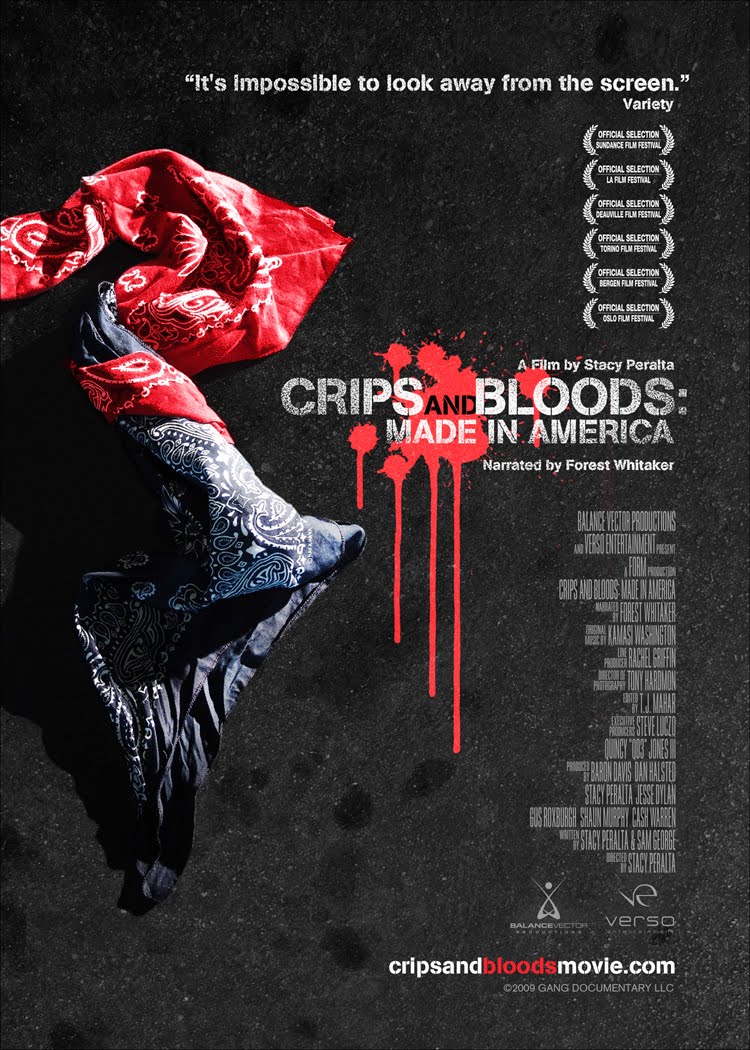
Crips and Bloods: Made in America, an Independent Lens production for PBS-TV, is a documentary, a soundtrack, a sociological and historical review, and a vivid dissection of the violence that young black men visit upon their own communities.

This film is also intended as an adjunct to the peace and reconciliation movements in Los Angeles founded and run by ex-gang members. Listening to the articulate and reflective people interviewed in the course of this 94-minute documentary, it is sobering to assess the waste of talent and potential behind the bald statistics--15,000 gang-related deaths over the last 40 years in L.A. County.

The fundamental question of why the internecine feud between the Crips and Bloods has gone untreated or unchecked since the 1970s is addressed in the movie, which was directed by Stacy Peralta. The irony of blacks killing blacks who share the same sidewalks, strip malls, poverty, neglect, urban decay, stigmatization, and color is analyzed, although it remains baffling. One cogent explanation is provided by the 62-year-old Kumasi, an original member of L.A.’s Slauson street gang (they used fists rather than Uzis): “Part of the mechanics of oppressing people is to pervert them to the extent that they become their own oppressors.”

Kumasi has spent 18 years in jail. He is a revelation--passionate, articulate, forceful, enunciating his sense of oppression and dismay with a voice made for paying attention to, with a timbre made for radio or television that you could listen to for hours. One scene in Crips and Bloods finds him recounting how the violence was precipitated in the Watts neighborhood during the mid-1960s. He remarks that “Every day he [the police, whites, The Man] is feeding me a spoonful of hatred. Every day that’s my diet, a spoonful of hatred.” Not surprisingly, the built-up resentment had to erupt somewhere, as it did in Watts and almost three decades later in the Rodney King uprising.

This documentary traces the genesis of the Crips and the Bloods, beginning in the ’60s with the disintegration of organized Black Power and civil-rights movements after the killings of influential African-American leaders such as Malcolm X, Medgar Evers, and Martin Luther King Jr. The territorial limits placed on blacks in Southern California’s largest city (and enforced with manic determination by racist elements of the L.A. police) fostered a mindset of claiming and protecting territory within the segregated area by various local youths. Those claims were often backed up by fistfights, engaged in at set times--everyone knew you had an appointment, so you had to make sure you were there. In that era, comparatively few guns or other lethal weapons were used against rivals.

But after the optimism of the Black Power period was quashed, the gangs re-initiated themselves--only this time, they were far more deadly. The Crips reportedly evolved from the Slausons. The Bloods (using a nickname that had formerly been employed by black soldiers in the Vietnam War) established themselves as the rival force to the Crips, and black-on-black homicides became the norm. Rival gang members died by the hundreds every year defending blocks to which they were confined by the LAPD. The “enemy” was not perceived as the Establishment, the ruling class, the government, the police; instead, it was the population of equally deprived black men and women living in the adjacent blocks, people who suffered the same paucity of schooling, skills development, and opportunities.

The main aim of director Peralta and his fellow filmmakers is to initiate a debate about gang warfare in Los Angeles. But they also want to make clear to viewers of all races what carnage this turbulent history has left behind--and ask how differently residents might have reacted had it been affluent white adolescents in Beverly Hills who were killing each other, rather than young African Americans in South Central L.A. and elsewhere. Actor Forest Whitaker, who narrates Crips and Bloods, has made another valid comparison. He cites the decades-long “Troubles” in Northern Ireland, which claimed the lives of approximately 3,600 people and prompted major political and disarmament initiatives, before a peace process finally took hold in the 1990s. No such efforts have been made to quell the hostilities in the City of Angels.

Even now, the main initiatives in L.A. come not from politicians or Nobel Prize winners, but from ex-gang members pushing education and increased communication. Crips and Bloods attempts to bolster that work by presenting a cogent, artistic, and urgent call to reverse the tide of remorseless murder. In one segment, we see the mothers of young men who have been killed on both sides, each of them facing the camera while the names of their sons scroll past. Most of those mothers are crying, all are grieving--and remember, there are thousands just like them in one small area of L.A. County.

The Crips and Bloods were made in America. The poverty, police brutality, white supremacy, and oppression were made in America. It’s high time that social justice was made in America, too.


Above: The trailer for Crips and Bloods: Made in America.

READ MORE:Strange Maps #479: Gangs of L.A.,” by Frank Jacobs
(Big Think).

Tuesday, August 24, 2010

The Stark World of Parker

(Editor’s note: Today we welcome to The Rap Sheet Seamus Scanlon, writing on the late Donald E. Westlake’s Parker series. A librarian and professor at The City College of New York, Scanlon has contributed fiction to the Global City Review, Promethean, the Review of Post Graduate English Studies, and the Journal of Experimental Fiction. He was a finalist in the 2009 New Irish Writing Awards.)

The University of Chicago Press has already finished reissuing the first 12 crime novels by Richard Stark (Donald E. Westlake), and three more--Deadly Edge, Slayground, and Plunder Squad--will follow them to bookstores next month. The publisher hopes eventually to bring out the full set of 24 works.

This republication of Westlake/Stark’s series, which features professional thief Parker (and now carries elegant covers by David Drummond, whose clients include academic and literary presses, as well as Amnesty International), is both a vindication and a recognition of the literary integrity and purity of the writing that first assailed the noir fiction scene 48 years ago, when The Hunter debuted. Even all these decades later, the Parker novels still retain their vibrancy and power. They’re accomplished works that showcase the ethos of noir fiction--bleak, uncompromising, high fidelity, purposeful, unrelenting, non-squeamish. Westlake died suddenly on December 31, 2008, but I imagine he would have been very pleased to see his early books re-released for a new generation of crime-fiction enthusiasts.

Beginning with The Mourner, the fourth entry in the Parker series, these reprinted works have included forewords by such authors as John Banville (aka Benjamin Black), Dennis Lehane, Luc Sante, and Charles Ardai, which attests to the virtuosity of Westlake’s writing and the esteem with which he is regarded. Man Booker Prize winner Banville contends that Parker “is the perfection of that existential man whose earliest models we met in Nietzsche and Kierkegaard and Dostoevsky ... Parker will have recognized his own natural motto in Faust’s heaven-defying declaration--‘In the beginning was the deed.’”

All of the novels in the Parker series--which ended in 2008 with Dirty Money--hum with Westlake’s mix of lean prose, crisp dialogue, authentic capers, and stylish plots revolving around the protagonist, Parker (no first name--or maybe no surname), a villain’s villain with a self-referring inflexible moral code, which he abides by with a fierce adherence to an internal logic and ruthlessness. Parker is single-minded, aloof, self reliant, anti-establishment, and even anti-organized-crime-establishment. What could be more anarchic? The voice we first heard in 1962 remains just as authentic and modern today--a tremendous achievement.

While working at Cambridge University in the 1990s, I chanced upon some of the Parker books in the Allison & Busby American Crime Series. I still recall the striking monochrome covers and their bright blood-red price stickers. I bought The Black Ice Score the first day and read it in one sitting. I bought the rest of the series the next day. It was my first introduction to crime fiction, and the best introduction--tautly composed and executed tales that were seamless and searing.

The opening page of The Hunter succinctly captures Parker’s persona, as the hardened thief stalks across the George Washington Bridge, which spans the wide Hudson River and links Fort Lee, New Jersey, with Washington Heights in Manhattan, where “the black holes” of Gotham’s subways beckon. I have walked that same bridge myself--it sways under your feet because of the wind and the high volume of vehicles on its upper and lower traffic levels. This opening scene also evokes the deep folk memory of America in Parker’s manifest individualism, self-reliance, and steeliness. The physical landscape of the Palisades and the wide vista of the Hudson, where Indian war canoes once traversed, ideally augments the subliminal recall of the American essence.

The hardcore noir anti-hero is established--the resolute champion of the Western frontier recast in a modern outlaw mien. No one can mistake Parker for anything but trouble, the fearsome and fearless renegade we both admire and look at with alarm, who causes women to feel uncomfortable and men to frown at him with latent unease, and who makes us ashamed of our own petty trepidation.

Westlake’s cold, taut prose mirrors Parker’s nature and demeanor:
His hands, swinging curve-fingered at his sides, looked like they were molded of brown clay by a sculptor who thought big and liked veins. ... His face was a chipped chunk of concrete, with eyes of flawed onyx. His mouth was a quick stroke, bloodless. His suit coat fluttered behind him, and his arms swung easily as he walked.
In The Hunter Parker storms into Manhattan after being double-crossed by his wife and a gang member named Mal. He is looking for revenge and his money. He’s determined that nothing will stop him--and nothing does.

By page 16 we know Mal is in deep trouble. Says Parker:
“I’m going to drink his blood. I’m going to chew up his heart and spit it into the gutter for the dogs to raise a leg at. I’m going to peel the skin off him and rip out his veins and hang him with them.” He sat in the chair, his fists clenching and unclenching, his eyes glaring at her. He snatched up the coffee cup and hurled it. It caromed off the refrigerator and shattered on the edge of the sink, then sprayed onto the floor.
I dare anyone to stop reading after that beginning; I couldn’t.

Once Parker catches up with Mal and learns his money was given to the minions of organized crime (aka the Outfit) to repay a debt, he kills Mal and barely pauses before pursuing the dough. He is dedicated to his goal. Most mortals would probably say, “OK, it’s gone--I can’t compete against the Outfit (Mafia),” but Parker is relentless, driven to secure his money regardless of the opposition arrayed against him, which appears formidable. In the end, he outwits his foes and recovers his stolen cash.

In a long-ago interview, Westlake said he had fun writing the Parker books, and it shows. These works are full of brio, audacity, and wordplay. They offered sudden changes of focus, location, and action long before Quentin Tarantino used those same devices to great effect. The narrative timelines are often fractured, but they never lose the reader’s interest or commitment; on the contrary, they increase the reader’s enjoyment, because you experience the same scene more than once from different perspectives. Westlake was a true revolutionary in the field of noir fiction as well as an accomplished stylist, storyteller, and writer.

Crime fiction by Dashiell Hammett, Raymond Chandler, Kenneth Fearing, and others has been published by the Library of America, while Everyman’s Library has produced volumes by Hammett, Chandler, and James M. Cain. Now the University of Chicago Press celebrates Westlake/Stark’s Parker stories. Although the cachet of such recognition cannot be considered a final arbitrator of taste, it certainly proves right the librarians, critics, and general readers who believed all along that these works were endowed with particularly high-quality writing, pacing, and plots.

I await Donald E. Westlake’s promotion to the exalted altar of noir writers, and expect the reissuing of the Parker series will go a long way toward helping him achieve that.