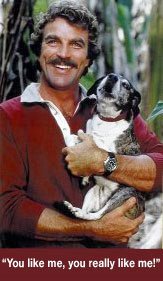
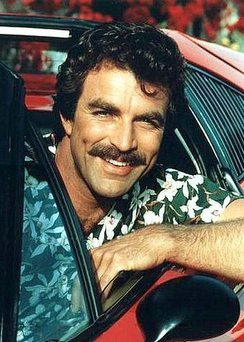
It’s an understatement to say that Hank Stuever, TV critic for The Washington Post, isn’t impressed with the rebooted Magnum P.I. series set to debut tonight on CBS. As he writes,
Despite the calibrated charm of your star, Jay Hernandez (who casually assumes Tom Selleck’s defining role, knowing full well that a hint of a stubbly goatee is no match for the ’stache), your pilot episode is an uninspired slop of cornball action and opening misfires. You are strewn with too many characters (that original sense of camaraderie now gives off a smarmy whiff of the bromantic) and preoccupied with checking off a long to-do list. Things are made worse by Hernandez’s ceaseless voice-over narration, which fails to explain much.
You are not good at the thing you’re trying to be, New Magnum, and instead of resurrecting a feeling, you’ve run right over it with that bright red Ferrari. Instead of declaring a creative or timely purpose (like your network friend and fellow exhumee, “Murphy Brown”), you are merely a piece of content placed between commercials. Your existence is cold and cynical, Magnum, predicated on the previous success of reboots such as “Hawaii Five-O” and “MacGyver.”
Well, that’s too bad. I wasn’t a big watcher of Tom Selleck’s original Magnum, P.I. (1980-1988), but I was at least willing to give Hernandez’s new version of the show a shot, if only because I like on-screen car chases every now and then, and I was amused by the notion of proper Englishman Jonathan Higgins III (John Hillerman) being re-imagined as ass-kicking former MI6 agent Juliet Higgins (played by Perdita Weeks, oh so recognizably the younger sister of Foyle’s War co-star Honeysuckle Weeks). However, the Magnum trailer—posted here—definitely has that too-cute, action-above-all-else vibe I dislike so much in the current Hawaii Five-O incarnation.
It seems that at the same time as it lost the comma from its title, this new Magnum P.I. also lost its heart and any purpose for its existence other than to make CBS lots and lots of money. Will America’s broadcast TV networks ever stop trying to breathe new life into once-popular shows, and instead come up with a few new ideas? No wonder people are turning to streaming services such as Netflix and Amazon Prime for more of their small-screen entertainment.
Virginia blogger-author B.V. Lawson keeps much better track of Hollywood deals and doings than I do. Which makes her weekly “Media Murder for Monday” posts among the most interesting elements of her blog, In Reference to Murder. Today, for instance, Lawson offers two tidbits of particular interest. First, this one:
Jay Hernandez (Scandal) has been tapped to play Thomas Magnum, the lead in CBS’ drama reboot pilot Magnum P.I. CBS had been looking to add a twist to the classic character played by Tom Selleck in the original series, which had been conceived as diverse in the reboot, with the network setting out to find a non-white actor for the role.
The reboot follows Thomas Magnum (Hernandez), a decorated ex-Navy SEAL who, upon returning home from Afghanistan, repurposes his military skills to become a private investigator. With help from fellow vets Theodore “TC” Calvin and Orville “Rick” Wright, as well as that of disavowed former MI:6 agent Juliet Higgins, Magnum takes on the cases no one else will, helping those who have no one else to turn to.
Sense8 alum Brian J. Smith has been cast as the lead in CBS’ drama pilot L.A. Confidential ... Directed by Michael Dinner, the TV series follows three homicide detectives, a female reporter and a Hollywood actress whose paths intersect as the detectives pursue a serial killer ... [in] gritty and glamorous 1950s Los Angeles. Smith is set to play Detective Ed Exley, the lead role played by Guy Pearce in 1997 that earned a Best Picture Oscar nomination. Cold, but not without a conscience, brilliant, fiercely ambitious, Ed Exley is an L.A. cop when the pilot story begins. Determined to make his mark and become a hero in his father’s eyes, Ed will do anything to prove himself.
Smith joins Justified’s Walton Goggins, who was recently cast as Detective Jack Vincennes.
If Lawson’s In Reference to Murder isn’t already on your list of blogs to check frequently, it really ought to be.
As hard as this may be to believe, ABC-TV has greenlighted a pilot film for a reboot of the 1974-1975 crime drama Get Christie Love!, which starred Teresa Graves as a (literally) kick-ass Los Angeles undercover cop. According to Deadline Hollywood, this not-quite-remake will star Canadian-American actress Kylie Bunbury.
The new Get Christie Love (no ! in the title), written by [executive producer Courtney] Kemp, is an action-packed, music-driven drama that centers on Christie Love (Bunbury), an African-American female CIA agent who leads an elite ops unit. She transforms into whomever she needs to be to get the job done, especially when it’s down to the wire and the stakes are life and death. The high-adrenaline missions of the series are anchored by an emotional mystery about Christie’s first love—unearthing the truth about this relationship will be the biggest mission impossible of her life.
John Hillerman, the actor who made a career out of playing snooty types, including Tom Selleck’s fastidious estate caretaker Jonathan Quayle Higgins III on Magnum, P.I., died Thursday. He was 84.
Hillerman, who received four Emmy nominations in consecutive years for portraying Higgins and won in 1987, died at his home in Houston, family spokeswoman Lori De Waal told the Associated Press. She said the cause of death had not been determined.
His Higgins character was a natural extension of a part he played on the [1975-1976] TV detective show Ellery Queen: Simon Brimmer, a radio personality and affected gent who fancied himself a savvy sleuth. Ironically, Hillerman, who often played condescending characters with more than a touch of the Tory Brit—the Mayfair accent—was a Texan from a tiny railroad town, the son of a gas station owner.
Hillerman’s face became familiar during an acting career that found him appearing frequently on television, not only on the aforementioned pair of programs, but also in The F.B.I., Mannix, The Betty White Show, Hawaii Five-O, Tenspeed and Brown Shoe, Lou Grant, Tales of the Gold Monkey, Valerie, and Murder, She Wrote. My earliest recollection of seeing him was in the 1975 picture Lucky Lady, but he also had roles in such films as The Last Picture Show, Blazing Saddles, Paper Moon, and Chinatown.
• Another notable passing:The Hollywood Reporterbrings word that German actress Karin Dor, “who played the
red-haired villainess Helga Brandt in the 1967 James Bond film You Only Live Twice,” died this last Monday, November 6, at a nursing home in Munich. She was 79. The Spy Command observes that Dor’s shapely turn as Brandt, “a SPECTRE assassin who is executed by [Ernst Stavro] Blofeld when she fails to kill Sean Connery’s James Bond,” was
not her only “brush with the spy genre.” Her most famous role in an espionage flick, it says, “was probably [in] 1969’s Topaz, directed by Alfred Hitchcock. She plays Juanita de Cordoba, who is involved in spying in early 1960s Cuba.” Viewers might recall spotting Dor, as well, in episodes of the American TV series It Takes a Thief, Ironside, and The F.B.I.
• By contrast, here’s an excellent bit of news, via EuroCrime: “Quercus has signed three novels by Philip Kerr, continuing his historical noir series featuring Detective Bernie Gunther.” Meanwhile, Kerr’s 13th and latest Gunther novel, Greeks Bearing Gifts, is due out in the States from Putnam come April of next year.
After taking home the Emmy for The Night Manager, AMC has green-lighted its next John le Carré miniseries: The Little Drummer Girl.
Florence Pugh (Lady Macbeth) will star in the six-parter based on le Carré‘s best-seller. Park Chan-wook (Old Boy) will make his small-screen debut and direct the series, which is a co-production between the Ink Factory, BBC One, and AMC. Production will begin in January, with Endeavor Content/IMG selling global rights to the series.
Set in the late 1970s, Drummer Girl is an espionage and international intrigue drama of love and betrayal. Set against the
background of rising tensions in the Middle East, the mini revolves around Charlie (Pugh), a young actress who prepares for her ultimate role in the “theater of the real.”
Shane Whaley’s Spybrary blog has a bit more on this film deal. And if there’s something tickling at the back of your brain, suggesting that this isn’t the first time Drummer Girl has been filmed … well, give yourself a gold star. George Roy Hill directed a 1984 big-screen version of le Carré’s Europe-trotting thriller, starring Diane Keaton. That earlier picture won mixed reviews; we’ll have to wait and see whether AMC’s interpretation can spark more enthusiasm.
• Since we’re on the subject of remakes, let me just remind everyone that Kenneth Branagh’s latest take on Agatha Christie’s 1934 whodunit, Murder on the Orient Express, is scheduled to open in theaters today. Critics are already offering opinions—good and not so good—on the production, while Smithsonian magazine has put together an intriguing “true history of the Orient Express.”
• If you’d rather stay in than launch out to a moviehouse, you can watch the 2010 TV adaptation of Orient Express, made as part of the long-running series Agatha Christie’s Poirot (with David Suchet in the starring role), by clicking here. Sadly, the even better 1974 film version, featuring Albert Finney, doesn’t appear to be available online. However, you can at least enjoy its trailer here.
• Stockholm novelist Leif G.W. Persson’s latest mystery, The Dying Detective, is the basis for a new Swedish TV series debuting on January 3. “Rolf Lassgård takes the lead role in the SVT adaptation,” explains The Killing Times, and the show “tells the story of retired Chief of the National Crime Police and Swedish Security Service, Lars Martin Johansson, who has just suffered a stroke. Johansson is paying the price for a life of excess—be it stress, good food, or fine wines. He has dangerously high blood pressure and his heart could fail at any moment. In the hospital, a chance encounter with a neurologist who confides an important piece of information about the rape and murder of a nine-year-old girl 25 years earlier piques [Johansson’s interest] and engages his unparalleled police instincts. However, the period for prosecution expired only weeks earlier and that isn’t the only limitation. Lars Martin Johansson is determined to solve the atrocious crime—from his deathbed.” There’s no word yet on whether The Dying Detective will be picked up by UK or U.S. broadcasters.
• Author Martin Edwards, who also happens to be chair of the UK Crime Writers’ Association and an editor of the British Library’s excellent Classic Crime line of books, clues us in on some of the works being readied for reissue as part of that series next year. They include “a new anthology of classic railway mysteries, called Blood on the Tracks,” and “two books from … E.C.R. Lorac—Bats in the Belfry [1937] and Fire in the Thatch [1946].” I am impressed with Edwards’
work on the British Library series, one that I have not yet plumbed to its fullest. More free reading time needed, please!
• In a previous crime-fiction news wrap-up, I mentioned that Southern California writer Tom Nolan, who edited the Library of America omnibus Ross Macdonald: Four Later Novels: Black Money/The Instant Enemy/The Goodbye
Look/The Underground Man, had posted essays about three of those Lew Archer detective stories on LOA’s Web site. More recently, he added a fourth essay to the mix, this one examining Macdonald’s 1971 Archer yarn, The Underground Man—one of my favorite entries in the series, and “a runaway bestseller,” thanks in part, Nolan says, to a most laudatory New York Times Book Review critique, penned by author Eudora Welty (who’d become a friend of Macdonald). “If William Goldman’s review of The Goodbye Look [1969] had provoked a sales earthquake for Macdonald,” explains Nolan, “Welty’s of The Underground Man caused a tsunami.” It’s only too bad that Macdonald went on to produce just two more Archer novels, Sleeping Beauty (1973) and The Blue Hammer (1976), before Alzheimer’s disease ended his fiction writing and he died in 1983.
• Gerald So is in the process of rounding up folks to help him celebrate National Poetry Month, coming up again in April 2018. In his role as editor of the “crime poetry weekly” The Five-Two, he’s planning a month-long blog tour, inviting participants to comment on their favorite works from his site or elsewhere, interview Five-Two contributors, or “post
your own poetry or fiction in response to a Five-Two poem.” He’ll be happy to link to contributions popping up around the blogosphere, or “if you don’t have a blog, e-mail me your entry and you’ll be my guest here [at The Five-Two ].”
• This is an interesting story about “how the world of private investigation has changed,” presented earlier this week on National Public Radio’s All Things Considered program: “NPR’s Robert Siegel speaks with journalist Ronen Bergman, who is … a contributing writer for The New York Times and the national security senior correspondent for Yedioth Ahronoth, about the new world of private investigation firms such as Black Cube, that are employed by law firms representing people such as [Hollywood film mogul] Harvey Weinstein. It was revealed that Weinstein used big-time private investigators to find disparaging information
about his accusers as well as prevent publication of stories about himself.”
• Tomorrow is Veterans Day in the States—and just in time, Mystery Fanfare highlights crime-fiction works tied to that holiday.
• It has now been just over 12 years since crime-fictionist Dennis Lynds died. I was reminded of this by a note in Mystery*File from his widow, thriller writer Gayle Lynds, who explains that her husband’s best-remembered protagonist, one-armed New York City gumshoe Dan Fortune, has recently been resurrected in print. She writes: “The entire 17-book series of private eye novels”—which Lynds published under his pseudonym Michael Collins—“are available again, for the first time in Kindle and trade paperback. We hope a new generation of readers will discover Dan, and that longtime fans will enjoy re-reading the classic tales.” Click here to find Amazon’s list of these reprinted works, from Act of Fear (1967) to Cassandra in Red (1993).
• Coincidentally, TracyK recently reviewedThe Nightrunners—a Fortune yarn originally released in 1978—in her blog Bitter Tea and Mystery. She applauded the fact that it contains “twists and turns I did not anticipate” and that “there is less action and gun play, and more emphasis on brains and persistence” than she’d expected.
• A little behind schedule, but welcome nonetheless.The last I heard, Spinetingler Magazine was planning to release “its first [print] issue in years” sometime this month. Today, however, a news release reached my e-mailbox, saying that Down & Out Books expects to publish the Fall 2017 edition of Spinetingler in November. Its contents will include “original stories by Tracy Falenwolfe, Karen Montin, Jennifer Soosar, B.V. Lawson, Nick Kolakowski, David Rachels, and more. There are author snapshots of Con Lehane, Rusty Barnes, Mindy Tarquini, and others. Book features and reviews fill out the magazine’s pages.” There’s no word yet on ordering this new issue.
• In June, I drew your attention to the first trailer for The Alienist, TNT-TV’s historical mini-series based on Caleb Carr’s 1994 psychological thriller of that same name. ScreenRant has now posted a second trailer (which is also embedded below), and finally shares a date for the debut of that program: Monday, January 22, 2018. It also suggests that there will be eight episodes, rather than the previously mentioned 10, all written by True Detective director Cary Fukunaga and starring Daniel Brühl, Luke Evans, and Dakota Fanning as “19th-century investigators on the trail of a serial killer.” Hmm. With three months to go until this mini-series begins airing, I might actually find free time enough to re-read Carr’s book.
• A British blog called The Killing Timesbrings word that Bron Studios, a Canadian production company, plans to build a new TV series around Louise Rick, the Copenhagen detective inspector who features in more than half a dozen novels from Danish writer Sara Blædel. “Deadline reports that the first Louise Rick story, The Forgotten Girls, will serve [as] the basis for Season One,” but Bron “has optioned the whole series,” according to The Killing Times.
• Variety carries the unexpected news that actor John Turturro (The Night Of) has been signed to play 14th-century Franciscan friar-cum-sleuth William of Baskerville in a “high-end TV adaptation” of Umberto Eco’s 1980 mystery novel, The Name of the Rose. The eight-episode English-language production will be produced by Italy’s Matteo Levi and Carlo Degli Esposti, and is set to start shooting in January at Rome’s Cinecittà Studios. In addition to the hangdog-faced Turturro, this mini-series will feature English performer Rupert Everett as the monk’s antagonist, Italian inquisitor Bernard Gui. An excellent 1986 film interpretation of Eco’s debut novel starred Sean Connery and F. Murray Abraham, and it’s hard to imagine that an extended remake is really needed. But of course, nobody asked me …
• … Just as no one solicited my opinion on whether the world requires a new version of Tom Selleck’s 1980-1988 private-eye TV series, Magnum, P.I. It seems screenwriters Peter Lenkov and Eric Guggenheim—the guys behind the disappointing current Hawaii Five-0 reboot and the latest version of MacGyver—think we need Magnum back, and have convinced CBS (the series’ original home network) to at least bankroll a pilot. The Hollywood Reporterdescribes the prospective series as an update of Selleck’s show.
It follows Thomas Magnum …, a decorated ex-Navy SEAL (also like the original) who, upon returning home from Afghanistan, repurposes his military skills to become a private investigator. With help from fellow vets Theodore “T.C.” Calvin and Orville “Rick” Wright, as well as that of disavowed former MI6 agent Juliet Higgins, Magnum takes on the cases no one else will, helping those who have no one else to turn to. Action, adventure and comedy aside, Magnum P.I. will also explore a brotherhood forged by the trauma of combat, what it means to return home an ex-soldier, and a commitment to continuing to serve while in the private sector.
This is the third time I remembering hearing that a Magnum comeback was on the drawing boards. The first was back in 2006, when Ben Affleck was set to star. Then, just last year, news broke that actress Eva Longoria had pitched a sequel that would have refocused the crime drama on “Magnum’s daughter, Lily ‘Tommy’ Magnum, who returns to Hawaii to take up the mantle of her father’s P.I. firm.” Neither of those efforts resulted in an actual show. Maybe we’ll be just as lucky this time around. Has Hollywood considered that not every once-popular series needs to be remade?
A “Nancy Drew” TV series is once again in the works, with NBC developing a new series based on the iconic novel series after CBS attempted such a project last season. The new series still hails from writers and executive producers Tony Phelan and Joan Rater and executive producer Dan Jinks, who developed the CBS version, but the new series follows the author of the most famous female teen-detective book series who is thrust into a real-life murder mystery. In need of help, she turns to her two best friends from childhood, who were the inspiration for all those books, and the women who
have a real axe to grind about the way their supposed best friend chose to portray them all those years ago. This will be a completely different version than the original at CBS. That projectwould have focused on Drew, now an adult who works as a detective for the NYPD. Sarah Shahi, who starred in the CBS drama Person of Interest since its second season, starred in the pilot as Drew but isn't currently attached to the NBC version.
• Barry Forshaw alerts us that, with this month’s release of Modesty Blaise: The Killing Game, Titan Books has completed its “all-inclusive run of Peter O’Donnell’s imperishable [British] comic strip Modesty Blaise (drawn by a variety of artists, including the great Jim Holdaway who inaugurated the strip and Enric Badia Romero, who concluded it).” Click here to find all of the preceding titles in this series.
• I’ve added several vintage TV openings to The Rap Sheet’s YouTube page, including those from Shotgun Slade, Johnny Bago (which features theme music by Jimmy Buffett), and Jack Palance’s Bronk.
• Florida’s Tampa Bay Times recently carried an interesting feature about how smoothly and satisfyingly author Michael Connelly has transferred his original series protagonist, Harry Bosch, from the page to the TV screen, in Amazon’s Bosch.
• Bookseller-turned-writer/editor Maxim Jakubowski has returned to CrimeTime as a monthly columnist, penning “To the Max.
• Fans of author Ted Lewis (Get Carter, GBH, etc.) should be interested to learn of a new volume, Nick Triplow’s Getting Carter: Ted Lewis and the Birth of Brit Noir, being brought out by No Exit Press. Crime Fiction Lover opines that “meticulous and thorough detective work is at the heart of this compelling and detailed biography of Ted Lewis, the Humberside author of nine novels, who was a huge influence on Brit Noir and remains so for leading names in crime fiction today.” Sadly, Triplow’s work is currently available only in Britain, but a U.S. release (from Oldcastle Books) is slated for May 2018.
• Three author interviews worth your time: Thomas Mullen talks with MysteryPeople about Lightning Men, his exceptional sequel to last year’s Darktown; Speaking of Mysteries host Nancie Clare chats with Joe Ide about Righteous, the second installment in his Isiah Quintabe series; and Geoffrey Girard fields a few queries from Mystery Tribune about his “contemporary gothic ghost story,” Mary Rose.
• And Peter Rozovsky, the Philadelphia editor, essayist, and photographer with whom I have frequently associated at Bouchercons over the last decade, takes questions from S.W. Lauden.
• With Kenneth Branagh’s film version of Agatha Christie’s Murder on the Orient Express set to reach theaters in November, Crime Fiction Lover has posted a photo tour of the author’s native Devon, England.
• Wow, this blog’s Facebook page seems to be experiencing a remarkable run of attention lately. In early October, I was impressed when a post there about the 60th anniversary of Have Gun—Will Travel “reached” more than 9,000 people. I thought
that was some kind of record, but more recently, a post leading to The Rap Sheet’s coverage of the 2017 Anthony Award winners jetted right past that high bar, “reaching” 15,246 people. With 694 followers, the blog’s Facebook presence seems to be justifying my efforts to keep it lively.
• Feeding the grand debate over which of Raymond Chandler’s handful of novels qualifies as his “best,” Tablet magazine columnist Alexander Aciman delivers an outstanding appraisal of 1953’s The Long Goodbye. He writes, in part:
If Raymond Chandler’s earlier novels were detective stories that just so happened to be good, The Long Goodbye is a full reversal; it is a great novel that just so happens to be a detective story. It should be no different than saying Moby-Dick is a great novel that happens to be about whalers, or that Ulysses is a great novel that happens to take place in Dublin. But by describing it as detective fiction, we can obscure the fact for more than 60 years that it was one of the greatest novels ever written in America. There is hardly a novel more human, more heartbreaking, strung together with prose as boozily and as meticulously exacting as The Long Goodbye’s.
• I’ve lived in four U.S. states during my lifetime—Oregon, Michigan, Colorado, and Washington—and have gotten around to reading only one of the books Travel & Leisure magazine editors say best represent those places: Snow Falling on Cedars, by David Guterson, set in the Seattle area. In my defense, I did see the Jack Nicholson movie version of Stephen King’s The Shining (which ostensibly takes place in Colorado), and have read many other works on T&L’s list.
• Here’s an excellent review of two new books that explore the fight against World War II-era Nazism in Los
Angeles, California, and specifically in its glitziest quarter, Hollywood.
• This, too, sounds like a book I should have. In its write-up on Sinclair MacKay’s new non-fiction work, The Mile End Murder: The Case Conan Doyle Couldn't Solve (Aurum Press), Amazon explains: “In 1860, a 70-year-old widow turned landlady named Mary Emsley was found dead in her own home, killed by a blow to the back of her head. What followed was a murder case
that gripped the nation, a veritable locked-room mystery which baffled even legendary Sherlock Holmes author, Arthur Conan Doyle. With an abundance of suspects, from disgruntled stepchildren concerned about their inheritance and a spurned admirer repeatedly rejected by the widow, to a trusted employee, former police officer and spy, the case led to a public trial dominated by surprise revelations and shock witnesses, before culminating with one of the final public executions at Newgate.”
• Your chance to get better acquainted with Frederic Brown: “‘Murder Draws a Crowd’ and ‘Death in the Dark’ by Fredric Brown (Haffner Press, $50 each) are the first two volumes in a well-designed, excellent new series edited by Steve Haffner, collecting all of Brown’s mystery fiction. … If you’ve never read anything by Fredric Brown, (1906-1972) you’re in for a real treat—he’s one of the genre’s most respected authors, long overdue for increased attention.”
• Who’d have thought that reading in bed could be dangerous? Many people once harbored such fears, according to The Atlantic:
Writings from the 18th and 19th centuries frequently dramatize the potentially horrifying consequences of reading in bed. Hannah
Robertson’s 1791 memoir, Tale of Truth as well as of Sorrow, offers one example. It is a dramatic story of downward mobility, hinging on the unfortunate bedtime activities of a Norwegian visitor, who falls asleep with a book: “The curtains took fire, and [with] the flames communicating with other parts of the furniture and buildings, a great share of our possessions were consumed.”
Even the famous and the dead could be censured for engaging in the practice. In 1778, a posthumous biography chastised the late Samuel Johnson for his bad bedside reading habits, characterizing the British writer as an insolent child. A biography of Jonathan Swift alleged that the satirist and cleric nearly burned down the Castle of Dublin—and tried to conceal the incident with a bribe.
• I usually think of H.G. Wells as a science-fiction writer (The Time Machine, The War of the Worlds, etc.). But he also produced a great deal of non-fiction, and evidently experimented as well with “criminous misadventures,” as Ontos recalls here.
• The Booksellerbrings the sad news that Britain’s “campaign group Voices for the Library is to disband due to the pressures of the workload on its members. The group, which counts Poet Laureate Carol Ann Duffy and author Julia Donaldson among its supporters, was created in 2010 to speak out and fight against the ‘assault’ on public libraries caused by deep cuts to the sector. In a statement posted on the Voices for the Library website, the group said: ‘Unfortunately, we ourselves are volunteers running an organisation in our spare time. We are unhappy to say that we can no longer undertake the work required to be a voice for public libraries. It is with great sorrow that we have decided that it’s time to close the doors on Voices for the Library. The irony of this is not
lost on us.’”
• Finally, these are dark days, indeed, for “alternative newsweeklies.” The Village Voice, historically one of the strongest and most influential such newspapers, discontinued its print publication in September (though it’s still available online), and L.A. Weeklyis currently experiencing a transition limbo likely to result in employee layoffs and a refocusing on its digital presence. Meanwhile, it appears that 41-year-old Seattle Weekly—which I was proud to work for during the late 1980s—will soon become unrecognizable. The Seattle news Web site Crosscut says that for budgetary reasons South Publishing, which has owned the tabloid-size paper since 2013, will restructure Seattle Weekly as a far less creative or challenging “community news weekly.” The paper’s staff will be slashed to just three employees (down from dozens of people who worked there when I did), and they will have no independent offices, but will be left to share editorial space and production facilities with Sound Publishing’s 16 other local small-time papers. This is tragic news, so far as I am concerned. I started out with “alt-weeklies” after college, working first for Willamette Week in Portland, Oregon, and eventually (after regrettable detours to a monthly magazine in Detroit and a daily broadsheet in Boulder, Colorado) wound up on the staff at Seattle Weekly, which was then known simply as The Weekly. That publication has had its ups and downs since David Brewster founded it in 1976, but it’s also produced a hell of a lot of solid, incisive reporting on politics, civic growth, the arts, local history, and much more. As with other alt-weeklies, Seattle Weekly suffered greatly with the rise of Internet advertising; however, I assumed it would ultimately find a way to make up for lost ad dollars and rebuild its journalistic stature. I guess I was wrong.
Hollywood’s determination to revive once-popular TV programs proceeds apace. The latest target: Magnum, P.I., which ran originally on CBS from 1980 to 1988. This report comes from Deadline Hollywood:
A famous 1980s title is eyeing a comeback. ABC has nabbed Magnum, a sequel to the classic series Magnum, P.I. that starred Tom Selleck, with a script commitment plus substantial penalty. The project, from Leverage creator John Rogers and Eva Longoria’s UnbeliEVAble Entertainment, will keep the fun, action-packed style of the original as it follows Magnum’s daughter, Lily “Tommy” Magnum, who returns to Hawaii to take up the mantle of her father’s P.I. firm. She and her tribe of friends mix tropical beaches with the seedy underbelly of international crime and modern espionage, even as she tries to unravel the mystery of the blown spy operation that ended her career in Navy Intelligence.
Rogers will write the script and executive produce through his Kung Fu Monkey banner alongside UnbeliEVAble’s Longoria and Ben Spector and Kung Fu Monkey’s Jennifer Court. Universal TV, which owns rights to the original series and where UnbeliEVAble is based, is the studio. …
“We knew no one could replace the iconic role of Thomas Magnum, so John decided to make the reboot a sequel and continue the adventure of a Magnum—his daughter, who was established in the original series,” Longoria and Spector told Deadline.
Hmm. This sounds like just another way to get more swaying palm trees and women in skimpy bikinis onto the boob tube. OK, maybe it’s not such a bad idea after all …
Before he became well-known for his starring role on Magnum, P.I. (1980-1988), it seems actor Tom Selleck signed on to play “Tom Boston” in a 1979 TV pilot film called The Chinese Typewriter. That film was written by Stephen J. Cannell of The Rockford Files fame and also starred James Whitmore Jr. (who’d previously been in Cannell’s Baa Baa Black Sheep). The Web site Modcinema, which sells this 78-minute movie, offers a description of its plot:
It’s a story about two opposites (one’s a genius, the other’s a weapons expert) who team up to bring back a stolen jet for their rich, powerful client. Parts were filmed in Hawaii (apparently at the estate that would later be used for Magnum, P.I.) and Los Angeles. Tom Selleck is a work in progress in this vehicle providing the eye candy. James Whitmore Jr. gets to play a more interesting set of characters throughout the story. This movie, paired with all the other pilots that Selleck did in the ’70s prior to Magnum, make for a fun evening of mindless entertainment.
I’d never heard of The Chinese Typewriter until earlier today, when--during a swing through YouTube--I stumbled across the film clip embedded atop this post. I can’t say it immediately attracts me, or that I am a candidate to purchase my own copy. But Cannell’s work could usually be depended on for good action and dialogue.
Supporters of increasinglyembattled, honesty-challenged GOP presidential contender John McCain scoffed at Honolulu-born Barack Obama this summer, when the Democratic nominee chose to vacation with his young family in Hawaii. They said that Hawaii was too “exotic” and “foreign” for most Americans to understand, that the Obamas should’ve gone to ... oh, maybe Myrtle Beach, South Carolina, instead. But this campaign dust-up only seemed to reiterate how strangely out-of-touch McCain is. Thanks to a succession of crime dramas having been shot in the Hawaii Islands over the last half-century, even the most travel-averse Americans have become pretty darn familiar with the 50th state. Remember Hawaiian Eye, with Anthony Eisley, Robert Conrad, and Connie Stevens? Or how about Jack Lord’s long-running Hawaii Five-O? Or even Jake and the Fatman, which starred William Conrad and Joe Penny?
You might think it’s easy being T.S. Magnum (Tom Selleck), Private Investigator. Well, it isn’t. Oh sure, he gets free lodging on a fabulous Hawaiian estate owned by a best-selling writer who’s almost never there. Sure, Magnum has that solid-gold signet ring with that striking French croix set on that gleaming black onyx. Granted, he leads an exciting life chasing various nefarious types. True, he’s a splendid hunk who’s usually surrounded by gorgeous, bikini-clad hunkettes. OK, so he has good buddies like TC (Roger E. Mosley) and Rick (Larry Manetti). All right, he gets to drive fast in his host’s $60,000 red Ferrari. Agreed, he has fun baiting Higgins (John Hillerman), the starchy major-domo. Well, what’s the catch? The catch is that old debbil, pressure: Magnum had better make good. ABC’sBarney Millerand NBC’s Thursday-night movie are waiting for him--and not with leis and warm alohas.
Prior to assuming the role of Naval Intelligence officer-turned-gumshoe Thomas Sullivan Magnum IV, then 35-year-old actor Tom Selleck had turned in plenty of guest shots on TV series--including The F.B.I., Mannix, The Streets of San Francisco, and even the situation comedy Taxi--but he’d never led a series. Selleck had, however, put in a memorable showing as a suave, if notably smarmy private investigator named Lance White on twoepisodes of James Garner’s The Rockford Files in the late ’70s. Magnum creators Glen A. Larson and Donald P. Bellisario decided he was worth the risk of hiring. Besides, they were under some pressure of their own to get their series going. Hal Erickson of the Web’s All Movie Guide explains the circumstances behind Magnum’s birth:
With the cancellation of the long-runningHawaii Five-O[in April 1980] CBS was stuck with two valuable commodities: the series’ choice Thursday-night time slot, and the series’ filming facilities on the island of Oahu. The solution? Commission another Hawaii-based detective show and schedule it in the old Thursday-evening berth. And that, boys and girls, was how Magnum, P.I. came to be.
Of course, the setting was pretty much where comparisons stopped between Hawaii Five-O, a straightforward police procedural, and Magnum, a deliberately more light-hearted turn on American private-eye TV series (a breed then rapidly approaching the end of its most recent heyday). The latter wasn’t really intended to break new ground, or be taken all that seriously. “Sure, it was cheesy,” the Web site Bits of News recalls of Magnum. “Yes, it had the intellectual content of a glue-sniffing monkey. But it was fun!”
Magnum, P.I. tackled crimes and saw that malefactors were brought to justice during its eight years on the air. (It was actually supposed to have ended after its seventh year, but Selleck & Co. were convinced to come back for one extra season.) Yet at heart it was a buddy show. Thomas Magnum always had his old Vietnam War compatriots--helicopter pilot Theodore “T.C.” Calvin and playboy Orville Wilbur Richard “Rick” Wright, the manager of a members-only club--to fall back on for help when he needed some extra muscle or underworld contacts to bring a case to its conclusion. A less willing cohort was Jonathan Quayle Higgins III (played by Hillerman, who had previously appeared as a radio star and amateur sleuth in the period series Ellery Queen). From this show’s outset, Magnum was dubiously ensconced in the guest house of a 200-acre beachfront estate on Oahu known as “Robin’s Nest,” after its owner, wealthy celebrity author Robin Masters (unseen, but voiced in the early episodes by none other than Orson Welles). While also doing private-eye work, and a little espionage when it was called for, Magnum ostensibly provided security services on the property in exchange for his lodging. This put him in frequent contention with Higgins, an ex-British Army officer whose by-the-book style could hardly have been more dissimilar from that of Magnum, a loose-limbed rules breaker. Their banter provided some of the funniest moments on the show, and a few heartwarming ones, too.
The main title sequence (embedded above) did a fine job of portraying the dual natures of this series--dramatic and humorous--which only rarely clashed, more often blending smoothly together. There’s plenty of action in the opener, from helicopter dashes over the Pacific and explosions, to scuba-diving skirmishes and Magnum wheeling around Oahu in Robin Masters’ Ferrari 308 GTS. But the clip of Magnum helping a young woman learn to snorkel, while trying not to look (too closely) at her shapely derrière, and the shot of him at the end wiggling his eyebrows at the camera reminded viewers that this show could poke fun at itself. Emmy and Grammy award-winning composer Mike Post’s theme music for Magnum, P.I., with its firm downbeat and eccentric guitar rhythms, ties the images together while itself suggesting the show’s range of seriousness to playfulness. This opener is what’s often called a “mood sequence,” establishing a particular tone for the program to follow.
More often than not, private-eye series of the 1970s and ’80s came and went without ever having evolved much. But Magnum had more time, and its writers took advantage of it. An article on the Museum of Broadcast Communications Web site explains:
Though originally dominated by an episodic narrative structure, Magnum, P.I. moved far beyond the simple demands of stock characters solving the crime of the week. Without using the open-ended strategy developed by the prime-time soap opera in the 1980s, the series nevertheless created complex characterizations by building a cumulative text. Discussion of events from previous episodes would continually pop up, constructing memory as an integral element of the series franchise. While past actions might not have an immediate impact on any individual weekly narrative, the overall effect was to expand the range of traits which characters might invoke in any given situation. For the regular viewer of the series, the cumulative strategy offered a richness of narrative, moving beyond the simpler “who-done-it” of the hard-boiled detective series that populated American television in the 1960s and 1970s.
Part of the success of Magnum, P.I. stemmed from the combination of familiar hard-boiled action and exotic locale. Just as important perhaps, the series was one of the first to regularly explore the impact of the Vietnam War on the American cultural psyche. Many of the most memorable episodes dealt with contemporary incidents triggered by memories and relationships growing out of Magnum’s past war experiences. Indeed, the private investigator’s abhorrence of discipline and cynical attitude toward authority seem to stem from the general mistrust of government and military bureaucracies that came to permeate American society in the early 1970s.
Thomas Magnum did some important evolving of his own. As Wikipedia observes, “The series was also marked by Magnum’s character growth over eight years, shedding an immature and often lazy beach bum streak that at times fostered an occasional callous hardness and a tendency to resolve problems by violence. Yet the change was subtle, almost imperceptible, and throughout it he managed to maintain the humor and other appealing traits which drew his friends (and viewers) to him. That he went back into the Navy, and simultaneously took on the role of responsible father, at the end of the series’ run was only superficially surprising; his character had been meandering toward that responsibility in small increments for years.”
Magnum, P.I. was far from being a perfect show. It suffered occasionally from silliness and at others times from an over-earnestness in trying to redeem America’s involvement in Vietnam. But even today, it remains popular in syndication. Enough so, that there’s been talk over the last couple of years of adapting Magnum, P.I. to the silver screen. George Clooney was an early favorite for the mustachioed starring role, but he was apparently not interested. Later, rumors spread of Ben Affleck being tapped as the new Magnum, but that too fizzled out. The last I heard, 38-year-old Matthew McConaughey (Tropic Thunder, How to Lose a Guy in 10 Days, A Time to Kill) was set to star in a movie adaptation that would also feature William H. Macy as Higgins, or “Higgy baby,” as Selleck’s Magnum frequently addressed him.
Skeptics question McConaughey’s fitness to take on the part, especially as he lacks Magnum’s original and prominent chest hair. But I don’t have too much trouble imagining McConaughey as a beach bum sleuth behind the wheel of a Ferrari. For me, he would be a far better choice than another candidate whose big name was bandied about some time ago: Nicholas Cage. The skeletal and pale Cage sporting a ’stache and a world-class assortment of Aloha shirts? Now that, folks, would’ve been exotic.
Speaking of Magnum, P.I. ... Last summer, I reported on rumors that the habitually wooden actor Ben Affleck was being considered for the title role in a big-screen version of that 1980-1988 CBS-TV series--a proposal that didn’t sit well with some of that series’ die-hard fans. (Talk of George Clooney or Vince Vaughn playing Hawaii’s coolest gumshoe were greeted with disdain, as well.) Now, both Cinematical and its sister blog, TV Squad, have follow-up squibs suggesting that this plum role might go, instead, to Matthew McConaughey (The Wedding Planner, Failure to Launch, etc.). “Other actors supposedly involved with this ‘on again, off again’ project,” TV Squad says, “include Steve Zahn as Rick, Tyrese Gibson as T.C. and William H. Macy as Higgins.”
And in the interests of modernizing the character, it seems Thomas Magnum is going to be an Iraq war veteran in the movie, rather than a Vietnam vet. Maybe, if this project doesn’t work out, producers can excuse themselves by claiming that Magnum has been called back for extended duty in George W. Bush’s disastrous Mideast conflict.
Well, the long wait is over. For those of you who have been waiting with bated breath--and for those whose breath just smells like bait--here are the results of the Sleuth Channel’s “America’s Top Sleuths” survey, chosen in an online poll and announced during a televised special last evening:
25. Marge Gunderson (Fargo)
24. Clarice Starling (The Silence of the Lambs)
23. Irwin M. “Fletch” Fletcher from the Fletch films
22. Lieutenant Frank Drebin (Police Squad)
21. John Shaft from the Shaft movies and TV series
20. Sam Spade (The Maltese Falcon)
19. Maddie Hayes & David Addison (Moonlighting)
18. Sabrina Duncan, Jill Munroe, & Kelly Garrett (Charlie’s Angels)
17. Lieutenant Tony Baretta (Baretta)
16. Detective Andy Sipowicz (NYPD Blue)
15. Fox Mulder & Dana Scully (The X-Files)
14. Detective Sergeant Joe Friday (Dragnet)
13. Martin Riggs & Roger Murtaugh from the Lethal Weapon films
12. Harry Callahan from the Dirty Harry movies
11. Lieutenant Theo Kojak (Kojak)
10. Sherlock Holmes from various movies and TV series
9. Detective Lenny Brisco (Law & Order)
8. Gil Grissom (C.S.I.)
7. Remington Steele (Remington Steele)
6. Jessica Fletcher (Murder, She Wrote)
5. Dr. R. Quincy (Quincy, M.E.)
4. James “Sonny” Crockett & Ricardo “Rico” Tubbs (Miami Vice)
3. Jim Rockford (The Rockford Files)
2. Lieutenant Columbo (Columbo)
1. Thomas Magnum (Magnum P.I.)
MAGNUM? It all comes down to Thomas friggin’ Magnum?
Yeah, that’s what I thought. But what were you expecting? This is TELEVISION!!!!
It’s just a popularity contest, fer cryin’ out loud, and an amiably hinky one, at that.
Voting was done via the Internet only (so right off and say good-bye to entire segments of “America”). Absolutely anyone with a few minutes and a mouse could vote--regardless of their knowledge or background.
The producers were further curtailed by what they could--and couldn’t--get the rights for, so even the shortlist that people were asked to vote on was less than all-encompassing.
So what we were left with was not the best or even necessarilty the most popular of all TV and film detectives, but the most popular among a short, pre-selected list of TV and film detectives, as voted upon by a relatively small segment of the population that possessed both Internet access and the knowledge and inclination to use it (i.e., middle-aged and younger, generally), which would also likely skew the results to those shows broadcast most recently. Which may in turn explain why we have one movie from 1941, one movie series from the 1930s and ’40s, one TV show from the ’50s, one (arguably) from the ’60s, and everything else from the ’70s onward.
So anyone thinking we’d get some sort of iron-clad critical list is bound to be disappointed. This is a popularity contest, plain and simple, with some serious limitations. Things like quality or artistry or influence and impact don’t even come into it, necessarily--just the lowest common denominator of popularity. So, while many of the choices are certainly of merit, this is closer to the Anthony Awards, say, than the Edgars. There are no judges, only voters.
Having said that, though, I thought this Sleuth Channel project was fun--and I think that’s all the producers had in mind. And on that level, they succeeded. As a detective geek, I have to admit it was enjoyable seeing all those old clips, and some of the talking heads offering commentary were fun, as well--even as I admit that I myself was one of those talking heads.
Yep, while not in any way involved (except by voting--and I’m not even American!) in the selection of the winners or the choosing of the nominees, I must confess that I did willingly and with forethought aid and abet the producers by offering my two cents worth on-camera. (“Yeah, they grilled me for an hour and a half, but I swear, I didn’t tell ’em nothin’!”)
Even though I never ran into any of the other talking heads when I went down to Hollywood for a taping (except for a brief hi/bye moment with Paula Woods), I still feel honored to have been in a group that included TV creators (Stephen J. Cannell), crime writers (Jason Starr, Sara Paretsky, Scott Turow, and Michael Connelly), actors (Peter Falk, Jesse Martin), and critics (Peter Travers from Rolling Stone, Leah Rozen from People), plus assorted comedians. I guess Web monkeys like me fit into the last group.
But as I was saying, it was fun. No great, deep thoughts from anyone--just light, breezy commentary, for the most part, with an ocasional zinger and a few insights. And hey, who knew Connelly was such a chatterbox?
Still, it was a genuine hoot seeing some of those old clips, both from the shows themselves and from old interviews, such as James Garner explaining why The Rockford Files had to end.
And now the REAL FUN begins.
The arguing.
Magnum? Yikes. I mean, I know it was popular, but THAT popular? The critic in me just can’t let it go. Everytime I caught an episode it seemed to be one of the Higgins nagging/Thomas whining-and-smirking episodes. The most sustained gay fantasy ever on American television. Why do you think none of those women lasted?
Columbo and Rockford I can live with, although I think Rockford should have been number one. Both great, great shows.
Miami Vice? At number four? Get outta here! Popular once, but last summer’s movie probably did more for its ranking than anything. A quick glance at the show itself (which, coincidentally, Sleuth is currently re-running) reveals it as mostly empty style and severely dated, something the far more popular and stylish Peter Gunn--which should have made the list--never was. You wanna talk cool music and sharp clothes, those wimps from Miami wouldn’t last a night at Mother’s.
Quincy? Was it really so popular? Why not Barnaby Jones, then, which ran even longer?
Ah, but Rumpole was British, you say? Well, so was Sherlock Holmes. So, was America’s Top Sleuth supposed to be America’s Top AMERICAN Sleuth?
If not, then what about Jane Tennyson from Prime Suspect? Or Hercule Poirot? Miss Jane Marple? Eddie “Fitz:” Fitzgerald of Cracker? All very popular in these here United States.
Remington Steele, Murder, She Wrote, and Charlie’s Angels I can live with. Not my favorites, but obviously wildly popular shows.
And it was nice to see Farrah Fawcett’s major, uh, assets still as perky as ever.
And so it goes. Some of the choices seem downright peculiar (the Lethal Weapon movies, but not James Bond?) And were the Fletch movies really that popular and well-regarded? Ever?
Indeed, if they were going to include comedy, why not the far superior, far funnier and far more popular Barney Miller?
And if they were going to include The Silence of the Lambs and Fargo (both fine films, mind you, but top 25?), what about The Big Sleep or Chinatown or Harper? Or The Thin Man (imagine Moonlighting with brains and class)?
And what about the great (and popular) TV shows that were skipped over? Mannix? The aforementioned Peter Gunn? Detective Frank Pembleton from Homicide: Life on the Street? Mickey Spillane’s Mike Hammer? Cagney and Lacey?
Even 77 Sunset Strip can still make a bigger case for its “popularity” than some of the shows that made the Sleuth Channel cut.
Harry O wasn’t even included in this survey. Yet it could easily have made--at least in a just world--the top 10. Maybe the top five.
And was it really necessary to mention Mel Gibson and Robert Blake’s recent tabloid-ready escapades at all, or were their recent travails actually the reason they made the list? I mean, does anyone really think like Baretta will stand the test of time (except in a car-crash way?).
Nope, the criteria for inclusion seemed too willy-nilly and wonky for my liking. Mixing TV and film was one major hurdle (does one popular film trump a long-running series?). Never quite defining what a “sleuth” is was another problem.
So this poll will never be more than a curiousity, a simple, enjoyable diversion.
But so what?
It was fun.
Now if only Sleuth would air some more of these films and TV series that it just finished applauding.
But don’t get me started on what Sleuth should be airing. That’s a whole other column ...
When are movie makers going to realize that it’s almost always a bad idea to try turning a TV series into a big-screen feature? I mean, remember the embarrassing 1999 remake of The Wild Wild West? Or the quick-disappearing 2002 film version of I Spy? After Bewitched, The Beverly Hillbillies, The Brady Bunch, The Dukes of Hazzard, McHale’s Navy, Scooby-Do, Starsky and Hutch, and S.W.A.T., how many more times can American filmmakers drain the well of TV history for their future big-budget projects? Can’t Hollywood come up with any new ideas anymore? Apparently not, as there are already plans being made for silver-screen versions of It Takes a Thief and Have Gun--Will Travel in the works, and the Michael Mann-directed movie release of Miami Vice is due in theaters next month.
Then there’s the feature adaptation of Magnum, P.I. The original action/comedy series ran on CBS-TV from 1980 to 1988, and made the mustachioed Tom Selleck (who’d previously guested as a too-good and too-lucky private eye, Lance White, on The Rockford Files) into a Hawaiian investigator with sex appeal and a red Ferrari. There was talk soon after the series went off the air about Selleck reprising his role in a big-budget picture. Later, rumors spread that the suave George Clooney might fill out Thomas Magnum’s Aloha shirts and sneakers. But nothing ever came of those suggestions. Now, however, Moviehole.net is reporting that a big-screen version of Magnum is actually in the works, with a 2007 release date--and Ben Affleck starring. Huh? The same Ben Affleck who tortured the role of Daredevil a few years back (and subsequently went on to marry his curvaceous co-star, Jennifer Garner)? Yep, him. IGN.com adds that Selleck “might only have himself to blame for losing the role in the film version.” It quotes Charles Floyd Johnson, one of the TV series’ producers, saying that Selleck “was asked to do six or eight TV movies and at that time he really wanted to do [Magnum] as a feature, so he held out on it and probably now they will consider him too old to do it.”
Still, though, Ben Affleck playing Navy Seal-turned-gumshoe Magnum? Although my father was a regular watcher of the show, I was never really a fan of Magnum, P.I. in its heyday (I much preferred Rockford and Harry O); yet even I can tell you that the protagonist had a cool confidence that boyish Ben can never hope to achieve. Sure, he might be able to pull off the flowered-shirts-and-shorts wardrobe, and he might not look like a total goofball in a ’stache. Throw in a few fast cars, faster women, and some helicopter hijinks, and there would undoubtedly be old fans of the series ready to plunk down a 10-spot to see what director Rawson Marshall Thurber (Dodgeball) and producer Brian Grazer (A Beautiful Mind, Arrested Development) can make of the original concept. However, there was a charm Selleck brought to his detective role that would be hard for most younger actors, not just Affleck, to duplicate. And after seeing Affleck’s wooden performances in Daredevil, The Sum of All Fears, and Pearl Harbor, I’m not optimistic about his turn in Magnum.
Send Us News:
The Rap Sheet is always on the lookout for information about new and soon-forthcoming books, special author projects, and distinctive crime-fiction-related Web sites. Shoot us an e-mail note here.
Check out our selection of more than 400 works of mystery, crime, and thriller fiction—from both sides of the Atlantic—scheduled to reach bookstores between now and Labor Day. Click here.
The Rap Sheet has now been around long enough that some older posts may include links to stories or Web sites that no longer exist. If you encounter such broken links, try searching for the original material via the Wayback Machine, an invaluable archive of digital content.
Also, we’d be very grateful if you could let us know where those inoperable links can be found. We’ll update them as soon as possible.
If You Can, Please Help The Rap Sheet to Survive and Thrive
Your Vigilance Is Welcome
Those of us responsible for The Rap Sheet try to get everything right, and we work to keep our Web links up to date. But we’re not perfect. So, if you spot any errors (typographical or otherwise) in this blog, or discover links or embedded videos that aren’t functioning properly, please let us know via e-mail.
The Rap Sheet Faithful
Disclosure Notice
The Rap Sheet accepts books sent free of charge from publishers, publicists, and authors. Those works may inspire comments on this page. However, in no case is there any promise given that a book will be the subject of an endorsement or review, either positive or negative.
Back in the fall of 1971, NBC-TV introduced its most successful “wheel series,” the NBC Mystery Movie. Look for our anniversary posts here.
Videos Disclaimer
From time to time, The Rap Sheet features short video clips. Use of these is for historical and entertainment purposes only, and is not meant to establish ownership of such materials. Rights to those clips stay with their owners/creators.
The One Book Project
In honor of The Rap Sheet’s first birthday, we invited more than 100 crime writers, book critics, and bloggers from all over the English-speaking world to choose the one crime/mystery/thriller novel that they thought had been “most unjustly overlooked, criminally forgotten, or underappreciated over the years.” Their choices can be found here.
In the Beginning ...
Before The Rap Sheet was a blog, it was a monthly newsletter in January Magazine. To find all the old editions of that newsletter, just click here.