A mere 30 days after publicizing its lists of finalists for the 2025 Derringer Awards, America’s Short Mystery Fiction Society brings us the winners of that competition, in five divisions.
Best Flash Story (up to 1,000 words): “Kargin the Necromancer,” by Mike McHone (Mystery Tribune, December 15, 2024)
Best Short Story (1,001-4,000 words): “The Wind Phone,” by Josh Pachter (Ellery Queen Mystery Magazine, September/October 2024)
Best Long Story (4,001-8,000 words): “Heart of Darkness,” by Tammy Euliano (from Scattered, Smothered, Covered & Chunked: Crime Fiction Inspired by Waffle House, edited by Michael Bracken and Stacy Woodson; Down & Out)
Best Novelette (8,001-20,000 words): “The Cadillac Job,” by Stacy Woodson (Chop Shop, Episode 1, edited by Michael Bracken;
Down & Out)
Best Anthology: Murder, Neat: A SleuthSayers Anthology, edited by Michael Bracken and Barb Goffman (Level Short)
On top of all these, the SMFS will present its Silver Derringer for Editorial Excellence to Janet Hutchings, who recently left as the editor in chief of Ellery Queen Mystery Magazine. Its Edward D. Hoch Memorial Golden Derringer for Lifetime Achievement is going to short-story writer and English professor Art Taylor. And the society’s 2025 Hall of Fame designee is O. Henry (aka William Sydney Porter).
Showing posts with label Art Taylor. Show all posts
Showing posts with label Art Taylor. Show all posts
Thursday, May 01, 2025


Wednesday, March 01, 2023
The Story Behind the Story:
“All Tomorrow’s Parties,” by Art Taylor
(Editor’s note: This is the 93rd installment in The Rap Sheet’s “Story Behind the Story” series. Its author is Art Taylor, a multiple award-winning short-story writer and associate professor of English at Virginia’s George Mason University. His fiction has appeared in publications such as Ellery Queen Mystery Magazine, Alfred Hitchcock’s Mystery Magazine, and Down & Out: The Magazine. Taylor penned the 2015 “novel in stories” On the Road with Del & Louise,  as well as the 2020 short-story collection The Boy Detective & The Summer of ’74 and Other Tales of Suspense. His latest book, The Adventure of the Castle Thief and Other Expeditions and Indiscretions, was released last month by Crippen & Landru. In the essay below, Taylor provides a bit of history behind that collection’s poignant eighth yarn, “All Tomorrow’s Parties.”)
The 2021 album I’ll Be Your Mirror: A Tribute to the Velvet Underground and Nico features a version of “All Tomorrow’s Parties” by St. Vincent with pianist Thomas Bartlett. More than a simple cover of the song, this version seems a complex reworking and reimagining, a technical tour de force.
In place of the insistent thrum and jangle of the original version, which appeared on the Velvet Underground’s 1967 debut album (the one with the banana), this one seems to build on patterns of echo and overlay. A jazz piano plays a melancholy tune, while St. Vincent’s voice navigates complex twists and turns: spoken word recitation of the lyrics here, a breathy whisper there, elsewhere a voice that’s been vocodered into electronic otherworldliness. Especially if you listen on headphones, the voices seem to come from various directions, oblique angles, sudden and unexpected, doubling and redoubling.
Reviews of the song have used the words ethereal, alien, bizarre, and spacey. I’d add haunted.
When I first heard St. Vincent’s take on the song, I kept hitting replay over and over again—not only because I felt mesmerized by it, but also on an intellectual level. With its layerings and shifts and complex melancholy, the song struck me as exactly the kind of thing I was trying to do with my story “All Tomorrow’s Parties,” inspired by the original Velvet Underground song and recently reprinted in my new short-story collection, The Adventure of the Castle Thief and Other Expeditions and Indiscretions, published in mid-February.
Listening to the St. Vincent version brought me deeper into my own story in other ways too—and into “the story behind the story,” as this feature promises, several layers to that as well.
Jon Ashley, a writer and editor based in Kentucky, reached out to me in early 2017 with an invitation to contribute to an anthology he was organizing for Gutter Books, a follow-up to Trouble in the Heartland: Crime Fiction Based on the Songs of Bruce Springsteen (2014), edited by Joe Clifford. It was Joe, in fact, who recommended me Jon’s way. As Jon explained in that first message, I’d have my choice of song, the guidelines called for 3,000 words, and the pay was $25.
I didn’t hesitate—told Jon I was leaning toward something from Reed’s album Magic & Loss, promised I’d get back to him soon. But as I started working my way through various albums, the song “All Tomorrow’s Parties” from that first Velvet Underground album was the one that kept calling me.
(Left) The 1967 album The Velvet Underground & Nico.
It wasn’t the lyrics only that sparked my imagination, though readers of my story can surely trace some direct connections from song to page: a poor girl who clowns and cries; the silks and linens of her past, her hand-me-down dress now, the blackened shroud ahead, and the idea of costuming generally; and then that repeated question “Where will she go, and what shall she do / When midnight comes around?”
In addition to those lines and phrases, I was also lured in by Nico’s monotone singing, nearly a chant, and then the relentless piano (paper clips entwined with the strings, I’ve heard) and that throbbing “ostrich-tuned” guitar lurking insistently around the edges.
The summer I wrote “All Tomorrow’s Parties,” I was also listening to Lorde’s extraordinary sophomore album, Melodrama (2017), and one track there, “Liability,” provided a second important inspiration, equally melancholy and introspective. After leaving a party where a man had complained about “dancing in [her] storm,” a young woman finds herself crying in the taxi, then returns to her home and to the arms of the one person who loves her, the one person she loves in return—“but all that a stranger would see / Is one girl swaying alone, stroking her cheek.”
The chorus echoes the title of the song: “You’re a little much for me / You’re a liability / You’re a little much for me.” And both the chorus and that image of a woman dancing with herself—that image in particular—joined with elements of the Velvet Underground song to point me in the directions I needed to go.
My story “All Tomorrow’s Parties” begins with the main character, Shayla, catching sight of her younger self wandering through a work party she’s attending—a younger self who is, in turn, watching her.
Shayla is recently divorced and estranged as well from her own young daughter. Both relationships have been undermined by Shayla’s alcoholism, and she’s trying desperately (emphasis on that word) to rebuild her life: a new apartment, a new job, and potentially a new love interest from the office. But everything still seems to be crumbling around her, desperation tipping into despair, and she’s set herself an ultimatum for this particular evening. In a twist on the Cinderella tale (a third inspiration), Shayla determines that she’s going to win over this new love interest before midnight, or else she’ll take her own life—and she’s even brought a gun in her purse to ensure she follows through.
Perhaps needless to say, things don’t go well for anyone, especially since Shayla pre-games the party with cocktails and then keeps drinking to stay loose and ready.
Despite the 3,000-word limit Jon had given me, my story ended up nearly double that length—necessary space to orchestrate (keeping a musical focus!) everything that I was trying to do: the forward momentum of the evening, drink after drink; the various memories haunting Shayla, literally with that vision of her younger self stalking through the rooms; the various observations on parties from the past, parties in general, and the promise of tomorrow’s too, if only …
I touched base with Jon after I was done—via Facebook Messenger—explained all this to him, apologized, told him I’d understand if he simply couldn’t use it at that length.
He said he’d look at it, asked if I’d be OK with him trying to cut. I told him sure, I’d be open for suggestions, glad to see what we could do.
I e-mailed him my Word document early that same afternoon—September 13, 2017.
I don’t know whether he ever read the story. For many reasons, I hope he did not.
Later that evening, Jon ended his own life. his Facebook page after his death and from talking with Joe Clifford later on: Jon’s persistent struggles with addiction and depression, which I hadn’t known about; his brilliant creativity both as a writer and a musician; his work as a bookstore owner at Second Story Books in Louisville; his “amazing” efforts (to quote his students) as an adjunct English instructor at Jefferson Community and Technical College, also in Louisville; and then the tremendous love and empathy and esteem which so many people felt for him, pouring out in the wake of his death at age 35.
Heartbreaking, all of it—then and now too.
You can read more about it on Down & Out’s Web page for the book. All the profits from sales of that anthology benefit suicide prevention.
When I’m presenting talks or serving on panels about short stories, the question of markets often comes up—writers seeking guidance about how to find the right venue for publication, how to sell their work—and the assumption has often been that it’s easy for me, but honestly that’s not always the case. My submissions have been rejected as not a good fit for the publication (time to find another) or as not quite done (more revisions), or perhaps just rejected without comment. No matter the success a writer might’ve had in the past, rejection is something all of us face.
And so it was with “All Tomorrow’s Parties”—in this case a lesson in word counts.
After he’d taken over the anthology, Keaton reached out to me about including the story, but it did indeed prove too long, and I simply wasn’t able to cut it down to the required word count without sacrificing too much of what I was trying to do.
I offered to write another one—did that too, in fact: “Sunday Morning, Saturday Night,” based on “Sunday Morning” from that same first Velvet Underground album. But this second story failed the word count in another direction—only 1,000 words, too short, and I couldn’t see stretching it out Procrustean-style to fit what was needed.
(Left) Author Art Taylor.
I’ll admit I’ve missed other opportunities for similar reasons, trying right up to a deadline to judge where and how to cut a story further, and then the deadline passes. It’s not that I’m against cutting a draft—even tremendously, in fact. In one instance, the story “Mrs. Marple and the Hit & Run” (also included in The Adventure of the Castle Thief and Other Expeditions and Indiscretions), my original draft was around 10,000 words, which I cut to a little over 2,000—nearly 80 percent of the first draft gone. And I’ve also been very fortunate to work with first readers and final editors who’ve helped me trim and tighten a story at various points along the way—outside perspectives a godsend!
It’s a process—drafting, workshopping, revising, working with editors—to find what the story needs and what it doesn’t, whether it’s a novella or a piece of flash fiction, and following it to its best final form.
All that said, I was sorry not to be included in Dirty Boulevard, but I was grateful that both stories I wrote for the anthology found publication elsewhere.
“All Tomorrow’s Parties” appeared in the 2020 Chesapeake Crimes anthology, Invitation to Murder. Before submitting it there, I made only the minor change of adding an invitation to the party Shayla attends—a gesture toward the book’s theme—and I’m grateful to editors Donna Andrews, Barb Goffman, and Marcia Talley for their guidance in bringing the story into its final form.
“Sunday Morning, Saturday Night,” appeared in Down & Out: The Magazine in 2018, with some very thoughtful editing by Rick Ollerman—gratitude again.
As I mentioned earlier, “All Tomorrow’s Parties” is now part of the new collection, The Adventure of the Castle Thief, and “Sunday Morning, Saturday Night” is also being republished in conjunction with this same release; it’s the bonus pamphlet included with the signed and numbered cloth edition of my book.
Both stories should work well on their own without any background regrading the various texts that inspired them. But I hope these extra stories behind the stories might add a bit of context and weight for readers inclined that way. And I’m grateful to the late Jon Ashley for that original message—his idea for the anthology, his invitation for me to submit a story, his confidence in my work.
Without Jon, neither of these stories would be out in the world today.
as well as the 2020 short-story collection The Boy Detective & The Summer of ’74 and Other Tales of Suspense. His latest book, The Adventure of the Castle Thief and Other Expeditions and Indiscretions, was released last month by Crippen & Landru. In the essay below, Taylor provides a bit of history behind that collection’s poignant eighth yarn, “All Tomorrow’s Parties.”)The 2021 album I’ll Be Your Mirror: A Tribute to the Velvet Underground and Nico features a version of “All Tomorrow’s Parties” by St. Vincent with pianist Thomas Bartlett. More than a simple cover of the song, this version seems a complex reworking and reimagining, a technical tour de force.
In place of the insistent thrum and jangle of the original version, which appeared on the Velvet Underground’s 1967 debut album (the one with the banana), this one seems to build on patterns of echo and overlay. A jazz piano plays a melancholy tune, while St. Vincent’s voice navigates complex twists and turns: spoken word recitation of the lyrics here, a breathy whisper there, elsewhere a voice that’s been vocodered into electronic otherworldliness. Especially if you listen on headphones, the voices seem to come from various directions, oblique angles, sudden and unexpected, doubling and redoubling.
Reviews of the song have used the words ethereal, alien, bizarre, and spacey. I’d add haunted.
When I first heard St. Vincent’s take on the song, I kept hitting replay over and over again—not only because I felt mesmerized by it, but also on an intellectual level. With its layerings and shifts and complex melancholy, the song struck me as exactly the kind of thing I was trying to do with my story “All Tomorrow’s Parties,” inspired by the original Velvet Underground song and recently reprinted in my new short-story collection, The Adventure of the Castle Thief and Other Expeditions and Indiscretions, published in mid-February.
Listening to the St. Vincent version brought me deeper into my own story in other ways too—and into “the story behind the story,” as this feature promises, several layers to that as well.
* * *
While I’ve long been a fan of Lou Reed and the Velvet Underground, I only turned to Reed’s music for inspiration because I asked to.Jon Ashley, a writer and editor based in Kentucky, reached out to me in early 2017 with an invitation to contribute to an anthology he was organizing for Gutter Books, a follow-up to Trouble in the Heartland: Crime Fiction Based on the Songs of Bruce Springsteen (2014), edited by Joe Clifford. It was Joe, in fact, who recommended me Jon’s way. As Jon explained in that first message, I’d have my choice of song, the guidelines called for 3,000 words, and the pay was $25.
I didn’t hesitate—told Jon I was leaning toward something from Reed’s album Magic & Loss, promised I’d get back to him soon.
But as I started working my way through various albums, the song “All Tomorrow’s Parties” from that first Velvet Underground album was the one that kept calling me.(Left) The 1967 album The Velvet Underground & Nico.
It wasn’t the lyrics only that sparked my imagination, though readers of my story can surely trace some direct connections from song to page: a poor girl who clowns and cries; the silks and linens of her past, her hand-me-down dress now, the blackened shroud ahead, and the idea of costuming generally; and then that repeated question “Where will she go, and what shall she do / When midnight comes around?”
In addition to those lines and phrases, I was also lured in by Nico’s monotone singing, nearly a chant, and then the relentless piano (paper clips entwined with the strings, I’ve heard) and that throbbing “ostrich-tuned” guitar lurking insistently around the edges.
The summer I wrote “All Tomorrow’s Parties,” I was also listening to Lorde’s extraordinary sophomore album, Melodrama (2017), and one track there, “Liability,” provided a second important inspiration, equally melancholy and introspective. After leaving a party where a man had complained about “dancing in [her] storm,” a young woman finds herself crying in the taxi, then returns to her home and to the arms of the one person who loves her, the one person she loves in return—“but all that a stranger would see / Is one girl swaying alone, stroking her cheek.”
The chorus echoes the title of the song: “You’re a little much for me / You’re a liability / You’re a little much for me.” And both the chorus and that image of a woman dancing with herself—that image in particular—joined with elements of the Velvet Underground song to point me in the directions I needed to go.
My story “All Tomorrow’s Parties” begins with the main character, Shayla, catching sight of her younger self wandering through a work party she’s attending—a younger self who is, in turn, watching her.
Shayla is recently divorced and estranged as well from her own young daughter. Both relationships have been undermined by Shayla’s alcoholism, and she’s trying desperately (emphasis on that word) to rebuild her life: a new apartment, a new job, and potentially a new love interest from the office. But everything still seems to be crumbling around her, desperation tipping into despair, and she’s set herself an ultimatum for this particular evening. In a twist on the Cinderella tale (a third inspiration), Shayla determines that she’s going to win over this new love interest before midnight, or else she’ll take her own life—and she’s even brought a gun in her purse to ensure she follows through.
Perhaps needless to say, things don’t go well for anyone, especially since Shayla pre-games the party with cocktails and then keeps drinking to stay loose and ready.
Despite the 3,000-word limit Jon had given me, my story ended up nearly double that length—necessary space to orchestrate (keeping a musical focus!) everything that I was trying to do: the forward momentum of the evening, drink after drink; the various memories haunting Shayla, literally with that vision of her younger self stalking through the rooms; the various observations on parties from the past, parties in general, and the promise of tomorrow’s too, if only …
I touched base with Jon after I was done—via Facebook Messenger—explained all this to him, apologized, told him I’d understand if he simply couldn’t use it at that length.
He said he’d look at it, asked if I’d be OK with him trying to cut. I told him sure, I’d be open for suggestions, glad to see what we could do.
I e-mailed him my Word document early that same afternoon—September 13, 2017.
I don’t know whether he ever read the story. For many reasons, I hope he did not.
Later that evening, Jon ended his own life.
* * *
I never met Jon (shown on the right), didn’t know him well at all—only had our exchange about the story he’d commissioned from me, a couple of handfuls of IMs, that was it. But I learned a lot about him from the posts on  his Facebook page after his death and from talking with Joe Clifford later on: Jon’s persistent struggles with addiction and depression, which I hadn’t known about; his brilliant creativity both as a writer and a musician; his work as a bookstore owner at Second Story Books in Louisville; his “amazing” efforts (to quote his students) as an adjunct English instructor at Jefferson Community and Technical College, also in Louisville; and then the tremendous love and empathy and esteem which so many people felt for him, pouring out in the wake of his death at age 35.
Heartbreaking, all of it—then and now too.
* * *
The anthology that Jon had begun did come out: Dirty Boulevard: Crime Fiction Inspired by the Songs of Lou Reed, edited by David James Keaton, another writer and editor I greatly admire, and published in September 2018 by Down & Out Books. The collection has a terrific introduction—Patrick Wensink paying tribute to Ashley—and a powerhouse group of writers: Ashley’s own “Ride into the Sun,” along with stories by Rusty Barnes, Reed Farrel Coleman, Alison Gaylin, Lee Matthew Goldberg, Cate Holahan, Gabino Iglesias, David James Keaton, Erin Keaton, Ross E. Lockhart, Tony McMillen, Richard Neer, Chris Orlet, J. David Osborne, Rob Pierce, and Eryk Pruitt.You can read more about it on Down & Out’s Web page for the book. All the profits from sales of that anthology benefit suicide prevention.
* * *
You’ll notice that my own name isn’t among the collection’s list of contributors—which is another part of the story behind the story here.When I’m presenting talks or serving on panels about short stories, the question of markets often comes up—writers seeking guidance about how to find the right venue for publication, how to sell their work—and the assumption has often been that it’s easy for me, but honestly that’s not always the case. My submissions have been rejected as not a good fit for the publication (time to find another) or as not quite done (more revisions), or perhaps just rejected without comment. No matter the success a writer might’ve had in the past, rejection is something all of us face.
And so it was with “All Tomorrow’s Parties”—in this case a lesson in word counts.
After he’d taken over the anthology, Keaton reached out to me about including the story, but it did indeed prove too long, and I simply wasn’t able to cut it down to the required word count without sacrificing too much of what I was trying to do.
I offered to write another one—did that too, in fact: “Sunday Morning, Saturday Night,” based on “Sunday Morning” from that same first Velvet Underground album. But this second story
 failed the word count in another direction—only 1,000 words, too short, and I couldn’t see stretching it out Procrustean-style to fit what was needed.
(Left) Author Art Taylor.
I’ll admit I’ve missed other opportunities for similar reasons, trying right up to a deadline to judge where and how to cut a story further, and then the deadline passes. It’s not that I’m against cutting a draft—even tremendously, in fact. In one instance, the story “Mrs. Marple and the Hit & Run” (also included in The Adventure of the Castle Thief and Other Expeditions and Indiscretions), my original draft was around 10,000 words, which I cut to a little over 2,000—nearly 80 percent of the first draft gone. And I’ve also been very fortunate to work with first readers and final editors who’ve helped me trim and tighten a story at various points along the way—outside perspectives a godsend!
It’s a process—drafting, workshopping, revising, working with editors—to find what the story needs and what it doesn’t, whether it’s a novella or a piece of flash fiction, and following it to its best final form.
All that said, I was sorry not to be included in Dirty Boulevard, but I was grateful that both stories I wrote for the anthology found publication elsewhere.
“All Tomorrow’s Parties” appeared in the 2020 Chesapeake Crimes anthology, Invitation to Murder. Before submitting it there, I made only the minor change of adding an invitation to the party Shayla attends—a gesture toward the book’s theme—and I’m grateful to editors Donna Andrews, Barb Goffman, and Marcia Talley for their guidance in bringing the story into its final form.
“Sunday Morning, Saturday Night,” appeared in Down & Out: The Magazine in 2018, with some very thoughtful editing by Rick Ollerman—gratitude again.
As I mentioned earlier, “All Tomorrow’s Parties” is now part of the new collection, The Adventure of the Castle Thief, and “Sunday Morning, Saturday Night” is also being republished in conjunction with this same release; it’s the bonus pamphlet included with the signed and numbered cloth edition of my book.
Both stories should work well on their own without any background regrading the various texts that inspired them. But I hope these extra stories behind the stories might add a bit of context and weight for readers inclined that way. And I’m grateful to the late Jon Ashley for that original message—his idea for the anthology, his invitation for me to submit a story, his confidence in my work.
Without Jon, neither of these stories would be out in the world today.
Tuesday, November 29, 2022
Bullet Points: World Cup Edition
• We’ve now entered the final round of voting in this year’s Goodreads Choice Awards competition. The original collection of 20 books vying for “Best Mystery & Thriller” honors has now been chopped in half, with the following candidates remaining:
— All Good People Here, by Ashley Flowers (Bantam)
— The It Girl, by Ruth Ware (Scout Press)
— Daisy Darker, by Alice Feeney (Flatiron)
— The Maid, by Nita Prose (Ballantine)
— Killers of a Certain Age, by Deanna Raybourn (Berkley)
— A Flicker in the Dark, by Stacy Willingham (Minotaur)
— Wrong Place, Wrong Time, by Gillian McAllister (Morrow)
— The Paris Apartment, by Lucy Foley (Morrow)
— The Book of Cold Cases, by Simone St. James (Berkley)
— The Bullet That Missed, by Richard Osman (Pamela Dorman/Viking)
Click here to select your favorite from among those, but tarry not—voting in this round will end on December 4, with winners in this and other categories to be announced on Thursday, December 8.
• Just when you thought you had heard the last of Lisbeth Salander, she’s back. The antisocial and troubled computer hacker, who made her initial appearance in Stieg Larsson’s The Girl with the Dragon Tattoo (2007) and was last spotted in David Lagercrantz’s third series continuation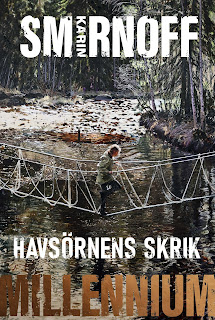 novel, The Girl Who Lived Twice (2019), returned earlier this month in Swedish author Karin Smirnoff’s Havsörnens Skrik, a thriller that’s set to be published in English next August 29 as The Girl in the Eagle’s Talons. The Guardian reported recently that “Smirnoff’s book moves Salander’s story from Stockholm to northern Sweden, which [the yarn’s] UK publisher MacLehose Press said was ‘an area vast and beautiful, but also dealing with economic and social problems and the effects of climate change and environmental exploitation,’” American readers should be pleased to learn that The Girl in the Eagle’s Talons will be brought out simultaneously on this side of the Atlantic under the Alfred A. Knopf imprint.
• English author Stuart Turton has won Germany’s 2022 Viktor Crime Award for The Devil and Dark Water, a standalone historical thriller first released in English in 2020—and one of my favorite books of that year. This announcement was made earlier in November at Mord am Hellweg, described as “Europe’s largest international crime film festival.” Also shortlisted for the 2022 Viktor Award were Kazltes Herz (Cold Heart), by Henri Faber, and Horvath und die verschwundenen Schüler (Horvath and the Missing Students), by Marc Hofmann. The Viktor Crime Award has been presented ever since 2018, when Michaela Kastel won it for her thriller So Dark the Forest.
• Double or Nothing, Kim Sherwood’s first (of three) Double 0 agents thrillers, hit the shelves in Britain early this last September; it won’t see print in the United States until April 2023. However, the author says she has already completed work on her second installment, which runs 101,042 words in length (before editing). That sequel’s title—if it even has one yet—has not been publicly circulated.
• Entries in next year’s Glencairn Glass Crime Short Story Competition are due by Saturday, December 31. Those stories should not exceed 2,000 words in length, and must not have been published previously in any format. The theme for this year’s brief yarns is “A Crime Story Set in Scotland.” Writers from anywhere in the world are eligible to take part in this contest, but all must be over 16 years old. Prizes of £1,000 and £500 will go, respectively, to the First Place winner and a Runner-up. “The overall winning entry,” says the Glencairn Glass Web site, “will be published in Scottish Field Magazine and online at www.whiskyglass.com.” Click here to enter.
• Well, this is unfortunate TV news. From Variety:
• The mid-November edition of Mike Ripley’s “Getting Away with Murder” column for Shots includes observations on the annual Richard Lancelyn Green lecture; Francis Clifford’s 1976 novel, Drummer in the Dark; this year’s “ultimate Christmas mystery,” Alexandra Benedict’s Murder on the Christmas Express; a quartet of Czechoslovakian thrillers; plus fresh releases from Louise Penny, Ant Middleton, and B.A. Paris. Read about all of that and more here.
• Congratulations to The Bunburyist for having clocked its one-millionth pageview! As I wrote in a brief comment attached to blogger Elizabeth Foxwell’s post yesterday about this achievement, “I check The Bunburyist regularly, and consider it a great source of both information and enjoyment.”
• Max Allan Collins’ 18th Nate Heller novel, The Big Bundle, isn’t due out until January (a month later than expected, because of shipping issues). But he says he’s already completed the writing of his 19th series entry, Too Many Bullets, which finds private eye Heller investigating Robert F. Kennedy’s 1968 assassination.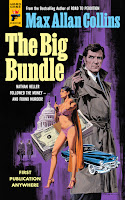 “It’s a big book,” he writes in his blog, “on the lines of [1983’s] True Detective, and in a sense it’s the bookend to that first Heller memoir. It’s been very difficult, in part because of my health issues (doing better, thanks) but also because it’s one of the most complicated cases I’ve dealt with.” The 74-year-old author says his next Heller tale for publisher Hard Case Crime will tackle the mysterious 1975 disappearance of labor union leader Jimmy Hoffa. After that? Collins admits he’s “wrestling with … how long I should to stay at it with Heller. The degree of difficulty ... is tough at this age. Right now I am considering a kind of coda novel (much like Skim Deep for Nolan and Quarry’s Blood for Quarry) that would wrap things up. … Should I go that direction, and should my health and degree of interest continue on a positive course, I might do an occasional Heller in a somewhat shorter format. Of course, the problem with that is these crimes are always more complex than I think they’re going to be.”
• On the subject of forthcoming works, English professor and author Art Taylor mentions in his blog that he has a new short-story collection, The Adventure of the Castle Thief and Other Expeditions and Indiscretions, due out from Crippen & Landru in February 2023 (though I see no Amazon ordering link yet). Packing in 14 abbreviated yarns, plus an introduction by the esteemed Martin Edwards, Castle Thief will be Taylor’s second book from Crippen, following 2020’s The Boy Detective & The Summer of ’74 and Other Tales of Suspense. Taylor was generous enough to send me an advanced readers copy of his new collection, but I’ve had to hold off opening it until after I get The Rap Sheet’s end-of-the-year features organized.
• Seriously, Universal Pictures is going to shoot a big-screen flick based on the 1981-1986 Lee Majors TV series The Fall Guy? Deadline reports Ryan Gosling, Emily Blunt, and Teresa Palmer are all in the cast, and that this movie will premiere in March 2024. The original series was about Hollywood stunt people who moonlight as bounty hunters. Click here to watch that show’s opening title sequence.
• Crime by the Book’s Abby Endler attended this month’s Iceland Noir festival in Reykjavik, and she wants to tell us all about it.
• Having greatly enjoyed the six-part, 2016 BBC One/AMC TV drama The Night Manager, based on John le Carré’s 1993 novel of that same name, I look forward to seeing how this project from the same producer turns out. As stated In Reference to Murder:
• There’s no topping George Easter when it comes to tracking down lists of 2022’s best crime, mystery, and thriller works. Just over the last few days, the Deadly Pleasures Mystery Magazine editor has pointed us toward collections in The Financial Times (by both Barry Forshaw and Adam LeBor), Crime Time (by columnist Maxim Jakubowski), The Irish Times (by author Jane Casey), New Zealand Listener magazine, and a couple of Web sites that are new to me: The List and Lifehacker AU. He has also helpfully edited National Public Radio’s original list of what it calls this year’s 46 best mysteries to remove horror fiction, young-adult works, non-fiction books, and others that exceed the limits of the genre.
• The only picks I don’t think Easter has mentioned yet are those from British blogger Rekha Rao, at The Book Decoder. She’s assembled a long post of book covers that lead to reviews written over the last 12 months. Her many categories of choices include Best Cozy Mystery (Series Debut), Best Crime and Mystery (in a Series), and Best Standalone Mysteries and Thrillers. There are also selections in the fields of general fiction and romance, if you swing that way.
• Although The New York Times hasn’t yet revealed its crime, mystery, and thriller “bests” of this year, it did recently come out with a rundown of “100 Notable Books of 2022.” Featured there are Harini Nagendra’s The Bangalore Detectives Club, Percival Everett’s Dr. No, and Elizabeth Hand’s Hokuloa Road.
• Mere days after announcing that Scottish actress Ashley Jensen will assume the helm of BBC One’s Shetland, now that Douglas Henshall has left his role on that TV series as Detective Inspector Jimmy Perez, The Killing Times asks: Was this new hire really a good idea? After all, it’s noted, viewers expected Perez’s number two, Detective Sergeant Alison “Tosh” McIntosh (played by Alison O’Donnell) to step into the breach. Editor Paul Hirons writes that “it felt like she was primed for a promotion—she had just become a mum, had come through a sticky moment after surviving a bomb attack in series seven, and had seemed to have accrued and soaked up all the knowledge and expertise from Jimmy she needed. Many will be disappointed that Tosh is not the show lead.” We’ll have to wait until Shetland’s eighth-season debut to see how Tosh herself views this surprising turn of events.
• This seems right: Dictionary publisher Merriam-Webster’s 2022 Word of the Year is … gaslighting. “In our age of misinformation—‘fake news,’ conspiracy theories, Twitter trolls, and deepfakes—gaslighting has emerged as a word for our time,” explains M-W editor at large Peter Sokolowski. “From politics to pop culture to relationships, it has become a favored word for the perception of deception.” Meanwhile, Washington Post columnist Paul Waldman reflects here on the recent history of gaslighting in politics.
• And Mystery Fanfare notes the death, on November 10, of Shelley Singer. It goes on to say that she was “the author of 12 novels, including the Jake Samson mystery series. She taught fiction writing and worked one-on-one with writers as a manuscript consultant on non-fiction, literary novels, and in every genre from memoir to mystery to science fiction to horror.” A resident of Minneapolis, Minnesota, Singer was 83 when she died of “heart failure and other complications.”
— All Good People Here, by Ashley Flowers (Bantam)
— The It Girl, by Ruth Ware (Scout Press)
— Daisy Darker, by Alice Feeney (Flatiron)
— The Maid, by Nita Prose (Ballantine)
— Killers of a Certain Age, by Deanna Raybourn (Berkley)
— A Flicker in the Dark, by Stacy Willingham (Minotaur)
— Wrong Place, Wrong Time, by Gillian McAllister (Morrow)
— The Paris Apartment, by Lucy Foley (Morrow)
— The Book of Cold Cases, by Simone St. James (Berkley)
— The Bullet That Missed, by Richard Osman (Pamela Dorman/Viking)
Click here to select your favorite from among those, but tarry not—voting in this round will end on December 4, with winners in this and other categories to be announced on Thursday, December 8.
• Just when you thought you had heard the last of Lisbeth Salander, she’s back. The antisocial and troubled computer hacker, who made her initial appearance in Stieg Larsson’s The Girl with the Dragon Tattoo (2007) and was last spotted in David Lagercrantz’s third series continuation
 novel, The Girl Who Lived Twice (2019), returned earlier this month in Swedish author Karin Smirnoff’s Havsörnens Skrik, a thriller that’s set to be published in English next August 29 as The Girl in the Eagle’s Talons. The Guardian reported recently that “Smirnoff’s book moves Salander’s story from Stockholm to northern Sweden, which [the yarn’s] UK publisher MacLehose Press said was ‘an area vast and beautiful, but also dealing with economic and social problems and the effects of climate change and environmental exploitation,’” American readers should be pleased to learn that The Girl in the Eagle’s Talons will be brought out simultaneously on this side of the Atlantic under the Alfred A. Knopf imprint.
• English author Stuart Turton has won Germany’s 2022 Viktor Crime Award for The Devil and Dark Water, a standalone historical thriller first released in English in 2020—and one of my favorite books of that year. This announcement was made earlier in November at Mord am Hellweg, described as “Europe’s largest international crime film festival.” Also shortlisted for the 2022 Viktor Award were Kazltes Herz (Cold Heart), by Henri Faber, and Horvath und die verschwundenen Schüler (Horvath and the Missing Students), by Marc Hofmann. The Viktor Crime Award has been presented ever since 2018, when Michaela Kastel won it for her thriller So Dark the Forest.
• Double or Nothing, Kim Sherwood’s first (of three) Double 0 agents thrillers, hit the shelves in Britain early this last September; it won’t see print in the United States until April 2023. However, the author says she has already completed work on her second installment, which runs 101,042 words in length (before editing). That sequel’s title—if it even has one yet—has not been publicly circulated.
• Entries in next year’s Glencairn Glass Crime Short Story Competition are due by Saturday, December 31. Those stories should not exceed 2,000 words in length, and must not have been published previously in any format. The theme for this year’s brief yarns is “A Crime Story Set in Scotland.” Writers from anywhere in the world are eligible to take part in this contest, but all must be over 16 years old. Prizes of £1,000 and £500 will go, respectively, to the First Place winner and a Runner-up. “The overall winning entry,” says the Glencairn Glass Web site, “will be published in Scottish Field Magazine and online at www.whiskyglass.com.” Click here to enter.
• Well, this is unfortunate TV news. From Variety:
ABC has reversed course on the drama series “Avalon,” opting not to move forward with the show despite giving it a straight-to-series order in February.• Adam Graham, host of The Great Detectives of Old Time Radio, shares his authoritative opinions about “The Top Ten Police Foils In Old Time Radio” (click here and here), and “The Four Worst Old Time Radio Detective Police Characters.”
“Avalon” hailed from David E. Kelley and executive producer Michael Connelly, with the show based on a short story that Connelly wrote. Neve Campbell was set to star in the lead role. Other cast members included Demetrius Grosse, Alexa Mansour, Steven Pasquale, and Roslyn Ruff.
Per the official logline, the show “takes place in the main city of Avalon on Catalina Island, where LA Sheriff Department Detective Nicole “Nic” Searcy (Campbell) heads up a small office. Catalina has a local population that serves more than 1 million tourists a year, and each day when the ferries arrive, hundreds of potential new stories enter the island. Detective Searcy is pulled into a career-defining mystery that will challenge everything she knows about herself and the island.”
According to an individual with knowledge of the situation, ABC opted not to move forward with the series order for “Avalon” after screening the pilot. A+E Studios is said to still be bullish about the project and are weighing options on how to proceed.
• The mid-November edition of Mike Ripley’s “Getting Away with Murder” column for Shots includes observations on the annual Richard Lancelyn Green lecture; Francis Clifford’s 1976 novel, Drummer in the Dark; this year’s “ultimate Christmas mystery,” Alexandra Benedict’s Murder on the Christmas Express; a quartet of Czechoslovakian thrillers; plus fresh releases from Louise Penny, Ant Middleton, and B.A. Paris. Read about all of that and more here.
• Congratulations to The Bunburyist for having clocked its one-millionth pageview! As I wrote in a brief comment attached to blogger Elizabeth Foxwell’s post yesterday about this achievement, “I check The Bunburyist regularly, and consider it a great source of both information and enjoyment.”
• Max Allan Collins’ 18th Nate Heller novel, The Big Bundle, isn’t due out until January (a month later than expected, because of shipping issues). But he says he’s already completed the writing of his 19th series entry, Too Many Bullets, which finds private eye Heller investigating Robert F. Kennedy’s 1968 assassination.
 “It’s a big book,” he writes in his blog, “on the lines of [1983’s] True Detective, and in a sense it’s the bookend to that first Heller memoir. It’s been very difficult, in part because of my health issues (doing better, thanks) but also because it’s one of the most complicated cases I’ve dealt with.” The 74-year-old author says his next Heller tale for publisher Hard Case Crime will tackle the mysterious 1975 disappearance of labor union leader Jimmy Hoffa. After that? Collins admits he’s “wrestling with … how long I should to stay at it with Heller. The degree of difficulty ... is tough at this age. Right now I am considering a kind of coda novel (much like Skim Deep for Nolan and Quarry’s Blood for Quarry) that would wrap things up. … Should I go that direction, and should my health and degree of interest continue on a positive course, I might do an occasional Heller in a somewhat shorter format. Of course, the problem with that is these crimes are always more complex than I think they’re going to be.”
• On the subject of forthcoming works, English professor and author Art Taylor mentions in his blog that he has a new short-story collection, The Adventure of the Castle Thief and Other Expeditions and Indiscretions, due out from Crippen & Landru in February 2023 (though I see no Amazon ordering link yet). Packing in 14 abbreviated yarns, plus an introduction by the esteemed Martin Edwards, Castle Thief will be Taylor’s second book from Crippen, following 2020’s The Boy Detective & The Summer of ’74 and Other Tales of Suspense. Taylor was generous enough to send me an advanced readers copy of his new collection, but I’ve had to hold off opening it until after I get The Rap Sheet’s end-of-the-year features organized.
• Seriously, Universal Pictures is going to shoot a big-screen flick based on the 1981-1986 Lee Majors TV series The Fall Guy? Deadline reports Ryan Gosling, Emily Blunt, and Teresa Palmer are all in the cast, and that this movie will premiere in March 2024. The original series was about Hollywood stunt people who moonlight as bounty hunters. Click here to watch that show’s opening title sequence.
• Crime by the Book’s Abby Endler attended this month’s Iceland Noir festival in Reykjavik, and she wants to tell us all about it.
• Having greatly enjoyed the six-part, 2016 BBC One/AMC TV drama The Night Manager, based on John le Carré’s 1993 novel of that same name, I look forward to seeing how this project from the same producer turns out. As stated In Reference to Murder:
The Night Manager producer, The Ink Factory, is creating a TV version of John le Carré’s A Most Wanted Man almost a decade after making a feature film version, with Snabba Cash writer, Oskar Söderlund, serving as showrunner. No broadcaster is attached as of yet, although Söderlund’s version is said to be updated to a modern-day European context. One of le Carré’s best known works, A Most Wanted Man follows a young Chechen ex-prisoner who arrives illegally in Germany with a claim to a fortune held in a private bank. It was written against the backdrop of George W. Bush’s policy of “extraordinary rendition” and inspired by the real-life story of Murat Kurnaz.• In The New Yorker, Jill Lepore asks that immortal question, “Is Mick Herron the Best Spy Novelist of His Generation?”
• There’s no topping George Easter when it comes to tracking down lists of 2022’s best crime, mystery, and thriller works. Just over the last few days, the Deadly Pleasures Mystery Magazine editor has pointed us toward collections in The Financial Times (by both Barry Forshaw and Adam LeBor), Crime Time (by columnist Maxim Jakubowski), The Irish Times (by author Jane Casey), New Zealand Listener magazine, and a couple of Web sites that are new to me: The List and Lifehacker AU. He has also helpfully edited National Public Radio’s original list of what it calls this year’s 46 best mysteries to remove horror fiction, young-adult works, non-fiction books, and others that exceed the limits of the genre.
• The only picks I don’t think Easter has mentioned yet are those from British blogger Rekha Rao, at The Book Decoder. She’s assembled a long post of book covers that lead to reviews written over the last 12 months. Her many categories of choices include Best Cozy Mystery (Series Debut), Best Crime and Mystery (in a Series), and Best Standalone Mysteries and Thrillers. There are also selections in the fields of general fiction and romance, if you swing that way.
• Although The New York Times hasn’t yet revealed its crime, mystery, and thriller “bests” of this year, it did recently come out with a rundown of “100 Notable Books of 2022.” Featured there are Harini Nagendra’s The Bangalore Detectives Club, Percival Everett’s Dr. No, and Elizabeth Hand’s Hokuloa Road.
• Mere days after announcing that Scottish actress Ashley Jensen will assume the helm of BBC One’s Shetland, now that Douglas Henshall has left his role on that TV series as Detective Inspector Jimmy Perez, The Killing Times asks: Was this new hire really a good idea? After all, it’s noted, viewers expected Perez’s number two, Detective Sergeant Alison “Tosh” McIntosh (played by Alison O’Donnell) to step into the breach. Editor Paul Hirons writes that “it felt like she was primed for a promotion—she had just become a mum, had come through a sticky moment after surviving a bomb attack in series seven, and had seemed to have accrued and soaked up all the knowledge and expertise from Jimmy she needed. Many will be disappointed that Tosh is not the show lead.” We’ll have to wait until Shetland’s eighth-season debut to see how Tosh herself views this surprising turn of events.
• This seems right: Dictionary publisher Merriam-Webster’s 2022 Word of the Year is … gaslighting. “In our age of misinformation—‘fake news,’ conspiracy theories, Twitter trolls, and deepfakes—gaslighting has emerged as a word for our time,” explains M-W editor at large Peter Sokolowski. “From politics to pop culture to relationships, it has become a favored word for the perception of deception.” Meanwhile, Washington Post columnist Paul Waldman reflects here on the recent history of gaslighting in politics.
• And Mystery Fanfare notes the death, on November 10, of Shelley Singer. It goes on to say that she was “the author of 12 novels, including the Jake Samson mystery series. She taught fiction writing and worked one-on-one with writers as a manuscript consultant on non-fiction, literary novels, and in every genre from memoir to mystery to science fiction to horror.” A resident of Minneapolis, Minnesota, Singer was 83 when she died of “heart failure and other complications.”
Thursday, February 14, 2019
Passion and Persistence Pay Off
I had only vaguely noticed recently that The Thrill Begins, a Web publication associated with the International Thriller Writers organization, had launched a series it calls “The Advocates.” The idea, I gather, is for crime and mystery writers to celebrate people who support and inspire the larger genre community.
The first person to be cheered in this new series was blogger and small-press supporter David Nemeth. And then today, university English professor and author Art Taylor devoted his tribute to editor-blogger Janet Rudolph … and me. Yes, that’s right: I woke up to some pretty hearty applause from Taylor, who I know from running into him occasionally at Bouchercons. He remarks, in part:
Although I don’t usually like to toot my own horn, or have others blow fanfares on my behalf, I’m very heartened by Taylor’s comments. The nature of my work is, on the whole, solitary, and outside of occasional cheers from editors to whom I submit my essays and interviews, I rarely hear from “satisfied customers” who read The Rap Sheet, Killer Covers, and the stories I’ve placed elsewhere. But a little validation of my efforts now and then helps to keep my enthusiasm up for the writing I have come to love so much. Thank you, Art. And congratulations as well to Janet Rudolph.
The first person to be cheered in this new series was blogger and small-press supporter David Nemeth. And then today, university English professor and author Art Taylor devoted his tribute to editor-blogger Janet Rudolph … and me. Yes, that’s right: I woke up to some pretty hearty applause from Taylor, who I know from running into him occasionally at Bouchercons. He remarks, in part:
Janet’s blog, Mystery Fanfare, and J. Kingston Pierce’s blog, The Rap Sheet, each have their own flavor. Janet’s is the go-to spot for lists of holiday mysteries (Happy Valentine’s Day! Find your books here!) and she’s always quick to post a clever cartoon. But both Janet and Jeff stay on top of major mystery news, and Jeff’s “bullet points” editions of The Rap Sheet are must-reads for their encyclopedic coverage of all corners of the mystery world, culling fascinating bits from other blogs—and his blogroll is one of the most extensive I’ve ever seen. This past weekend’s round-up covered television (Columbo, Endeavour, and the new series Gone, based on a Chelsea Cain novel), film (adaptations of Agatha Christie and Stephen King), music (the soundtrack from the short-lived ’70s series Archer), announcements of forthcoming books (Kate Atkinson, Ann Cleeves, James Ellroy), a flurry of author interviews (too many to list), news from the publishing world (the fresh imprints Scarlet and Agora), and much more—including, not incidentally, an announcement about the latest issue of Janet Rudolph’s Mystery Readers Journal.(Again, the full piece can be read here.)
The Rap Sheet features a couple of ongoing series speaking directly to the theme here: 158 installments so far of “The Book You Have to Read,” with today’s authors and readers revisiting forgotten titles, and 82 entries so far in “The Story Behind the Story,” with writers offering glimpses at the inspirations and artistic processes behind their own works. Several times a year, Jeff offers comprehensive lists of forthcoming titles in both the U.S. and the U.K., focusing on both the major publishing houses and the small presses. Together, these initiatives offer shout-outs to mysteries past, present, and future.
The Rap Sheet has been a passion project of Jeff’s for nearly 13 years now, but his work isn’t confined to the blog. He’s also a long-time editor at January Magazine; he runs a second blog, Killer Covers, focused on classic cover designs; he covered mysteries and thrillers for six years for Kirkus; and he’s now contributing long-form essays to CrimeReads, too.
Although I don’t usually like to toot my own horn, or have others blow fanfares on my behalf, I’m very heartened by Taylor’s comments. The nature of my work is, on the whole, solitary, and outside of occasional cheers from editors to whom I submit my essays and interviews, I rarely hear from “satisfied customers” who read The Rap Sheet, Killer Covers, and the stories I’ve placed elsewhere. But a little validation of my efforts now and then helps to keep my enthusiasm up for the writing I have come to love so much. Thank you, Art. And congratulations as well to Janet Rudolph.
Tuesday, September 15, 2015
In Love and on the Lam
I appreciate a comment that author, educator, and editor Art Taylor shared in the blog Jungle Red Writers: “As writers, it’s our responsibility to
give readers a good ride--whether in a piece of fiction we’ve written or in a simple online posting. It doesn’t have to be a white-knuckled thrill ride each time.  Pacing your way through a cross-country journey, a few scenic stops along the way, can be transformative. Even a contemplative jaunt on a leisurely Sunday has its pleasures (and maybe a surprise or two in store, too, we’d hope). Maybe the best rides are not knowing when the Sunday drive or cross-country trip might take that white-knuckled turn.”
It’s absurdly easy to connect that comment to Taylor’s brand-new “novel in stories,” On the Road with Del & Louise (Henery Press). Over the 267-page length of said work, Taylor offers readers a literal “good ride,” one that is filled with unexpected curves and a few moral quandaries to boot. As I note today in my Kirkus Reviews column:
As you may already know, Art Taylor is a 47-year-old North Carolina native (the same state from which Louise hails!), who attended Yale University and is now an assistant professor of English at George Mason University in Fairfax, Virginia. He’s married to editor and writer Tara Laskowski (Modern Manners for Your Inner Demons), with whom he shares a very active young son, Dash. In addition to On the Road with Del & Louise, Taylor has another book coming out soon, Murder Under the Oaks, an anthology he edited to commemorate next month’s Bouchercon World Mystery Convention in Raleigh, North Carolina.
I recently e-mailed Taylor a (lengthy) series of questions about his personal history and professional career, which he was kind enough to answer. He even supplied some tips to Bouchercon 2015 attendees on what they should see and do while in Raleigh.Some of his responses I fit into my latest Kirkus Reviews column, but the majority--featuring the “surprise or two” he likes to promise readers--are posted below.
 Author Art Taylor, photographed by Tara Laskowski.
J. Kingston Pierce: You were born in Richlands, North Carolina. What sort of town is that, and what was it like for you to grow up there?
Art Taylor: Richlands is a small rural town in eastern North Carolina--less than a thousand people when I was a child there, good people, a lot of tobacco fields and hog farms, and the sense that everybody knew everybody. I remember what seemed like the whole town gathering the night the Piggly Wiggly burned down, the only big grocery store in town, and then the way it changed everyone’s routines until the store could rebuild. My father was the Chevrolet dealer there for 20 years, one of only two small car dealerships in town when I was born, and I remember when the Ford place went under. I’d thought it was a good thing at that young age; now all the business would be Dad’s, right? Dad let me know it wasn’t good, not at all.
It was a fine place to call home, and my childhood was a happy one. My friends and my [younger] brother and I were always tromping through the fields and woods around our houses, building forts, riding bikes--the world ours, it seemed like, adventures awaiting, even as I realize in retrospect how insular, in many ways, any sort of small-town living can be. I’ve actually tried to write about it in my fiction--revising now a piece that I’ve worked and worked (and maybe overworked) for umpteen years to try to explore what it meant to grow up there.
JKP: Were you a big reader when you were young?
AT: I was indeed a big reader--related in another way to that adventuring I mentioned. Books opened up the world even further, perspectives on the wider world. My mom always read to me each night as a young child, same as my wife and I read now to our own son, Dash. I remember being thrilled when I got my own subscription to the Junior Literary Guild, and I still have boxes of those books waiting till Dash is old enough. Not all of it was mystery in those days, but mysteries are the ones which have had the most lasting influence--Encyclopedia Brown, Nancy Drew, The Three Investigators, those three series in particular. And then as part of one of those school fundraiser programs, I sold magazine subscriptions to the neighbors and ended up subscribing myself to one of the featured titles: Ellery Queen Mystery Magazine. That quickly became a favorite too, and it’s still hard to believe that I’ve been published there myself.
JKP: As you were growing up, were there people in your life who encouraged you to read or to write?
AT: There’s a lot in the news these days about the poor state of North Carolina’s education system, and I recognize the struggles and challenges, especially in the current political climate. But the teachers I had--especially the English teachers--were nurturing and encouraging and pushed us to think deeper, articulate ourselves better, write more precisely. Betsy Travis, my English teacher in the 7th through 9th grades, introduced us to The Odyssey, Beowulf, and Ivanhoe, and to Shakespeare and Hugo and Emerson and Thoreau and I don’t know who else. And her lessons in diagramming are still the basis for everything I know about writing at the level of the line. I can’t help but see sentences in spatial terms, always.
In addition to teachers, and then my parents themselves, we had a small but very supportive library and a community devoted to expanding it. I remember when the library was a single small room in the corner of a community center and then when they moved into much more spacious digs downtown. I was a regular user, and our librarian (I’m sorry I can’t remember her name!) was always willing to indulge my interests in books that might well have seemed too old for me at the time. The same was true of the owner of The Book Cellar in nearby Jacksonville--treasure houses, each of those places. Harry Kemelman’s Rabbi Small series was a favorite there at the cusp of those teen years, John D. MacDonald’s Travis McGee series too, and all the James Bond novels, and then John le Carré’s Karla trilogy--at least some tentative steps into that last series.
JKP: When did you first know that you wanted to be a writer?
AT: As I look back on even those earliest years, my love of reading and my desire to write always seem inextricably intertwined--the joy I got from reading and the desire to provide that same experience to some other reader myself. I distinctly remember telling my third-grade teacher before Christmas break that I was writing a book and that it would be in bookstores sometime in the spring. (A longer journey ahead than I knew in terms of a first book!) And I was always entering school writing contests--poetry mostly at that age.
JKP: I understand that you attended an all-boys boarding school at some point. Which one, and how did that experience shape you?
AT: I attended Episcopal High School in Alexandria, Virginia, from my sophomore year through graduation. As a kid from a town of 900-some people, going to school within a stone’s throw of Washington, D.C., was eye-opening, to say the least. From my dorm room I could see the Washington Monument, and each night as I went to bed, I watched it and wondered, “How did I get here?”
To a great degree, getting there was thanks to my parents’ commitment to my education--for which I’m eternally grateful. Between elementary school and junior high, they’d worked to get me enrolled in a brand-new gifted and talented program at a nearby school--I still bristle a little at that “gifted and talented” phrase, but it proved a great privilege to be part of it and a turning point in my life. Going away to boarding school was the same, both in terms of the education in the classroom and the broader perspectives and experiences I gained being so close to a major metropolitan city--to the Kennedy Center and Arena Stage and the Folger Library and … well, you name it. And without attending EHS, I’m not sure I would even have applied to Yale, much less gotten in, so all this is part of a continuum of sorts in my mind. And there’s a whole world of stories that could come out of the boarding-school
experience--same as most high-school years, but maybe more intense, given how concentrated those experiences are.
part of it and a turning point in my life. Going away to boarding school was the same, both in terms of the education in the classroom and the broader perspectives and experiences I gained being so close to a major metropolitan city--to the Kennedy Center and Arena Stage and the Folger Library and … well, you name it. And without attending EHS, I’m not sure I would even have applied to Yale, much less gotten in, so all this is part of a continuum of sorts in my mind. And there’s a whole world of stories that could come out of the boarding-school
experience--same as most high-school years, but maybe more intense, given how concentrated those experiences are.
JKP: Was it after you finished up at Yale that you moved to Raleigh, North Carolina, or before?
AT: Not until several years after. When I graduated from Yale, my parents gave me a year off to try to work on my writing--pursue that dream--and I lived in Atlantic Beach, North Carolina, for that year. (Most of my writing turned out pretty bad.) Then I ended up working with my dad, selling cars for a couple of years at the dealership, which was in Goldsboro, North Carolina, at that point. It was during this time that I moved to Raleigh--still writing, of course, both fiction and increasingly some journalism.
JKP: In fact, you wrote literary news and book reviews for Metro Magazine in Raleigh from 2001 to 2011. Was it then that you also began taking a serious interest in penning fiction?
AT: Creative writing was first always, but from high school on, I also pursued journalism as well. I began writing film reviews for the school paper at Episcopal--reviews that were ultimately picked up by two newspapers in North Carolina: the Jacksonville Daily News and the Goldsboro News-Argus. In Raleigh, I wrote book reviews and other articles for Spectator Magazine, a local alternative weekly, and eventually became managing editor there--a gig which led to my work with Metro and really to my writing for other publications, including now The Washington Post and Mystery Scene.
JKP: As a fledgling fictionist, who were your models for success in the short-story field? Who did you most wish to learn from or emulate?
AT: Reading Hemingway was formative in my high-school years, and then later some of the great masters of short fiction generally: Raymond Carver, of course, and Eudora Welty and Flannery O’Connor … and in the wake of the previous question, it’s not lost on me that these are among the biggest names in “serious literature” of the 20th century, though you’ll also find O’Connor’s stories anthologized in crime anthologies, of course, and one of my favorite of Welty’s stories, “A Curtain of Green,” brims with violence. But hand-in-hand with reading those writers and all that New Yorker fiction (I subscribed to that too), I was also entranced with [Edgar Allan] Poe, whose comments on the “single effect” in short-story writing still provide guiding principles. And I was still reading widely in Ellery Queen Mystery Magazine, Ed Hoch and Hugh Pentecost maybe chief among the writers I followed regularly there. Topping all of them, Stanley Ellin stands as the writer I’d most aspire toward emulating, though I really came to his work later. He set the bar for all of us--still a high one.
JKP: Let’s talk about On the Road with Del & Louise, this “novel in stories” you’re just now welcoming into the world. You have said before that you think the “novel in stories” is “one of the most exciting trends in fiction today.” Why do you make that case? And what does such a novel offer the writer or the reader that a conventional novel doesn’t?
AT: Was I wearing my marketing hat at the time? While it may sound like hyperbole, I do appreciate the structural opportunities available to writers in this form. My own book is fairly conservative in that direction: the six stories all keep the same perspective and follow one another chronologically, though with slight leaps in time from one to another. But when I consider the furthest extremes of structuring such a cycle, I’m excited by the idea of fragmented storytelling--bits and pieces of a narrative coming together in a mosaic of sorts: different points of view; different characters from a complex narrative or wider community; stories from the past, present, and future of a place; greater leaps like that. The possibilities there strike me as exciting on a storytelling level, distinct from the excitement of the story itself. When I read a book like Steve Weddle’s Country Hardball [2013], I’m thrilled as much by the daring architecture of the book as by the story that it tells.
The novel is an incredibly flexible form, and while I certainly appreciate conventional novels, I also enjoy seeing writers push that form in fresh directions--structurally, aesthetically.
JKP: Young, spirited, and oft-reckless Louise is the narrator of your new book. Did you have a difficult time assuming a woman’s viewpoint? Did you have any particular person’s voice in your head, telling the tale through Louise’s mouth?
AT: Louise’s voice is what drives these stories, no doubt about it, and I wish I had some idea where it came from! The drafting went best when I felt like I was channeling that voice accurately, stumbled most when I couldn’t seem to catch it.
Looking back at other stories, I myself find it interesting how often I’ve ended up writing from a woman’s perspective--whether first-person, third-person, or even second-person (two cases of that). It’s something I’ve tried to figure out myself, why I’m drawn in that direction. For one thing, women simply strike me as more interesting than men, but I’m sure there’s more to it than that.
JKP: The other crucial player in this new novel is Louise’s mother, Cora, who constantly utters concerns that Louise is making mistakes, that she’s headed toward the same disappointments that Cora herself experienced. What sort of gravity does Cora exert on your plot?
AT: My editors at Henery Press told me that the scenes with Cora really brimmed with energy, and I’ll admit I loved writing her from the first--again I hope that readers might agree. Even in the stories where she’s merely a voice on the phone, she still has great power over Louise--and indirectly over Del. She’s part of the conflicts that span the stories, struggles that only find resolution in the final story when all three characters are finally face to face.
One of the book’s lingering concerns is the dual role of the past: on the one hand, something to escape (or at least to avoid repeating) and, on the other, an entity that exerts its own gravity (to rework your own word), the pull of nostalgia. To some degree, Cora embodies both--that desire to break free from a family member, be your own person, at the same time that you want to maintain good relations, make peace with people to whom you’re inextricably linked.
JKP: Remind me: Del’s full name is Delwood Grayson, as I recall, but do we ever learn Louise’s full name in this book?
AT: Maybe it’s a result of writing on a smaller canvas generally, but I don’t always think of last names for my characters--sometimes not even first names. In my EQMM story “The Odds Are Against Us,” for example, the narrator is never named at all.
Delwood got a last name because of a scene with caller ID; his name shows up when he first calls Louise. But no occasion for Louise’s last name presented itself until late in the manuscript, and I eventually decided against giving her one--for several reasons. At that point in the story it would’ve been too jarring to introduce it suddenly. Reworking it into the earlier stories (for balance) seemed unnecessary. And Louise didn’t seem to need it either: her voice, her attitudes, her everything seemed big enough, full-bodied enough, all on their own.
JKP: The second story in your book, “Commission,” finds Louise and Del going to live with his real-estate agent sister out in California, and there becoming mixed up with thefts of microwave ovens and such from vacant homes. It’s the most complicated plot you’re offering here. Is it perhaps based on some real news story?
AT: “Commission” grew out of the setting--in an unexpected way. When I wrote the first story, “Rearview Mirror,” as a standalone, I had to pick someplace that Del and Louise were headed--so I randomly chose Victorville, California, just a dot on the map, thinking what did it matter? And the same with Del’s sister’s job in real estate--a random choice. It was only when I began drafting the second story years later that I actually investigated Victorville itself in more detail and discovered that it was among the hardest-hit areas when the real-estate bubble burst--a boomtown with high ambitions that quickly went bust, with lots of vandalism and thievery as fall-out from that bust. More than just backdrop, Victorville’s woes helped determine the story’s plot--which was a surprise even to me, again having picked it on a lark initially. And again, here too, family plays a significant role--Del’s sister, Brenda, being similar to Louise’s mother in some respects.
(Left) Taylor shows off his 2015 Agatha Award.
JKP: Correct me if I’m wrong here, but you’ve won two Agatha Awards, a Macavity Award, and three consecutive Derringer Awards for your short stories. In addition, you have twice been named a finalist for an Anthony Award. When you were starting out as a fiction writer, did you ever imagine such accolades coming your way? And how helpful have such prizes been in terms of building up your self-confidence?
AT: I cannot stress enough how grateful I am, how fortunate I feel, that my stories have won these awards. Having judged [on behalf of the Mystery Writers of America] the short-story Edgar Awards several years ago, reading upwards of 700 submissions for that purpose, I recognize all too well how many stories are published each year, and how many more fine stories [there are] from online and print publications both that haven’t earned MWA-approved status. Amidst that wealth, even to have my stories read is a true honor.
Like many writers I’ve spoken with, I’m frequently plagued by self-doubt; each blank page is a daunting challenge, and the next one behind it often more so. The award recognition helps to counter (somewhat) those fears--to remind me that I have indeed managed to write something of value to others and that maybe, with work, I can do so again.
JKP: What’s the most important thing you realize you still need to learn as a fiction writer?
AT: Patience--both with developing your craft and with how long it might take to find a publisher and readers. What’s the old Woody Allen quote? Something like, “80 percent of life, of success is simply showing up”? There are different versions of the quote circulating, but I’d up that percentage considerably. Show up, keep showing up.
JKP: Reading through a number of pieces you’ve written recently, I get the idea that you’re someone in desperate need of editing. You wrote in Criminal Minds last month about making errors in the Acknowledgements section of your novel, and your wife mentioned in the Washington Independent Review of Books that you tend to overuse words such as “just.” I also remember reading somewhere about how you had thought On the Road with Del & Louise was in good shape … until the advance reader copies went out, at which point you discovered myriad small errors and absent words. Can most of these errors be chalked up to your impatience with the mechanics of writing, or is there some other personal devil at work?
AT: That phrase “in desperate need of editing”--yowsa! That’s increasingly all too true.
Ironically, I’ve always prided myself on being an attentive, even precise writer, but I’m also a very slow writer by nature--ponderously so, I think--and that’s at the core of my recent troubles. On the Road was written at a faster pace than much of my other fiction, and at a time when my schedule generally was more demanding than usual: a rising number of writing opportunities (I contribute fairly regularly to several publications and a couple of blogs), a steady teaching schedule, the demands of parenting … and then the distractions of social media, a presence which most publishers these days would call part of the job as much as it’s a break from the job. These are issues that most writers face--day-jobs, family obligations, marketing needs--so I know I’m far, far from unique in those respects, but this feeling that I’m constantly fighting against the next deadline … well, that’s caused the biggest erosion of my sense of precision, especially given, as I said, that my usual nature is to write so very slowly.
Other factors, too, figure in: All those instances of “just” in my book had been part of Louise’s voice--though perhaps a little went further than I thought? And I really did believe that EQMM had published “Commission” a year before! Time gets away from me. I blame that on parenting too--that old saying that the days are long but the years are short. My perspective has suffered.
JKP: Long ago I interviewed a thriller writer named Robert Ferrigno (The Wake-Up, etc.), who lived with his family in the Seattle, Washington, area but invariably set his dark thrillers in Southern California. He took that approach, he told me, because it kept the darkness of his tales away from the people he loved. Your short stories have sometimes been dark, grim. Have you noticed your fiction-writing change any since the birth of your son, Dash? Are there now subjects you don’t want to approach, or things you don’t want to write because you know Dash will read them someday?
AT: Such a good question, and such a weighty one. Soon after Dash was born, I was reading the finalists for the Derringer Awards, and one of the stories dealt with a child who’d been abducted and then rescued and a father’s struggle to determine what to do with the man who’d kidnapped and hurt his son. The story wasn’t graphic at all, but the suggestions were maybe worse—what the reader’s imagination can conjure up—and I could hardly read it, so powerful was the impact on me.
Ironically, though I’d never written about children in jeopardy before Dash was born, one of my upcoming stories--“Parallel Play” from the forthcoming anthology Chesapeake Crimes: Storm Warning--does deal with parenting and with kids at the center of some intense conflict. My wife, Tara, is always my first reader, and when she retuned her comments to me on that one, she asked me to please, please never ask her to read it again.
We live in a world of great violence, great potential for violence. Maybe confronting it in fiction is a way to defuse some of our fears of it in real life?
It will be a long while before I’ll let Dash read that particular story, and several others, but he’ll be at my book launch for On the Road. The sample I’m reading there is about a sock monkey, so we should all be safe.
JKP: How old is Dash now? And can I assume he’s named after a certain Mr. Hammett?
AT: Dash is around three-and-three-quarters--and going on 16, always. He loves cars and has talked several times about how he can’t wait to be big enough to reach both the steering wheel and the accelerator in my Highlander.
And yes to Hammett too--which prompts a funny anecdote about connections and community in the mystery field. Dash recently got his own library card and was blissfully proud of it (he loves books), so I took a picture and posted it on Facebook. One of the comments was from Hammett’s granddaughter, Julie M. Rivett, who noted that Hammett himself had been a great lover of libraries--a level of pride connecting her Dash with ours. Such a small world.
JKP: You and your wife both attended George Mason University. Is that also where you first met?
AT: Yes, we were both in Mason’s [Master of Fine Arts] program in creative writing, both in the fiction track. I don’t think it’s at all an overstatement to say that our friendship and then relationship were built in part on our mutual admiration of one another’s work. She’s still my first reader, as I said, and my best always--and a stronger writer than I am, no question. Her example pushes me higher in my own writing.
(Left) The classic detective-fiction work Taylor most wishes he had written.
JKP: I understand that you’re currently working on “three intertwined novellas that may become my second book,” and that all of those tales build around a crime-solving duo--a middle-aged, agoraphobic bookseller and a young accountant who “often suspects the universe is telling her something.” But are there other large writing projects on your to-do list as well?
AT: For better or worse, I’ve been juggling work on several short stories this year--taking breaks from the longer, intertwined novellas project for a couple of standalone short stories. This summer, I completed a shorter story with a speculative angle, which I’m recognizing might prove a tough sell, and I’m currently revising a story with a long history, the one I mentioned earlier that deals with growing up in small-town North Carolina: It began as a fairly straightforward short story many years ago, was eventually expanded into one half of a failed novel project, and now I’ve been trimming, trimming, trimming it into a short story again--187 pages cut down to less than 50. I still don’t trust that it’ll ever come together in a satisfying manner, but I’m working on it. In addition, I’ve got another couple of stories in various stages of planning/drafting, including a collaboration with Josh Pachter [a crime fictionist and assistant dean at Northern Virginia Community College-Loudoun] as part of a longer project of his--though he’s maybe given up on me by now!
Apparently, in addition to having a toddler calling for my time, I also have him rubbing off on me. My attention seems to be fractured, at best, as I try to keep my concentration suspended between several projects.
JKP: Which other authors of crime fiction do you most admire and read? And if you could have penned any novel in the field that doesn’t currently carry your byline, which would it be?
AT: My tastes run pretty wide, with longtime favorites ranging from Margaret Maron to James Ellroy among our more recent MWA Grand Masters, for example. Tana French is tops for me in younger writers, as are Megan Abbott and Laura Lippman--and I know I’m not alone in admiring their novels. I mentioned Steve Weddle earlier as well--a tremendous talent--and there are several other short-story writers I admire greatly, probably too many to name without feeling like I was leaving someone out, but David Dean would head that list, surely.
As for books I wish I’d written, that’s easy: Raymond Chandler’s The Long Goodbye. Other end of the spectrum from the tightness of a short story, of course--shaggy at times, and even a little self-indulgent in spots--but such a magnificent achievement. Any of us should feel lucky to write something even half as good.
JKP: Finally, with Bouchercon set to open in your old hometown of Raleigh next month, tell us what convention-goers should not fail to see or do while they're in the city.
AT: It’s been more than a decade now since I’ve lived in Raleigh, and so much about the city has changed in the time since I’ve lived there, but there’s still much to recommend. The North Carolina Museum of Art is one of the chief cultural jewels of the state, and I still haven’t seen their new galleries—so that’s a must-do for me and should be for others. Bouchercon itself will surely have plenty of opportunities for book-buying, but Raleigh has three great bookstores for folks wanting to browse more widely: the local indie bookstore, Quail Ridge Books, and two great spots for used books, The Reader’s Corner and Nice Price Books, both down on Hillsborough Street. And Raleigh is a great restaurant town too--particularly thanks to James Beard Award-winning chef Ashley Christenson, with several restaurants now under her brand. Personally, I’m looking forward to revisiting a couple old favorites, including the Hayes Barton Café and The Roast Grill, the latter an institution since 1940. I ate hot dogs at the Roast Grill nearly every Saturday--my personal record being five in one sitting!--and I’ll always remember the day that former governor Jim Hunt ended up on the stool right beside me. If you go, say hi to George, tell him Art sent you, but don’t--under any circumstances--ask for ketchup.
Pacing your way through a cross-country journey, a few scenic stops along the way, can be transformative. Even a contemplative jaunt on a leisurely Sunday has its pleasures (and maybe a surprise or two in store, too, we’d hope). Maybe the best rides are not knowing when the Sunday drive or cross-country trip might take that white-knuckled turn.”It’s absurdly easy to connect that comment to Taylor’s brand-new “novel in stories,” On the Road with Del & Louise (Henery Press). Over the 267-page length of said work, Taylor offers readers a literal “good ride,” one that is filled with unexpected curves and a few moral quandaries to boot. As I note today in my Kirkus Reviews column:
On the Road with Del & Louise … comprises half a dozen linked tales about a generally optimistic but trouble-attracting couple who meet by the oddest chance, when Delwood Grayson, wearing a too-hot wool ski mask and toting a pistol, comes to rob the 7-Eleven in New Mexico where Louise has been clerking. It’s the most polite robbery imaginable, with the bored Louise even giving the thief her phone number, hoping he’ll call sometime. Incredibly, Del does just that, and the next thing you know, this pair have set off in his old Nova on a cross-country odyssey that will include their stealing a painting, getting involved in a real-estate scam, peddling hot microwave ovens, planning a major wine heist, getting trapped in a Las Vegas wedding chapel holdup, falling into a kidnapping in North Dakota and … well, didn’t I say they were magnets for trouble?After years of penning crime-oriented short fiction for Ellery Queen Mystery Magazine and other publications--and collecting a shelf-full of prizes for his efforts--Taylor’s inaugural leap into novel composition has paid off rather handsomely. I wasn’t sure what I would get when I cracked open On the Road with Del & Louise (which I keep wanting to retitle On the Road with Thelma & Louise, for understandable reasons), but my expectations were ultimately exceeded. This is not a flawless work; indeed, one chapter, “The Chill,” requires your accepting some pretty dubious developments. However, the combination Taylor provides in these pages of convincingly eccentric characters, humorous situations, and fragile souls in need of hope--all narrated by the sassy 27-year-old Louise--both charms and disarms. I can only agree with Criminal Element’s review of this book, in which Terrie Farley Moran opines that “making the reader connect to the characters is clearly Taylor’s forte.” It’s no wonder author Taylor, who had recruited Del and Louise for an Ellery Queen short story several years ago, wanted to explore what might have happened to those lovers next--the result being On the Road.
As you may already know, Art Taylor is a 47-year-old North Carolina native (the same state from which Louise hails!), who attended Yale University and is now an assistant professor of English at George Mason University in Fairfax, Virginia. He’s married to editor and writer Tara Laskowski (Modern Manners for Your Inner Demons), with whom he shares a very active young son, Dash. In addition to On the Road with Del & Louise, Taylor has another book coming out soon, Murder Under the Oaks, an anthology he edited to commemorate next month’s Bouchercon World Mystery Convention in Raleigh, North Carolina.
I recently e-mailed Taylor a (lengthy) series of questions about his personal history and professional career, which he was kind enough to answer. He even supplied some tips to Bouchercon 2015 attendees on what they should see and do while in Raleigh.Some of his responses I fit into my latest Kirkus Reviews column, but the majority--featuring the “surprise or two” he likes to promise readers--are posted below.
Author Art Taylor, photographed by Tara Laskowski.J. Kingston Pierce: You were born in Richlands, North Carolina. What sort of town is that, and what was it like for you to grow up there?
Art Taylor: Richlands is a small rural town in eastern North Carolina--less than a thousand people when I was a child there, good people, a lot of tobacco fields and hog farms, and the sense that everybody knew everybody. I remember what seemed like the whole town gathering the night the Piggly Wiggly burned down, the only big grocery store in town, and then the way it changed everyone’s routines until the store could rebuild. My father was the Chevrolet dealer there for 20 years, one of only two small car dealerships in town when I was born, and I remember when the Ford place went under. I’d thought it was a good thing at that young age; now all the business would be Dad’s, right? Dad let me know it wasn’t good, not at all.
It was a fine place to call home, and my childhood was a happy one. My friends and my [younger] brother and I were always tromping through the fields and woods around our houses, building forts, riding bikes--the world ours, it seemed like, adventures awaiting, even as I realize in retrospect how insular, in many ways, any sort of small-town living can be. I’ve actually tried to write about it in my fiction--revising now a piece that I’ve worked and worked (and maybe overworked) for umpteen years to try to explore what it meant to grow up there.
JKP: Were you a big reader when you were young?
AT: I was indeed a big reader--related in another way to that adventuring I mentioned. Books opened up the world even further, perspectives on the wider world. My mom always read to me each night as a young child, same as my wife and I read now to our own son, Dash. I remember being thrilled when I got my own subscription to the Junior Literary Guild, and I still have boxes of those books waiting till Dash is old enough. Not all of it was mystery in those days, but mysteries are the ones which have had the most lasting influence--Encyclopedia Brown, Nancy Drew, The Three Investigators, those three series in particular. And then as part of one of those school fundraiser programs, I sold magazine subscriptions to the neighbors and ended up subscribing myself to one of the featured titles: Ellery Queen Mystery Magazine. That quickly became a favorite too, and it’s still hard to believe that I’ve been published there myself.
JKP: As you were growing up, were there people in your life who encouraged you to read or to write?
AT: There’s a lot in the news these days about the poor state of North Carolina’s education system, and I recognize the struggles and challenges, especially in the current political climate. But the teachers I had--especially the English teachers--were nurturing and encouraging and pushed us to think deeper, articulate ourselves better, write more precisely. Betsy Travis, my English teacher in the 7th through 9th grades, introduced us to The Odyssey, Beowulf, and Ivanhoe, and to Shakespeare and Hugo and Emerson and Thoreau and I don’t know who else. And her lessons in diagramming are still the basis for everything I know about writing at the level of the line. I can’t help but see sentences in spatial terms, always.
In addition to teachers, and then my parents themselves, we had a small but very supportive library and a community devoted to expanding it. I remember when the library was a single small room in the corner of a community center and then when they moved into much more spacious digs downtown. I was a regular user, and our librarian (I’m sorry I can’t remember her name!) was always willing to indulge my interests in books that might well have seemed too old for me at the time. The same was true of the owner of The Book Cellar in nearby Jacksonville--treasure houses, each of those places. Harry Kemelman’s Rabbi Small series was a favorite there at the cusp of those teen years, John D. MacDonald’s Travis McGee series too, and all the James Bond novels, and then John le Carré’s Karla trilogy--at least some tentative steps into that last series.
JKP: When did you first know that you wanted to be a writer?
AT: As I look back on even those earliest years, my love of reading and my desire to write always seem inextricably intertwined--the joy I got from reading and the desire to provide that same experience to some other reader myself. I distinctly remember telling my third-grade teacher before Christmas break that I was writing a book and that it would be in bookstores sometime in the spring. (A longer journey ahead than I knew in terms of a first book!) And I was always entering school writing contests--poetry mostly at that age.
JKP: I understand that you attended an all-boys boarding school at some point. Which one, and how did that experience shape you?
AT: I attended Episcopal High School in Alexandria, Virginia, from my sophomore year through graduation. As a kid from a town of 900-some people, going to school within a stone’s throw of Washington, D.C., was eye-opening, to say the least. From my dorm room I could see the Washington Monument, and each night as I went to bed, I watched it and wondered, “How did I get here?”
To a great degree, getting there was thanks to my parents’ commitment to my education--for which I’m eternally grateful. Between elementary school and junior high, they’d worked to get me enrolled in a brand-new gifted and talented program at a nearby school--I still bristle a little at that “gifted and talented” phrase, but it proved a great privilege to be
part of it and a turning point in my life. Going away to boarding school was the same, both in terms of the education in the classroom and the broader perspectives and experiences I gained being so close to a major metropolitan city--to the Kennedy Center and Arena Stage and the Folger Library and … well, you name it. And without attending EHS, I’m not sure I would even have applied to Yale, much less gotten in, so all this is part of a continuum of sorts in my mind. And there’s a whole world of stories that could come out of the boarding-school
experience--same as most high-school years, but maybe more intense, given how concentrated those experiences are.JKP: Was it after you finished up at Yale that you moved to Raleigh, North Carolina, or before?
AT: Not until several years after. When I graduated from Yale, my parents gave me a year off to try to work on my writing--pursue that dream--and I lived in Atlantic Beach, North Carolina, for that year. (Most of my writing turned out pretty bad.) Then I ended up working with my dad, selling cars for a couple of years at the dealership, which was in Goldsboro, North Carolina, at that point. It was during this time that I moved to Raleigh--still writing, of course, both fiction and increasingly some journalism.
JKP: In fact, you wrote literary news and book reviews for Metro Magazine in Raleigh from 2001 to 2011. Was it then that you also began taking a serious interest in penning fiction?
AT: Creative writing was first always, but from high school on, I also pursued journalism as well. I began writing film reviews for the school paper at Episcopal--reviews that were ultimately picked up by two newspapers in North Carolina: the Jacksonville Daily News and the Goldsboro News-Argus. In Raleigh, I wrote book reviews and other articles for Spectator Magazine, a local alternative weekly, and eventually became managing editor there--a gig which led to my work with Metro and really to my writing for other publications, including now The Washington Post and Mystery Scene.
JKP: As a fledgling fictionist, who were your models for success in the short-story field? Who did you most wish to learn from or emulate?
AT: Reading Hemingway was formative in my high-school years, and then later some of the great masters of short fiction generally: Raymond Carver, of course, and Eudora Welty and Flannery O’Connor … and in the wake of the previous question, it’s not lost on me that these are among the biggest names in “serious literature” of the 20th century, though you’ll also find O’Connor’s stories anthologized in crime anthologies, of course, and one of my favorite of Welty’s stories, “A Curtain of Green,” brims with violence. But hand-in-hand with reading those writers and all that New Yorker fiction (I subscribed to that too), I was also entranced with [Edgar Allan] Poe, whose comments on the “single effect” in short-story writing still provide guiding principles. And I was still reading widely in Ellery Queen Mystery Magazine, Ed Hoch and Hugh Pentecost maybe chief among the writers I followed regularly there. Topping all of them, Stanley Ellin stands as the writer I’d most aspire toward emulating, though I really came to his work later. He set the bar for all of us--still a high one.
JKP: Let’s talk about On the Road with Del & Louise, this “novel in stories” you’re just now welcoming into the world. You have said before that you think the “novel in stories” is “one of the most exciting trends in fiction today.” Why do you make that case? And what does such a novel offer the writer or the reader that a conventional novel doesn’t?
AT: Was I wearing my marketing hat at the time? While it may sound like hyperbole, I do appreciate the structural opportunities available to writers in this form. My own book is fairly conservative in that direction: the six stories all keep the same perspective and follow one another chronologically, though with slight leaps in time from one to another. But when I consider the furthest extremes of structuring such a cycle, I’m excited by the idea of fragmented storytelling--bits and pieces of a narrative coming together in a mosaic of sorts: different points of view; different characters from a complex narrative or wider community; stories from the past, present, and future of a place; greater leaps like that. The possibilities there strike me as exciting on a storytelling level, distinct from the excitement of the story itself. When I read a book like Steve Weddle’s Country Hardball [2013],
I’m thrilled as much by the daring architecture of the book as by the story that it tells.The novel is an incredibly flexible form, and while I certainly appreciate conventional novels, I also enjoy seeing writers push that form in fresh directions--structurally, aesthetically.
JKP: Young, spirited, and oft-reckless Louise is the narrator of your new book. Did you have a difficult time assuming a woman’s viewpoint? Did you have any particular person’s voice in your head, telling the tale through Louise’s mouth?
AT: Louise’s voice is what drives these stories, no doubt about it, and I wish I had some idea where it came from! The drafting went best when I felt like I was channeling that voice accurately, stumbled most when I couldn’t seem to catch it.
Looking back at other stories, I myself find it interesting how often I’ve ended up writing from a woman’s perspective--whether first-person, third-person, or even second-person (two cases of that). It’s something I’ve tried to figure out myself, why I’m drawn in that direction. For one thing, women simply strike me as more interesting than men, but I’m sure there’s more to it than that.
JKP: The other crucial player in this new novel is Louise’s mother, Cora, who constantly utters concerns that Louise is making mistakes, that she’s headed toward the same disappointments that Cora herself experienced. What sort of gravity does Cora exert on your plot?
AT: My editors at Henery Press told me that the scenes with Cora really brimmed with energy, and I’ll admit I loved writing her from the first--again I hope that readers might agree. Even in the stories where she’s merely a voice on the phone, she still has great power over Louise--and indirectly over Del. She’s part of the conflicts that span the stories, struggles that only find resolution in the final story when all three characters are finally face to face.
One of the book’s lingering concerns is the dual role of the past: on the one hand, something to escape (or at least to avoid repeating) and, on the other, an entity that exerts its own gravity (to rework your own word), the pull of nostalgia. To some degree, Cora embodies both--that desire to break free from a family member, be your own person, at the same time that you want to maintain good relations, make peace with people to whom you’re inextricably linked.
JKP: Remind me: Del’s full name is Delwood Grayson, as I recall, but do we ever learn Louise’s full name in this book?
AT: Maybe it’s a result of writing on a smaller canvas generally, but I don’t always think of last names for my characters--sometimes not even first names. In my EQMM story “The Odds Are Against Us,” for example, the narrator is never named at all.
Delwood got a last name because of a scene with caller ID; his name shows up when he first calls Louise. But no occasion for Louise’s last name presented itself until late in the manuscript, and I eventually decided against giving her one--for several reasons. At that point in the story it would’ve been too jarring to introduce it suddenly. Reworking it into the earlier stories (for balance) seemed unnecessary. And Louise didn’t seem to need it either: her voice, her attitudes, her everything seemed big enough, full-bodied enough, all on their own.
JKP: The second story in your book, “Commission,” finds Louise and Del going to live with his real-estate agent sister out in California, and there becoming mixed up with thefts of microwave ovens and such from vacant homes. It’s the most complicated plot you’re offering here. Is it perhaps based on some real news story?
AT: “Commission” grew out of the setting--in an unexpected way. When I wrote the first story, “Rearview Mirror,” as a standalone, I had to pick someplace that Del and Louise were headed--so I randomly chose Victorville, California, just a dot on the map, thinking what did it matter? And the same with Del’s sister’s job in real estate--a random choice. It was only when I began drafting the second story years later that I actually investigated Victorville itself in more detail and discovered that it was among the hardest-hit areas when the real-estate bubble burst--a boomtown with high ambitions that quickly went bust, with lots of vandalism and thievery as fall-out from that bust. More than just backdrop, Victorville’s woes helped determine the story’s plot--which was a surprise even to me, again having picked it
on a lark initially. And again, here too, family plays a significant role--Del’s sister, Brenda, being similar to Louise’s mother in some respects.(Left) Taylor shows off his 2015 Agatha Award.
JKP: Correct me if I’m wrong here, but you’ve won two Agatha Awards, a Macavity Award, and three consecutive Derringer Awards for your short stories. In addition, you have twice been named a finalist for an Anthony Award. When you were starting out as a fiction writer, did you ever imagine such accolades coming your way? And how helpful have such prizes been in terms of building up your self-confidence?
AT: I cannot stress enough how grateful I am, how fortunate I feel, that my stories have won these awards. Having judged [on behalf of the Mystery Writers of America] the short-story Edgar Awards several years ago, reading upwards of 700 submissions for that purpose, I recognize all too well how many stories are published each year, and how many more fine stories [there are] from online and print publications both that haven’t earned MWA-approved status. Amidst that wealth, even to have my stories read is a true honor.
Like many writers I’ve spoken with, I’m frequently plagued by self-doubt; each blank page is a daunting challenge, and the next one behind it often more so. The award recognition helps to counter (somewhat) those fears--to remind me that I have indeed managed to write something of value to others and that maybe, with work, I can do so again.
JKP: What’s the most important thing you realize you still need to learn as a fiction writer?
AT: Patience--both with developing your craft and with how long it might take to find a publisher and readers. What’s the old Woody Allen quote? Something like, “80 percent of life, of success is simply showing up”? There are different versions of the quote circulating, but I’d up that percentage considerably. Show up, keep showing up.
JKP: Reading through a number of pieces you’ve written recently, I get the idea that you’re someone in desperate need of editing. You wrote in Criminal Minds last month about making errors in the Acknowledgements section of your novel, and your wife mentioned in the Washington Independent Review of Books that you tend to overuse words such as “just.” I also remember reading somewhere about how you had thought On the Road with Del & Louise was in good shape … until the advance reader copies went out, at which point you discovered myriad small errors and absent words. Can most of these errors be chalked up to your impatience with the mechanics of writing, or is there some other personal devil at work?
AT: That phrase “in desperate need of editing”--yowsa! That’s increasingly all too true.
Ironically, I’ve always prided myself on being an attentive, even precise writer, but I’m also a very slow writer by nature--ponderously so, I think--and that’s at the core of my recent troubles. On the Road was written at a faster pace than much of my other fiction, and at a time when my schedule generally was more demanding than usual: a rising number of writing opportunities (I contribute fairly regularly to several publications and a couple of blogs), a steady teaching schedule, the demands of parenting … and then the distractions of social media, a presence which most publishers these days would call part of the job as much as it’s a break from the job. These are issues that most writers face--day-jobs, family obligations, marketing needs--so I know I’m far, far from unique in those respects, but this
feeling that I’m constantly fighting against the next deadline … well, that’s caused the biggest erosion of my sense of precision, especially given, as I said, that my usual nature is to write so very slowly.Other factors, too, figure in: All those instances of “just” in my book had been part of Louise’s voice--though perhaps a little went further than I thought? And I really did believe that EQMM had published “Commission” a year before! Time gets away from me. I blame that on parenting too--that old saying that the days are long but the years are short. My perspective has suffered.
JKP: Long ago I interviewed a thriller writer named Robert Ferrigno (The Wake-Up, etc.), who lived with his family in the Seattle, Washington, area but invariably set his dark thrillers in Southern California. He took that approach, he told me, because it kept the darkness of his tales away from the people he loved. Your short stories have sometimes been dark, grim. Have you noticed your fiction-writing change any since the birth of your son, Dash? Are there now subjects you don’t want to approach, or things you don’t want to write because you know Dash will read them someday?
AT: Such a good question, and such a weighty one. Soon after Dash was born, I was reading the finalists for the Derringer Awards, and one of the stories dealt with a child who’d been abducted and then rescued and a father’s struggle to determine what to do with the man who’d kidnapped and hurt his son. The story wasn’t graphic at all, but the suggestions were maybe worse—what the reader’s imagination can conjure up—and I could hardly read it, so powerful was the impact on me.
Ironically, though I’d never written about children in jeopardy before Dash was born, one of my upcoming stories--“Parallel Play” from the forthcoming anthology Chesapeake Crimes: Storm Warning--does deal with parenting and with kids at the center of some intense conflict. My wife, Tara, is always my first reader, and when she retuned her comments to me on that one, she asked me to please, please never ask her to read it again.
We live in a world of great violence, great potential for violence. Maybe confronting it in fiction is a way to defuse some of our fears of it in real life?
It will be a long while before I’ll let Dash read that particular story, and several others, but he’ll be at my book launch for On the Road. The sample I’m reading there is about a sock monkey, so we should all be safe.
JKP: How old is Dash now? And can I assume he’s named after a certain Mr. Hammett?
AT: Dash is around three-and-three-quarters--and going on 16, always. He loves cars and has talked several times about how he can’t wait to be big enough to reach both the steering wheel and the accelerator in my Highlander.
And yes to Hammett too--which prompts a funny anecdote about connections and community in the mystery field. Dash recently got his own library card and was blissfully proud of it (he loves books), so I took a picture and posted it on Facebook. One of the comments was from Hammett’s granddaughter, Julie M. Rivett, who noted that Hammett himself had been a great lover of libraries--a level of pride connecting her Dash with ours. Such a small world.
JKP: You and your wife both attended George Mason University. Is that also where you first met?
AT: Yes, we were both in Mason’s [Master of Fine Arts] program in creative writing, both in the fiction track. I don’t think it’s at all an overstatement to say that our friendship and then relationship were built in part on our mutual admiration of one another’s work. She’s still my first reader, as I said, and my best
 always--and a stronger writer than I am, no question. Her example pushes me higher in my own writing.
(Left) The classic detective-fiction work Taylor most wishes he had written.
JKP: I understand that you’re currently working on “three intertwined novellas that may become my second book,” and that all of those tales build around a crime-solving duo--a middle-aged, agoraphobic bookseller and a young accountant who “often suspects the universe is telling her something.” But are there other large writing projects on your to-do list as well?
AT: For better or worse, I’ve been juggling work on several short stories this year--taking breaks from the longer, intertwined novellas project for a couple of standalone short stories. This summer, I completed a shorter story with a speculative angle, which I’m recognizing might prove a tough sell, and I’m currently revising a story with a long history, the one I mentioned earlier that deals with growing up in small-town North Carolina: It began as a fairly straightforward short story many years ago, was eventually expanded into one half of a failed novel project, and now I’ve been trimming, trimming, trimming it into a short story again--187 pages cut down to less than 50. I still don’t trust that it’ll ever come together in a satisfying manner, but I’m working on it. In addition, I’ve got another couple of stories in various stages of planning/drafting, including a collaboration with Josh Pachter [a crime fictionist and assistant dean at Northern Virginia Community College-Loudoun] as part of a longer project of his--though he’s maybe given up on me by now!
Apparently, in addition to having a toddler calling for my time, I also have him rubbing off on me. My attention seems to be fractured, at best, as I try to keep my concentration suspended between several projects.
JKP: Which other authors of crime fiction do you most admire and read? And if you could have penned any novel in the field that doesn’t currently carry your byline, which would it be?
AT: My tastes run pretty wide, with longtime favorites ranging from Margaret Maron to James Ellroy among our more recent MWA Grand Masters, for example. Tana French is tops for me in younger writers, as are Megan Abbott and Laura Lippman--and I know I’m not alone in admiring their novels. I mentioned Steve Weddle earlier as well--a tremendous talent--and there are several other short-story writers I admire greatly, probably too many to name without feeling like I was leaving someone out, but David Dean would head that list, surely.
As for books I wish I’d written, that’s easy: Raymond Chandler’s The Long Goodbye. Other end of the spectrum from the tightness of a short story, of course--shaggy at times, and even a little self-indulgent in spots--but such a magnificent achievement. Any of us should feel lucky to write something even half as good.
JKP: Finally, with Bouchercon set to open in your old hometown of Raleigh next month, tell us what convention-goers should not fail to see or do while they're in the city.
AT: It’s been more than a decade now since I’ve lived in Raleigh, and so much about the city has changed in the time since I’ve lived there, but there’s still much to recommend. The North Carolina Museum of Art is one of the chief cultural jewels of the state, and I still haven’t seen their new galleries—so that’s a must-do for me and should be for others. Bouchercon itself will surely have plenty of opportunities for book-buying, but Raleigh has three great bookstores for folks wanting to browse more widely: the local indie bookstore, Quail Ridge Books, and two great spots for used books, The Reader’s Corner and Nice Price Books, both down on Hillsborough Street. And Raleigh is a great restaurant town too--particularly thanks to James Beard Award-winning chef Ashley Christenson, with several restaurants now under her brand. Personally, I’m looking forward to revisiting a couple old favorites, including the Hayes Barton Café and The Roast Grill, the latter an institution since 1940. I ate hot dogs at the Roast Grill nearly every Saturday--my personal record being five in one sitting!--and I’ll always remember the day that former governor Jim Hunt ended up on the stool right beside me. If you go, say hi to George, tell him Art sent you, but don’t--under any circumstances--ask for ketchup.
Thursday, March 19, 2015
Bullet Points: St. Paddy’s Week Edition
• To hardly anyone’s surprise, Amazon has renewed the TV crime drama Bosch for a second season. That show is based on Michael Connelly’s popular novels featuring Los Angeles police detective Harry Bosch. You’ll find The Rap Sheet’s recent coverage of Bosch here.
• In the latest installment of her fine newsletter, The Crime Lady (now available online, not just to e-mail subscribers, it seems), critic Sarah Weinman relates a very uncomfortable moment during last weekend’s Left Coast Crime convention in Portland. UPDATE: Gar Anthony Haywood has since apologized for what he calls his “boneheaded, sexually-offensive joke.”
• As you might expect, I already own all six seasons of James Garner’s renowned private-eye series, The Rockford Files, on DVD, and have managed over the years to find most of the subsequent teleflicks on YouTube. But word has finally come down that Universal Studios Home Entertainment will release The Rockford Files: The Complete Series--a 34-disc anthology including 120 episodes and all eight TV films--on May 26. Retail cost: $149.98. On that very same day, says TV Shows on DVD, Universal will put on sale a DVD set of the last four Rockford movies, those that weren’t featured in The Rockford Files: Movie Collection--Volume 1, which hit shelves back in 2009. The Rockford Files: Movie Collection--Volume 2 will reportedly retail for $26.98. If you’ve been waiting for the right moment to add Rockford to your DVD-viewing diet, now might be the perfect time.
• Also worth watching for is the release, on June 16, of The Bold Ones: The Senator. Starring Hal Holbrook, that 1970-1971 NBC-TV political drama was one of several series rotating under the umbrella title The Bold Ones. Only nine episodes (plus a pilot film) of The Senator were made, yet it won five Emmys, including one for Holbrook himself. TV Shows on DVD offers this program synopsis:
• Have you ever seen Harry Houdini’s 1926 death certificate?
• Might President Barack Obama and his family be planning to buy the beachfront estate on the Hawaiian island of Oahu that once served as “Robin’s Nest,” home to private eye Thomas Magnum (Tom Selleck) in the 1980-1988 CBS-TV series Magnum, P.I.? The president clearly loves Hawaii, where he was born in 1961 (nutty “birther” theories aside) and where the First Family has often vacationed since Obama’s election to the White House in 2008. But so far, this is just a rumor and there’s no official confirmation that Obama will take up residence in Magnum’s old digs after he leaves office in early 2017.
• We already knew that Christian Bale was slated to star as Florida “salvage consultant”-cum-private eye Travis McGee in a film adaptation of John D. Macdonald’s 1964 novel, The Deep Blue Good-by, and that Rosamund Pike would play the female lead in that picture. Now, though, I hear Game of Thrones star Peter Dinklage has been cast as McGee’s brainier-than-thou sidekick, Meyer, in this story that sends McGee “on the trail of stolen sapphires, which leads to a sadistic torturer.” Meanwhile, the lovely 20-year-old actress Nicola Peltz (Transformers: Age of Extinction) “will play a woman who acts older than she is, knows more about the sapphires than she lets on, hires McGee to find them, and ends up on the wrong side of the torturer.” This big-screener is currently scheduled for a 2016 debut. Oh, and did I mention that author Dennis Lehane is working on its screenplay?
• Lehane, whose new novel, World Gone By, has just seen print, is certainly a busy guy these days. As fellow author Craig Mcdonald writes: “Word on the street is Dennis Lehane is mounting a TV series about [former Untouchables investigator Eliot] Ness that will presumably come closer to the real and ‘touchable’ Ness than previous incarnations ever contemplated.” Ohio’s Cleveland Plain Dealer explains that Lehane is putting together a program “based on Douglas Perry’s 2014 biography, Eliot Ness: The Rise and Fall of an American Hero. The series will focus on the crime-fighter’s post-Untouchables years [in Cleveland] as public safety director, mayoral candidate, society swell, and alcoholic. Don’t get too excited, though,” remarks the newspaper’s book editor, Joanna Connors. “As Lehane cautioned last week, in a phone interview, the show still has many steps to take before you add it to your DVR lineup.”
• And before we leave the subject of John D. MacDonald, here’s a link to a post Peter Quinones wrote about the women appearing in the first four Travis McGee novels.
• The new James Bond film poster is downright uninspiring.
• Stephen King’s novel Joyland has already won a good deal of publicity, including critic Ali Karim’s choice of it, in January Magazine, as one of the best crime novels of 2013. However, paperback publisher Hard Case Crime--which previously also issued a hardcover limited edition of Joyland, with new frontal art by Robert McGinnis--has still more plans for King’s popular book. HCC announced yesterday that it will release an illustrated edition of Joyland in September 2015.
• Paula Hawkins, author of the much talked-about novel The Girl on the Train, dropped a few hints to Entertainment Weekly about her next project: “It’s a similar genre [as that of Train] and it’s also going to be narrated by women, but a very different book. I haven’t really talked about this much because it’s quite a difficult thing to explain. Because it sounds weird. It’s got quite a gothic feel to it. It’s not about witch-hunting, I can tell you this. However, I wanted there to be something about women being accused of witchcraft. That didn’t happen much in the south of England. Mostly that happened in Scotland and the north. That part of England really lends itself to a dark and gothic and brooding novel, so it worked out. I’m not at the point where I’ve got an elevator pitch, as you can tell! But I’m working on it and I think that [the novel] will be out next year.”
• Since I recently interviewed novelist David Morrell for Kirkus Reviews (with part of our e-mail exchange spilling over into The Rap Sheet), my radar is still quite sensitive to stories about his work. So it was to be expected that I’d catch mention on Facebook of a forthcoming collector’s edition of First Blood, his 1972 debut novel and the story that introduced resourceful Vietnam War veteran John Rambo. On his Facebook author page, Morrell writes that Gauntlet Press will issue “a numbered edition of 500 signed copies and a lettered edition of 52 signed copies. The lettered edition includes everything that’s in the numbered edition, but it also has additional items: manuscript pages, research photographs, and 1972 publicity materials.” Gauntlet’s own site adds that, along with Borderlands Press, it “will publish special editions of the entire Rambo trilogy over the next three years.” Something to look forward to, indeed.
• So, as it turns out, I’ve been loading toilet paper the wrong my whole life. Inventor Seth Wheeler apparently had specific ideas about this when he applied for his patent in 1891.
• I’d pretty much forgotten the one-season TV spinoff, Law & Order: Los Angeles. But then Mystery*File reminded me of its passing.
• This is a most promising development: Publisher Altus Press has announced the premiere of its new line, The Argosy Library series, which will resurrect fiction originally featured in Argosy magazine (one of my grandfather’s favorite publications) or its sister periodicals, The All-Story, Flynn’s Detective Fiction Weekly, and others. Ten books at a time are set to be brought to market (in hardcover, paperback, and e-book versions), with the initial batch coming in May. As the press release for this venture phrases it, “The Argosy Library expects to showcase the varied mix of genres that made Argosy one of the most popular pulps of all time, and Series 1 does just that by showcasing adventure, mystery, Western, science fiction, fantasy, and crime stories by … authors such as Lester Dent, W. Wirt, Otis Adelbert Kline, W.C. Tuttle, George F. Worts, and Theodore Roscoe …” Click here to find the covers and write-ups about each volume.
• With his first book, On the Road With Del and Louise: A Novel in Stories, coming out this fall from Henery Press, Virginia author Art Taylor explores the “novel in stories” concept in this piece for the Ellery Queen Mystery Magazine blog.
• Who remembers Robert Loggia’s T.H.E. Cat?
• After revisiting the 1974-1975 ABC-TV crime drama Get Christie Love! during last month’s Classic Detective TV Blogathon (see his post here), Hal Horn of The Horn Section has apparently decided to stay on the GCL beat at least a while longer. Go here to read his review of the November 13, 1974, episode, “Downbeat for a Dead Man.” Personally, I’d be happy to see him write about all 24 regular episodes of that Teresa Graves series, though since there’s been no DVD release of the show, I suspect they’re hard to locate.
• Director Guy Ritchie’s big-screen version of The Man from U.N.C.L.E.--set to premiere this coming August--has evidently fiddled a bit with the back story of American secret agent Napoleon Solo (portrayed in the original 1960s TV series by Robert Vaughn). The Spy Command has that story.
• I’m intrigued to read that Portland, Oregon, author Evan Lewis has resurrected Dashiell Hammett’s The Continental Op for a story--the first in a new series--being published in the May 2015 edition of Alfred Hitchcock Mystery Magazine. More here.
• Finally, it seems Benedict Cumberbatch and Martin Freeman, who play Sherlock Holmes and Dr. John Watson, respectively, in the BBC One TV series Sherlock, will--by some strange alchemy of storytelling--be sent back to Victorian England (Holmes’ traditional milieu) for a holiday special “likely set to air next Christmas.”
• In the latest installment of her fine newsletter, The Crime Lady (now available online, not just to e-mail subscribers, it seems), critic Sarah Weinman relates a very uncomfortable moment during last weekend’s Left Coast Crime convention in Portland. UPDATE: Gar Anthony Haywood has since apologized for what he calls his “boneheaded, sexually-offensive joke.”
• As you might expect, I already own all six seasons of James Garner’s renowned private-eye series, The Rockford Files, on DVD, and have managed over the years to find most of the subsequent teleflicks on YouTube. But word has finally come down that Universal Studios Home Entertainment will release The Rockford Files: The Complete Series--a 34-disc anthology including 120 episodes and all eight TV films--on May 26. Retail cost: $149.98. On that very same day, says TV Shows on DVD, Universal will put on sale a DVD set of the last four Rockford movies, those that weren’t featured in The Rockford Files: Movie Collection--Volume 1,
which hit shelves back in 2009. The Rockford Files: Movie Collection--Volume 2 will reportedly retail for $26.98. If you’ve been waiting for the right moment to add Rockford to your DVD-viewing diet, now might be the perfect time.• Also worth watching for is the release, on June 16, of The Bold Ones: The Senator. Starring Hal Holbrook, that 1970-1971 NBC-TV political drama was one of several series rotating under the umbrella title The Bold Ones. Only nine episodes (plus a pilot film) of The Senator were made, yet it won five Emmys, including one for Holbrook himself. TV Shows on DVD offers this program synopsis:
In this gripping drama, Senator Hays Stowe [Holbrook] … works tirelessly to serve his constituents, and the American people as a whole. Exploring the issues facing our nation, The Senator received praise for its intelligent portrayal of the challenges and responsibilities inherent in one of the most sacred duties imaginable.The Bold Ones: The Senator--The Complete Series will be a three-disc offering produced by Timeless Media Group, a division of Shout! Factory. It will set you back $29.93.
Co-starring Sharon Acker and Michael Tolan, and featuring guest appearances by Randolph Mantooth and Burgess Meredith, The Bold Ones: The Senator is a fascinating look back at the ideals held within our political system and a program whose themes still resonate today.
• Have you ever seen Harry Houdini’s 1926 death certificate?
• Might President Barack Obama and his family be planning to buy the beachfront estate on the Hawaiian island of Oahu that once served as “Robin’s Nest,” home to private eye Thomas Magnum (Tom Selleck) in the 1980-1988 CBS-TV series Magnum, P.I.? The president clearly loves Hawaii, where he was born in 1961 (nutty “birther” theories aside) and where the First Family has often vacationed since Obama’s election to the White House in 2008. But so far, this is just a rumor and there’s no official confirmation that Obama will take up residence in Magnum’s old digs after he leaves office in early 2017.
• We already knew that Christian Bale was slated to star as Florida “salvage consultant”-cum-private eye Travis McGee in a film adaptation of John D. Macdonald’s 1964 novel, The Deep Blue Good-by, and that Rosamund Pike would play the female lead in that picture. Now, though, I hear Game of Thrones star Peter Dinklage has been cast as McGee’s brainier-than-thou sidekick, Meyer, in this story that sends McGee “on the trail of stolen sapphires, which leads to a sadistic torturer.” Meanwhile, the lovely 20-year-old actress Nicola Peltz (Transformers: Age of Extinction) “will play a woman who acts older than she is, knows more about the sapphires than she lets on, hires McGee to find them, and ends up on the wrong side of the torturer.” This big-screener is currently scheduled for a 2016 debut. Oh, and did I mention that author Dennis Lehane is working on its screenplay?
• Lehane, whose new novel, World Gone By, has just seen print, is certainly a busy guy these days. As fellow author Craig Mcdonald writes: “Word on the street is Dennis Lehane is mounting a TV series about [former Untouchables investigator Eliot] Ness that will presumably come closer to the real and ‘touchable’ Ness than previous incarnations ever contemplated.” Ohio’s Cleveland Plain Dealer explains that Lehane is putting together a program “based on Douglas Perry’s 2014 biography, Eliot Ness: The Rise and Fall of an American Hero. The series will focus on the crime-fighter’s post-Untouchables years [in Cleveland] as public safety director, mayoral candidate, society swell, and alcoholic. Don’t get too excited, though,” remarks the newspaper’s book editor, Joanna Connors. “As Lehane cautioned last week, in a phone interview, the show still has many steps to take before you add it to your DVR lineup.”
• And before we leave the subject of John D. MacDonald, here’s a link to a post Peter Quinones wrote about the women appearing in the first four Travis McGee novels.
• The new James Bond film poster is downright uninspiring.
• Stephen King’s novel Joyland has already won a good deal of publicity, including critic Ali Karim’s choice of it, in January Magazine, as one of the best crime novels of 2013. However, paperback publisher Hard Case Crime--which previously also issued a hardcover limited edition of Joyland, with new frontal art by Robert McGinnis--has still more plans for King’s popular book. HCC announced yesterday that it will release an illustrated edition of Joyland in September 2015.
The acclaimed coming-of-age story set in a possibly haunted small-town amusement park spent more than 25 weeks on the New York Times Best-Seller List in paperback and e-book format. Aside from certain extremely limited editions for collectors, however, no hardcover edition of the book has ever been published. The new edition will feature a brand-new cover painting by popular Hard Case Crime artist Glen Orbik, whose other covers for the series include books by Gore Vidal and Michael Crichton; a map of the Joyland amusement park illustrated in the classic “mapback” style by Susan Hunt Yule; and more than twenty interior illustrations by acclaimed artists Robert McGinnis, Mark Summers, and Pat Kinsella.• Was Arthur Conan Doyle the victim of a police conspiracy?
• Paula Hawkins, author of the much talked-about novel The Girl on the Train, dropped a few hints to Entertainment Weekly about her next project: “It’s a similar genre [as that of Train] and it’s also going to be narrated by women, but a very different book. I haven’t really talked about this much because it’s quite a difficult thing to explain. Because it sounds weird. It’s got quite a gothic feel to it. It’s not about witch-hunting, I can tell you this. However, I wanted there to be something about women being accused of witchcraft. That didn’t happen much in the south of England. Mostly that happened in Scotland and the north. That part of England really lends itself to a dark and gothic and brooding novel, so it worked out. I’m not at the point where I’ve got an elevator pitch, as you can tell! But I’m working on it and I think that [the novel] will be out next year.”
• Since I recently interviewed novelist David Morrell for Kirkus Reviews (with part of our e-mail exchange spilling over into The Rap Sheet), my radar is still quite sensitive to stories about his work. So it was to be expected that I’d catch mention on Facebook of a forthcoming collector’s edition of First Blood, his 1972 debut novel and the story that introduced resourceful Vietnam War veteran John Rambo. On his Facebook author page, Morrell writes that Gauntlet Press will issue “a numbered edition of 500 signed copies and a lettered edition of 52 signed copies. The lettered edition includes everything that’s in the numbered edition, but it also has additional items: manuscript pages, research photographs, and 1972 publicity materials.” Gauntlet’s own site adds that, along with Borderlands Press, it “will publish special editions of the entire Rambo trilogy over the next three years.” Something to look forward to, indeed.
• So, as it turns out, I’ve been loading toilet paper the wrong my whole life. Inventor Seth Wheeler apparently had specific ideas about this when he applied for his patent in 1891.
• I’d pretty much forgotten the one-season TV spinoff, Law & Order: Los Angeles. But then Mystery*File reminded me of its passing.
• This is a most promising development: Publisher Altus Press has announced the premiere of its new line, The Argosy Library series, which will resurrect fiction originally featured in Argosy magazine (one of my grandfather’s favorite publications) or its sister periodicals, The All-Story, Flynn’s Detective Fiction Weekly, and others. Ten books at a time are set to be brought to market (in hardcover, paperback, and e-book versions), with the initial batch coming in May. As the press release for this venture phrases it, “The Argosy Library expects to showcase the varied mix of genres that made Argosy one of the most popular pulps of all time, and Series 1 does just that by showcasing adventure, mystery, Western, science fiction, fantasy, and crime stories by … authors such as Lester Dent, W. Wirt, Otis Adelbert Kline, W.C. Tuttle, George F. Worts, and Theodore Roscoe …” Click here to find the covers and write-ups about each volume.
• With his first book, On the Road With Del and Louise: A Novel in Stories, coming out this fall from Henery Press, Virginia author Art Taylor explores the “novel in stories” concept in this piece for the Ellery Queen Mystery Magazine blog.
• Who remembers Robert Loggia’s T.H.E. Cat?
• After revisiting the 1974-1975 ABC-TV crime drama Get Christie Love! during last month’s Classic Detective TV Blogathon (see his post here), Hal Horn of The Horn Section has apparently decided to stay on the GCL beat at least a while longer. Go here to read his review of the November 13, 1974, episode, “Downbeat for a Dead Man.” Personally, I’d be happy to see him write about all 24 regular episodes of that Teresa Graves series, though since there’s been no DVD release of the show, I suspect they’re hard to locate.
• Director Guy Ritchie’s big-screen version of The Man from U.N.C.L.E.--set to premiere this coming August--has evidently fiddled a bit with the back story of American secret agent Napoleon Solo (portrayed in the original 1960s TV series by Robert Vaughn). The Spy Command has that story.
• I’m intrigued to read that Portland, Oregon, author Evan Lewis has resurrected Dashiell Hammett’s The Continental Op for a story--the first in a new series--being published in the May 2015 edition of Alfred Hitchcock Mystery Magazine. More here.
• Finally, it seems Benedict Cumberbatch and Martin Freeman, who play Sherlock Holmes and Dr. John Watson, respectively, in the BBC One TV series Sherlock, will--by some strange alchemy of storytelling--be sent back to Victorian England (Holmes’ traditional milieu) for a holiday special “likely set to air next Christmas.”
Subscribe to:
Comments (Atom)