Showing posts with label Story Behind the Story. Show all posts

Friday, February 02, 2024

My 50-Year Search for Patty Hearst

(Editor’s note: The following essay comes from Roger D. Rapoport, a Michigan-based author, film producer, journalist, and playwright who now heads the Heartland Independent Film and Drama Forum. He’s seen his articles published in Esquire, The Atlantic, Wired, the Los Angeles Times, The Wall Street Journal, and other periodicals. Rapoport’s books include the Michael Moore biography Citizen Moore: The Life and Times of an American Iconoclast (1976) and Grounded: How to Solve the Aviation Crisis (2010), which he co-wrote with Captain Shem Malmquist. His latest book is the “true crime novel” Searching for Patty Hearst [Lexographic Press]. It transports readers back to February 1974, when Hearst—the 19-year-old granddaughter of American newspaper tycoon William Randolph Hearst—was kidnapped from her Berkeley, California, apartment by a revolutionary guerilla group known as the Symbionese Liberation Army [SLA]. As PBS-TV’s American Experience Web site explains, Patty Hearst soon “transformed into a seemingly willing accomplice; over the [19] months of her kidnapping, she participated in crimes, claimed allegiance to the SLA, and defended her captors as valiant heroes. From tape recordings, her trial testimony and own telling of the story years later, several different versions of events emerge, but there seems to be no resolution to the questions about her transformation. Her parents thought that she had been brainwashed; experts suggested that she was a victim of the Stockholm Syndrome, mistakenly identifying with her captors in an effort at self-preservation. Yet it is also possible that Hearst repudiated her upbringing to flirt with radical terrorism.” Press materials say that Rapoport’s Searching for Patty Hearst “explores alternative theories of the crime and delves into the complex psychology of many of the key actors in a drama that kept the country riveted.” Below, the author recounts his evolution from a reporter covering the Hearst abduction to a novelist seeking to tease out hidden truths about the case through the techniques of fiction.)

Second chances surround every writing project. Even in your darkest moments, when all your hard work seems lost, never let anyone tell you to give up.

The catch is you have to be patient. A book I wrote in 1974 with kidnap victim Patty Hearst’s fiancé Steve Weed was abandoned due to unforeseen circumstances. I was Weed’s co-author, and as I was happily moving on to page 276 with the enthusiastic support of our publisher, Ballantine Books, he unexpectedly pulled the plug.

At a time when 20-year-old Hearst, who had joined her kidnappers in a San Francisco bank robbery, was still at large, Steve was determined to rewrite our book. He wanted to pull out key elements of the inside story of their three years together that began when he was her math teacher at a private school near San Francisco.

Steve went on to publish a different book, partially based on the interviews and writing I had done during a collaboration. As a journalist I continued to cover the case for newspapers and magazines, scoring a big interview with Patty’s kidnapper, Bill Harris, after he was paroled. I also interviewed the Los Angeles coroner, Dr. Thomas Noguchi, who autopsied six of the Symbionese Liberation Army captors after they died in a Los Angeles Police Department firefight.

I continued following the story for decades as numerous non-fiction books were published on the kidnapping that also inspired fiction projects, including Stephen King’s The Stand and a work-in-progress dropped by Joan Didion.


(Above) Her family’s flagship newspaper, the San Francisco Examiner, headlined Patty’s abduction on February 5, 1974.


Six years ago, I ran several ideas by Megan Trank, an editor who had begun her publishing career as an intern at my own company. She told me a novel on Patty Hearst was the one she’d actually read. I wrote the last chapter first, and once she gave a thumbs-up, I began work on the manuscript acquired by my publisher James Sparling at Lexographic Press. A great deal of editing and revision, plus an AI-developed cover, led to the book being published in January just ahead of February 4, 2024—the 50th anniversary of Hearst’s kidnapping.

One of Sparling’s key decisions was to add me as a character in the story, which was much harder than it sounds. That challenge gave me an opportunity to question some of my assumptions. I began to see that the book required a narrator struggling to reach the truth on the question of Hearst’s guilt or innocence. I could not pretend to be omniscient on a story with so many holes.

In interviews and at bookstore and library events, I’ve been pleased to find that most readers discover historical fiction is a window to the “true story.” In this case, because Hearst’s “conversion” to the revolutionary cause of her SLA kidnappers remains debatable, fiction is a great way to give life to all points of view. I prefer this approach because it goes beyond the celebrity motif to provide equal time to forgotten people central to an unforgettable story.

One of the great luxuries of basing a novel on true events is a chance to continue reporting, even after the book is out. One of the first people to call me after publication was Hearst’s Symbionese Liberation Army kidnapper Bill Harris who was now, after decades of legal battles, in a position to talk about subjects that had been off-limits. Equally helpful is the fact that many of the political issues addressed in the Hearst case remain front and center today.

Patty’s denunciation of her family as capitalist pigs turned much of the public against her. Overnight, she went from being a charity case, with millions of dollars donated to pay for her ransom, to becoming a public enemy. In Searching for Patty Hearst, I look at some of the factors that led to her apparent “conversion” and the legal battle she faced attempting to recant it.

By presenting all sides and giving the entire supporting cast—including her family, lovers, police, FBI agents, the coroner, journalists, psychiatrists, and me—equal time, readers can come to their own conclusions. Fiction has an advantage because it opens readers up to the possibility that only through painstaking research can they reasonably decide who to believe.

Strategic omission is a key issue in my novel. When Steve Weed told me that some of the facts in our 1974 Ballantine book were too hot to handle, he was pinpointing the pitfalls created by assuming a single point of view is gospel.

He knew that telling the whole truth and nothing but ran the risk of damaging his chances of reconnecting with Patty Hearst after she came home. This was a very sensitive issue, since she called off their wedding in a communiqué. At the time she told the world she had fallen in love with one of her SLA comrades, Willie Wolfe. In a sense, the book we were working on was his love letter to Patty, asking her to take him back after Wolfe died in that LAPD firefight.

Thus, telling the world how he helped Patty cheat on a geometry exam or how her mother used the N-word on a roots trip back to Atlanta, Georgia, could potentially kill his chances to reconnect.

As it turned out, despite all of the brainwashing theories, when she was finally freed after 22 months in jail for bank robbery, Hearst did not come rushing back into Weed’s arms. She married her bodyguard.

Publishing a redacted “true story” was not a possibility for Ballantine Books, and Weed went on to happily work with another publisher. My novel focuses on all of these details and makes it clear that any narrator’s account needs to be balanced with other points of view, all deserving serious consideration.

(Left) Author Roger D. Rapoport

Mark Twain made this point well when he said, “Truth is stranger than fiction, but it is because Fiction is obliged to stick to possibilities; Truth isn’t.”

What I learned by writing both a non-fiction and fiction account of this half-century-old case is that even when two people are in the same room at the same moment they can easily walk away with conflicting accounts that sound credible. When people tell you what they heard or saw with their own eyes, you need to ask yourself if their memory was compromised. Stress can interfere with their ability to accurately recall what happened. Stress can compromise their memory of an event.

Fiction gives you an opportunity to represent protagonists who are no longer available for comment. Re-creating the thinking of someone who is gone requires reading what they had to say, looking at recordings of their interviews and appearances, and then balancing their point of view with the record of events. In the process, historical fiction looks at many possibilities. It also encourages younger readers bombarded with self-serving information to never simply assume a single narrator has all the answers.

Good journalists cross-examine the experts, making sure that the reader doesn’t treat opinion as fact. Novelists take this process one step further, going into rooms where no one was taking notes and making an educated guess about what “really” happened. In the end it’s up to you, the reader, to write the perfect ending. It is up to you to come to your own conclusions.

READ MORE: An excerpt from Roger D. Rapoport’s new Searching for Patty Hearst can be enjoyed here; “The Crime of Living: What the Kidnapping of Patty Hearst Teaches Us About Assumption and Perspective,” by Kelly McClure (Salon).

Tuesday, October 31, 2023

The Story Behind the Story:
“A Good Rush of Blood,” by Matt Phillips

(Editor’s note: This is the 98th entry in The Rap Sheet’s “Story Behind the Story” series. Its author is Matt Phillips, who now lives in San Diego but grew up in Palm Springs, California. In addition to his latest novel, A Good Rush of Blood—about which he writes below—he has written the noir novels Countdown, Know Me from Smoke, To Bring My Shadow, You Must Have a Death Wish, Three Kinds of Fool, and The Bad Kind of Lucky. Phillips’ short fiction has appeared in Mystery Tribune, Tough, Retreats from Oblivion, Shotgun Honey, Yellow Mama, and elsewhere.)

I’ve never met a weak woman. Not once that I can remember. The women I know—the ones in my life now and the ones long gone—are hard as diamonds. They are, pure and simple, ass kickers.

When I placed my hands on the keyboard to write my latest noir novel, A Good Rush of Blood (Run Amok Crime), I knew one thing for certain: The center of this story would be a woman, and she would be a total badass.

So was born, or forged in creative fire, Creeley Nash, a former-runaway-longtime-waitress-now-drug-runner who finds herself face-to-face with her estranged mother, a woman who is in prison for life … for murder. And who declares absolute innocence. Is she innocent? As much as Creeley loathes her mother for a rough childhood rife with drugs and abuse and wayward sex, she has a gut feeling—maybe her mother is truly innocent? And what then?

Creeley tries to do right. That’s what then. She undertakes a dark journey—contrasted against sun-bleached Palm Springs—to solve the mystery of her mother’s wrongful conviction. Because that’s what Creeley has inside her, a compass needle whose north is forever aimed at true justice.

Whether it’s delivered by the streets or not.

Look, I’ll be honest: I finished writing this book and thought it was a no-brainer for agents or publishers who profess to want diverse characters and strong women protagonists. I was wrong, and not in the way some might think. I was wrong in thinking that gatekeepers would listen to the thoughts and fears and rage of a woman born of the streets—somebody from down in the gutter. Creeley runs away at 13 years old and lives the street life. We encounter her as she takes the drug mule job, and that’s who she is … Creeley will always live on the dark side.

She’s a gutter punkette. And proud of it.

But that’s not what the gatekeepers wanted.

They didn’t like that Creeley is exploring her sexuality, just coming to terms with who she is or might want to be. Creeley would rather get off to a White Snake album than let a man touch her. She’s downright sick of the male gaze, and all that comes with it. Just make her gay or straight, they told me. It’s less confusing for readers.

And then there is Creeley’s chance encounter—and fast friendship—with a recently divorced gay man. Based partly on an old bartender pal of mine, Kimmie is not only a true Palm Springs party animal, but also a man deeply shaken by his own failure at love. His role in the story as a politically incorrect gay sleuth, though more an emotional shamus than a procedural one, didn't sit well with gatekeepers. Because it complicates things … Couldn’t I just make him a woman, too?

They didn’t like the woman-fighting-for-woman angle. Because it makes more sense if Creeley is trying to unravel her daddy’s wrongful conviction. Can’t I see that? How it lends to the “daddy issues” complex and makes for [melo]drama?

Look, I could have changed all this stuff and—in excruciating revision after excruciating revision—worked my way to a vanilla ice cream novel. Some of you know what I’m talking about: Middle aged white woman—likely a law enforcement officer—is thrust into mysterious circumstances and must “face down demons” to find child in peril. Or, we can all just admit something to ourselves: The gatekeepers don’t want to read, and they don’t want us to read, stories that come from street people. They don’t want people like Creeley Nash speaking to us because maybe, just maybe, there’s something wrong with the world … for real. And maybe we’re part of the problem.

I didn’t want to turn my rocky road into vanilla ice cream. Because Creeley is a composite of all the women I’ve known and still know. She stands up and speaks. She faces you down no matter how big you are. She tells you to fuck off when you deserve it. She keeps moving forward, no matter how hard she gets hit. And it’s not that Creeley isn’t flawed. She has screwed up and made bad choices. She has fucked the wrong men and stayed too long and let everything go to hell. But she owns that, from her first step to her last. And when she stares her mother in the eyes and hears those words—I did not do it—Creeley knows the bonds of blood are calling to her. And everything she’s been through, every wrong turn and bad deed, every mistake she’s made or somehow reversed, give her the grit she needs to solve this mystery.

After a year of shopping my book in all the regular places, with all the inclusive gatekeepers, it was a woman—no surprise—who swiped it off the slush pile at Run Amok Crime. There is no greater honor than to have Creeley chosen—yes, chosen—by a woman.

(Left) Author Matt Phillips.

I said I’ve never met a weak woman. I was wrong about that. I meet them all the time—they live between the pages and sheets of commercial novels the world over. Women who survive by the grace of a heroic man. Women who need a child in peril to bid them to action. Women who need a man to contrast what they are and who they deserve to be. It’s sad, man. All these men writing weak women. Can’t we grow up?

Because it’s a myth—the myth of a woman coming into herself, finally, by the grace of myriad familiar tropes. Another illusion born of the gatekeepers, those treasured arbiters of good taste.

I think men—like me in this moment, paradoxically—are so scared of who we are or aren’t that we need to control what the ideal woman is. We can’t let this thing get away from us … all this power. Otherwise, we’ll be seen for what we truly are—weak. I say we—all of us now—start writing and reading the women we know: Tough characters who know what it is to bleed and suffer and fight and, in the end, stand up to anything and everything.

I don’t know about you, but those are the women I know.

READ MORE:Sudden Death and the Startlement of Absence,” by Matt Phillips (CrimeReads).

Monday, June 26, 2023

The Story Behind the Story:
“Time Will Break the World,” by Aaron Jacobs

(Editor’s note: This is the 96th entry in The Rap Sheet’s “Story Behind the Story” series. It comes from Aaron Jacobs, who lives mostly in the Catskills with his wife, Katie, and their dog, Monty. Jacobs’s debut novel, The Abundant Life, was published in 2018. Comedian-commentator Samantha Bee called it “delightfully unique, hilarious, and acerbic.” His other writing has appeared in publications such as Tin House, Alaska Quarterly Review, JMWW, and The Main Street Rag. Below, he offers some background on his latest novel, a tense thriller titled Time Will Break the World, which is being released this week by Run Amok Crime.)

As far as day jobs go, there aren’t many ways of making a living less connected to the world of books and writing than mine. I sell school buses. But inspiration is a funny thing and reveals itself in unlikely places. There is an industry newsletter called School Transportation News that lands in my inbox fairly regularly. I’m not sure if I ever subscribed to it or if my e-mail address got put on a mailing list. It reports on topics such as new emissions standards, and which air-conditioning manufacturer recently filed for Chapter 11, and which giant transportation company bought or merged with another giant transportation company. It’s about as exciting as you can imagine an industry newsletter to be.

One day, while purging my inbox of newsletter junk mail, I accidentally clicked on a link that opened on the headline: “Last of Chowchilla School Bus Kidnappers Denied Parole.” The article was about a man named Frederick Woods, the mastermind of a massive crime. He’d been incarcerated for almost four decades and recently lost a chance at freedom at his 11th parole hearing. This was the first time I’d ever heard of him and what he had done, and it sent me down a rabbit hole trying to find out more.

In 1976, Woods and two brothers, Richard and James Schoenfeld, hijacked a school bus and kidnapped the 26 students on board, along with the bus driver, as part of a plan to collect $5 million in ransom from the state of California. After driving the victims around in vans for 12 hours, Woods and his co-conspirators transferred them to a moving truck that was buried in a rock quarry 100 miles from where the bus was found. To be clear: they buried the children alive and left them in a suffocating box with just a few moldy mattresses, water, and holes cut in the floor for toilets. It was only through the victims’ bravery and luck, and the assailants’ stupidity, that tragedy was averted. The students and driver managed to escape before a ransom demand was made. The Chowchilla Bus Kidnapping, as the incident became known, was the biggest kidnapping plot in American history.

This crime captured the zeitgeist for a brief moment. In the immediate aftermath, the children were taken to Disneyland and honored as heroes. Robert Goulet sang a novelty song called the “Ballad of Chowchilla Ray,” a tribute to bus driver Ed Ray, and Karl Malden starred as Ray in They’ve Taken Our Children (also known as Vanished Without a Trace), a 1993 made-for-TV movie about the abduction. Then the whole episode faded from consciousness. The more I learned about the case, the harder it became to understand how that incident had been lost from the collective memory of the general public. The details are as sensational as other infamous 1970s crimes: the Patty Hearst kidnapping, or D.B. Cooper’s swashbuckling skyjacking, or Son of Sam terrorizing New York City. There was a school bus that appeared to vanish into thin air on a deserted highway, armed gunmen, terrified children, and an entire community in anguish. This is a story that contains all the elements needed to inspire artists and live on in the imagination of popular culture. How had it been largely forgotten?

The actions of Woods, the Schoenfeld brothers, and their victims stayed with me. I couldn’t shake it and I knew I had to write about it. I recognized that I could use the crime to explore other ideas and subjects that interested me, including how people's lives turn out the way they do, the stories we tell to explain our lives, the myth of American exceptionalism, the suburbs, money, con men, fraud, and sports.

(Right) Author Aaron Jacobs.

Since I’m a fiction writer, and not a journalist, the story I shaped became a novel. The result is Time Will Break the World. It is a kaleidoscopic portrait of the crime, with a story that moves from character to character, charting the thoughts and fears of the children, kidnappers, parents, and investigators. The novel also contains a parallel story line that takes place 30 years after the crime. My protagonists are Emily and Brenda Mashburn, twin sisters and survivors of the ordeal. Now, at age 40, they must experience their trauma anew as they film a documentary about the event in an attempt to prevent the parole of one of their abductors. Several other key characters also get current-day updates, to reveal the ways in which they, as adults, still grapple with the effects of their childhood horror. Meanwhile, the perpetrator’s brother fights for his release, hoping that a reunited family can finally bring peace to their elderly mother and ease the guilt he feels over his role in the kidnapping. A feud erupts between the criminals and the victims, and neither side is willing to back down.

Like all fiction inspired by fact, I’ve taken many liberties with the actual case and veered and swerved far from reality where the story demanded it. I’ve changed names, moved the location from the West Coast to the East Coast, and shifted the decade of the crime from the ’70s to the ’80s. As a matter of fact, the kidnapping takes place during the 1984 Summer Olympics, on the night gymnast Mary Lou Retton wins her gold medal, allowing me to juxtapose the best our country has to offer with the worst. But, in spite of all my tinkering, the heart of the novel is firmly rooted in a dark moment in American history, one that I likely would have never heard about if I’d gone ahead and deleted that e-mail message.

Wednesday, June 07, 2023

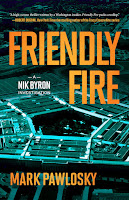
The Story Behind the Story: The Nik Byron Investigations, by Mark Pawlosky

(Editor’s note: This is the 95th entry in The Rap Sheet’s “Story Behind the Story” series. Its author is award-winning reporter, editor, and media executive Mark Pawlosky. A former reporter for The Wall Street Journal, editorial director for American City Business Journals (ACBJ), and editor-in-chief of CNBC.com/msn, he oversaw financial news channels in the United States, London, Munich, Paris, Tokyo, and Hong Kong. He successfully helped launch several media operations nationwide, including MSNBC, American City Business Journals, and Biz Magazine. A graduate of the Missouri School of Journalism at the University of Missouri, Pawlosky and his family spent the past 20 years living on an island in Washington state before relocating to the American Midwest. Below, he writes of his transition from journalist to fictionist, and about the two thriller novels—Hack [Girl Friday, 2022] and Friendly Fire [Girl Friday, 2023]—that have resulted from that evolution.)

(Right) Author Mark Pawlosky. (Photo ©Evan McGlinn)

It was a little past 9 a.m. on a cool mid-April morning in 1995 when, while at my desk of The Wall Street Journal’s Dallas Bureau, a bulletin moved over the wires: A massive explosion of unknown origin had ripped through downtown Oklahoma City. There were reports of multiple fatalities. My bosses at the Journal didn’t wait for confirmation on the cause of the blast before acting and ordering myself and another reporter immediately to Love Field in Dallas to get the next flight out to OKC. Two hours later I was standing at the edge of what looked like a bombed-out city as rescue workers, police, FBI, and military personnel swarmed the area around the pulverized Alfred P. Murrah Federal Building, searching for survivors and clues as to the cause of the explosion. Over the next 48 hours, rumors of foreign terrorists would be floated and knocked down before a state police patrol officer, on a routine traffic stop, arrested the mastermind behind the bombing that killed 168 people, including 19 children, in what was at that time the deadliest domestic terrorist strike in U.S. history.

Little did I know then that that experience would, some 20 years later, be the spark that inspired the creation of reporter protagonist Nik Byron and a series of books, beginning with my debut novel, Hack, and its follow up, the recently published Friendly Fire.

It was in the news trenches in Dallas, Washington, D.C., Seattle, Kansas City, and a small town in Indiana that I honed the craft of journalism that Nik Byron now practices and carries on at Newshound, a feisty online media operation, where he is a reporter, podcaster, and sometimes editor.

In a true art-imitates-life moment, there are sections in both novels that closely parallel events I experienced as a journalist.

In Hack, for example, the book opens with two characters, Cooley and Nukowski, driving away from a devastating explosion they set off in Washington, D.C., much as I would have imagined the two perpetrators of the Murrah bombing, Timothy McVeigh and Terry Nichols, escaping as they fled OKC and the scene of the crime.

In Friendly Fire, the young wife of one of the world’s richest individuals shoots and kills her husband in the first chapter in what appears to be self-defense, when, in actually, it is a cover-up. This scene, while not a perfect parallel, was inspired by a story I covered years ago in the Midwest. In that instance, a woman, distraught by the kidnapping of her daughter by escaped convicts, blamed her husband for the girl’s fate and killed him and then burned down her home with his body in it to cover up the murder. Somewhere in the deep recesses of my mind, that story lived on and only surfaced when I set out to write Friendly Fire, the second book in the series.

I also drew on my time in Seattle for Friendly Fire. How could a journalist live in one of the world’s greatest high-tech centers and not be influenced by its surroundings? The company at the heart of Friendly Fire, Yukon Corp., is the world’s largest artificial-intelligence firm. While AI is now all the rage, that wasn’t true when I began writing the novel; nonetheless, I had plenty of inspiration and insight regarding how mammoth technology companies and their leaders operate, thanks to my having worked in around Microsoft Corporation on and off for several years as an executive producer for [the Internet news side of] MSNBC, and later as an editor for MSN.

Both novels are set in Washington, D.C, where I lived and worked as a journalist in the late 1980s and early 1990s. D.C.’s ambience—political backroom deals, cutthroat journalism wars, power-hungry men and women—permeates the novel and drives its plotlines forward.

And while I’ve drawn on my reporting experiences to shape narrative, and many of my characters share similarities with journalists I’ve known, novel writing and journalism operate on two separate planes. Both are hard in their own ways. Journalism deadlines are more exacting and daily. Then there’s the hot breath of the competition on the back of your neck and the constant fear of getting something wrong. Authors have lengthier deadlines—a year or oftentimes much longer—but that can prove crippling, as procrastination, writer’s block, and ennui snare and sidetrack the novelist.

Fiction writers have license to shape facts to their own liking, while reporters, at least the good ones, do not. One might think that would be to the benefit of the novelists, but oddly, not so. The advantage goes to the reporter, since facts act as guardrails, keeping the story on the straight and narrow. Authors are free to chase the story wherever it wants to go, which, more times than not, is over the cliff.

I thought I had the best job in the world as a reporter and could never imagine doing anything else.

I feel the same way about being an author.

Monday, April 03, 2023

The Story Behind the Story:
“The Dead of Night,” by Elaine Viets

(Editor’s note: This is the 94th entry in The Rap Sheet’s “Story Behind the Story” series. It comes from prolific Hollywood, Florida, mystery novelist Elaine Viets. A winner of the Anthony, Agatha, and Lefty awards, Viets has penned dozens of books in four different series, including those starring St. Louis, Missouri, newspaper columnist Francesca Vierling [Backstab, Doc in the Box] and her latest, focused around Angela Richman, a death investigator working in a wealthy St. Louis suburb. The essay below provides the eccentric and ominous background to her latest Richman yarn, The Dead of Night, due out this week from Severn House.)

A Transylvania tomb and a 200-year-old curse gave me the bones for my new, seventh Angela Richman, death investigator, mystery, The Dead of Night. This Transylvania is in the United States. I’m talking about Transylvania University.

Transylvania is a real, private university, and an old one at that. Founded back in 1780, the name has nothing to do with vampires. Transylvania is Latin for “through the woods.” The university was located in a forested area that later became Lexington, Kentucky. It’s known by staff and students as “Transy.”

Transy goes all out each year for Halloween, the way New Orleans celebrates Mardi Gras. At Transy, the Halloween celebration lasts all week, with PumpkinMania, a pumpkin-carving contest, a cider bar, and food trucks.

Perhaps the oddest event is a raffle. The winners get to spend Halloween night in a cold, creepy tomb.

As John Friedlein, with Transy’s marketing and communications team, explains, “students actually compete with each other for the honor, which is said to appease the spirit of the deceased—Constantine Samuel Rafinesque, a [botany] professor who cursed the school back in the 1800s.”

(Left) Zoologist, botanist, writer, and polyglot Constantine Rafinesque

Rafinesque—now known as Raf—spent seven productive years (1819-1826) at Transy, teaching, researching, and squabbling with his colleagues. Raf discovered and named various flora and fauna, including “Rafinesque’s big-eared bat,” a scary-looking sucker with enormous ears. Raf’s bat is now the school’s sports mascot.

Transy finally booted the quarrelsome teacher, “following a rumor that he had slept with the college president’s wife,” explained onetime editor Allison Spivey in the school’s newspaper, The Rambler.

The school’s periodic bad luck, including fires and lots of “very spooky, weird stuff,” was blamed on Raf’s curse. After his dismissal, he moved to Philadelphia, Pennsylvania, where he lectured and researched until his passing in the fall of 1840 at age 56.

In the 1920s, bones believed to be Raf’s were brought back to Transy. They were buried on campus beneath the steps of the Old Morrison building, a Greek Revival landmark completed in 1834.

For The Dead of Night, I changed names, facts, and the location, transporting the cursed crypt 337 miles west to fictional Chouteau County, home of the one-percent. Chouteau County is based on the rich parts of St. Louis County, Missouri, which I covered for many years as a newspaper reporter. Raf became professor “Mean Gene” Cortini, and he’s buried in Chouteau Forest University’s crypt. Mean Gene’s crypt is far more elaborate than Raf’s resting place. Mean Gene’s was spruced up with a marble bier and Victorian angels.

But like Raf, Mean Gene has been causing death and destruction in Chouteau County for some two centuries.

(Right) Author Elaine Viets.

The local fat cats don’t give away a night in Mean Gene’s crypt. They’re too rich to give away anything. Transy’s student raffle became a fund-raising auction in Chouteau County. During the auction depicted in The Dead of Night, outsider Trey Lawson, son of a hedge funder, challenges the old money elite cats who rule Chouteau County. Trey bids an outrageous $1.3 million and wins the auction and a night in the cursed crypt. In addition to the prestige, if Trey can spend the night in that vault, he’ll become a member of the exclusive Chouteau Founders Club, the unacknowledged rulers of the county. Lydia, his fiancée, joins Trey in the crypt. The doors are locked at 11:37 p.m., the time of Mean Gene’s death, in front of witnesses. A guard is posted outside the tomb, and a camera is trained on the entrance.

Death investigator Angela Richman is uneasy about this auction. She works for the Chouteau County medical examiner’s office, and she believes there’s too much money and power at stake. Her fears are ignored—even laughed at.

The next morning, the tomb is unlocked with great fanfare. Trey is only the second person to stay the night in the cursed crypt since the 1980s. Chouteau County is his. The media, as well as the university brass gather for the ceremonial unlocking of the vault at 6 a.m.

But the couple’s triumph turns to horror. Trey and Lydia are dead, their bodies mutilated on the marble.

Angela Richman and her best friend, Detective Jace Budewitz, have to solve this locked-tomb mystery.

Wednesday, March 01, 2023

The Story Behind the Story:
“All Tomorrow’s Parties,” by Art Taylor

(Editor’s note: This is the 93rd installment in The Rap Sheet’s “Story Behind the Story” series. Its author is Art Taylor, a multiple award-winning short-story writer and associate professor of English at Virginia’s George Mason University. His fiction has appeared in publications such as Ellery Queen Mystery Magazine, Alfred Hitchcock’s Mystery Magazine, and Down & Out: The Magazine. Taylor penned the 2015 “novel in stories” On the Road with Del & Louise, as well as the 2020 short-story collection The Boy Detective & The Summer of ’74 and Other Tales of Suspense. His latest book, The Adventure of the Castle Thief and Other Expeditions and Indiscretions, was released last month by Crippen & Landru. In the essay below, Taylor provides a bit of history behind that collection’s poignant eighth yarn, “All Tomorrow’s Parties.”)

The 2021 album I’ll Be Your Mirror: A Tribute to the Velvet Underground and Nico features a version of “All Tomorrow’s Parties” by St. Vincent with pianist Thomas Bartlett. More than a simple cover of the song, this version seems a complex reworking and reimagining, a technical tour de force.

In place of the insistent thrum and jangle of the original version, which appeared on the Velvet Underground’s 1967 debut album (the one with the banana), this one seems to build on patterns of echo and overlay. A jazz piano plays a melancholy tune, while St. Vincent’s voice navigates complex twists and turns: spoken word recitation of the lyrics here, a breathy whisper there, elsewhere a voice that’s been vocodered into electronic otherworldliness. Especially if you listen on headphones, the voices seem to come from various directions, oblique angles, sudden and unexpected, doubling and redoubling.

Reviews of the song have used the words ethereal, alien, bizarre, and spacey. I’d add haunted.

When I first heard St. Vincent’s take on the song, I kept hitting replay over and over again—not only because I felt mesmerized by it, but also on an intellectual level. With its layerings and shifts and complex melancholy, the song struck me as exactly the kind of thing I was trying to do with my story “All Tomorrow’s Parties,” inspired by the original Velvet Underground song and recently reprinted in my new short-story collection, The Adventure of the Castle Thief and Other Expeditions and Indiscretions, published in mid-February.

Listening to the St. Vincent version brought me deeper into my own story in other ways too—and into “the story behind the story,” as this feature promises, several layers to that as well.

* * *

While I’ve long been a fan of Lou Reed and the Velvet Underground, I only turned to Reed’s music for inspiration because I asked to.

Jon Ashley, a writer and editor based in Kentucky, reached out to me in early 2017 with an invitation to contribute to an anthology he was organizing for Gutter Books, a follow-up to Trouble in the Heartland: Crime Fiction Based on the Songs of Bruce Springsteen (2014), edited by Joe Clifford. It was Joe, in fact, who recommended me Jon’s way. As Jon explained in that first message, I’d have my choice of song, the guidelines called for 3,000 words, and the pay was $25.

I didn’t hesitate—told Jon I was leaning toward something from Reed’s album Magic & Loss, promised I’d get back to him soon. But as I started working my way through various albums, the song “All Tomorrow’s Parties” from that first Velvet Underground album was the one that kept calling me.

(Left) The 1967 album The Velvet Underground & Nico.

It wasn’t the lyrics only that sparked my imagination, though readers of my story can surely trace some direct connections from song to page: a poor girl who clowns and cries; the silks and linens of her past, her hand-me-down dress now, the blackened shroud ahead, and the idea of costuming generally; and then that repeated question “Where will she go, and what shall she do / When midnight comes around?”

In addition to those lines and phrases, I was also lured in by Nico’s monotone singing, nearly a chant, and then the relentless piano (paper clips entwined with the strings, I’ve heard) and that throbbing “ostrich-tuned” guitar lurking insistently around the edges.

The summer I wrote “All Tomorrow’s Parties,” I was also listening to Lorde’s extraordinary sophomore album, Melodrama (2017), and one track there, “Liability,” provided a second important inspiration, equally melancholy and introspective. After leaving a party where a man had complained about “dancing in [her] storm,” a young woman finds herself crying in the taxi, then returns to her home and to the arms of the one person who loves her, the one person she loves in return—“but all that a stranger would see / Is one girl swaying alone, stroking her cheek.”

The chorus echoes the title of the song: “You’re a little much for me / You’re a liability / You’re a little much for me.” And both the chorus and that image of a woman dancing with herself—that image in particular—joined with elements of the Velvet Underground song to point me in the directions I needed to go.

My story “All Tomorrow’s Parties” begins with the main character, Shayla, catching sight of her younger self wandering through a work party she’s attending—a younger self who is, in turn, watching her.

Shayla is recently divorced and estranged as well from her own young daughter. Both relationships have been undermined by Shayla’s alcoholism, and she’s trying desperately (emphasis on that word) to rebuild her life: a new apartment, a new job, and potentially a new love interest from the office. But everything still seems to be crumbling around her, desperation tipping into despair, and she’s set herself an ultimatum for this particular evening. In a twist on the Cinderella tale (a third inspiration), Shayla determines that she’s going to win over this new love interest before midnight, or else she’ll take her own life—and she’s even brought a gun in her purse to ensure she follows through.

Perhaps needless to say, things don’t go well for anyone, especially since Shayla pre-games the party with cocktails and then keeps drinking to stay loose and ready.

Despite the 3,000-word limit Jon had given me, my story ended up nearly double that length—necessary space to orchestrate (keeping a musical focus!) everything that I was trying to do: the forward momentum of the evening, drink after drink; the various memories haunting Shayla, literally with that vision of her younger self stalking through the rooms; the various observations on parties from the past, parties in general, and the promise of tomorrow’s too, if only …

I touched base with Jon after I was done—via Facebook Messenger—explained all this to him, apologized, told him I’d understand if he simply couldn’t use it at that length.

He said he’d look at it, asked if I’d be OK with him trying to cut. I told him sure, I’d be open for suggestions, glad to see what we could do.

I e-mailed him my Word document early that same afternoon—September 13, 2017.

I don’t know whether he ever read the story. For many reasons, I hope he did not.

Later that evening, Jon ended his own life.

* * *

I never met Jon (shown on the right), didn’t know him well at all—only had our exchange about the story he’d commissioned from me, a couple of handfuls of IMs, that was it. But I learned a lot about him from the posts on his Facebook page after his death and from talking with Joe Clifford later on: Jon’s persistent struggles with addiction and depression, which I hadn’t known about; his brilliant creativity both as a writer and a musician; his work as a bookstore owner at Second Story Books in Louisville; his “amazing” efforts (to quote his students) as an adjunct English instructor at Jefferson Community and Technical College, also in Louisville; and then the tremendous love and empathy and esteem which so many people felt for him, pouring out in the wake of his death at age 35.

Heartbreaking, all of it—then and now too.

* * *

The anthology that Jon had begun did come out: Dirty Boulevard: Crime Fiction Inspired by the Songs of Lou Reed, edited by David James Keaton, another writer and editor I greatly admire, and published in September 2018 by Down & Out Books. The collection has a terrific introduction—Patrick Wensink paying tribute to Ashley—and a powerhouse group of writers: Ashley’s own “Ride into the Sun,” along with stories by Rusty Barnes, Reed Farrel Coleman, Alison Gaylin, Lee Matthew Goldberg, Cate Holahan, Gabino Iglesias, David James Keaton, Erin Keaton, Ross E. Lockhart, Tony McMillen, Richard Neer, Chris Orlet, J. David Osborne, Rob Pierce, and Eryk Pruitt.

You can read more about it on Down & Out’s Web page for the book. All the profits from sales of that anthology benefit suicide prevention.

* * *

You’ll notice that my own name isn’t among the collection’s list of contributors—which is another part of the story behind the story here.

When I’m presenting talks or serving on panels about short stories, the question of markets often comes up—writers seeking guidance about how to find the right venue for publication, how to sell their work—and the assumption has often been that it’s easy for me, but honestly that’s not always the case. My submissions have been rejected as not a good fit for the publication (time to find another) or as not quite done (more revisions), or perhaps just rejected without comment. No matter the success a writer might’ve had in the past, rejection is something all of us face.

And so it was with “All Tomorrow’s Parties”—in this case a lesson in word counts.

After he’d taken over the anthology, Keaton reached out to me about including the story, but it did indeed prove too long, and I simply wasn’t able to cut it down to the required word count without sacrificing too much of what I was trying to do.

I offered to write another one—did that too, in fact: “Sunday Morning, Saturday Night,” based on “Sunday Morning” from that same first Velvet Underground album. But this second story failed the word count in another direction—only 1,000 words, too short, and I couldn’t see stretching it out Procrustean-style to fit what was needed.

(Left) Author Art Taylor.

I’ll admit I’ve missed other opportunities for similar reasons, trying right up to a deadline to judge where and how to cut a story further, and then the deadline passes. It’s not that I’m against cutting a draft—even tremendously, in fact. In one instance, the story “Mrs. Marple and the Hit & Run” (also included in The Adventure of the Castle Thief and Other Expeditions and Indiscretions), my original draft was around 10,000 words, which I cut to a little over 2,000—nearly 80 percent of the first draft gone. And I’ve also been very fortunate to work with first readers and final editors who’ve helped me trim and tighten a story at various points along the way—outside perspectives a godsend!

It’s a process—drafting, workshopping, revising, working with editors—to find what the story needs and what it doesn’t, whether it’s a novella or a piece of flash fiction, and following it to its best final form.

All that said, I was sorry not to be included in Dirty Boulevard, but I was grateful that both stories I wrote for the anthology found publication elsewhere.

“All Tomorrow’s Parties” appeared in the 2020 Chesapeake Crimes anthology, Invitation to Murder. Before submitting it there, I made only the minor change of adding an invitation to the party Shayla attends—a gesture toward the book’s theme—and I’m grateful to editors Donna Andrews, Barb Goffman, and Marcia Talley for their guidance in bringing the story into its final form.

“Sunday Morning, Saturday Night,” appeared in Down & Out: The Magazine in 2018, with some very thoughtful editing by Rick Ollerman—gratitude again.

As I mentioned earlier, “All Tomorrow’s Parties” is now part of the new collection, The Adventure of the Castle Thief, and “Sunday Morning, Saturday Night” is also being republished in conjunction with this same release; it’s the bonus pamphlet included with the signed and numbered cloth edition of my book.

Both stories should work well on their own without any background regrading the various texts that inspired them. But I hope these extra stories behind the stories might add a bit of context and weight for readers inclined that way. And I’m grateful to the late Jon Ashley for that original message—his idea for the anthology, his invitation for me to submit a story, his confidence in my work.

Without Jon, neither of these stories would be out in the world today.

Wednesday, February 01, 2023

The Story Behind the Story:
“Little Follies,” by Carolyn Korsmeyer

(Editor’s note: This is the 92nd installment in The Rap Sheet’s “Story Behind the Story” series. Its author is Carolyn Korsmeyer, a research professor of philosophy at the University at Buffalo, in New York. She is especially interested in how the senses and emotions are engaged by works of art, themes prominent in three of her philosophy books: Things: In Touch with the Past [2019], Savoring Disgust: The Foul and the Fair in Aesthetics [2011], and Making Sense of Taste: Food and Philosophy [1999]. She is keen to explore the ways that fiction can revive lives from long ago by engaging the reader in the sights, sounds, smells, and tastes of the past. Her first novel, Charlotte's Story [2021], imagined the life that Charlotte Lucas [of Pride and Prejudice] might have had after her hasty marriage. Little Follies is her second novel, released just last month by Black Rose Writing.)

The idea for Little Follies: A Mystery at the Millennium was inspired during a lengthy stay in Krakow, Poland, a city so full of history, art, and shadow that it seemed an ideal setting for a mystery novel.

I’ve visited Krakow five times, once for a stay of four months. It is a complex and intriguing place, best known for its beautiful Old City with its worn buildings and fascinating past. My first visit in the 1990s was only a few years after the disintegration of the Warsaw Pact, and Poland was emerging energetically from decades of Communist rule. This trip was inspired by a university colleague who arranged for six American scholars in different fields to visit the Jagiellonian University and conduct seminars on the advent of feminism in the scholarship in our disciplines. On the whole, this project was fairly successful (although having just rid themselves of one “ism,” many Poles were reluctant to take on another). Certainly for the six of us, venturing into Poland was fascinating.

Of course, we blundered a good deal. Assuming that after years of scarcity, Poles would be unfashionable, we all packed our oldest, dowdiest clothes. Scarcity, however, does not entail lack of style, and we found Krakow to be filled with women carrying themselves with considerably more elegance than we did. Nonetheless, there were certainly far fewer consumer goods available than in the United States, and we learned to go to restaurants early before they ran out of their main dishes.

Ten years later, I moved with my husband to Krakow for a semester, when we both taught at the Jagiellonian and got to know the city better. Even in one decade, the place had changed a great deal. There was more food readily available and more items from various places for sale. On my first visit, there had been only one synagogue still open for services in the area called Kazimierz, once the home of the many Jews who lived in Krakow, most of whom perished in the Holocaust. (Auschwitz, the infamous camp that is now a memorial as well as a much-visited site, is slightly more than 40 miles away.) Now, several more synagogues have been renovated and are open for services.

For all the improvements, on that second visit and the three that followed, I had to guard against a kind of retrospective nostalgia for the city as I had first experienced it. I quashed resentment that things had been cleaned up, repainted, and rebuilt, but I still found myself filled with the proprietary reactions of a tourist. How dare they gild St. Florian in his niche? (I remembered fondly the dirt-encrusted image atop the gate at the end of Florianska Street, which I had carefully photographed by hanging out the second-floor window of our guest house.) Why replace the perfectly good cobblestones in the big market square with flat pavers? (Better for the feet, of course.) And what are horse-drawn carriages doing here? (The latter query as a clopping horse came up behind me and snorted into my ear when I didn’t move to the sidewalk quickly enough.) And why put a parking lot on the river bank?

Every time I went to Krakow, I revisited the places that I was describing in my slowly-progressing novel, and the writing seemed to stretch on indefinitely. It is fortunate that the plot demanded that my story take place in 1999, or I would have been too flummoxed by all the changes to keep up with the renovations that now describe the setting. Perhaps the most dramatic change has been the discovery of layers of ancient Krakow lying beneath the cobblestones of the huge, old Market Square (the very stones whose removal I had resented). Now there is a vast underground area that has been meticulously excavated and turned into a captivating museum where one can descend to the oldest periods of the city’s past. Had I known that when I began writing, including it in the story would have been irresistible.

So fixing the plot in 1999 guarded against the temptation to start over repeatedly. I felt safe, but only for a little while. An unexpected and spectacular event in the art world caused a nearly fatal problem.

Krakow is a city of museums, including the Czartoryski, which holds Leonardo da Vinci’s exquisite Lady with an Ermine. Like so many old art works, the provenance of this painting was interrupted, and for a time the attribution to the artist was disputed before the work was firmly authenticated. This history inspired part of the plot of Little Follies when I recalled another controversial painting that I had seen many years before.

(Left) Carolyn Korsmeyer

A painting bearing the title Salvator Mundi made the rounds of the United States sometime in the 1980s, sparking debate over whether it could possibly be one of the few paintings from the hand of Leonardo da Vinci. A popular subject for paintings in the Renaissance, renderings of the “Savior of the World” typically picture Christ holding a globe in one hand, while the other is raised in blessing. I viewed it when it was exhibited locally and was skeptical, but the disputes over its authenticity were intriguing. I made a fictional painting of the same name—and possibly by the same artist—the target of a theft in Little Follies.

But suddenly, life decided to imitate art. To my surprise and temporary dismay, in 2017 another Salvator Mundi was authenticated as a genuine work of Leonardo da Vinci. To great fanfare, this painting was auctioned at Christie’s and sold for a record-breaking $450 million dollars. Needless to say, both the authentication and the extraordinary price made headlines.

At first, this seemed like irrecoverable bad luck, and I wondered what I could do with this collision of fictional plot and factual news. I considered changing the subject of the fictional painting, but it was too closely woven into the story. At a low point, I thought about scrapping the novel altogether, or maybe just hoping that whoever read my story had somehow missed the headline-making news about the upheaval in the art world. In the end, I confronted the problem head-on and added a preface that acknowledged the coincidental second painting, taking refuge in the fact that Leonardo sometimes painted the same subject more than once.

I continue to hope that the ambiguity of attribution and the ongoing controversies that still circulate about the “real” painting might even enhance interest in my plot. After all, sometimes mysteries—fictional and non-fictional—are best left with a few dangling, unsolved questions.

Monday, August 29, 2022

The Story Behind the Story:
“A Deadly Covenant,” by Michael Stanley

(Editor’s note: This is the 91st installment in The Rap Sheet’s “Story Behind the Story” series. It comes from Michael Sears and Stanley Trollip, who write under the name Michael Stanley. Their award-winning mystery series, set in the fascinating southern African nation of Botswana, features Detective David “Kubu” Bengu of the Botswana Police Service Criminal Investigation Department. This week brings the release of their latest entry in that line, A Deadly Covenant (White Sun)—the subject of their essay below. The pair have also penned a thriller, Shoot the Bastards (2019), which introduced Minnesota environmental journalist Crystal Nguyen. Set mainly in South Africa, it has as its back story the vicious trade in rhino horn. Sears has lived in South Africa, Kenya, Australia, and the United States, but now resides in Knysna on the Cape south coast of South Africa. Trollip splits his time between Minneapolis, Cape Town, and Denmark. Learn more about these authors and their books by clicking here.)

When we first visited the Shakawe area on the Kavango (or Okavango) River in northwestern Botswana many years ago, we were blown away by the multitude of birds and animals to be found there. The falling river had trapped thousands of fish, and water birds were there in abundance. We experienced “bird overload”—not knowing where to look next. The trees were packed with majestic fish eagles; the banks were lined with herons and egrets literally waiting their turn to move to the riverfront to help themselves to a juicy morsel. At night we spotted the iconic Pel’s fishing owl going after the same prey. It was a magnificent experience. When we started our Botswana mystery series, we knew that one day we’d want to set a book in the area.

The Kavango River rises in the sandy uplands of Angola and usually floods in January. Each year, after generous summer rains there, it flows down through Namibia, into Botswana, and eventually spreads out into the Okavango Delta in the middle of the Kalahari Desert during the dry winter months. The water never reaches a sea, but forms a mass of waterways and lush islands before soaking into the desert. Since the Okavango is a huge oasis in the desert, animals abound, attracted to the water and green vegetation from miles around, forming one of Botswana’s superstar tourist attractions.

However, water is a precious resource in southern Africa, and the Kavango crosses Namibian territory north of Botswana. At one stage, Windhoek, the growing capital city of Namibia, proposed a plan for a water pipeline from the river to supply the city’s residents hundreds of kilometers away. Tempers flared as Botswana accused its neighbor of endeavoring to steal its water. Fortunately, the idea seems to have been shelved—for the moment at least.

(Above) Sunset over the Kavango.

The Kavango River not only floods the Okavango every year, but it is also the source of water for Batswana people living and farming along the river all the way from Shakawe until it spreads out into the Delta. What, we wondered, would be the result of a significant water project designed to open up the desert area further back from the river for cultivation? Could it be done without damaging the Okavango environment? How would people react? Water and water rights seemed a promising back story for a mystery.

Another theme which has featured in several of our Botswana mysteries (including the first, 2008’s A Carrion Death) is the history and culture of the Bushman peoples of the Kalahari. In fact, there were Bushman groups, the River Bushmen, who populated the region around the Kavango River and the Okavango. Their descendants still live in that area—there is even a tourist camp named Bushman Plains, owned and managed by the local Bushman people.

Not far from Shakawe is Tsodilo Hills, a World Heritage site with an amazing profusion of rock art. The Bushmen believe it is the birthplace of humankind, so the importance of the area to them is very clear.

Of course, there has been conflict over the years between these Bushmen and the Tswana people, who need the river for their livelihood. We wondered how that might play out in modern times. Suppose that in the midst of a controversy over water issues, evidence was found of a violent conflict from the past. Not the distant past, but rather 30 or 40 years earlier—recent enough that people would not want to talk about it, let alone be held accountable for it. Now we could see the first glimmer of an actual plot.

A leopard in a tree near the Kavango.

A Deadly Covenant is the eighth mystery featuring Detective David Bengu of the Botswana Criminal Investigation Department (CID). His nickname is Kubu, which means hippopotamus in the local language. This mainly refers to what he would describe as his generous size and healthy appetite, but he also shares the hippo’s determination to reach its goal, no matter what gets in its way.

In the series’ first six books, Kubu was portrayed as the senior detective in the Botswana Police Service CID and a close associate of its director, Jacob Mabaku. We then took a step back, realizing that Kubu’s history needed filling in, and that there had to be interesting stories from the time he was maturing into being an expert detective.

Facets of Death (2020) was a prequel covering his first big case—a massive heist from one of the world’s richest diamond mines, Botswana’s Jwaneng. Facets of Death seemed to suggest a new Kubu series, one which followed his growth as a young detective as he built a professional role and a personal life for himself.

So A Deadly Covenant is set at the end of the 20th century, a few months after Facets of Death. Kubu is still a new detective, cutting his teeth on police work.

While digging a trench for a controversial new project using water from the Kavango River, a backhoe operator unearths the skeleton of a long-dead Bushman. Kubu and Scottish pathologist Ian MacGregor are sent to sort out the formalities, but the situation rapidly gets out of hand. MacGregor discovers eight more skeletons—a massacre of Bushmen including women and children. However, the locals deny any knowledge of such an event.

(Left) Michael Sears and Stanley Trollip.

When an elder of the village is murdered at his home, the local police believe it was the result of a robbery gone wrong. Kubu thinks otherwise. So does an elderly woman who believes it was connected with Mami Wata, a powerful river spirit. After she dies in an apparent crocodile attack, suspicions rise.

Things become still more complicated when a mysterious Bushman appears at the massacre site, collapses, and then disappears again, but seems connected to the murders in some way.

Kubu’s superior, Assistant Superintendent Mabaku, joins them as accusations of corruption are leveled at the water project, and international anger builds over the massacre of the Bushman families. Do the recent murders link somehow to the long-deceased Bushmen? As Kubu and his colleagues investigate, they uncover a deadly covenant made many years before by an unknown group, and they begin to fear that their own lives may be at risk.

So the threads come together in what we hope is an enjoyable murder mystery, at the same time illustrating some features of Bushman culture and the idyllic setting of Shakawe, a gateway to the fabulous Okavango Delta.

(Photo credits: The two Kavango River shots come from Michael Sears and Stanley Trollip. The photo of the authors was taken by Ali Karim at the 2016 Theakstons Old Peculier Crime Writing Festival.)

Monday, November 22, 2021

Story Behind the Story: Out of the Fog of War

(Editor’s note: This is the 90th installment in The Rap Sheet’s “Story Behind the Story” series. Bringing us today’s contribution is Paul A. Barra, a writer and retired chemistry teacher in Columbia, South Carolina. He has had five novels published, plus a non-fiction book about a Catholic high school founded without diocesan approval. His most recent novel, 2019’s Westfarrow Island, was shortlisted for Killer Nashville’s Silver Falchion award. His short story “Assignment: Sheepshead Bay” was selected for the Mystery Writers of America anthology When a Stranger Comes to Town, released earlier this year by Hanover Square Press. Barra is a decorated former naval officer, and once served as a reporter for local papers and the senior staff writer for the diocese of Charleston, South Carolina. In the essay below, he recalls a few of his experiences during the Vietnam War and how they affected a new crime novel he’s hoping to publish.)

(Left) Paul A. Barra

One of the pleasant memories I have from my tours in South Vietnam, prosecuting what the locals referred to as The American War, was that of a boy the GIs of the Ninth Army Infantry battalion called Salém. He was perhaps 10 years old, and he hung out by the army base in a Mekong Delta village outside of Mỹ Tho, begging any westerner he saw for a Salem cigarette, a popular brand of menthol fag in the 1960s. I never saw him smoking, never smelled cigarette smoke on his person, so I suspected he sold them to Vietnamese military men, all of whom seemed to smoke.

Salém was a hustler, but he was so enjoyable to be around—and so helpful in his inimitable way—that every American I knew liked him. He had taught himself to speak English, a sort of colloquial patois full of army slang, and became so proficient at it that I used him as a translator a few times. He spoke better and understood more than the sullen ARVN (Army of the Republic of Vietnam) translators occasionally assigned to us. The difference was, Salém liked our language and worked at learning it. He liked Americans.

Unfortunately, Salém also drew the ire of the villagers he lived among. They regarded him as an outlier in a society that tolerated the U.S. soldiers assigned to the area but wished they would go back across the Pacific Ocean. Their country had been at war almost continually since World War II; the South Vietnamese people were tired of foreigners occupying their land, filling their lives with noise and danger, and enriching the corrupt bureaucrats in Saigon. Salém seemed to genuinely appreciate that we were not any happier being there than they were having us, and that we were fighting and dying to maintain their freedom. Maybe the everyday folk thought Uncle Ho was the lesser of two evils. Maybe he was.

One morning, early enough so that the humid air was not yet pressing down on me and raising a sheen of perspiration, I sat drinking coffee on the deck of a village bistro overlooking the mighty Mekong River, waiting for the crew of my gunboat to come back from shore leave. Mornings were not only relatively cool but also relatively safe. Charlie was back at his civilian occupation, waiting for darkness to resume his secret killing trade. Salém sauntered up and sat opposite me in the shade of a yellow umbrella.

“Would you like coffee, Salém?” I asked him.

“Yes, plea’, Dai Ùy.”*

I pushed a few đồng over to him; he pushed them back.

“Dey no like me,” he said, raising his chin to the waiters inside.

He had a sad kind of smile on his face, the only time I ever saw him the least bit downcast. I went into the bar and bought him a cup of coffee, dark espresso-type stuff with a layer of sweet condensed milk on top. To this day it is my favorite drink in the morning.

Salém and I talked about life in the United States. He told me how his dream was to live in California. By then it was 1972, and the end of the Republic of Vietnam was fast becoming evident. “Vietnamization” was another failed Washington scheme, and small North Vietnamese Army units were already being spotted in the southern provinces. I wanted to help Salém escape to a better life, where I was certain he would succeed as an entrepreneur. I wanted to, but I didn’t.

My change of station orders came through when I was back in Saigon, and I found myself on a Pan Am airliner heading east without ever seeing him again.

I think of Salèm often these days, wondering what became of him, if he was able to charm the Communists the way he did us. If he survived. It is a great regret of mine that I hadn’t then the courage and drive to rescue him. It wouldn’t have been easy, but there were ways. I adopted a child from Regina Pacis Orphanage in Saigon, our eldest daughter, and got her home via the auspices of a charity-minded worker at the U.S. Embassy; maybe I could have adopted Salèm. Maybe I could have just sneaked him aboard a plane with a diplomat going home on leave, the way our daughter came to us.

There were also Republic of South Vietnam ship commanders who enjoyed almost complete autonomy once they sailed away from the capital and who proved they were amenable to using their vessels to supplement their puny Navy salaries, sometimes to the detriment of their duties.

Once we escorted two merchantmen up into Cambodia, then stood by loading inexpensive dried apricots for the VNN (Republic of Vietnam Navy) crew to sell at a profit in Saigon while an ARVN outpost was under attack. The outpost advisor called me for assistance; we continued loading our illegal cargo. Our guns stayed silent.

I may have been able to bribe a commanding officer heading off to Guam for a ship overhaul to take Salèm with him to that U.S. territory, but I didn’t try.

When I was writing my latest crime novel manuscript, Sgt. Ford’s Widow (now in the hands of my agent, Pamela Malpas), I wanted to write into it a refugee from the war in Vietnam as a way to remember Salèm and to elucidate the difficulty of someone of low status in Southeast Asia acclimating to life in a huge western country. I chose to set my story in Wyoming, a state about as opposite from the Mekong Delta as is possible to imagine, and made the refugee a middle-aged woman, illiterate, wounded, and no longer capable of having sex. I didn’t want the character to be a child, because I don’t generally like coming-of-age stories, although she turned out to be a 40-something who comes of age—in a manner of speaking.

My character, Linh, arrives before the onset of the Boat People and Little Saigon; she lands alone, in the dead of winter, different and completely reliant on her protector, Gil Ford, a private eye. She ends up teaching herself to speak English by watching television, to drive and shoot a handgun and, eventually to investigate crimes. By the final chapter, she rescues the protagonist, who rescued her, and solves a mystery. Now she is ready to serve as a main character in a series, and maybe even to star in her own novel someday soon.

Past regrets may not be correctable, but sometimes for a writer the pain of his or her failure can be softened by the work of his hand. That’s another of the many benefits of writing that I’ve just now discovered.

* Dai Ùy is military rank, lieutenant in the Navy, captain in the Army.

Monday, October 18, 2021

The Story Behind the Story:
“Five Will Die,” by Trace Conger

(Editor’s note: This is the 89th installment in The Rap Sheet’s “Story Behind the Story” series. Today’s contribution comes from Trace Conger, a Cincinnati, Ohio, resident who writes a thriller series starring Connor Harding [Mirage Man], a former fixer for a New York mob family; and another series featuring unlicensed private eye Finn Harding, aka Mr. Finn [The Prison Guard’s Son]. Conger won a Shamus Award for his debut novel, 2014’s The Shadow Broker. His suspense novella, The White Boy, won the Fresh Ink Award for Best Novella of 2020. Below he writes about Five Will Die, a police procedural being released this month in both print and e-book editions.)

I’ve had an interest in serial killers for as long as I can remember. It was one of the reasons I enrolled in college with aspirations of a criminology degree. My major shifted to creative writing my sophomore year, but that’s a story for another time. To me, one of the more interesting aspects of serial murderers was their enthusiasm toward taunting the police via letters to the department or published in the local paper. All the big boys did it, from the Zodiac Killer and BTK to Son of Sam and even Jack the Ripper.

But while all of these headline-makers taunted the authorities after they began their murder sprees, I wondered if anyone had contacted the police before claiming their first victim. Less of a “catch me if you can” angle and more of an “I’m coming to your town, get ready” approach. As far as I know, that’s never happened. So I made it happen.

My sixth novel, Five Will Die (Black Mill), follows Tim Burke, a retired Cleveland homicide detective who moves to the sleepy town of Lincoln, Ohio. Three years after his retirement, Burke takes up as that town’s sheriff to stave off the boredom of small-town life.

In Lincoln, the only thing Sheriff Burke has to worry about is who spray-painted the side of Walt Tanner’s barn. That all changes when someone slips a note under his door. A note claiming five people will die in Lincoln.

At first, Burke and his two green deputies dismiss it as a prank by local teenagers, the same troublemakers he singled out for defacing Walt’s barn.

Then the first body turns up. Then the second.

Writing this novel was a personal experience for me. Actually, all of my books have touched me personally, but Five Will Die was different.

As readers will learn, Burke didn’t retire from the Cleveland Police Department voluntarily. A panic disorder, triggered by a brutal, unsolved case, punched his ticket for him. His role as Lincoln’s sheriff was a compromise with himself. He gets to return to his law-enforcement roots and contribute something positive to society, but in a much less violent environment, one that won’t feed his panic disorder.

Where’s the personal tie? In early 2020, I began experiencing severe stomach pain. Gut-wrenching stuff. I had all the tests, and a few procedures and a few grand in medical bills later, my doctors told me nothing was wrong with me. All that expensive diagnostic imagery couldn’t find a thing.

For most people, the idea of medical tests confirming there was nothing physically wrong with them would bring a sigh of relief. Apparently, that’s not how my brain works. My brain was convinced the medical community missed something. So, I demanded more tests, which I got, and which confirmed the results of all the other tests.

That’s when the darkness came. On my worst days, I would wake up and immediately lose feeling in my hands and feet. I lost a tremendous amount of weight in a short time. I didn’t eat. I didn’t sleep. I was falling apart. I felt an invisible weight crushing me. It took so much energy just to get out of bed or off the couch. The most lingering sensation was that of someone cinching a belt around my chest and pulling as hard as they could, as if trying to cut me in half.

Then I talked to a psychologist who confirmed that I had a panic disorder. Mine was severe, almost as if I was trapped in some panic-loop for days on end. She explained the science behind it, and I was floored at how my noggin was causing so much physical pain.

I worked with a few professionals who gave me ways to cope. One of those coping mechanisms was to journal. They said writing about your feelings and sending them into the ether via (in my case) a leather-bound journal with fancy paper helped. But there was a problem. I hate journaling. Loathe it. Always have.

To stay busy, and to get my mind off the dark shit my brain was conjuring up, I decided to start my next novel. I already had the serial-killer-alerts-the-police plot in my head, but I didn’t know that, like me, Tim Burke would suffer from a panic disorder. But all of a sudden, he did. He began experiencing the same things I had, and I found it therapeutic to torment him as my own mind had tormented me. It wasn’t journaling, but it was just as effective.

I wrote off and on. Concentrating on something other than what was happening to me gave me a reason to get out of bed every day. It likely saved my life, too.

(Left) Author Trace Conger

Five Will Die was a departure for me. It was my first police procedural. I usually write about P.I.s and mob fixers, all of whom straddle the line between criminal and investigator, between good guy and bad guy. Burke was my first truly good guy.

The story unfolded pretty quickly. The ending shifted on me and went in a different direction than I had outlined. Like a bucking bronco, sometimes you just have to hang on and see where the story takes you. The killer wasn’t who I expected it to be, which surprised the hell out of me. That’s the fun part of the writing process.

As the story unfolds, the investigation takes Burke and his team in different directions. With a lack of physical evidence, Burke needs help, and he receives it from Maren Krueger, a free-spirited criminal psychologist. Maren introduces into this tale the art of criminal profiling and builds a list of suspects based on psychological traits instead of physical evidence. Burke soon discovers that everyone in Lincoln is a suspect, including some on his payroll.

Burke also uncovers a link to another small Ohio town, where a killer left a similar note, claimed five victims, and vanished without a trace. This offers a glimpse of what awaits Lincoln if he can’t catch his killer, and the prospect of not making an arrest sends his disorder into overdrive.

As Burke’s condition worsens, propelled by the floundering investigation and his inability to seek help for what’s happening to him, his health begins to unravel. He hides his condition from his colleagues, convinced they’ll run him out of town, just like the chief of police did in Cleveland.

You’ll have to read the novel to see if Burke overcomes his debilitating condition and whether he’s able to keep it together long enough to solve the case. I suspect you may think you already have the answer, but I wouldn’t be so sure. Like I said earlier, stories have a way of shifting on you and going in a direction you didn’t see coming.