Showing posts with label Harrogate 2008. Show all posts

Tuesday, August 19, 2008

The Stars Come Out at Harrogate, Part VI

Lucy Ramsey, Rebecca Jenkins, and Ron Beard at Harrogate.

(Editor’s note: This is the final installment of British correspondent Ali Karim’s report from the recent Harrogate Crime Writing Festival. Previous parts can be read here.)

Our discussion of necrophilia and the appalling things one can do with farmyard fowl was, thankfully, interrupted by our rather unsteady arrival at Harrogate’s Hotel Du Van, site of the Quercus Publishing cocktail party. Greeting us immediately were publicists extraordinaire Lucy Ramsey and Nicci Praça, as well as Jane Wood, who I have known for many years, back to when she was still the publishing director at Orion Publishing. Having drunk a bit too much already that evening, we naturally dove into the food and were appreciative of the chilled wine in large glasses.

Our little group--Roger Jon Ellory, Chris Simms, Steve Mosby, Simon Kernick, my son, Alex, and I--were soon fanning out over the floor. After another brief chat with Thomas H. Cook, who had also found his way from the festival hotel to this fête, I was introduced by Ron Beard, Quercus’ paperback director, to a charming writer named Rebecca Jenkins. A broadcaster and journalist, she has also recently made her debut as a historical mystery novelist with The Duke’s Agent. Over a bit more wine, I asked her what prompted her to pen that new book. Herewith, her explanation:
I fell in love with The Scarlet Pimpernel at the age of 12. It wasn’t just the derring-do and the style and wit of the hero, it was the clothes, the carriages, the streets--the world--that caught my imagination. Baroness [Emma] Orczy’s stories were too few and I began to explore beyond them. I took up fencing, seized by an ambition to master the pris de feu (I executed the move successfully just once, twisting my opponent’s foil out of his hand, but I suspect my teacher let me). I began to frequent secondhand bookshops, hunting out cheap 1920s editions of memoirs from the period. A reprint of a 17th-century herbal, a volume of a Regency courtesan’s recollections, a late-18th-century manual for the correct governance of a duel--my library began to build.

My fascination with the Napoleonic War generation--that pivotal generation in which the Enlightenment met Romanticism, and the Georgian Age gave way to the Victorian--led me to study history at university. But it was my move to Teesdale in the north east of England that brought [my protagonist] Raif Jarrett into being.

“Having once resided in Teesdale,” Richard Garland wrote in 1804 in his published Tour, “I cannot resist an inclination to communicate to others an acquaintance with those delicious scenes.”

Southerners have a tendency to associate County Durham with slag heaps and mining and other ugly things. They haven’t seen the Dales with their big skies and painterly clouds.

Teesdale combines rugged moorland with wooded valleys, cut with gorges and waterfalls that share the picturesque charm of a Swiss mountain scene. It is a landscape sufficiently isolated for the remnants of the past to linger relatively undisturbed. You can find an Iron Age mound in the field behind an inn. The ruins of a medieval abbey perch on a hillside by a country road, while the remains of a Roman fort linger by a ford. J.B.S. Morritt was the Regency owner of the Palladian mansion Rokeby Park that stands near the junction of the rivers Greta and Tees. The scenery, he firmly believed, deserved “to become classic ground.”

Morritt’s hospitality drew several famous artists to the area in the first decade of the 19th century. John Sell Cotman spent the summer of 1805 sketching along the Greta. J.M. Turner was a repeated guest. Engravings of Turner’s paintings of the waterfalls at High Force and Cauldron Snout, and the ruins of Egglestone Abbey, served to popularize these local beauty spots. And when Sir Walter Scott penned his poem, “Rokeby,” in the grounds, he established the area around Greta Bridge as a stage on the Romantic pilgrimage to the Lakes.

One wet autumn day I sat reading through the catalogue of J.B.S. Morritt’s library. In the handwritten lists Jarrett’s world coalesced. A folio containing the latest French archaeological finds from Egypt, another on Russian costume; the march of leather-bound volumes of sermons and Shakespeare plays; the illustrated travels of Marco Polo, military memoirs, herbals and architectural treatises, manuals on animal husbandry, surgery and physic, botany, and the geology of coal mines. This was human knowledge spanned by a gentleman of the Enlightenment, when a rational man’s reason might encompass theology, folklore, magic and art, as well as science and engineering; before the explosion of data made the world too vast and the disciplines were perforce divided.

My Regency detective, Frederick Raphaele “Raif “ Jarrett, combines the rational mind of the Enlightenment with the romantic imagination of an artist. A returning soldier, he comes to Teesdale a good year before Byron is made famous by the publication of Childe Harold’s Pilgrimage. The British have been at war with the French most of his life. He is shipped home wounded from the Peninsular [War], where his talents as an artist led him to serve as an intelligence officer, riding out to bring back maps of enemy dispositions. His aristocratic family connections find him a job overseeing isolated properties, as the agent to the Duke of Penrith. As a newcomer to the community, and an outsider with unusual skills, he finds himself thrust into a series of investigations.

For me the charm of murder investigation before forensics rest on two things. Firstly they require close observation that identifies disturbances in the regular pattern of everyday life, and secondly, an understanding of human character--the teasing out of motives and secrets. Thus Jarrett’s artist’s eye gives him the advantage of a trained observer, but at the same time his investigations draw the returning soldier into civilian relationships, forcing him to engage in the world he fled as a betrayed and disappointed teenager.
My interesting conversation with Rebecca Jenkins was finally interrupted by a hungry Alex, who reminded me that it was time for us all to head off for a dinner sponsored by Orion Publishing. With Mosby, Ellory, and Simms in tow we thanked our hosts and followed Alex (who had the map) for the elegant Balmoral Hotel. Fortunately, there was no more talk of chicken sex, lest it put Simms off his dinner.

Waiting impatiently inside the hotel were Orion publicity manager Angela McMahon and Robert Crais (Chasing Darkness), who were concerned that we’d all somehow become lost. (Plainly, she wasn’t acquainted with Alex’s superb navigational prowess.) She ushered us in to the hotel restaurant, where we were joined by Crime Squad editor Chris Simmons and his partner, Andrew, David Headley and Daniel Gedeon from London’s Goldsboro Books, and another Orion author, Andrew Pepper (above). In addition to being a historical crime novelist, Pepper is a lecturer in English at Queen’s University in Belfast. His latest book, Kill-Devil and Water, has received some excellent word-of-mouth, so I decided to whip out my tape recorder and ask him to tell me something about it. As we waited for our meals to be served, he said:
Most of the crime novels that interest me deal, on some level or another, with the pressing social and political issues of their particular day, whether state coercion in the 1980s or religious persecution in the 1550s. In my two previous novels, The Last Days of Newgate and The Revenge of Captain Paine, I tried to pursue this kind of writing: thus [protagonist and Bow Street Runner] Pyke grapples with police reform and religious sectarianism in the former, and industrial sabotage, forced labor, and working class protest in the latter. In my new novel, Kill-Devil and Water, I wanted to write about slavery and the aftermath of successful efforts to outlaw slavery and “apprenticeship” in the British colonies in the 1830s.

All crime fiction has to tell these larger social and political stories through the lives and deaths of individual protagonists. Kill-Devil and Water begins with Mary Edgar, a woman of mixed race--or a mulatto, as she would have been called in 1840 when the novel is set--who is murdered and mutilated in the docks area of London’s East End. The task of my investigator, Pyke, is to try and piece together her life and, as he imagines it, to expose the exploitative practices which have resulted in her death. But all is not as it seems and, as Pyke sets off on a path that will take him from the slums of the East End to the crumbling sugar plantations and colonial mansions in Jamaica, he comes to realize that culpability is not easily apportioned.

Writing Kill-Devil and Water threw up all kinds of interesting challenges for me. Was it possible, in 2007 or 2008, to write a novel in which a white man “helps” or even comes to the rescue of former black slaves? If not, how could I write a novel about slavery from a white, British perspective? The Jamaican setting of the middle third of the novel deliberately evokes the Caribbean of Ian Fleming; but if the racial politics of the Bond novels were dubious even in the 1950s, how much more so would they be today? And, if the ex-slaves couldn’t simply be passive victims (and the colonials, of course, heartless oppressors), could I write a crime novel in which the villains are really the victims and the victims the villains? Would the subject and setting allow for such re-imagining without turning into an offensive, right-wing attempts to recuperate Empire?

Like most crime novels, Kill-Devil and Water is more about Pyke and his moral journey through the underworld than the crimes he investigates. But unlike the “man who is not himself mean” perfected by [Raymond] Chandler, I’ve tried to paint Pyke more in the [Dashiell] Hammett mold; as someone who is profoundly influenced and disturbed by what he comes across and who cannot remain separate from the nastiness around him. In this novel, as in the two previous ones, Pyke’s self-interest is countered with his courage and boldness--but he is a few years older and still grieving for his deceased wife. With his son, Felix, to look after, the investigation gives him the chance to pull his life together. His quest to avenge Mary Edgar’s death, meanwhile, forces him to confront his own grief and yearnings--sentiments which blind him to a truth that is staring him in the face.

For me, if the crime novel is the best literary vehicle for social and political commentary, the crimes need to be grounded in social reality. People exploit, and occasionally kill, other people for financial gain and personal advancement. This is the world that Pyke is a part of, a world that has shaped him and a world he must confront. In the end, Pyke comes to understand that while slavery may have been abolished, exploitation continues in different guises. But what was interesting for me in writing the novel was to see whether Pyke could fight these new forms of exploitation, or whether, in spite of his best efforts, he becomes complicit in them.
The dinner proved to be excellent. But Alex and I had only the main course, and needed still to wolf it down, in order to attend that evening’s rare public appearance at the Harrogate festival of soldier-turned-author Andy McNab (Crossfire). Alex has become quite a fan of McNab’s work, and he wasn’t about to miss this engagement. (I, too, have tried reading McNab’s Nick Stone military adventures, but can never manage to get past the first chapter. I can’t love every book that falls into my hands.)

So after saying our good-byes to the rest of the party, we walked briskly back to the Crown Hotel, where we found seats in the back of the room while author Laura Wilson (Stratton’s War) interviewed this former SAS man. Unfortunately, I cannot report on the course of their discussion, as between the drink and rushing around, I used the opportunity to catch a little sleep. I won’t call it “rest,” however, as Alex kept nudging me when I began to snore. In short enough order, the interview was done and we scurried off to have Alex’s McNab books signed. Finally reaching the front of the queue, I gestured for Alex to speak with the writer, while I chatted with the semi-mysterious “Brad,” who often escorts Transworld’s many authors--including Lee Child--about the UK during their visits here.

With his signed book in hand, Alex and I headed off to our final obligation of that evening: the famous Harrogate Quiz, which tests the crime-fiction knowledge of festival participants. My team had won last year’s quiz, so the pressure was on. Fortunately, that little nap during McNab’s talk had made me feel alive again.

My team of six, fielded by the online mag Shots, was composed of Transworld’s publishing director, Selina Walker, Crime Squad editor Simmons, author Roger Ellory, a pair of journalists, and myself. Adjacent to us, and taunting us the whole while, as they wished to take our trophy away, was a team comprising writer and journalist Mark Lawson, who also presents BBC Radio 4’s Front Row program, authors Mark Billingham, Robert Crais, Kevin Wignall, and two more journalists. I felt confident of our chances in this contest. But I was a bit concerned from the outset, as quiz masters Simon Kernick and Laura Wilson had informed us that this year’s questions would be “more accessible,” which is to say that they’d be less obscure, with more queries pertaining to television and film. Obscurity is what I do best; I am pretty knowledgeable on films, but I’m not a huge TV viewer. As I looked out at the large audience of writers, editors, publishers, journalists, and others who’d come to see this match-up, I began to realize that we could have my work cut out for us.

Sure enough, as the questions were cannoned our way, there were a few we struggled over, areas that challenged our collective familiarity with this genre. And when the score-marking came, a hush settled prominently over the room. Finally, Kernick and Wilson announced that the winning team was … you could have heard a feather drop at that moment …Mark Lawson’s Radio 4 team. We’d been beaten, but accepted the fact with honor, shaking hands with our opponents before they went onto the stage to accept the Harrogate Trophy. I heard later that Lawson was delighted with this outcome, as he’s been attending the Harrogate festival since its start in 2003, and is a big crime-fiction reader and supporter of the genre. I met up with Lawson after the competition, and he beamed, telling me that the trophy would be shelved at the Front Row studio at BBC’s Broadcasting House in London.

Noticing that Alex was weary (it was close to midnight by now, after all), I escorted him back to our hotel room and then returned for a nightcap. Or two. Or three. By 4 a.m., I was ready for bed myself.

The next morning, our last day at Harrogate, Alex and I decided to ignore the alarm, miss the early panel presentations, and treat ourselves to a lie-in. That was followed by a room-service breakfast with a couple of aspirin. Eventually, we showered and headed off for the festival’s final event: a sold-out interview with American author Tess Gerritsen, who was scheduled to be interviewed by writer, broadcaster, and presenter with Oneword Radio Paul Blezard. However, Blezard didn’t show, so Gerritsen improvised by detailing for the crowd the aspects of her writing life. This was only unfortunate, because I remained hung over from the previous night’s intoxicants. So I am a bit sketchy on all that Gerritsen related. But I do recall she admitted that the first drafts of her books are usually very rough--basically “unreadable”--and after that she gets down to the serious business of rewriting. Her bottom line was that successful writing is actually re-writing.

After having our Gerritsen novels signed, Alex and I picked up coffee and some additional aspirin. Stopping in at the bar, I thanked Harrogate operations director Sharon Canavar, as well as Simon Kernick, who served as this year’s programming chair. No less under the weather than I was, Kernick thanked us both for attending and downplayed his impact on the weekend’s events, saying “The least I do, the better it runs ...” He was joking, of course, since I know that behind the scenes Kernick had worked tirelessly to ensure that the Harrogate festival program was as interesting as it could be. The large attendance this year proved that he’d done his work well. From my perspective, the only problem was that this event had left me with a trunk full of new books. As we prepared to depart for home, Alex and I had to find extra room for our luggage, which by that point we considered less important than our new, signed acquisitions.

Next year’s Harrogate Crime Writing Festival is already in the planning, and will feature Laura Wilson as programming committee chair. I am willing to guarantee that it will be a fine event for crime-fiction enthusiasts.

Meanwhile, I’m off next to Bouchercon in Baltimore in mid-October.

READ MORE:More from the Harrogate Crime Writing Festival,” by Jake Kerridge (The Independent); “We’ll Always Have Harrogate,” by Kevin Wignall (Contemporary Nomad); “Theakstons Old Peculier Crime Writing Festival at Harrogate: The 2008 Experience,” by Rhian Davies (It’s a Crime! [or a Mystery ...]); “Simon Kernick’s Harrogate Festival Diary” (London Times); “Exclusive Interviews: Talking Criminal Tendencies in Harrogate” (Yorkshire Post).

Sunday, August 17, 2008

The Stars Come Out at Harrogate, Part V

Robert Crais submits to a grilling by our man Ali.

(Editor’s note: This is the latest installment of British correspondent Ali Karim’s report from the recent Harrogate Crime Writing Festival. Previous parts can be read here.)

So, after dropping a huge bolluck (American translation: “making a tremendous blunder”) during my post-panel session conversation with Thomas H. Cook (Master of the Delta, 2008), my son, Alex, and I headed off to the Crown Hotel bar, where Orion Publishing publicity manager Angela McMahon and author Robert Crais were waiting for us. I’d scheduled an interview with Crais even before this crime-fiction festival began.

Crais is easy to spot--he’s always the one in the colorful shirts. I’ve interviewed him several times and have followed his work religiously, ever since I read L.A. Requiem (1999), his eighth novel featuring Los Angeles private eye Elvis Cole and his “sociopathic sidekick,” Joe Pike. Crais is an erudite but modest man (which is quite remarkable, considering that he’s become world renowned for his TV writing and best-selling novels). And among the ranks of P.I. novelists, I’d classify him as one of the greatest working today.

When he saw me approaching, Crais came over right away and shoot my hand in a Joe Pike-like clasp. Then he talked to Alex for a while, as I set up my tape machine. We found a place on a stairwell where we could converse quietly, and he graciously answered my questions about his new novel, Chasing Darkness, Hollywood’s interest in his fiction, and why--despite his being a comic book fan--he’s not likely to join other crime novelists in contributing to that storytelling field.

Ali Karim: After a number of years of not coming to the UK, you seem to be frequenting our shores with some regularity. So what have you been up to in England?

Robert Crais: I’m having the time of my life as this is my first time at the Harrogate event, which, simply put, is the best. All my writer friends in the U.S.--Harlan Coben, Mike Connelly, and Lee Child--told me that the Harrogate Crime Writing Festival is the best experience they’ve had at any conference or convention, and I echo that.

AK: I must say, I was delighted with your latest novel, Chasing Darkness, and having Cole and Pike back in action after their adventures in The Watchman.

RC: Thank you very much. Coming from someone so well read, that means a lot, believe me.

AK: So, after writing a few standalone novels, do you have a plan for Cole and Pike in the near future?

RC: Next year’s book is a Joe Pike book, and then the book after that may well be a standalone. It’s an idea I’ve been toying with for some time, something I’ve been actually working on for a few years now. And then it’s back to Elvis and Joe again.

AK: The Watchman was really a Joe Pike novel, with Elvis being the sidekick, as opposed to the other way around in your earlier books. Will the next Pike book feature Elvis again?

RC: Yes. Elvis Cole’s role will be a lot larger than it was in The Watchman, but it will be set up in exactly the same way. Since writing The Watchman I can tell when I start writing, [the differences in plot that] make it a Joe Pike book as opposed to an Elvis Cole book. Pike books, by their nature, are more … how can I explain it? Well, Joe’s not an investigator, that’s not his thing, he’s more proactive …

AK: [Laughing] Proactive. That’s a nice way of putting it.

RC: Yes. Proactive is my way of saying he kick’s ass. [Laughing] That’s right, he kicks down doors and takes names. He needs stories that are not best suited for an Elvis Cole novel. But I enjoy writing Joe Pike novels; I enjoy getting inside Joe’s head and seeing the world the way he sees it. I really enjoyed writing The Watchman, and I want to do it again.

AK: I think you’ve really hit your stride in this series with Chasing Darkness. As you get more publicity, are you finding renewed interest in your older novels, because L.A. Requiem remains, for me, the definitive post-Chandler, contemporary P.I. novel currently in print.

RC: Well, thank you. And you’re right: interest in my backlist is very strong. In fact, every time a new book comes out, the sales of my backlist spike as readers explore the world of Elvis Cole and Joe Pike as well as my standalones. … [W]hen The Watchman was released, the spike was more pronounced; in fact, the sales spike was bigger than anything we’ve had before when a new book was released. Wonderfully, the same can be said for Chasing Darkness. Maybe it was as a result of the wider distribution of The Watchman; beyond that I’m not sure. The only figures I have are that the first week’s sales of Chasing Darkness, [which were] up 30 percent above that for The Watchman.

AK: My U.S. critic friend David Montgomery e-mailed me when he read Chasing Darkness, telling me that it was one of his top three reads of 2008--and I have to agree with him, after reading it myself just last month.

RC: Well, David has great taste. [Laughing] I am flattered that you and David enjoyed it.

AK: We know of course about your previous work writing for television. And it leads me to ask whether there’s anything happening as far as adapting Joe and Elvis for the small screen, or perhaps the large one.

RC: Nothing has changed here, you know. People always pursue film rights to Elvis and Joe, but the only thing new is that there’s a possibility that Demolition Angel [2000], which featured Carol Starkey, could wind up as a weekly TV series. I originally sold the film rights to Columbia TriStar, who wanted to make a film out of it, but for whatever reason they couldn’t make a go of it; but they still own the rights. They called me up a few weeks before Chasing Darkness was released and they said that they are now looking to adapt Demolition Angel as a weekly TV show. They wanted my participation and my blessing. Well, I gave them my blessing, so now we’re seeing how that progresses.

AK: As a Marvel comic-book reader from your youth, you must be aware that many writers are working on comics these days: Stephen King [The Dark Tower] Richard Morgan [The Black Widow], and David Morrell [Captain America], to name just a few. Do you have any plans of your own to write for Marvel?

RC: Well, funny you should mention that, as I have had a lot of offers from many comic-book publishers for me to write for them, but I’m not going to do it. Now, it’s not that part of me wouldn’t like to do it; but I suffer the burden of being a slow writer. I am always knocked out by these guys who can knock out a novel in four to five months. There is no way I can do that; in fact, there is no way I can take a month out of my schedule to write a four-to-six comic-book series--it would kill me. So I have had to turn down the offers.

AK: As a comic-book fan, I must admit I’m disappointed. However, your novels--especially Chasing Darkness--are so damn good, I’m glad you’ll be using your time to chronicle the lives of Elvis Cole and Joe Pike. Thank you for your time.

RC: And, hey, thanks for the kind words. Always a pleasure. Now let’s get a drink.

With that, Alex and I accompanied Crais and McMahon to the bar. We were soon joined there by some of Crais’ fellow Orion authors, Roger Jon Ellory, Chris Simms, and Steve Mosby. Over beers, what did we discuss? Crime fiction of course. Crais was very generous in telling Alex about how he’d worked with actor Bruce Willis on the 2005 film adaptation of his 2001 novel, Hostage. My son loves Willis’ Die Hard movies, so he was transfixed by the author’s recollections.

Due to our meeting with Robert Crais, we’d missed enjoying one of the annual highlights of Harrogate, the “Bloody Women” panel. However, I spotted a thick stream of people exiting from that sold-out event and heading for the book-signing room. So I sent Alex off with my copies of Chelsea Cain’s two most recent novels, Sweetheart and Heartsick, to have them autographed. Now, those books are not suitable, in my opinion, for a 15-year-old. So, as Alex told us later, when he finally arrived at the front of the signing queue, Cain, who had come over from America to participate in this festival, was a bit surprised. “My, my,” she said, “you must be an advanced reader.” To which Alex replied sheepishly, “No, I haven’t read them. They are for my dad.” Apparently, Cain smiled and winked at my son and said, “Yeah, right ...”

McMahon, Crais, and I all broke out laughing when Alex recalled this meeting with Chelsea Cain. And then Alex and I had to say our good-byes, because we were headed off to our hotel for a quick change and then a cocktail party at Harrogate’s Hotel Du Van, hosted by Quercus Publishing.

Tagging along with us on our way to the Quercus affair were Steve Mosby, Simon Kernick, Chris Simms, and Roger Ellory. And since the rest of us had consumed a rather great quantity of beer by this point, I thought it wise to hand the navigating responsibilities off to Alex. He’d surely get us to the hotel on schedule. In the meantime, I had the chance to ask Simms, who’s a terrific writer of Manchester-based police procedurals, about a scene in his 2004 book, Pecking Order. In that scene, a male character--a subnormal psychopath named Roy “Rubble” Bull--has sexual intercourse with a chicken. A fowl act, indeed. I inquired offhandedly of Simms what his mother (who I had met during the Manchester launch of Pecking Order) thought when she read that particular chapter. Simms blushed heavily and answered that his mum had ... er, skipped that part. The rest of us just roared laughing. Poor Simms explained that I was (pardon the pun) “over-egging” that scene--and besides, the chicken Rubble had had sex with was dead. Ellory screwed up his face then and said, “But that doesn’t make it any better that the chicken was dead. ... [I]n fact it makes it worse, as not only are you writing about bestiality but as the chicken is dead, you also are involving necrophilia.”

We were still laughing as we came in sight of the Hotel Du Van.

(Part VI can be found here.)

Saturday, August 16, 2008

The Stars Come Out at Harrogate, Part IV

(Editor’s note: This is the latest installment of British correspondent Ali Karim’s report from the recent Harrogate Crime Writing Festival. Previous parts can be read here.)

After a fitful night’s sleep, plagued by dreams about conspiracy theories, Alexander and I roused ourselves in the morning, breakfasted like kings, and then headed back to the Crown Hotel to see American novelist Jeffery Deaver speak. It turned out to be one of the highlights of this year’s Harrogate festival.

Even at 9 a.m., the room in which Deaver (left) spoke offered standing room only. He began with a hilarious “diary of my life as a writer” monologue. Apart from being a sharp thriller novelist, Deaver can be very droll, with a dry and ironic sense of humor. I recall Left Coast Crime in Bristol, during which Deaver read out a long poem he’d composed, titled “The Death of Reading,” about the naysayers in publishing who always think that the sky is falling in. And then at last summer’s ThrillerFest, he sang a song while accompanying himself on a guitar. Deaver is a showman, and a very talented performer--not the sort of person you’d expect to find taking on a role in one of his tense thrillers. He was no less engaging at Harrogate.

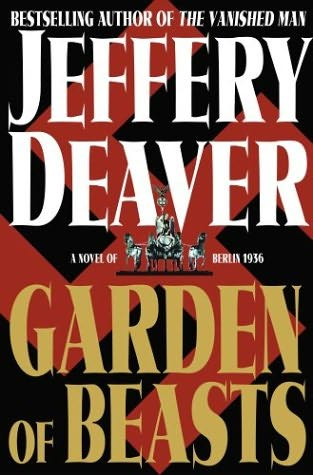
At the end of his presentation, I managed to ask him a question about the opening chapter of his dazzling 2004 historical thriller, Garden of Beasts, which is sort of my in-joke with Deaver. “And what made me think I’d be asked about that novel?” he responded, laughing as he recognized my voice, even though I was seated back in the shadows. Then he went on to talk at some length to the audience in general about why he’d loved writing Garden of Beasts and why, despite critical acclaim and a Dagger Award win, it didn’t sell all that well in the United States. As is our tradition, Alex and I left the room shortly before Deaver had finished speaking, so we could be at the front of the queue waiting for him to sign our books. By the time he arrived in the signing room, the queue stretched out like a twisting motorway, and even Deaver appeared shocked by its length. He thanked me for my tireless promotion of Garden of Beasts and signed a copy of the book for my son. Interestingly, I noticed later that all the copies of Garden of Beasts had sold out of the festival’s book room, so maybe it’s worth mentioning that work at events such as this one. I envy people, like Alex, who have the chance to read it for the first time.

After the Deaver session, we stopped for a quick coffee and were amused to see authors Mark Billingham and Peter Guttridge obsessing over their iPhones in the bar. It appears that both of them have fallen in love with those gleaming gadgets. I managed to pull Billingham away from his mini-screen long enough to chat about his latest work and first standalone book, In the Dark, which I am looking forward to reading. (For a taste of what it offers, here’s the opening chapter.) Billingham, incidentally, is going to serve as toastmaster at Bouchercon in Baltimore this fall. Being a stand-up comic in addition to an excellent novelist, his presence alone ought to be worth the price of admission. As I was talking with Billingham, Alex rooted about in my bag for a signable proof copy of In the Dark. Watching, the author smiled and said to me, “Poor old Alex, you’ve just brought him as your donkey-boy to help cart your books around.” Alex laughed, but he knew that there was a grain of truth in Billingham’s jibe. Mind you, Alex was well paid for his efforts, and he was spending the money wisely on books. “Like father like son,” Billingham remarked, as he saw the size of Alex’s to-be-signed stack.

From there, it was panel time again. We went to watch Caroline Carver (aka C.J. Carver) moderate a discussion about location use in fiction writing, her fellow panelists being Jeff Abbott, Frank Schätzing, Tom Rob Smith, and Meg Gardiner. This turned out to be an engaging presentation, as location so often plays a crucial role in thriller fiction. Carver, being a globetrotter and setting her novels (including Gone Without Trace) in exotic spots, was the perfect choice as moderator. German novelist Schätzing (who I first met at London’s Goethe Institute in 2004, when he launched his popular eco-thriller, The Swarm) related the story of one of his readers who, during a tsunami in Southeast Asia, had warned beach bathers to flee a second, larger, and more destructive wave--a phenomenon he’d only just heard about in The Swarm. And when it came his turn to speak, Smith emphasized the importance of writers actually visiting the places in which they intend to set their fiction. It seems he had traveled to Russia well before starting work on his Ian Fleming Dagger-awarded novel, Child 44.

After this session, I managed to nab a choice few minutes with the Simon & Schuster team of Joe Pickering and Kate Lyall-Grant, together with their now Man Booker Prize-nominated author, Tom Rob Smith. They were all delighted that I loved Child 44 so much, but Smith was also still amused by one question I’d asked him when I interviewed him for The Rap Sheet some months ago:
Ali Karim: Sometimes the most despicable traits of villains are not always the most visceral. I found the scene in which Vasili and his men ransack Leo Demidov’s apartment, while Leo watches Vasili rummage through Raisa’s underwear, sniffing the contents, probably the most disturbing and repellent part of the novel. Do you agree?

Tom Rob Smith: Yes, that is horrible! You’re right, though: paradoxically, depictions of violence can often become less disturbing the more graphic it becomes.
Jokingly, Smith asked if I had a fetish about “underwear,” which incited laughs all around. But he agreed that the act of sniffing undergarments was rather disturbing, as it depicted the “badness” in his villain so effectively.

From there, Alex and I attended a cocktail party (again in the Thackery Suite) hosted by UK television channel ITV3. Seems it’s launching yet another award for crime and thriller fiction. Emma Tennant, controller of ITV3, took up the microphone and informed her audience that presentation of these Crime Thriller Awards will be preceded by a jam-packed ITV3 broadcast schedule--six weeks of the greatest TV crime dramas, with specially commissioned documentaries profiling the six finest British crime writers working today: Colin Dexter, Ian Rankin, P.D. James, Lynda La Plante, Val McDermid, and Ruth Rendell. Viewers of ITV3 will then be invited to vote for the author who’s work they think is the best. (Note that the work of all six has been adapted for television.) Each of those documentaries will look back at how their subjects created their fictional detectives, and see how their success is reflected in their present lifestyles. Other crime fictionists, including Mark Billingham, Peter James, Peter Robinson, Martina Cole, Jeffery Archer and Giles Brandreth, will also be featured, as will real-life detectives, pathologists, and criminals. The preliminaries over, we were treated to a 10-minute collection of video highlights from the documentaries to come. Unfortunately, the volume was turned up to maximum. We were lucky to survive with our eardrums intact.

We didn’t really have too much time to stay around and mingle with the TV folk, before we darted off to panel discussion called “A Dirty Job But Someone’s Got to Do It.” Moderated with erudition by our dining companion of the evening before, Quintin Jardine, the session was an opportunity to learn more about a rather eclectic and international bunch of writers: Jo Nesbø from Norway, Thomas H. Cook from the States, Barbara Nadel from the UK (though she sets a great deal of her work in Turkey), and my friend Roger Jon Ellory (who, though he’s British, sets his work in America).

The discussion was all over the map. Cook, a tremendous writer of mystery novels, explained how he got into print by sheer luck, as one of his early manuscripts was picked up by a friend ... who showed it to a publisher buddy ... who got him on the first rung of the ladder. He said, dryly, that he’s remained there ever since. To me, Cook’s work (especially Red Leaves) is outstanding; I can never understand why Cook (shown at right with Simon Kernick) is not a mega-seller. Meanwhile, Ellory explained that he wrote 20-odd novels before his first was accepted for publication--Candlemoth, which was a January Magazine favorite in 2003. Ellory laughed when he recalled how naïve he was before being signed by Jon Wood of Orion Publishing--a story he detailed to me several years ago. And listening to Jo Nesbø was a particular treat, as I have followed the work of this musician-journalist turned full-time writer ever since it was first translated into English. (His latest is the fourth in the Harry Hole series, Nemesis.)

Afterward, Alex and I sped to the signing room with a huge hold-all of books. I was especially pleased to have Thomas H. Cook signing my collection of his work. As he did so, I chatted on about how I’d first discovered Red Leaves (through Larry Gandle of Deadly Pleasures magazine), how my enthusiasm for that novel had brought my reviewing work to the attention of publishing house Quercus (and led Quercus to send me an early copy of Stieg Larsson’s The Girl with the Dragon Tattoo), and how disappointed I was that Red Leaves had not won the Crime Writers’ Association’s Duncan Lawrie Dagger Award in 2006. It was just then that I realized British author Ann Cleeves was sitting within easy earshot. “Bollucks,” I whispered to Cook, because it was Cleeves’ novel Raven Black that had defeated Red Leaves for the Dagger that year.

It’s lucky that I know Ann Cleeves well. She just smiled graciously and didn’t make a big deal of my faux pas. I proceeded to backtrack a little, saying that the Duncan Lawrie Dagger shortlist in 2006 had been a particularly strong one, and Cook concurred. I should note here that I’ve enjoyed Cleeves’ work greatly over the years, and thought she did an excellent interview with Karin Fossum at CrimeFest a couple of months ago. But I find Cook’s work very special. His writing is poetic, chilling, and alters my way of thinking. To me, Thomas H. Cook is something of a god amongst authors, and Red Leaves was, without question, my favorite novel of 2006.

Quickly gathering up my books and rejoining Alex, I realized that it was time for me to meet with Robert Crais. Orion Publishing’s wonderful Angela McMahon had kindly arranged that get-together for me, and I didn’t want to be late, as upsetting the creator of Joe Pike would not be a healthy thing to do.

(Part V can be found here.)

READ MORE:
Is Jo Nesbø Europe’s Top Crime Writer?” by Uriah Robinson (Crime Scraps).

Tuesday, August 12, 2008

The Stars Come Out at Harrogate, Part III

Novelist Charlie Higson signs a book for fan Alex Karim.

(Editor’s note: This is the third installment of British correspondent Ali Karim’s report from the recent Harrogate Crime Writing Festival. Part I can be found here, while Part II is here.)

So, after concluding our interview with Cody McFadyen and wishing him well with The Darker Side, my son, Alex, and I headed off to that day’s James Bond panel discussion. The event was moderated by Simon Brett (Blood at the Bookies) and featured thriller writers Joe Finder, Catherine Sampson, and James Twinning, as well as British TV comedy writer Charlie Higson, author of the Young James Bond novels. As it happened, the panelists were divided on their opinions of Sebastian Faulks’ recently released Devil May Care, but were unanimous in their appreciation of Ian Fleming’s original novels. Which is not to say that they thought every one of those early Bond books excellent; the panelists agreed that the series’ quality dropped off as Fleming’s health deteriorated. On the whole, the panel was entertaining and lighthearted but didn’t really offer great insight into Bond or his adventures. Then again, so much has already been written about Agent 007 and his creator that it would be difficult to find a fresh angle. The highlight of this event, for yours truly anyway, was having my son meet Charlie Higson at the signing table. He’s an avid reader of the Young Bond books.

Then it was back to the hotel’s Thackeray Suite, as we’d been invited by publisher Hodder and Stoughton to help celebrate the 21-year career of Inspector Alan Banks, Peter Robinson’s music-loving Eastvale police detective. It happens that Robinson, British born but for many years now a resident of Canada, is a favorite author of mine, and I’m looking forward to reading his forthcoming 18th Banks novel, All the Colours of Darkness.

I was staggered by the turnout in celebration of Robinson’s novel-writing career. Basically, anyone who is anyone in this genre (and was at Harrogate, of course) stopped by to raise a toast to this gentle Yorkshireman’s success. When asked to take the microphone, Robinson was, as ever, modest in the extreme. He thanked everyone for their support and then reassured us--and his publishers, no doubt--that there’s still plenty of life in both Inspector Banks and himself. Afterward, I chatted briefly with Robinson (shown below), who I have known ever since the publication of In a Dry Season (1999), which proved to be his breakout book. I congratulated him on his writing and told him that I think the Banks novels are probably the most interesting police procedurals still being written. I also thanked him again for helping to engineer my meeting with Stephen King in 2006. He, in turn, thanked me for taking a photograph of him with King, which he says he cherishes as a memento of that night.

Anyone who regularly attends crime-fiction conventions knows that you never get to relax much at these affairs, even with writers you know, admire, and wish to talk with at length. And so it was with Alex and me. Following a bit of mingling amongst the Hodder and Stoughton folks, my son and I had to return quickly to our hotel and change in order to make a dinner engagement with the Headline Publishing crew, headed by Vicki Mellor, that house’s commissioning editor for crime and thriller fiction.

Soon after, finding our places at a table in the nearby Loch Fyne restaurant, we discovered that we were seated next to Headline authors Joe Finder, Anne Perry, Charlie Owen, and Quintin Jardine. Finder laughed when he saw that I was wearing one of the Paranoia promotional T-shirts he sent to me several years ago, following my excitement in reading the novel that changed his writing direction.

Now, I must admit that while I’ve consumed all of Finder’s books, I have read only a couple of novels each by the prolific Perry and Jardine. (Jardine’s new Aftershock, the 18th entry in his Detective Chief Constable Bob Skinner series, just happens to be on my TBR pile currently.) So, while both were delightful dinner companions, I found interrogating them about their written works a bit daunting. Fortunately, the Headline team took up a bit of slack with Alex, making sure that he was kept in the conversation as it rolled along. And we all shared a passion for crime and mystery fiction, so I didn’t have to test the true limits of my knowledge about my table mates.

The evening was a long one, and meant that I would miss seeing American author Robert Crais (Chasing Darkness) interviewed on stage by Mark Lawson of BBC Radio 4. But since I already had my own meeting with Crais lined up for the next afternoon, Saturday, I just relaxed with the Headline team and drank like a fish (the Loch Fyne was a seafood restaurant, after all). The time also allowed me to quiz my friend Finder about the new novel he was preparing to submit to Headline. It’s the first book in a series, and his editors in the UK and United States are both said to be excited about it; but Finder proved that, as a member of the former intelligence officers association, he could remain tight-lipped. We’ll all just have to wait to learn more.

As desserts were offered, Alex could be heard to groan a bit. The lethal combination of too little sleep and too much alcohol at the various parties that day had started me off on a favorite subject: conspiracy theories. Reading so many thrillers has made me interested in real-life conspiracies, as well; and my scientific nature causes me to analyze some of them in considerable detail. Sure, many of these theories are as nutty as filberts, but a few are troubling, indeed. And in a few of the biggest ones, the evidence appears to be in “plane” sight.

But before I could spend too much time pointing toward grassy knolls, Alex decided it was time for us to head off for bed. He made the case that the next day would be extremely busy (including the infamous Harrogate quiz and that Crais conversation). So, after thanking our Headline hosts for an excellent repast, we retired to our hotel. All the rich food and talk of plots and counterplots, though, caused me to sleep fitfully, my dreams filled with men who spoke in whispers into their starched cuffs and wore Ray-Ban sunglasses, even at night. These were the folks who really scare me.

Maybe I really do read more thrillers than is healthy ...

(Part IV can be found here.)

Thursday, August 07, 2008

The Stars Come Out at Harrogate, Part II

(Editor’s note: This is the second installment of British correspondent Ali Karim’s report from the recent Harrogate Crime Writing Festival. Part I can be found here.)

After having our books signed by members of the New Blood panel, my son, Alex, and I headed off to the hotel’s Thackery Suite for a cocktails-and-buffet celebration of Simon Kernick’s latest thriller, Deadline. Transworld Publishing’s publishing director, Selina Walker, welcomed all of us who showed up and was clearly delighted by Kernick’s success. At one point, she held up the latest issue of Waterstone’s Books Quarterly--a crime-fiction special on the cover of which appeared a menacing Simon Kernick, supposedly digging a grave in a forest. Kernick, when he took up the microphone, thanked us all for our support and indicated that although he had started his writing career penning police procedurals, he felt far more at home composing thrillers. He recounted the tale of a nightmare he suffered at a Bouchercon conference, which he turned into a Richard & Judy selection, Relentless (2007).

After mingling with the other guests, Alex and I wandered off to the bar, where we joined Andrew Gross (The Dark Tide) and Joseph Finder (Power Play) for drinks. I told Gross that I had read several of the novels he wrote with James Patterson, The Jester (2003) being my favorite--stylistically distinctive, and extremely engaging. Gross beamed and admitted to me that it was his favorite, as well. Then we turned to talk with Joe Finder about the business side of writing and how much time it takes away from the actual writing process. Finder still gets up at 4:30 a.m. every day to write, and after an initial half-hour of reading and responding to e-mail messages, he hits the keyboard until 9 a.m., then takes a break and continues on until lunch. It was a pleasure to talk with Gross and Finder, and they were very gracious in ensuring that my 15-year-old son was kept in the conversational loop. Afterward, Alex purchased Finder’s Paranoia and Gross’ The Dark Tide, both of which I thought would be suitable for somebody his age, and asked the authors to sign them.

My son has become quite the crime-fiction enthusiast. Conventions such as Harrogate inspire his further investigation of this genre. Since he met Harlan Coben last year, he has read the entire Myron Bolitar series and regularly corresponds with Coben himself via their respective MySpace pages. (Alex’s is here.) It seems Coben actually writes his own MySpace material, rather than turning that chore over to a Webmaster of some sort.

Just as we were parting from Gross and Finder, Simon Kernick stepped up and overheard us conversing about Harlan Coben. He laughed, seeing me with my camera and recalling a rather dreadful photograph I took of him and Coben at the Las Vegas Boucheron in 2003. Both authors wish I would take that shot down off the Internet, but every time I see it, it makes me laugh. To share in the amusement, click here.

Then we were on to meet with Texas author Cody McFadyen (photographed at the top of this post), who I had arranged beforehand to interview. I first met McFadyen a few years ago, after his first dark thriller, Shadow Man (2006), was published. He has since composed a pair of sequels--The Face of Death (2007) and his latest, The Darker Side (2008)--both of which also feature a damaged FBI agent named Smoky Barrett. With three books under his belt now, McFadyen seems to have come out of the shadows a bit, even blogging about Harrogate here.

With my trusty tape machine in hand, I sat down with McFadyen, hoping to discover how such a mild-mannered chap became the author of such noticeably dark books.

Ali Karim: So, I hear you were at ThrillerFest in New York last week. Care to tell us your impressions of that event?

Cody McFadyen: Well, I attended one panel and I was on another, and it was great. The thing I got out of it the most was the sense of perspective, because I met up with a number of authors who were having a breakout success with their fifth or sixth book, and so as a writer it was helpful for me to see that sometimes you need to settle in and write good books that people want to read and not sit back and watch your Amazon ranking every half an hour.

AK: Is it true that ThrillerFest was the first crime/thriller fiction convention you’ve attended?

CM: Yes, it was. And it certainly won’t be my last, as I am coming to Bouchercon in Baltimore this fall.

AK: You now have three books out in Britain, including The Darker Side. Is that new novel due for publication in the States soon?

CM: That’s right. The Darker Side is out in the UK currently, but not out in the U.S. until September 29 from Bantam Press.

AK: The Darker Side is your third book to feature Smoky Barrett. I find her, as a protagonist, fascinating. Could you tell us a little about what she faces in this latest yarn?

CM: Sure, Smoky is a female FBI agent. In the first novel, Shadow Man, she lost her family [her husband and daughter] to a serial killer who attacked her and disfigured her. She killed him, but it took its toll on her and she’s not in the best of shape as a result. As the books go on, she’s healed somewhat. The Darker Side takes place two years after the second book, The Face of Death, and she’s a lot more stable--she’s not suicidal anymore, she has a love interest, she has an adopted daughter. I won’t say she’s entirely well--in fact, I don’t think she’ll be entirely well ever--but she’s managing.

AK: Now, Cody, your novels are very dark. In fact, they’re the sort of books you can’t begin until you’ve checked that all the doors and windows are locked …

CM: Sure, there’s no getting around the fact that these are dark books.

AK: So, what attracted you to the distant, darkest edge of the crime-fiction genre?

CM: I really don’t know, and I do get asked this question a lot. In fact, I listened to a panel at ThrillerFest where a novelist who also writes dark/violent work was asked this question. His response is akin to my own thoughts. Basically, he is aware of the modern reality of living in a violent society and how it disturbed him, and so the only way he found he was able to deal with it is by writing about it. Afterward, I met up with him and thanked him because it mirrored my own thoughts in why I write such dark material.

AK: Some people would be perplexed to see someone so dapper and debonair writing such dark and, in some cases, sick stuff.

CM: [Laughing] Yes, I get asked that question a lot--sometimes accusingly. But I must say, I’ve run into a lot of bad people in my life.

AK: Care to say more about those individuals?

CM: In my past, I used to counsel drug addicts and I got to meet some really bad people. … And to augment that, I also read a lot, especially true crime. In fact, there is nothing in fiction that gets anywhere near the horrors of the real world and that is a fact, believe me. I find it’s actually therapeutic to write about this stuff, and the interesting side of it is I have a lot of female readers.

AK: But that might be because Smoky Barrett is a particularly strong female protagonist.

CM: Precisely--that’s the point. [Although I’m] writing something so dark, believe me that most of my books have redemptive and loosely “happy endings,” so if you take and deal with the worst, it can help bring out the best. Contrasts, I like big contrasts.

AK: Such as … ?

CM: Well, have you ever read Jack Ketchum?

AK: Yes. In fact, I find some of his work, such as The Girl Next Door [1989], too disturbing for my tastes--and I read very dark works. But his short story “The Box” is one of the greatest short stories I have ever read--a really scary tale; not visceral, but as frightening as hell.

CM: Well, when I read The Girl Next Door, I was frankly … appalled. Then I saw the movie and I was even more appalled--and I have a really strong stomach for that stuff. As the novel and movie disturbed me so much, I did a little research and I was shocked to discover that it was based on a real event, and what made it more shocking was that the real event was even worse than Ketchum’s novel and subsequent film.

But tell me about “The Box.”

AK: “The Box” is an award-winning short story that I read in Al Sarrantonio’s collection, 999. However, it has also appeared in many other horror-fiction collections. Basically, it’s about a man who roams the subways looking for another man who is carrying a cardboard box. What’s in the box, and what it did to his children is the McGuffin in that very disturbing story. The surreal thing is that, you mention Ketchum today, but a couple of years ago when [British publisher] Hodder and Stoughton arranged a literary lunch in London for you to meet with some critics, including Mark Timlin, Susanna Yeager, Barry Forshaw, and me, we talked about Ketchum’s “The Box.” Kerry Hood and Eleni Fostiropoulos of Hodder were so intrigued, that I actually sent them copies of the story and they agreed that it chilled them.

CM: Yes, I remember and I’ll have to check it out.

AK: So, without giving too much away, are we destined to see a fourth Smoky Barrett novel in the future?

CM: Yes, we are. In fact, I’m working on that book right now.

AK: Using Smoky Barrett as a series character is great. But was that a decision based on publisher pressure to create a series, or is it because you like her so much as a protagonist?

CM: It’s totally about the character. In fact, for amusement I started writing a standalone, which I haven’t finished yet, and it is fun to do. But I kinda wanted to go back to Smoky’s world--it’s comfortable; it’s like I want to know more about these people and see how their lives pan out.

AK: That’s all well and good, but I have to admit your books do give me, well, nightmares.

CM: [Laughing] I’m glad they do.

AK: Now, a tough question: How do you function as a person when you are writing the Smoky Barrett books, and you are forced to look into the abyss all the time? Are you a difficult person to live with, when you are deep in the darkness?

CM: In a word--yes. I am a difficult person to be around when I’m writing. I write every day and tend to think about it all the time, irrespective of what I’m doing. Like, I could be watching TV but in reality my mind is still trapped in the story. I dream about the book [I’m working on] sometimes, and that can make me very distracted. In fact, it was book number two [The Face of Death], that really was tough for me. It may sound clichéd, but I was a mess writing that book--I drank a lot, I couldn’t sleep. Maybe because it was also my second novel, [I felt the] added the pressure on me. The new book, my third, I found a lot less stressful writing, maybe because I felt more confident as a writer, and found the craft easier …

AK: I’ve noticed that you now have a Web site and have even started blogging. How did all that come about?

CM: I’ve wanted to do this for some time. I first put a Web site up, but it was a shell, and I’d always wanted to do something properly, which I finally did recently. I decided to add a blog, as there are things I would like to say. I also get a lot of e-mail correspondence about the books, so I thought blogging was the answer. One thing I know as a reader is that if I am a fan-boy of a particular writer, I’d like to know more about them and their work, but not what they had for breakfast …

AK: Who are the writers you most admire?

CM: Obvious ones, Stephen King, Thomas Harris, John Connolly … In fact I am halfway through [Connolly’s] The Unquiet, which is just stunning.

AK: Now that I think about it, Connolly’s work is similar to your own in terms of themes. However, he tends to look more toward the supernatural than the forensic. And on the subject of Thomas Harris, did you read Hannibal Rising?

CM: I like Harris’ work, but he doesn’t write often enough. I have his latest, but the interesting fact is that the movie versions are nowhere near as dark as his novels.

AK: So are you now writing full-time?

CM: Yes, I am. And it’s interesting, as I have a brother who has a wife, three kids, and a hard job--so whenever I get fed up I think of him and how he has to really work hard to support his family, and that straightens me out.

AK: Your fiction is very cinematic in terms of style and theme. Has there been any interest in committing your stories to film?

CM: Thank you. Yes, there was initial interest from a film company, but the main problem is that they want rights to the character[s], not just the books. That poses a problem, as they are not optioning Shadowman, [for instance, but] they’re optioning Smoky Barrett.

AK: So what’s the plan?

CM: Well, I’ve leave the film rights to my agent, and concentrate on the novels. In fact, I could quite easily write two books a year, so maybe I’ll start doing that. I am considering doing standalones, or may start a new series as well as Smoky Barrett. I could be more prolific. Unless I am in my office writing for at least four hours each day, I feel guilty. So I guess I will increase my output.

(Part III can be found here.)

READ MORE:Cody McFadyen on Writing The Darker Side” (Shots).

Tuesday, August 05, 2008

The Stars Come Out at Harrogate, Part I

Harrogate alumni Jane Gregory, Laura Wilson, Simon Kernick, Val McDermid, and Mark Billingham.

(Editor’s note: This is the first part of British correspondent Ali Karim’s report from the recent Harrogate Crime Writing Festival, held in the North Yorkshire spa town of Harrogate. Additional installments will roll out over the coming days.)

My life has been hectic over the last couple of months, what with the troubled world economy creating havoc in my day job, CrimeFest in Bristol, the Crime Writers’ Association’s Dagger Awards presentation, and then Heffers’ Bodies in the Bookstore event. Oh, and of course I have to squeeze a life with my family in between all of this excitement. So you’ll have to pardon my tardiness in reporting back from the latest Harrogate Crime Writing Festival.

This year welcomed the sixth annual Harrogate festival, though it seems like only yesterday that I arrived at the town’s Majestic Hotel just in time to have dinner with Sarah Weinman and Simon Kernick and celebrate the start of the inaugural Harrogate Festival. That was a great time, in 2003, to be kicking off a new crime-fiction convention in England. Dead-on-Deansgate had by then truly died, with the last such event having been held in Manchester in 2002, and people were looking around for a replacement. Thanks to the efforts of novelist Val McDermid (Beneath the Bleeding, A Darker Domain) and literary agent Jane Gregory, the Harrogate event got off in grand style, with American writer Jeffery Deaver serving as one of the first guests of honor. I may remember that convention best, because of Deaver’s participation. He told me back then about the latest book he’d been working on--a historic thriller called Garden of Beasts, which would become one of my favorite thriller novels of all time, right up there with Geoffrey Household’s Rogue Male, David Morrell’s First Blood, and Alistair MacLean’s Puppet on a Chain. (An excerpt from Garden of Beasts can be found here.)

But I digress ...

I knew that attending this year’s Harrogate festival was going to be a challenge, for I am a book collector as well as a reviewer and writer. With so many high-caliber authors participating from around the world, it would be difficult to pack along all of the volumes I hoped to have signed. In 2006 I attended Harrogate with Shots editor Mike Stotter; last year I brought along my entire family. This time, with my wife and daughters unable to attend, only my son, Alexander--who has become an enthusiastic crime/thriller reader, as well as a budding reviewer--would be able to accompany me to Harrogate, and help carry the many pounds of books I was toting with me.

Due to my work obligations, we had to miss Thursday’s gala opening party. Instead, we set off from home at 5 a.m. on Friday, hoping to beat traffic on the notorious M62 motorway, and arrived at the festival hotel--The Crown--in time for a full English breakfast. During our meal, we were met by Jane Gregory and novelist Joseph Finder (Power Play). They informed us that Stef Penney had been presented with the 2008 Theakstons Old Peculier Award the night before for her first novel, The Tenderness of Wolves. (Since Penney was the only one of the nominees who wasn’t male, that might have been quite a surprise to some observers.)

More relaxed after the drive, and fully sated, Alex and I bumped into Simon Kernick, who had been tapped as this year’s programming chair. I’ve known Kernick ever since he debuted with the novel The Business of Dying (2002), and we have become friends over the years. On this particular morning, he looked rather worse for wear, which was not surprising as he’d been up late the previous evening celebrating. Alex and I followed Kernick to the main convention room, were he was scheduled to interview British-born Canadian novelist Peter Robinson (Friend of the Devil, All the Colours of Darkness).

One of the most appealing features of the Harrogate convention is its single track of panels (as opposed to multiple, overlapping events). This ensures that panel presentations have huge audiences, with many of them sold out. The downside, of course, is that there are fewer opportunities for writers to participate in such panel discussions, as there aren’t so many of them. It’s tough for newer authors to win panel seats--especially as the panels are sponsored mostly by publishers, to highlight their own writers.

Alex and I were lucky to find seats for Kernick’s conversation with Robinson. A highlight of their interview pivoted on both Kernick’s and Robinson’s relationships with Canada; apparently, Kernick lived in Canada for a few years, while Robinson has made that expansive country his home for decades. The latter also noted that he didn’t see his Inspector Alan Banks series really hit its commercial stride until the 10th installment, In a Dry Season (1999), and Robinson went on to ponder aloud how daunting it is for new writers to establish themselves nowadays, what with mammoth commercial pressures weighing on publishers. Kernick and Robinson agreed that writers will have a hard time making a go of novel-writing careers, if they can’t attract huge readerships early in the game. Robinson went on to explain that along his own road to success, he’d had to change publishers in the United States and the UK, and that he had been fortunate to have been given time to establish himself and his fiction. But he also made clear how hard he’d worked, touring and promoting his books on both sides of the Atlantic, believing that those efforts would one day establish his Inspector Banks series as a staple of bestseller charts.

Even before Kernick and Robinson received a huge round of applause for their exchange, Alex and I were out the door and on our way to the book-signing room. The way Harrogate operates is that after each event, authors are escorted to the signing room, which is an annex of the Waterstone’s bookstore located inside the hotel. As a Harrogate vet, I’ve learned to leave five minutes before any panel presentation is completed, in order to be at the front of the queue. Because believe me, those signing queues are something to behold.

After having our books inked, my son and I dashed off to the nearby Holiday Inn where we were staying, checked in, and then found our way back to The Crown in time for a quick coffee before the next festival presentation.

The event this time was a “New Blood” panel discussion moderated by Laura Wilson (Stratton’s War)--who, incidentally, is set become next year’s Harrogate programming chair. One of the reasons for my interest in this discussion was to hear Swedish writer Johan Theorin (shown at left), whose debut novel, Echoes from the Dead (2008), really haunted me. (If you appreciated Stieg Larsson’s The Girl with the Dragon Tattoo, you’re going to love Theorin’s work.) I also wanted to listen to Andrew Gross, who I think is a very talented writer, but one who is often referred to as living in the shadow of mega-seller James Patterson. I first met Gross at ThrillerFest in 2006, where I found him to be modest but erudite and extremely well-read. I enjoyed his first solo novel, The Blue Zone (2007), and have been looking forward to digging into the follow-up, The Dark Tide. Joining them at the front of the room were two former TV writers with whom I was not familiar--Kolton Lee and Claire Seeber--but whose latest books have found places in my towering to-be-read pile.

Wilson proved to be an excellent moderator, drawing out the experiences and frustrations of these first-time novelists. At one point, though, Gross pointed out that he was appearing under false pretenses, as he’s published six novels with the aforementioned Patterson. In fact, Gross was the first co-writer Patterson took on. He recalled that turn of events last year in an interesting essay for Shots. Gross explained in the piece that his partnership with Patterson had started with an unexpected phone call:
“Can you talk to James Patterson. He’d like to have a word with you.”

“I think I can fit him in,” you say, counting to five before fully committing as not to appear too desperate. (Okay, three.)

The call that changed my writing life.

Completely unbeknownst, the top editor (now president) at one of [the] houses who rejected me, didn’t chuck my book in the circular can. Instead, she passed it along to her top-selling author, Patterson, sagely noting, “This guy does women well!” (Something my wife’s been insisting ever since is a gross overstatement.)

Six books later, all #1 bestsellers, I’d written about women crime fighters in San Francisco; an inspired innkeeper in France in the fourteenth century who becomes a court jester to search for his abducted wife; a likeable loser in Palm Beach thrust in the center of a multiple homicide; and a single mother whose son is murdered in retaliation by a vicious mobster--and who sets out to find her revenge. I grew accustomed to seeing my books read as the morning paper on airplanes, my name atop the bestseller lists, even receiving a check or two from projects sold to film. As a writer, I was about as lucky as one of my own characters, leaping the span of a rising drawbridge on a motorcycle, knocking off the bad guy, finding the girl.
Meanwhile, Johan Theorin recounted how, as a journalist, he came across the story in Sweden that would evolve into Echoes from the Dead. It seems that on a small insular Swedish island, there was a murder, and everyone knew that the killer was a sociopathic young man. The killer’s parents were an elderly couple, who used up their life-savings to bribe a ships’ captain to take away their son before police came to arrest him. The postmaster of their village noticed several months later that postcards from all over the world started arriving for the elderly couple, but they were all blank. Everyone conjectured that they were sent by the sociopathic son as a means of indicating that he was fine. Then one day, a coffin arrived on the island and inside was the body of the sociopath and alleged killer. There was a funeral that only the parents attended. And then two months after the burial, the postcards started to arrive again. ... Theorin told his audience that he couldn’t vouch for the authenticity of this tale or the significance of the postcards, as no one on the island would tell him very much more; but that vignette haunted him for many years, until he finally used it as the seed for Echoes from the Dead (originally published in Sweden as Skumtimmen). Last year, Skumtimmen was acclaimed the Swedish Academy of Crime as the Best First Mystery Novel of the year, and it has since been translated into 12 languages. Let me just say that it’s a novel not to be missed.

After listening also to Kolton Lee and Claire Seeber recount their transitions from television work to writing novels, Alex and I headed back to the signing room. And then it was on to cocktails and a buffet, sponsored by Transworld Publishing in honor of Simon Kernick’s latest thriller, Deadline.

We were due a break, after all.

(Part II can be found here.)