Showing posts with label ThrillerFest 2007. Show all posts

Friday, July 27, 2007

Escape to New York, Part III

(The first installment of Ali Karim’s recollections from ThrillerFest 2007 can be found here. Part II is available here.)

Saturday morning, the third day of this year’s ThrillerFest--and the one bound to generate the most headlines--found Shots editor Mike Stotter and I breakfasting like potentates. After which we went to support Bookreporter’s Joe Hartlehaub, a friend and the moderator of a panel titled “Protect and Defend: Lawmen Who Track Crime Coast to Coast.” His panelists were real-life lawmen James O. Born and George D. Shuman, along with John Ramsey Miller, Michelle Gagnon, and Jeffery Deaver. I was particularly interested to see Shuman, a 20-year veteran of the Washington, D.C., Metropolitan Police force whose very first book, 18 Seconds, was vying for the International Thriller Writers Best Novel award. But after the discussion was over, I couldn’t help also approaching Deaver and asking him when he intends to write another Golden Age-style thriller on the order of his 2004 standalone, Garden of Beasts, my personal favorite among his books and a past winner of the British Crime Writers’ Association’s Ian Fleming Steel Dagger Award. My friend Stotter, who has heard me pester Deaver with this query before, groaned openly as I made my way toward the author once more, my question/hint loaded and ready. But I found time afterwards, too, to say hello to John Ramsey Miller (Too Far Gone), a very interesting writer from America’s Deep South, who sat on a panel I moderated during last year’s ThrillerFest.

Following the “Protect and Defend” session, I sought a bit of relaxation at the Grand Hyatt Hotel’s nearest bar, only to run into Anthony Rainone. He of course is a contributing editor of January Magazine and one of my fellow Rap Sheet bloggers. (In the photo above, he’s the one with the glasses.) We have similar reading tastes, but I had never had the opportunity before to meet him face-to-face. So we pulled up a sofa in the bar, grabbed a couple of cold beers, and commenced to talking. And talking. Apart from being well read, Rainone also has a wicked sense of humor, and therefore enjoyed being introduced to Stotter, though he had a bit of difficulty understanding my editor friend’s cockney rhyming slang.

When it was time, I escorted Stotter to the panel on which he was to appear. Actually, he’d signed on originally as moderator, but a recent eye operation (which left him looking rather too much like Mr. Magoo) compelled Stotter to hand those duties over to Connecticut author Justin Scott (McMansion). Just as well, since the panel’s topic seemed a bit on the weird side: “Strangers in Paradise: Toting Guns and Sunblock.” Joining those two were multiple award-winner Jeremiah Healy, Don Bruns, Tina Wainscott, and journalist-author Rick Mofina, my friend and fellow ITW judge. Together with Deadly Pleasures editor George Easter, über-books blogger Sarah Weinman, and others, I positioned myself squarely in the front row--just so that if Stotter’s vision got any worse than it already was, he’d at least be able to see us. As it turned out, Scott did an admirable job on short notice, encouraging his panelists to recount their best scary stories about traveling to tropical and politically unstable lands. (He also asked that I pass along his best regards to Mike Ripley, a UK crime writer and Shots columnist.)

Once more, there was a post-panel retreat of reviewers and literary judges to the bar. Along with Rainone, Easter, Weinman, Stotter, and myself, the crowd this time featured Deadly Pleasures’ Larry Gandle and Maggie Mary Mason, along with Elaine Flinn (Deadly Vintage) and critic David J. Montgomery. Ours was a big enough group that we attracted attention, with writers stopping by to say hello and share drinks. So comfortable was this arrangement, that we carried on right through the formal presentations of ThrillerFest’s two guests of honor: James Patterson, recipient of this year’s ThrillerMaster Award for outstanding contribution to the genre; and Clive Cussler, who was given that same honor in 2006. Oh, well ...

However, I wasn’t about to miss that afternoon’s St. Martin’s Press cocktail party, to which I had been invited. It turned out to be a terrific affair, during which I bumped into British spy novelist Charles Cumming--a real delight, since I had just finished reading his latest novel, The Spanish Game. This was apparently the first time Cumming had attended a conference of this size, and he seemed to be enjoying himself immensely. It wasn’t easy talking with him, though, as he towered over me, as he did over most other ThrillerFest-goers. (In the photo at left, he’s shown with author Barry Eisler.) So I eventually had to mingle, chatting with Gayle Lynds, Lee Child, and several of the “Killer Year” authors, such as Brett Battles (The Cleaner), Sean Chercover (Big City, Bad Blood), Marcus Sakey (The Blade Itself), and J.T. Ellison (All the Pretty Girls). After an exhausting round of good-natured debate, though, I had to thank our St. Martin’s Press hosts and hustle off to get changed for the main event, the Thriller Awards banquet.

Done up finally in suits and ties, Stotter and I descended to the ballroom, where we encountered award nominee Nick Stone (Mr. Clarinet) and his wife, who had just arrived from Florida. While Stotter was seated with the Stones and Larry Gandle, I was placed at a table with Elaine Flinn and “P.J. Parrish” (aka Kris Montee), among others. Montee was noticeably edgy, and explained that she’d been nominated for awards so many times, but had never walked away with one in hand; she was expecting to lose this evening, as well. I reassured her, telling her to remain confident of her chances--which turned out to make me look far more prophetic than I’d expected. (An Unquiet Grave, which she’d penned with her sister and collaborator, Kelly Nichols, would be named that night as the ITW’s Best Paperback Original of 2007.)

While the dinner was fine, the drinks were horrifically priced and, in fact, the banquet all told was rather expensive--and far less well managed than last year’s, if you ask me. The show seemed to drag on and on. And on. And apart from a blistering rendition of Creedence Clearwater Revival’s “Proud Mary,” the performances were disappointing. What made the banquet worth remembering were the awards presentations. After ringing through to Rap Sheet editor J. Kingston Pierce, who was standing by in Seattle for news of the winners, ready to spread the word online, I managed to corner the victors for photographs. I was happy to see Joseph Finder pick up Best Novel kudos for Killer Instinct, and Parrish/Montee’s acceptance speech was very moving, as she burst into tears of sheer joy. Nick Stone pulled some of the same heart strings, as he accepted the commendation for Best First Novel. I also met the wonderful, glamorous, and prolific Heather Graham (The Dead Room), whose family was huddled around Stone, since they were all apparently major fans of Mr. Clarinet.

After the awards presentation, I dragged Gandle, Stotter, and Stone off for a drink with Vince Flynn (Act of Treason), who like Stotter enjoys his Knob Creek. We had a vigorous discussion about the realities of today’s “war on terror,” as seen from a liberal viewpoint. Then I chatted briefly with Andrew Gross (The Blue Zone) and James Patterson, before finding my way back to the bar, where toasts were offered to the night’s winners and runners-up. Finder (pictured here on the left, with Nick Stone) was most entertaining, as he seemed genuinely shocked to be among the honorees. Not until I had spread my congratulations around did I retire for the evening, exhausted, only to find Stotter already in the room we shared, sound asleep in his suit and snoring like a sawmill.

The next morning, Saturday--the final day of this year’s ThrillerFest--came sooner than I would have preferred. While Stotter slumbered on, I showered and changed and hit a 9 o’clock panel discussion on horror fiction chaired by David Morrell (Creepers). For somebody like me, who’s long been interested in that genre and, sadly, watched it implode in the 1980s, it was relieving to see this attention being again paid to horror. Even if what I discovered from that panel discussion is that horror romance novels featuring werewolves and vampires are hot right now--not exactly my taste. I think I’ll stick to more thriller-oriented fare by Peter Staub, Stephen King, Dean Koontz, and F. Paul Wilson.

Two more panel events awaited me. First, one of ThrillerFest’s most popular gatherings, a discussion of ways in which writers and publishers get you to buy their books. Contributing to that exchange were Tess Gerritsen, M.J. Rose, Jason Pinter, and David Montgomery (the last of whom wrote about it in his own blog). Second, I participated in a panel talk about how writers and readers interact with the Internet, and how very draining that involvement can be. I had a chance to share not only my experiences with The Rap Sheet and Shots, but memories of how I got into this whole Internet thing back in the late 1990s through the newsgroup rec.arts.mystery (RAM). And I pointed out author J.D. Rhoades (Safe and Sound), who happened to be seated in the audience, and was a fellow RAM poster way back when.

Then it was off to this convention’s finale: a brunch in the Grand Hyatt ballroom. ThrillerFest coordinators M. Diane Vogt and Shirley Kennett received thanks for their tireless efforts, and they in turn thanked the many volunteers. M.J. Rose followed them, explaining to the audience that next year’s ThrillerFest will likewise be held in Manhattan (news that raised a mixed response), but that after that, it will go “on the road,” as it were. As a capper, Jeff Deaver took the stage to recount how he got involved in the novel-writing game, and to take questions. Stotter kicked me under the table when I once more asked about his doing a follow-up to Garden of Beasts.

And suddenly, the conference was over, and we had to say good-bye to our friends, colleagues, and faithful drinking buddies. One always has a hollow feeling at the conclusion of intense events such as ThrillerFest, when you must walk away from people who share your passion for the smell of books, the excitement to be found in turning new pages, and the images that fine prose can paint in one’s mind.

Tuesday, two days after ThrillerFest ended, was our last day in the Big Apple, so Stotter and I went off to explore famous Central Park. The sun was beating down as we negotiated the pathways and were awed by this urban greensward’s dimensions. On our way out of the park, I noticed Stotter squinting at a hooded figure who was walking at a rather brisk pace in our direction. “Hey,” my friend proclaimed, “it’s Christopher Walken!” I quickly said hello once Walken came face to face with us, and greeted him in the way I thought most appropriate: as the “King of New York.” He smiled, said “Good to meet you,” shook my hand, and then ran off, waving as he went. It was a very surreal ending to our New York City adventure. But it proved that Stotter’s vision was finally on the mend.

London, here we come!

READ MORE: “BookBitch” Stacy Alesi’s own three-part ThrillerFest report here, here, and here; “Non-fiction Terror,” by M.J. Rose (Buzz, Balls & Hype).

Wednesday, July 25, 2007

Escape to New York, Part II

(The first installment of Ali Karim’s recollections from ThrillerFest 2007 can be found here.)

With our heads still banging from the previous night’s drink, and with Mike Stotter’s throat sore after singing that Mary Poppins favorite “Chim Chim Cher-ee,” we decided to skip ThrillerFest’s Friday morning breakfast for debut thriller authors (hosted by Lee Child) and instead wandered off to Midtown Manhattan’s Pershing Square restaurant, where we consumed plates of Eggs Benedict. To be quite frank, this wasn’t exactly to my taste. But, coupled with plenty of strong coffee, breakfast revived me.

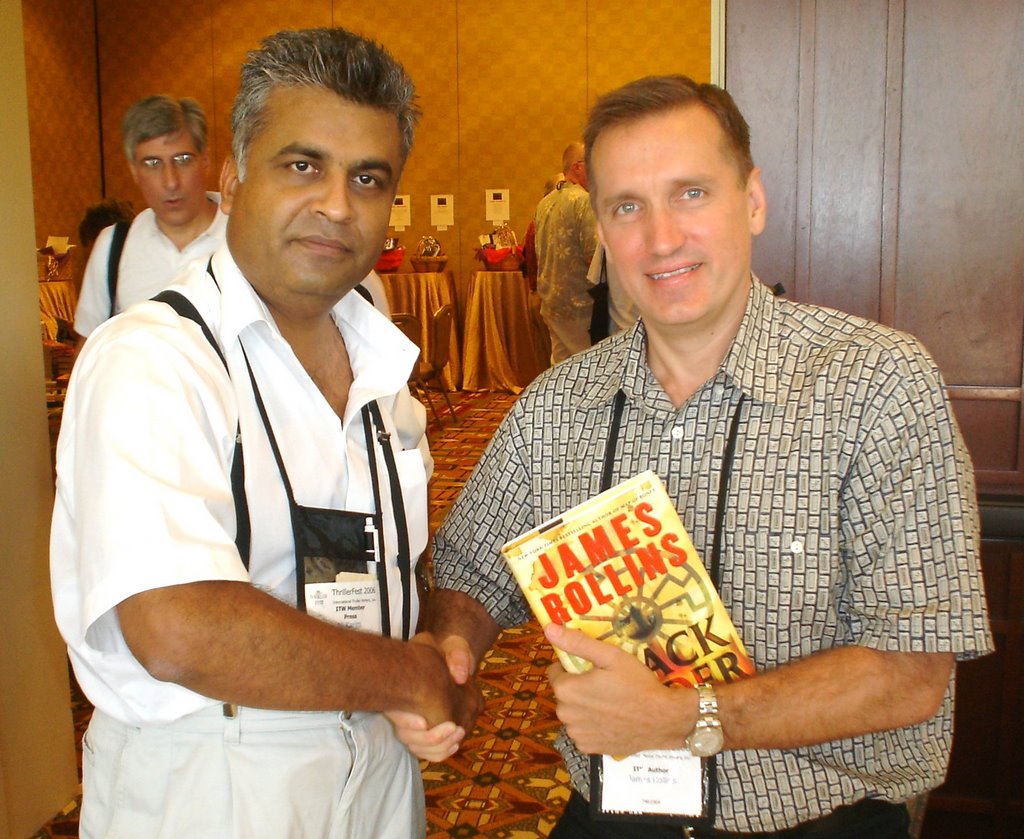
Then it was back to the Grand Hyatt Hotel for our first panel discussion of this convention, “The Day of the Thriller,” with Gayle Lynds, David Morrell, James Rollins, and David Hewson, and moderated by Lincoln Child and Douglas Preston (shown in the photo above). The conversation was light-hearted, and there was much discussion of sex in thrillers, which caused Lynds to laugh out loud--a lot. Talking about pivotal novels in the thriller genre, the one that all panel members seemed to agree on was Geoffrey Household’s Rogue Male (1939), which had made such a deep impression on me as an adolescent. Morrell went on to recount how he had long ago corresponded with Household (who died in 1988) and had sent him a review copy of his 1972 debut novel, First Blood, in hopes of receiving a favorable “cover blurb.” Household, however, declined, stating that he found Morrell’s novel too violent, which brought out laughs from the audience. Morrell also gave us an update on the progress of Thrillers: 100 Best Books, a volume he’s been laboring on with Hank Wagner, and which collects essays about “the top 100 thriller novels” from writers, editors, and genre enthusiasts. That book is currently doing the rounds, and Morrell indicated that he and Wagner hope soon to have a publisher lined up. I was flattered last year to be asked by Morrell to contribute to this collection, and went on to compose a lengthy piece about Eric Ambler’s 1939 novel, The Mask of Dimitrios (aka A Coffin for Dimitrios). As a consequence, I am really looking forward to this book becoming available.

Back at the panel debate, Rollins soaked up a round of applause after Preston and Child noted that his latest Sigma Force thriller, The Judas Stain, hit the New York Times hardcover bestseller chart at No. 4. Rollins was, as ever, self-depreciating and came back with some witty lines about how we was pleased to become an overnight success after a decade of scribbling. That brought on a standing ovation.

After the panel discussion, Stotter and I whipped off to a crowed auditorium to listen to Vince Flynn. Now, despite Flynn being classified as something of a right-wing wordsmith, there’s actually a hidden liberal strata that ripples through his prose. Due to work demands, I missed seeing him last year, when he visited the UK, promoting Consent to Kill (which annoyed me no end, since his publisher, Simon & Schuster UK, had offered London critics a helicopter trip along the Thames and then a visit to a gun range). So I wasn’t about to miss him this time. Flynn’s talk was very funny, given his deadpan sense of humor. He mentioned that he’d once met George W. Bush, who told Flynn how much he loved his books. (The author said he wasn’t sure whether this was much of a compliment, given that Bush isn’t known as much of a reader.) Apparently, Bush inquired, too, as to the identity of Flynn’s sources in the U.S. Secret Service, adding, “the boys in Langley love your work, but are hunting down your mole.” Flynn said he’d also met former President Bill Clinton, who--despite being much more liberal than his unpopular Republican successor--said he appreciated his books, as well.

Flynn was delighted to find that I like his storytelling, given that I’m a man of color and that many of his yarns revolve around the CIA’s top counter-terrorism operative, Mitch Rapp, confronting madmen from the Middle East. Flynn even posed for a photograph with me (that’s Flynn on the right, by the way). And, in the same spirit of generousness, I told Flynn--who is actually much taller than I am--that if he ever needs a bodyguard, he knows who to call in London. Since there were many people queuing up after Flynn’s presentation, all hoping to have their books signed, the author suggested that Stotter and I resume our discussion in the fall, when he’ll be back in the UK to promote his eighth Rapp outing, Protect and Defend.

From there, we decided to take a break and join the gang from Deadly Pleasures magazine--Maggie Mary Mason, Larry Gandle, and editor George Easter. With rare-books dealer “Mystery Mike” Bursaw, we assembled in ThrillerFest’s book room, where Easter and I soon put everyone in stitches with our accounts of Stotter’s Dick Van Dyke routine of the night before. Bursaw was laughing so hard, I feared he’d make himself sick. He later told me that he’s been tapped as one of the organizers of Bouchercon 40, to be held in Indianapolis, Indiana, in 2009, and that he wants me to run a one-panel presentation entitled “Ali Karim Talks About Books,” in which I could roll out my full repertoire of jokes, anecdotes, and insights into books and book publishing. Hmm. Unlikely. But it was great to be with the Deadly Pleasures team again, as I have known and trusted them for so long, and every time we get together we have a great time.

The next commitment on our schedule was a panel called “Honor Among Thieves,” chaired by Barry Eisler (Requiem for an Assassin) and featuring Brits Zoë Sharp and Humphrey Hawksley, along with Jeff Buick, Bill Cameron, and Vicki Hendricks. Again, this was a very amusing panel, its members debating the traits of heroes and villains. I was most interested to hear from Hendricks, as Michael Connelly had only recently asked if I’d read her work, and I was ashamed to admit that I had not. I subsequently grabbed up her latest novel, Cruel Poetry, of which Connelly had written: “I loved this book. It’s a private ticket into a secret world of desire and sex and the raw edge between them. I don’t know why the book has chapters. I read it page to page with the fever of the addicted.” That was a good enough recommendation for me.

During the question-and-answer session that followed this discussion, I couldn’t resist delivering my own query: “Considering that Hannibal Lecter has been portrayed by Anthony Hopkins and Brian Cox, while the Die Hard movies feature Alan Rickman and Jeremy Irons as bad guys--why is it that the British make such compelling villains?” This provoked a humorous back-and-forth, with the conclusion being that (a) the British accent sounds very intelligent and intimidating, hence ideal for a super-villain, and (b) that the UK’s long colonial past may have left the world with the impression that Britons are somehow villainous. All food for thought. We were only lucky that Stotter didn’t choose that moment to break into his Dick Van Dyke-as-cockney-chimney-sweep repertoire, else the pair of us might have been lynched.

Seeking another respite, Stotter and I headed for the bar--he to meet his fellow panelists for the next day’s “Strangers in Paradise” discussion, and I to sip a glass of the strong gin I’d carried with me across the Atlantic. I bumped into my dear friends Sarah Weinman, Elaine Flinn, and Mary Reagan, with whom I shared my bottle (after warning that the gin was so concentrated, it might well burn through organic matter, if spilled). Over the course of our exchange, I mentioned to Flinn that I’d enjoyed her latest Molly Doyle mystery, Deadly Vintage. She beamed, knowing that my taste usually runs to hard-boiled stories, but that every so often some “perfect traditional mystery” (as Stephen Booth characterized Deadly Vintage in his review) catches my eye.

And then it was on to a lecture by David Morrell, who talked mostly about his relationship with award-winning American screenwriter Sterling Silliphant (In the Heat of the Night, Marlowe, The Towering Inferno, The Poseidon Adventure). I knew some of their association already, having asked him about Silliphant during the course of a 2003 interview for Shots:
Ali: You have said that in your teenage years, you got into serious trouble, but aged seventeen you found direction from the TV Show Route 66, scripted by the great screenwriter Stirling Silliphant. Would you care to explain in what way?

David: In my early teenage years, I ran with street gangs and committed crimes such as shoplifting. Most of the kids I hung around with went to prison. But somehow my life took another turn, perhaps because I knew that I wanted something better and was willing to work to get it. Then on the first Friday in October of 1960, the classic TV show ROUTE 66 premiered. Its premise was that two young man in a Corvette convertible drove across the United States in search of America and themselves. Very Jack Kerouac ON THE ROAD. Each episode was filmed on location. The scripts by Stirling Silliphant were an amazing blend of action and hip philosophy that knocked me out and changed my life. I had never been so captivated by stories. Out of the blue, I had the idea that I would be a writer like Silliphant. I wrote letters to him. He encouraged me. I owe everything to him. Incidentally, it wasn’t until I was in my twenties that I realized that both main characters were orphans and that one of them, a street kid from Hell’s Kitchen in New York City, was a parallel to my own life. Silliphant was eventually the executive producer of the miniseries of my novel THE BROTHERHOOD OF THE ROSE.
Morrell explained during his ThrillerFest presentation that over the years, he and Silliphant became friends, and it was a terrible blow to him when his mentor passed away in the Far East in 1996. His stories were all very moving. Then the lights dimmed and Morrell put on an episode of Route 66 featuring a very young Robert Duvall. Unfortunately, due to the jet lag and my difficulty in sleeping the night before, when the lights went out ... so did I. I woke up just as the episode’s closing credits were coming up, and to my shock I discovered David Morrell sitting in what had been an empty chair right beside me. I quickly rubbed my eyes and tried to appear alert, and hoped that I hadn’t snored during the presentation. Graciously, Morrell didn’t remark on my nap.

After he returned to the front of the room, to admit that he may have unconsciously employed some themes from Silliphant’s In the Heat of the Night in his own novel First Blood, I slipped out discreetly, embarrassed at having snoozed through Route 66.

Back at the bar, I found Mike Stotter and Larry Gandle waiting for me, and very soon we hitched up with unpublished writer C.J. Carpenter, Australian author Mike Robotham, photographer Mary Reagan, and Elaine Flinn for dinner. Carpenter proved to be an amusing dinner companion, and Robotham was effusive in his appreciation at having been nominated this year for the British Crime Writers’ Association’s Ian Fleming Steel Dagger Award (Stotter was one of the judges for that commendation). But I was exhausted, despite that nap during Route 66, and Stotter and I decided to retire early, as we knew the next night would be a late one. That would be the evening, after all, of the Thriller Awards presentations--with much partying expected afterward.

(Part III is available here.)

Tuesday, July 24, 2007

Escape to New York, Part I

Last summer I made the long trek from my home in England all the way to Phoenix, Arizona, to attend the inaugural ThrillerFest conference, organized by the International Thriller Writers (ITW). It was a wonderful convention, held at the Arizona Biltmore Hotel, where I encountered some old friends and made a few new ones.

So good a time did I have, in fact, that I decided to return (this time with Shots editor and blogger Mike Stotter) to the States for this year’s second annual ThrillerFest, held recently at New York City’s Grand Hyatt Hotel. What a surreal time we had, replete with fun, adventure, and a chance meeting with the “King of New York,” Christopher Walken. I’ll look back at those experiences in a trio of Rap Sheet posts, beginning today.

* * *

We flew from London in company with novelist Zoë Sharp (Second Shot) and her husband, Andy Butler, arriving at John F. Kennedy International Airport on Tuesday afternoon, a few days before the event was to begin. This allowed us a bit of acclimatization time, a chance to see some of Manhattan’s wonders before the conference kicked into gear.

On Wednesday, with my tourist hat firmly in place, I was pleased to photograph the name of the first Karim who had reached America via Ellis Island--a very moving experience for this visitor. I also took in the Statue of Liberty, climbed atop the Empire State Building, and bought an assortment of K-Swiss track shoes for my children. Then, that evening, while Stotter went off to the launch of Peter Spiegelman’s Wall Street Noir at Otto Penzler’s Mysterious Bookshop, I dined with Lee Child and some of his longtime fans from his forum, a meal organized by Child’s always delightful Web maven, Maggie Griffin. This dinner was held at an Italian restaurant called Carmine’s, just off Broadway. Dining out with Child has become a sort of tradition for me, a regular chance to talk with him about books and what’s been happening in our respective lives. This Wednesday affair was no exception. The group of us began by toasting the success of Child’s 11th Jack Reacher thriller, Bad Luck and Trouble, which hit both the U.S. and UK book sales charts hard earlier this summer.

Due to a combination of reading too much of Philip K. Dick’s work recently, sleep deprivation, and alcohol consumption, I confused everyone with what I thought was my brilliant disquisition on existentialism and writing, going on and on about how to get past the conventional view of existence. I think my friend hild was near to calling someone from Bellevue, until I moved on to the subject of tachyon signals sent from the future--at which point he requested that a straitjacket be brought to the table straight away. Needless to say, I suffered a pretty severe headache the next morning.

Thursday was reserved for the pre-conference “CraftFest,” which turned out to be a series of lectures and tutorials delivered by some of the biggest names in the genre--Tess Gerritsen, David Morrell, Gayle Lynds, James Rollins, and many more--to help fledgling thriller writers succeed in what has become a crowded and tough genre. (ITW has since produced audio CDs of those lectures for folks who couldn’t attend ThrillerFest. They can be ordered here.)

Rather than exhaust all of our time at CraftFest, Stotter and I met up with blogger, short-story writer, and sometime January Magazine contributor Sarah Weinman (the three of us pictured above) and went out to lunch in company with New Jersey author Dave White. At one point, I got talking about how hard I was finding it to read the plethora of books sent my way, and I made the faux pas of saying, “Man, there are so many P.I. novels out there. How many variations can there be to finding a missing person? Besides, so few people seem even to have read Raymond Chandler these days.” And then I asked White to tell me what his debut novel, When One Man Dies, is about. He replied with a good-natured “It’s a P.I. novel,” at which time I ordered another pitcher of beer and listened to Weinman and Stotter laugh. After lunch, I went with local girl Weinman to shop for cosmetics for my wife. A few hours at Macy’s and Bloomingdale’s, though, and I started to receive tachyon transmissions, telling me it was time for more alcohol and book talk.

Safely back at the Grand Hyatt, all properly badged up for the conference and well hydrated with my special London Gin and Indian tonic water, Stotter and I entered the mêlée that was the Random House Publishers Party. In attendance were many of the writers who had contributed to last year’s ITW anthology, Thriller: Stories to Keep You Up All Night. I was quickly spotted by James Siegel (Deceit), and soon, with Stotter and author M.J. Rose in tow, we headed out again for dinner. I have to say, Siegel (shown at left in the beard, with yours truly) is one the fastest walkers I have ever met. To keep up with his lengthy strides, I found myself almost running. Looking behind me, I saw that Stotter and Rose--the latter in high heels--were struggling to keep up with us. I found it hard to carry on a conversation with Siegel, as I was out of breath for most of this walk-cum-jog. Had I not quit the smokes a few months back, it could’ve been worse. Along the way, Siegel dropped a few hints about his upcoming fifth novel, but as I was struggling just to keep up with him, I missed most of what he said.

Dinner, in yet another Italian bistro, was altogether pleasant, though Siegel (whose day job is as a director of BBDO, one of the world’s largest advertising agencies) finally apologized for letting his BlackBerry beep throughout the meal. Seems he was expecting an urgent call, and just before the main course arrived, he had to leave the table to talk to somebody. When he returned, he explained that it was U.S. senator and Democratic presidential candidate Hillary Clinton on the phone, and that he had to go back to his office to watch a video she’d asked him to oversee. He apologized profusely and left us suddenly, and from the bistro window I smiled, watching him walk off in his fast-jogging style.

The rest of that dinner was spent chatting with Rose (shown at left in the photo below, with author Lisa Gardner) about her upcoming novel, The Reincarnationist. Rose seems very proud of this work, which is a marked departure from her previous novels. She told us that writing a suspense story is very much like uncovering gardens that have long been hidden away. She explained, too, that her fascination with reincarnation dates back to when she was still a child; that she’s been laboring over this new book for more than nine years; and that she shares her interest in reincarnation with a score of notable historical figures, among them Carl Jung, Rudyard Kipling, Albert Einstein, Louisa May Alcott, General George Patton, Mark Twain, Henry Ford, and Mahatma Gandhi. Given my own fascination with existentialism, and after my twisted conversation with Lee Child of the previous night, I was delighted when Rose handed me an advance reader’s copy of The Reincarnationist. She’s also set up a Web site devoted to this field of interest.

Following our meal, both Stotter and Rose were delighted by my suggestion that, rather than resume our James Siegel-like pace back to the Hyatt, we take a cab.

By the time we returned, though, the night still seemed young. So what were a pair of spirited Englishmen to do? Naturally, we hit the bar, where we bumped into Larry Gandle, the assistant editor of Deadly Pleasures magazine (and, in Michael Connelly’s world, Harry Bosch’s new boss). For the next several hours, we carried on about recent books read, relished, and regretted. And amid that discussion, Gandle mounted his soapbox to complain about the British Crime Writers’ Association’s nominees for the Ian Fleming Steel Dagger Awards. It seems he didn’t think the books shortlisted this time around were actually thrillers. Since Stotter was a CWA Fleming judge, while Gandle served as a judge on the thrillers committee of this year’s Barry Awards and also judged the ITW’s Best Thriller category, fireworks at our table were to be expected. I could just sit back and listen to those two debate the definition of a modern “thriller.” Six beers, eight glasses of Knob Creek, and four and a half hours later, I realized that (a) thrillers are damnably hard to define, and (b) Mike Stotter needs an interpreter after imbibing too much of Knob Creek’s best. Only when he started to belch loudly, could I make out the words Shutter Island and Tom Ripley from amongst his cockney rhyming slang.

When Stotter finally broke into his Dick Van Dyke impersonation of a chimney sweep from Mary Poppins, complete with dance routine, all eyes in the place turned our way--and all eyebrows were raised. We were presently, if gently escorted out of the bar by an embarrassed Gandle, who calmed the bartender--obviously, no fan of Stotter’s singing:
Chim chiminey
Chim chiminey
Chim chim cher-ee!
A sweep is as lucky
As lucky can be

Chim chiminey
Chim chiminey
Chim chim cher-oo!
With that, we trod off to bed. But it seems that Stotter’s singing isn’t restricted to conscious activity. He continued to mumble out Van Dyke’s part even as he drifted off into slumber.

(Part II of Ali Karim’s recollections from ThrillerFest 2007 can be found here. Part III is available here.)