Showing posts with label Birthdays 2007. Show all posts

Wednesday, October 31, 2007

Scaring Up Other Reasons to Celebrate

The first time I remember coming across actress Lee Grant, who is celebrating her 80th birthday today, was in the 1971 TV movie Ransom for a Dead Man, the second pilot for Peter Falk’s Columbo series. She played an overconfident (as it turned out) lawyer who does away with her husband and then tries to make it look like a kidnapping gone disastrously wrong. Of course, Lieutenant Columbo--who was not nearly so dense as he acted at times--ultimately managed to figure out Grant’s plan and corner her, but not before the pair had jousted on-screen to rave reviews.

Of course, this was not her first small-screen performance. Grant had previously guest-starred in a rather wide variety of crime dramas, including The Defenders, Ironside, Judd, for the Defense, The Mod Squad, and The Name of the Game; she’d also been featured in cinematic roles, such as those of a shoplifter in the 1951 film Detective Story and a neurotic mother in The Landlord (1970), for the latter of which she won an Academy Award nomination. Later, I would watch as Grant tried--painfully, it seemed--to fit into a TV sitcom lead (in Fay, 1975-1976). And, in Partners in Crime, she stole the show as a retired judge who opens a private detective agency with an ex-con associate (Lou Antonio). That 1973 teleflick was actually the second attempt by Columbo creators William Link and Richard Levinson to develop a weekly series around a female magistrate; an earlier effort, The Judge and Jake Wyler, had starred Bette Davis and Doug McClure. Regrettably, Partners in Crime didn’t make it onto the fall ’73 television schedule.

During the 1970s and early ’80s, Lee Grant was in high demand, both on the boob tube and in movies, though her contributions to crime-fiction works appear to have petered out slowly. (Her last role I recognize as belonging within this genre was as a member of the cast in Peter Ustinov’s 1981 flick, Charlie Chan and the Curse of the Dragon Queen.) She has since popped up less frequently, as she did in David Lynch’s 2001 “cult classic,” Mulholland Dr. Yet my memories of her performances will always be weighted toward her standout work in those late-20th-century TV crime dramas.

* * *

Celebrating a birthday on this Halloween, too, is another TV staple, Charles Cioffi. I remember him best for the role he played as Robert Conrad’s U.S. intelligence contact, Major Bernard Caldwell, in the sadly short-lived ABC series Assignment: Vienna (1972-1973). But he also made appearances in Madigan, Faraday and Company, Get Christie Love!, The Streets of San Francisco, Kojak, Hawaii Five-O, a Columbo teleflick from 2000, and ... well, the list goes on. And on.

Charles Cioffi turns 72 today.

* * *

Finally, lest we forget, this date also marks the birthdays of three--count ’em, three--crime-fiction stalwarts: British jockey-turned-novelist Dick Francis, whose latest book is Dead Heat, written in company with his son Francis, is 87 today; H.R.F. Keating, creator of the Inspector Ghote series, turns 81; and Richard S. “Kinky” Friedman--novelist, singer, songwriter, and would-be Texas governor--is going to find a fire hazard of 63 candles decorating his birthday cake today.

Sunday, October 14, 2007

007 Turns 80

Doubly favored in this genre for once having played Simon Templar (aka The Saint) on television, and later portraying concupiscent British secret spy James Bond in seven Agent 007 feature films, actor Roger Moore turns 80 years old today.

Recapping Moore’s Bond years (1973-1985), Gerald So offers some thoughts and interesting tidbits about the actor in his blog today:
In that time, Moore broadened Bond’s sense of humor and thus his appeal. No one can wrinkle his nose and smirk with disdain better than Sir Roger.

By the same token, Moore is probably most responsible for turning Bond into a caricature, a reputation that followed the character until 2006’s Casino Royale. Moore hates shooting firearms, which caused him to ruin countless Bond takes. All the scenes that involve running in his seven Bond movies were performed by doubles as he felt he looked awkward running. He hates being wet while acting, not the best quality for someone playing a Royal Navy commander.
At the same time as we’re applauding Moore for filling the shoes of Templar and Bond, though, we shouldn’t forget that he also played Lord Brett Sinclair, an aristocratic Englishman who teamed up with oil exec and playboy Danny Wilde (Tony Curtis) to solve crimes in the 1971 UK series The Persuaders!; and later, he donned a deerstalker and pipe as Arthur Conan Doyle’s Great Detective in the 1976 teleflick Sherlock Holmes in New York. All of these roles combined give him near-exalted status in this genre.

If you would like to send the nose-wrinkling Sir Roger a birthday greeting today, you can do so here.

Saturday, September 08, 2007

The Girl from “Guy”

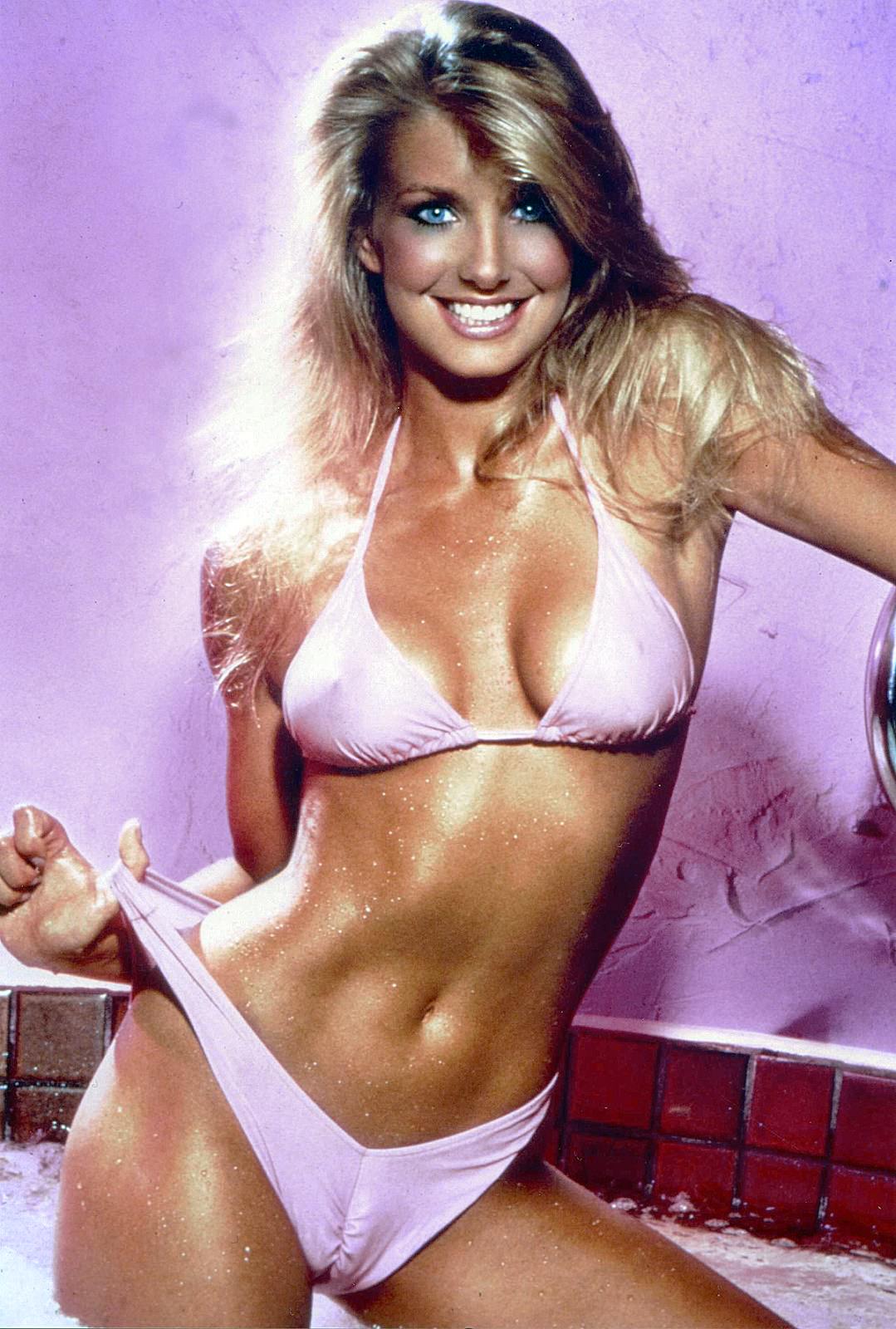
How is it possible that today could mark the 50th birthday of onetime poster babe Heather Thomas? You remember her, right? In her mid-20s, she spent almost as much time strutting about in bikinis on the 1981-1986 ABC-TV series The Fall Guy as she did helping Hollywood stuntman/bounty hunter Colt Seavers (Lee Majors) round up bail-jumpers and other lawbreakers.

Back then, the number of Heather Thomas photos taped inside boys’ high-school lockers might have exceeded even the quantity of Ray-Bans and Rubik’s Cubes being sold in the United States. I have no statistics to back this up, but my guess would be that only the famous pin-up of the Charlie’s Angels star then known as Farrah Fawcett-Majors provoked more male salivation than Thomas did at the time. (Cheryl Tiegs’ own poster probably came in third.)

This Connecticut-born, California-reared actress, who in the era of The Fall Guy boasted all the appeal of a blonde, tomboyish, small-town girl unselfconscious of her own beauty, looked to have fame within her grasp. After attending the University of Southern California’s Film School, Thomas scored roles in the eminently forgettable series David Cassidy: Man Undercover and B.J. and the Bear before finally being signed to play “Jody Banks” on The Fall Guy. In 1982, Us Weekly chose her as its “Favorite Female Newcomer.” Unfortunately, the Majors series, with its country-ish theme song, typecast Thomas for parts that emphasized her sex-symbol looks, rather than her acting chops. “There’s obligatory condescension that goes with that,” she told People magazine back in 2003. “You fill that archetype--the blonde bimbo. But at that point, I was just having fun.” She guest-starred on The Love Boat, T.J. Hooker, Mickey Spillane’s Mike Hammer, and the somewhat less than award-winning 1990 series Swamp Thing.

After The Fall Guy’s five-year run, recalls one Web bio, Thomas found several roles in TV movies. She “co-starred with Cliff Robertson and Hope Lange in Ford: The Man and the Machine (1987), a biopic about the renowned manager who revolutionized the industry. Her fine acting in the telepic brought Thomas a Gemini nomination for Best Performance by a Supporting Actress. She then was cast as Marilyn Monroe in a Kennedy-themed movie called Hoover vs. the Kennedys: The Second Civil War (1987), had a feature role as Lt. Carol Campbell in the World War II film The Dirty Dozen: The Fatal Mission (1988) and acted alongside Rodney Dangerfield and Tim Allen in the comedy Rodney Dangerfield: Opening Night at Rodney’s Place (1989).”

However, she also battled drug problems. In 1984, says TV.com, Thomas “entered rehab for cocaine addiction. She blames a Hollywood lifestyle. After exiting rehab, she continued acting, but started writing scripts. She penned more than 40 scripts, before selling one in 1997.” That story carried the unpromising title School Slut, says People, and focused on “two high school girls, one an outsider, one a beauty queen, who feel ostracized and ‘decide to work outside the paradigm.’” Despite Thomas’ enthusiasm, no movie of her work was ever made.

Married since 1991 to an entertainment attorney, Thomas divides her time these days between Santa Monica, California, and Jackson Hole, Wyoming. She has a couple of stepdaughters and one child of her own, India Rose, who was born on June 19, 2000. According to the Internet Movie Database, her last acting part was as an unnamed showgirl in the 1998 Billy Crystal film My Giant.

The fact that Heather Thomas, a fantasy babe from my youth, will today blow out 50 candles on a birthday cake makes me feel awfully damn old. It’s almost enough to send me out in search of The Fall Guy: The Complete First Season, which was finally released a couple of months ago on DVD, if only so that I can once more appreciate the sight of Thomas sashaying provocatively through a pair of swinging bar doors, and cocking her bikini’ed left hip, as she did in the main title sequence of that series (see below).

Be still my aging heart.


READ MORE: “TV’s Turd Blossoms,” by Gedeon Maheux (Gedblog); “The Ultimate Team of Woman and Machine,” by Tom Fury
(Raw Panic).

Sunday, March 04, 2007

Happy Birthday, Mr. Ellroy

James (né Lee Earle) Ellroy was born on this day in Los Angeles, back in 1948. Coming off last fall’s overwrought Black Dahlia movie adaptation and attendant noise, it is a very good time to, for the moment, set aside Ellroy’s larger-than-life “Demon Dog” persona (a persona that can be hypnotic and that surely helped burnish the Ellroy legend, but can also prevent clear-eyed visions of his literary turnout) and instead look more closely at the written works themselves.

And what books he has given us. Sprawling, meaty, kaleidoscopic novels that take us on unforgettable, labyrinthine journeys into a simmering, epic Los Angeles (and Las Vegas and Miami and New York and Havana and Chicago ... but especially Los Angeles)--a city swelling at the seams with uncontrollable violence, deceit, self-deceit, predation, grief, self-hatred, dangerous bravado, and a deep, lingering sorrow over itself.

Always one to speak in broad strokes, Ellroy has claimed that he was sick and tired of novels about “bullshit loner private eyes,” and set out instead to “show bureaucracies as obscenely corrupt, structural systems in society as extremely corrupt, and policemen as both exploiters of it and victims of it, drawn by hellishly personal motives to solve crimes and restore personal order to their own lives because the corruption that engulfs them on all levels is huge.” And that sounds about right. He gives us American history as a pulp history of organized crime, tabloids, corruption, bureaucratic tyranny, disordered desires, and the eternality of vice. His books, in total, present for us a stylized and staggering master view of the dark heart of mid-20th-century America.

In the sweep of Ellroy's vision--the way he, as he puts it, seeks to give readers crime fiction on an epic, transcendent scale--it's easy to forget Ellroy's more subtle contributions. It's not just the grandiosity that matters. It’s everything else, too. It’s the women, Ellroy’s women, complicated and damaged, defined by loss but resilient beyond measure; and it’s the men, Ellroy’s men, complicated and damaged, and defined by those women, whose scars they carry helplessly, leading them down dangerous paths.

And, too, consider the brilliance he often achieves in his non-fiction prose, where the Grand Guignol element disappears and in its place you find a pastiche of tabloid newspaper subject matter and a police blotter cadence so good you forget how good it is. You’re just there. You’re in the patrol car. You’re at the crime scene. You’re not reading Ellroy anymore; you’re in Ellroy’s world. And strong, broken women are slipping through desperate men’s fingers, and the loss is so great the pages shudder.

Indeed, last but not least, we might thank James Ellroy today for that great, thumping heart of his, unabashed and doom-struck, which brings us lines like those from the end of “Stephanie” (featured in Destination: Morgue! L.A. Tales), a recounting of time Ellroy spent observing Los Angeles’ Cold Case Unit, as its members attempted to solve a long-ago mystery: the murder of 16-year-old Stephanie Gorman in her family’s West L.A. home back in 1965. In the final paragraphs of that story, realizing that the case will likely never be solved, Ellroy shifts from hard-boiled staccato and unfurls this, as if at the young woman’s feet:

Baby, who were you? How would you grow and who would you love? Did you know you’d touch driven men and teach them?

You’ve got torchbearers. Three detectives and one chronicler. We want to know you. It’s a pursuit. It’s a likelier outcome than justice.

We’re spinning our wheels. It doesn’t matter. We get glimpses. You’re twirling in your prom gown. Color us devoted. Color you gone.

For paragraphs like these, for the ache in every line, for giving us characters as rich and unforgettable as Bud White (L.A. Confidential) and Dave Klein (White Jazz) and Danny Upshaw (The Big Nowhere), for defying and exploding genre limitations, for the uncanny way he can make his obsessions our obsessions, for the way he’s marked crime fiction for us and for the depth and beauty of that mark, for all this and more ... Happy 59th birthday, Mr. Ellroy.