Showing posts with label Awards 2021. Show all posts

Tuesday, December 21, 2021

Trophy Life


By Fraser Massey
The drill’s becoming all too familiar. Where once book awards ceremonies provided an opportunity to meet with old friends, walk up to worthy winners and extend congratulations—or commiserate with unsuccessful finalists—these days, we must make do with virtual affairs. Although it’s good that an alternative way has been found to reward the best books of the year and their authors, it’s difficult not to sigh and wish that things were still as they used to be.

This year’s awards season for crime fiction (recognizing works published primarily in 2020) kicked off in March with the Audies, presented by the New Jersey-based Audio Publishers Association. The host of that online event—actor, comedian, and audiobook voice artist John Leguizamo—resisted the temptation to lament what might have been, though he did draw attention in his self-deprecating opening remarks to the fact that he couldn’t see or hear who he was addressing: “It’s weird to tell jokes and not hear anyone laugh, I’ve got to be honest. But I’m not a stranger to it …”

Alyssa Cole’s unsettling New York-based thriller, When No One Is Watching, took top honors that night in the Audies’ Thriller/Suspense category. It went on to triumph again in April, capturing the Edgar Award for Best Paperback Original.

By the time we reached July and ThrillerFest, during which the International Thriller Writers organization announced the recipients of its annual Thriller Awards amid a Web-exclusive gathering, Cole’s novel still numbered among the victors. But there were signs that things weren’t going to go all her way in the coming months.

ThrillerFest, as you may recall, gave its 2021 Best Hardcover Novel prize to S.A. Cosby’s Deep South noir page-turner, Blacktop Wasteland, while David Heska Wanbli Weiden’s 21st-century western, Winter Counts, walked away with the Best First Novel commendation. Those two novels would go on to dominate the rest of this year’s ceremonies and awards announcements.

As we reached December, it was anybody’s guess which one of them would top the year’s winner of winners honor roll. On December 8, we finally got our answer, when voters weighing in on nominees for a new set of annual accolades, Britain’s Crime Fiction Lover Awards, gave Winter Counts one last prize and cemented that novel’s position at the top of the chart that follows—The Rap Sheet’s roster of 2021’s most highly decorated crime, mystery, and thriller novels.
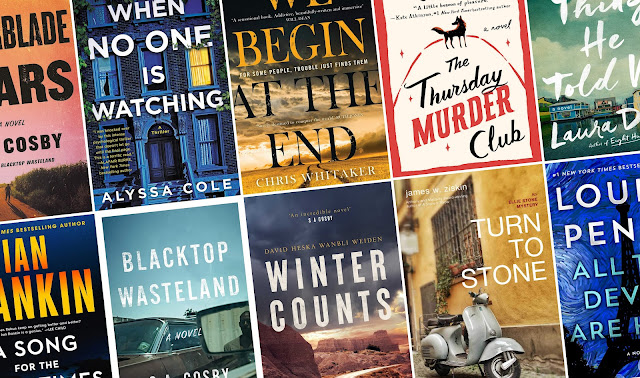
1. Winter Counts, by David Heska Wanbli Weiden (Ecco [U.S.], Simon & Schuster [UK])
2. Blacktop Wasteland, by S.A. Cosby (Flatiron [U.S.],
Headline [UK])
3. When No One Is Watching, by Alyssa Cole (Morrow)
4. We Begin at the End, by Chris Whitaker (Henry Holt [U.S.], Zaffre [UK])
5. Razorback Tears, by S.A. Cosby (Flatiron [U.S.],
Headline [UK])
6. All the Devils Are Here, by Louise Penny (Minotaur [U.S.], Sphere [UK])
7. Turn to Stone, by James W. Ziskin (Seventh Street)
8. The Last Thing He Told Me, by Laura Dave (Simon & Schuster [U.S.], Viper [UK])
9. The Thursday Murder Club, by Richard Osman (Pamela Dorman [U.S.], Viking [UK])
10. A Song for the Dark Times, by Ian Rankin (Little, Brown [U.S.], Orion [UK])
Bubbling just under this list: The Law of Innocence, by Michael Connelly (Little, Brown [U.S.], Orion [UK]; Squeeze Me, by Carl Hiaasen (Knopf [U.S.], Sphere [UK]); The Turning Tide, by Catriona McPherson (Quercus [U.S.], Hodder & Stoughton [UK]); and Murder at the Mena House, by Erica Ruth Neubauer (Kensington).

Author Cosby can perhaps find some consolation for having been pipped at the post for first place in the fact that he had two novels ranked among the winners—one of which, Razorblade Tears, was actually released this year, rather than last, and is therefore likely to secure still more laurels during the 2022 awards season.

The results from 21 awards announcements made over the last year were consulted in order to create our top-10 list.* A total of 37 books won prizes during the 10 months of the 2021 awards season, with another 177 nominees falling at the final hurdle and failing to make it into the virtual winners’ circle.

All of the novels selected offered welcome distractions from the real-life events of this past year, though Ziskin’s Turn to Stone—which features a group of murder suspects placed in quarantine in 1963 to avoid the potential spread of a highly contagious virus—was maybe a knowing nod to a plight that many of us understand today.

For readers, prize ceremonies provide a handy guide, if needed, to what titles one should consider buying next. For writers, they serve an altogether different function. Thomas Perry may have put it most eloquently, back in August, when he thanked the judging panel of the Barry Awards for naming his Eddie’s Boy their Thriller of the Year.

“Nobody writes in the hope of being given awards,” he said. “But when awards come along, they certainly inspire us to work harder, think of more ambitious projects, and try to get better at telling stories, because knowledgeable people are out there paying attention.”

Sadly, as things turned out, this became another year when writers and “the knowledgeable people paying them attention” were once again socially distanced by digital technology.

Congratulations are due to all of the 2021 award winners and nominees, and we send them our profound thanks for the amazing stories they brought into our lives.

* A note about list placements: In 2020, when Northern Irish author Adrian McKinty topped this chart with The Chain, he tweeted that The Rap Sheet had “scientifically proved” he’d written the best book of the year. It’s not really like that. Our top-10 list is based on nothing more than simple arithmetic. The novels are listed in order of the number of awards they won during the year. When more than one title has picked up the same number of prizes, their relative positions in the chart are decided (whenever possible) by the number of nominations each received over that period. If a tie still results, then the book that appeared in the greatest number of awards longlists is given precedence. If even then there’s nothing separating certain winning titles, then prize lists from ceremonies which published the number of votes cast for individual titles are consulted.

Results of the following 21 honors contests went into developing this year’s “champions of champions” roll: the Agathas, the Anthonys, the Audies, the Barrys, the CrimeFest prizes, the Daggers, the Edgars, the Crime Time FM Awards, the Goodreaads Choice Awards for Best Mystery & Thriller, the Thriller Awards, the Leftys, the Los Angeles Times prize for Mystery & Thriller, the Crime Fiction Lover Awards, the Macavitys, the Neddies (actually, just the International Crime Fiction prize at Australia’s Ned Kelly Awards, since my aim was to include only ceremonies open to all entrants, rather than exclusive groupings), the Nero Award, the Shamuses, the Shirley Jackson Awards, the Strand Magazine Critics Awards, the She Reads Best of 2021 Awards, and the Theakston Old Peculier Crime Novel of the Year.


READ MORE:The Award-Winning Novels of 2021” (Book Marks).

Saturday, December 11, 2021

Fun with Fleeting Fiction

I’m not a huge fan of short stories, instead preferring longer, more immersive tales. However, I’ll acknowledge that many briefer narratives can be highly effective. Since 2017, the Rocky Mountain chapter of Mystery Writers of America has been making that fact clear with its annual Six-Word Mystery Contest, “inspired by the legends of [Ernest] Hemingway’s heartbreaking story: ‘For sale: Baby shoes. Never worn,’” as the organization’s Web site explains.

Jean Garrison, a Florida resident, has been announced as the winner of the RMMWA’s 2021 competition, triumphing over 25 other finalists with her brief yarn of retribution, “He gaslighted her. She candlesticked him.” Garrison’s yarn plays nicely on a term that’s being employed more and more in our politically divided era: “gaslighting,” defined as “making someone question their own reality.”


There were five submission categories in this year’s Six-Word Mystery Contest. The Denver, Colorado-based RMMWA released the complete list of winners and finalists yesterday, along with the names of entrants, shown in parentheses below.

Cozy:
Category Winner — Chimney sweep murdered. Shot through hearth. (Z.J. Czupor)
A pie so good, it killed. (Cynthia Kuhn)
Baker battered over muffin top comment. (Lori Lacefield)
She died to hide her roots. (Jean Garrison)
Wanted: botanicals expert (nightshades). Confidentiality required. (Robert Miller)

Hard-boiled/Noir:
Category Winner — Detective follows hunch back to Notre-Dame. (Jennie MacDonald)
A badge makes vengeance murders easier. (Pat Remick)
Disappearance of dame derails detective’s denouement.
(William Frank)
Embezzling mob accountant's days were numbered. (Jean Garrison)
Lifeless eyes glisten in the streetlamp. (Darynda Jones)

Police Procedural:
Category Winner — Librarian booked for murder, justice overdue. (Angela Henry)
Gregor’s dead. Father suspected of insecticide. (Jeffrey Lockwood)
“I’m no flight risk!” insisted emu. (Jean Garrison)
Success? The murder made the news. (Dru Ann Love)
White collar thief nabbed for laundering. (Brooke Terpening)

Romance/Lust:
Overall Winner — He gaslighted her. She candlesticked him.
(Jean Garrison)
Exhibitionist murdered. Rounded up usual voyeurs. (Ryan Garms)
Florist arranged knotted noose for Bridezilla. (Kristin Horton)
Promised his heart. Kept his promise. (Julie Kerr Daly)
Silk stockings, a new neck accessory. (Barb Bathrick)

Thriller:
Category Winner — 3 people, 2 parachutes, 1 dilemma.
(Sage Naumann)
In every mirror, I'm someone else. (Kristin Horton)
Serial killer periodically opens BBQ stand. (Mary Stojak)
The wildfire raged. Grinning, he spit. (Mike Chiropolos)
They almost escaped. Then he sneezed. (Lissa Marie Redmond)

I must admit, it took me a moment to puzzle out several of these. Others caused me to chuckle immediately.

Previous Six-Word Mystery Contest winners are here.

Wednesday, December 08, 2021

Love It and List It


The UK Web site Crime Fiction Lover announced back in October that it would begin conducting its first-ever competition for what it was calling, of course, the Crime Fiction Lover Awards. The reading public was invited to vote for their favorites in each category, and CFL editors reserved the right to name their own picks—which in each and every case, turned out to differ from the popular consensus.

The winners were announced earlier today.

Best Crime Novel: The Night Hawks, by Elly Griffiths (Quercus)

Also nominated: The Dark Remains, by William McIlvanney and Ian Rankin (Canongate); Razorblade Tears, by S.A. Cosby (Headline); The Devil’s Advocate, by Steve Cavanagh (Orion); I Know What I Saw, by Imran Mahmood (Bloomsbury); True Crime Story, by Joseph Knox (Transworld); and 1979, by Val McDermid (Little, Brown)

Best Novel Editor’s Choice: Razorblade Tears, by S.A. Cosby (Headline)

Best Debut Crime Novel: The Source, by Sarah Sultoon (Orenda)

Also nominated: Black Drop, by Leonora Nattrass (Viper); Edge of the Grave, by Robbie Morrison (Macmillan); The Waiter, by Ajay Chowdhury (Harvill Secker); Winter Counts, by David Heska Wanbli Weiden (Simon & Schuster); and Burying the Newspaper Man, by Curtis Ippolito (Red Dog Press)

Best Debut Editor’s Choice: Winter Counts, by David Heska Wanbli Weiden (Simon & Schuster)

Best Crime Novel in Translation: The Girl Who Died, by Ragnar Jónasson, translated by Victoria Cribb (Michael Joseph)

Also nominated: Hotel Cartagena, by Simone Buchholz, translated by Rachel Ward (Orenda); Bullet Train, by Kotaro Isaka, translated by Sam Malissa (Harvill Secker); The Rabbit Factor, by Antti Tuomainen, translated by David Hackston (Orenda); Riccardino, by Andrea Camilleri, translated by Stephen Sartarelli (Mantle); Cold As Hell, by Lilja Sigurdardóttir, translated by Quentin Bates (Orenda); and Little Rebel, by Jérôme Leroy, translated by Graham H. Roberts (Corylus)

Best in Translation Editor’s Choice: Riccardino, by Andrea Camilleri, translated by Stephen Sartarelli (Mantle)

Best Indie Crime Novel: The Strangers of Braamfontein, by Onyeka Nwelue (Abibiman)

Also nominated: Black Reed Bay, by Rod Reynolds (Orenda); Evaders, by E.C. Scullion (RedDoor Press); Little Lies, by Valerie Keogh (Bloodhound); The Butcher’s Prayer, by Anthony Neil Smith (Fahrenheit 13); The Quiet People, by Paul Cleave (Orenda); and The Corpse with the Iron Will, by Cathy Ace (Four Tails)

Best Indie Novel Editor’s Choice: The Quiet People, by Paul Cleave (Orenda)

Best Crime Show: Line of Duty

Also nominated: Bosch, Mare of Easttown, Paris Police 1900, Time, and Endeavour

Best Crime Show Editor’s Choice: Mare of Easttown

Best Author: Elly Griffiths

Also nominated: Ian Rankin, M.W. Craven, Ann Cleeves, William Shaw, and S.A. Cosby

Best Author Editor’s Choice: Ian Rankin

Congratulations to all of this year’s nominees! Crime Fiction Lover has already declared that this contest for commendations will return in 2022, and it is soliciting sponsors for that event.

Friday, December 03, 2021

Outback Is in with Stiletto Awards

Somewhat belatedly comes news that Hayley Young, a 32-year-old Canberra pharmacist and first-time crime writer, has won the Swinburne University of Technology First Prize in this year’s 28th Scarlet Stiletto Short Story Awards competition, sponsored by Sisters in Crime Australia. That announcement was made online on November 27. Young’s Outback police procedural, “Monster Hunters,” also picked up the 2021 ScriptWorks’s Great Film Idea Award. Her total in prize money for both victories is $2,000 AUD.

The Scarlet Stiletto Awards were established in the mid-1990s to recognize short fiction “written by Australian women and featuring a strong female protagonist.” The Sisters in Crime Australia Web site reports that 241 short stories—“equal to last year’s record”—were submitted in 2021. In addition to Young’s honors, assorted other prize recipients were named during the same online event.

Simon & Schuster Second Prize:
“On the Inside,” by Jaclyn Riley-Smith

Sun Bookshop & Wild Dingo Press Third Prize:
“The Gospel of Cecily,” by Ellen Coates

Affirm Press Young Writer’s Award:
“The Braxton Mystery,” by Caitlyn Whitbread

Melbourne Athenaeum Body-in-the-Library Library Award:
“Death’s Waiting Room,” by Clare Fletcher

Kerry Greenwood’s Malice Domestic Award:
“What I Did in Lokdown by Chloe Martin age 9 1/2,” by Jane Lee

Every Cloud Production’s History with Mystery Award:
“The Séance,” by Natalie Conyer

Viliama Grakalic Best Art and Crime Story Award:
“The Fragrance of the Corpse Flower,” by Caroline de Costa

Booktopia Publisher Services Best Environmental Mystery Award:
“Mystery Off the Jillawong Road,” by Stephanie Holm

Writers Victoria’s Crime and Punishment Award for Most Satisfying Retribution: “Cash Sale,” by Janet Moore

HQ Fiction Award for Best Thriller:
“Put the Kettle On,” by Janice Shaw

Queensland Chapter of Sisters in Crime’s Liz Navratil Award for the Story with the Best Disabled Protagonist: “Waiting,” by
Christine Fontana

More information about these winning tales and their authors can be obtained by clicking here.

Thursday, November 25, 2021

One Winner in “56 Days”

Following up on a bit of news from earlier this month about nominees for the 2021 An Post Irish Book Awards, we can now report that the novel 56 Days, by Catherine Ryan Howard (Atlantic/Corvus), has been named as the Irish Independent Crime Fiction Book of the Year.

Also competing in the crime-fiction category were the following five novels: All Her Fault, by Andrea Mara (Transworld); April in Spain, by John Banville (Faber and Faber); The Dark Room, by Sam Blake (Atlantic/Corvus); The Devil’s Advocate, by Steve Cavanagh (Orion); and The Killing Kind, by Jane Casey (Harper Fiction).

As The Irish Times reports, the winners of this year’s Irish Book Awards—in 19 categories—were announced online on Tuesday evening. “Voting is now open here,” it adds, “for Irish Book of the Year, which will be announced on [TV channel] RTÉ One on December 8th.”

(Hat tip to In Reference to Murder.)

Friday, November 12, 2021

Ireland Shows Off Its Literary Finest

There are still three more days left before the public voting period closes in this year’s An Post Irish Book Awards competition. You have until this coming Monday, November 15 (at 5 p.m. Dublin time), to make your preferences known online here.

There are 20 categories of nominees, including six novels shortlisted for the Irish Independent Crime Fiction Book of the Year:

All Her Fault, by Andrea Mara (Transworld)
April in Spain, by John Banville (Faber and Faber)
The Dark Room, by Sam Blake (Atlantic/Corvus)
The Devil’s Advocate, by Steve Cavanagh (Orion)
56 Days, by Catherine Ryan Howard (Atlantic/Corvus)
The Killing Kind, by Jane Casey (Harper Fiction)

All of the 2021 winners are to be announced during an in-person ceremony at Dublin’s Convention Centre on Tuesday, November 23. “The event,” explains The Irish Times, “will also be live-streamed for those who are unable to attend.”

(Hat tip to In Reference to Murder.)

Friday, November 05, 2021

Further UK Honors Readied

Organizers of Britain’s 2021 Staunch Prizes, awards given to crime-fiction works that do not include violence toward women, are publicizing their new shortlists of nominees in the categories of both unpublished flash fiction and short stories.

The Bookseller reports that, “in the short story category, the shortlist features ‘My Flood Book’ by Greg Beatty, ‘Swine Tags’ by Tom Leins, ‘The Toll Bridge’ by Arendse Lund, ‘Like Glue’ by Kimberly Shaw along with Moinet’s ‘Tremor,’ In flash fiction, ‘Cornered’ by Moinet is pitted alongside ‘Serial Killers’ by Adele Evershed, ‘Two Faced” by M.J. Harbottle, ‘Pale on the Gatepost’ by Alison Ringrose and Ros Thomas’ ‘How to Leave Your Childhood Behind.’”

The winners are to be declared on November 25, which by no coincidence will also be the International Day for the Elimination of Violence against Women.

There will be no prize given in the original novel category this year; it is being held over until 2022. Previous recipients of the honor are Jock Serong’s On the Java Ridge (2018), Samantha Harvey’s The Western Wind (2019), and Attica Locke’s Heaven, My Home (2020).

* * *

Also from across the pond comes word that this year’s Waterstones Book of the Year shortlist has made room for only one mystery novel, Janice Hallett’s The Appeal (Viper), a cozyish yarn that, The Guardian says, finds “law students Charlotte and Femi investigat[ing] a mystery in the sleepy town of Lower Lockwood, dealing with everything from an amateur dramatic society’s disastrous staging of All My Sons to a dodgy charity appeal for a child’s medical treatment.”

Among the 12 additional works vying for this commendation, sponsored by one of the UK’s largest book retailers, are Around the World in 80 Plants, by Jonathan Drori (Orion); Klara and the Sun, by Kazuo Ishiguro (Faber and Faber); Ariadne, by Jennifer Saint (Headline); The Lyrics: 1956 to the Present, by Paul McCartney, edited by Paul Muldoon (Allen Lane); and They Both Die at the End, by Adam Silvera (Simon & Schuster).

The winner is espected to be announced on December 2.

(Hat tip to In Reference to Murder.)

Thursday, November 04, 2021

Swedish Suspense Yarn Scores Big

It was announced this morning that Swedish author Mikael Niemi’s To Cook a Bear (MacLehose Press) has won the 2021 Petrona Award for the Best Scandinavian Crime Novel of the Year. A press release says this marks the first time a historical novel has won the prize.

Regarding Niemi’s book, which is set in northernmost Sweden in 1852 and was released in hardcover in the fall of 2020, the Petrona judges had this to say: “We were particularly impressed with the novel’s use of historical detail, its fascinating reimagining of a figure from history, the sense of location and atmosphere, the rumination on religion versus the natural world, and the depiction of early forensics. To Cook a Bear’s superb characterisation of the main protagonists Læstadius and Jussi, which is tinged with sadness yet hope, also allows the author to explore the issues of literacy and class with sensitivity and compassion. The beautiful translation by Deborah Bragan-Turner lets the novel shine for English-language readers around the world.”

There were half a dozen other novels in contention for this year’s Petrona Award: A Necessary Death, by Anne Holt, translated by Anne Bruce (Corvus; Norway); Death Deserved, by Jørn Lier Horst and Thomas Enger, translated by Anne Bruce (Orenda; Norway); The Secret Life of Mr. Roos, by Håkan Nesser, translated by Sarah Death (Mantle; Sweden); The Seven Doors, by Agnes Ravatn, translated by Rosie Hedger (Orenda; Norway); and Gallows Rock, by Yrsa Sigurðardóttir, translated by Victoria Cribb (Hodder & Stoughton; Iceland).

“I am very proud and happy to have received the Petrona Award,” Niemi declared after hearing of his victory, “and would like to thank my editor, Katharina Bielenberg, my translator Deborah Bragan-Turner, and my agency, Hedlund Literary Agency, who have made it possible for this novel to reach British readers. This happy news has brightened the growing winter darkness here in the very north of Scandinavia. I am sending my warmest thanks to all my British readers.”

Congratulations to all of this year’s nominees!

(Hat tip to Mystery Fanfare.)

Saturday, October 30, 2021

Of All the Kiwi Contenders

During a special video-streaming event held earlier today in association with New Zealand’s WORD Christchurch Festival, the winners of four 2021 Ngaio Marsh Awards for crime, mystery, and thriller fiction (and crime non-fiction) were announced. If you’re interested, you can watch the full 72-minute Zoom presentation—which includes appearances by 20 authors—by clicking here.

Best Novel: Sprigs, by Brannavan Gnanalingam (Lawrence & Gibson)

Also nominated: The Murder Club, by Nikki Crutchley (Oak House Press); The Tally Stick, by Carl Nixon (Penguin); The Secrets of Strangers, by Charity Norman (Allen & Unwin); and Tell Me Lies, by J.P. Pomare (Hachette)

Best First Novel: For Reasons of Their Own, by Chris Stuart
(Original Sin Press)

Also nominated: The Girl in the Mirror, by Rose Carlyle (Allen & Unwin); The Beautiful Dead, by Kim Hunt (Bloodhound); Where the Truth Lies, by Karina Kilmore (Simon & Schuster); and While the Fantail Lives, by Alan Titchall (Devon Media)

Best Non-fiction: Black Hands: Inside the Bain Family Murders,
by Martin van Beynen (Penguin)

Also nominated: Weed: A New Zealand Story, by James Borrowdale (Penguin); Rock College: An Unofficial History of Mount Eden Prison, by Mark Derby (Massey University Press); From Dog Collar to Dog Collar, by Bruce Howat (Rangitawa); and Gangland: New Zealand’s Underworld of Organised Crime, by Jared Savage (HarperCollins)

Best YA/Kids Book: Katipo Joe, by Brian Falkner (Scholastic)

Also nominated: Red Edge, by Des Hunt (Scholastic); A Trio of Sophies, by Eileen Merriman (Penguin); and Deadhead, by Glenn Wood
(One Tree House)

A hearty congratulations to all of this year’s nominees!

Wednesday, October 27, 2021

Lover’s Big Leap

Given the existing plenitude of annual awards presented for crime, mystery, and thriller fiction, you might think there was no necessity in establishing a brand-new one. Yet that’s exactly what the popular British Web site Crime Fiction Lover has chosen to do.

“These awards are different,” the site says in its announcement. “They’re international, with a very special judging panel. And you’re on it. That’s right, the winners of our awards are going to be chosen by readers. We’ve spent many long years building up a community of crime fiction lovers around our website and we believe this is the way it should be. As part of our gang, you will play a role in deciding who wins a Crime Fiction Lover Award in 2021.”

Nominations will be accepted between now and noon (UK time) on Wednesday, November 10, in six different categories:

Best Crime Novel
Best Debut
Best in Translation
Best Indie Novel
Best Author
Best Crime Show

The official nominating form can be filled out here. You need not enter a title or name in every category.

Books, authors, and TV shows will be ranked according to their numbers of nominations, with the biggest vote-getters earning spots on a shortlist of contenders. “To qualify for the shortlist,” explains Crime Fiction Lover, “your nomination will need to have been published in English between 1 November 2020 and 31 October 2021. In the Best Author category, the author needs to have published a work of crime fiction during this period. We know it’s difficult to define what an ‘indie’ crime novel is. For this category we’re looking for crime novels published by smaller independent companies or self-publishing authors with a turnover under £500,000 (US$690,000).”

Following publication of the shortlist, a second online poll will determine the winners. In addition, says the site, “our team will select an Editor’s Choice award from the shortlist—which may or may not be the same as the book, show or author that receives the most votes.”

Now, I’m always suspicious of prize selections based solely on public opinion; they tend to favor books that have received the most publicity, rather than those that are truly imaginative or distinctive. I place greater faith in programs that at least balance public votes with those of established critics and editors. Still, we’ll see what Crime Fiction Lover can produce here. The results could be enjoyable.

Again, click here to register your votes.

Thursday, October 21, 2021

Carrying on Hillerman’s Legacy

Courtesy of In Reference to Murder comes the news that Christina Estes, an Emmy award-winning reporter and author in Phoenix, Arizona, has won the 2020 Tony Hillerman Prize for Best First Mystery Set in the Southwest. Her novel, Off the Air, is being readied for release, by Minotaur Books, in 2023.

A news release explains that Estes’ story focuses on “a local TV news reporter who gets the scoop of a lifetime while investigating the murder of a popular radio talk show host. But the killer is determined to keep her silent.” Commenting on that work, Joseph Brosnan, who oversees the Hillerman Prize program for Minotaur, says, “We’re so excited to publish Off the Air. Christina’s novel was a treat to read, and both Hillerman and mystery fans are going to love it.”

Atlanta, Georgia, bookseller Samantha Jayne Allen captured the 2020 Hillerman Prize; her debut novel, Pay Dirt Road, is due out in April 2022. A list of other previous recipients is available here.

Wednesday, October 20, 2021

Boyle’s Voice Rises Above All

A little over a month after the announcement of finalists for Capital Crime’s 2021 Amazon Publishing New Voices Award, competition organizers bring word that London-based journalist and writer Darren Boyle has secured the accolade with his unpublished thriller, The Black Pool. You can watch the digital declaration of Boyle’s victory here.

As Shotsmag Confidential explains, “Boyle has more than 20 years’ experience working in the national media in Dublin and London. The Black Pool is set in contemporary Dublin and features a journalist protagonist who ventures deep into the murky world of organised ‘tiger raids’ gangs. How much is he willing to risk for the ultimate story?”

“In acknowledgement of the quality of this year’s entries,” the blog adds, “the judges gave two honourable mentions to the shortlisted writers Patti Buff, a native of southern Minnesota who has lived in Germany for the last twenty years (for The Ice Beneath Me), and Casey King, an Irish crime writer from County Cork (for No Time to Cry).” The other seven works contending for this year’s New Voices Award were The Incident at Palmer Road, by Andrea Crossett; Wasteland, by Luke Deckard; Garotte 2, by Mary McQueen; Self Help for Serial Killers: Let Your Creativity Bloom, by Mairi Campbell-Jack; Five by Five, by Claire Wilson; How Like Wolves, by Andrew Fadairo; and The Venom of the Snake, by M.Z. Turner.

As this year’s top vote-getter, Boyle will receive £1,000 in prize dough, plus a trophy and a “potential offer” of publication (apparently no promises are being made) from Thomas & Mercer, Amazon Publishing’s imprint for mysteries and thrillers.

Tuesday, October 05, 2021

The Critics Have Spoken

During a Zoom-carried event last evening, The Strand Magazine announced the winners of its 2021 Critics Awards, in two categories.

Best Mystery Novel: Snow, by John Banville (Hanover Square Press)

Also nominated: You Again, by Debra Jo Immergut (Ecco); Trouble Is What I Do, by Walter Mosley (Mulholland); The Missing American, by Kwei Quartey (Soho Crime); A Song for the Dark Times, by Ian Rankin (Little, Brown); Survivor Song, by Paul Tremblay (Morrow); and Confessions on the 7:45, by Lisa Unger (Park Row)

Best Debut Novel: When No One Is Watching, by Alyssa Cole (Morrow)

Also nominated: Amnesty, by Aravind Adiga (Scribner); Leave the World Behind, by Rumaan Alam (Ecco); Empire of Wild, by Cherie Dimaline (Morrow); A Burning, by Megha Majumdar (Knopf); A Certain Hunger, by Chelsea G. Summers (Unnamed Press); and Catherine House, by Elisabeth Thomas (Custom House)

In addition, The Strand gave out not one, but three Lifetime Achievement Awards this year, to Stephen King, Joyce Carol Oates, and Alexander McCall Smith. And Josh Stanton of Blackstone Publishing was chosen to receive its 2021 Publisher of the Year Award.

(Hat tip to Mystery Fanfare.)

Friday, October 01, 2021

A Ripper Yarn for the Win

Much to my surprise, at least, the winner of the 2021 Goldsboro Books Glass Bell Award, announced today, is People of Abandoned Character (Head of Zeus), a tense historical thriller by Clare Whitfield. Sponsored by London’s Goldsboro Books, this accolade is “awarded annually to a compelling novel, of any genre—from romance and thrillers, to historical, speculative and literary fiction—with brilliant characterisation and a distinct voice that is confidently written and assuredly realized.” In addition to great publicity, this victory fetches Whitfield £2,000 and “a beautiful, handmade glass bell.”

Goldsboro Books reports that choosing People of Abandoned Character “was pretty much unanimous. Clare Whitfield’s thrilling debut impressed the whole team for its fresh and unique take on the Whitechapel Murders. Told from the point of view of a woman who wonders whether her violent and manipulative husband could be Jack the Ripper, it’s also a thoughtful and compelling exploration of the endless violence faced by women of all walks of life. We’re delighted to award this year’s Glass Bell to Clare Whitfield—a hugely exciting new name in fiction, we know that she will go far!”

When I say this decision surprises me, it is primarily because Whitfield’s novel faced four remarkable rivals for the Glass Bell: The Girl with the Louding Voice, by Abi Daré (Sceptre); The Court of Miracles, by Kester Grant (HarperVoyager); Apeirogon, by Colum McCann (Bloomsbury); Eight Detectives, by Alex Pavesi (Michael Joseph); and The Devil and the Dark Water, by Stuart Turton (Raven). I would’ve put my bet to win on either Turton’s high-seas whodunit (one of my own favorite works of 2020), or McCann’s story rooted in the tragically ongoing Arab-Israeli conflict to triumph.

Last year’s Glass Bell Award recipient was Taylor Jenkins Reid’s coming-of-age tale, Daisy Jones and the Six.

Thursday, September 30, 2021

Who Will Pick Up the Petrona?

Out of a collection of 28 books—submitted from six countries—all vying to take home the 2021 Petrona Award for the Best Scandinavian Crime Novel of the Year, that prize’s organizers have chosen half a dozen finalists. They were announced this morning:

A Necessary Death, by Anne Holt,
translated by Anne Bruce (Corvus; Norway)
Death Deserved, by Jørn Lier Horst and Thomas Enger,
translated by Anne Bruce (Orenda; Norway)
The Secret Life of Mr. Roos, by Håkan Nesser,
translated by Sarah Death (Mantle; Sweden)
To Cook a Bear, by Mikael Niemi,
translated by Deborah Bragan-Turner (MacLehose Press; Sweden)
The Seven Doors, by Agnes Ravatn,
translated by Rosie Hedger (Orenda; Norway)
Gallows Rock, by Yrsa Sigurðardóttir,
translated by Victoria Cribb (Hodder & Stoughton; Iceland)

To read the judges’ comments about each work, click here.

The Petrona Award, established back in 2013, derives its name from a blog written by Maxine Clarke, a British editor and “champion of Scandinavian crime fiction,” who had died the year before that. This competition is open to “crime fiction in translation, either written by a Scandinavian author or set in Scandinavia, and published in the UK in the previous calendar year.”

Euro Crime notes that “The winning title, usually announced at the international crime-fiction convention CrimeFest, will now be announced on Thursday, 4 November 2021. The winning author and the translator of the winning title will both receive a cash prize, and the winning author will receive a full pass to and a guaranteed panel at CrimeFest 2022.”

Last year’s Petrona Award recipient was Finnish writer Antti Tuomainen, who captured the honor with his humorous novel Little Siberia (Orenda), translated by David Hackston.

Congratulations to every one of the 2021 nominees!

Friday, September 24, 2021

Bullet Points: First of Fall Edition

• Shortly after I posted on this page about the 50th anniversary of the debut of Columbo as part of the NBC Mystery Moviewheel series,” I was contacted by Jeffrey Marks, the publisher at Crippen & Landru, who told me his company has in the works a posthumous collection of short stories by the two creators of that landmark TV crime drama, William Link and Richard Levinson. (Link passed away in 2020, Levinson in 1987). “Shooting Script and Other Mysteries is the title,” states Marks, “and it will be published this fall. I’m guessing November at this time.” Levinson and Link, as you may already know, became friends when they attended the same junior high school in Philadelphia, and they went on to be writing partners for 43 years. In addition to creating TV series and scripting films, they penned short pieces of fiction. Back in 2010, Crippen & Landru released Link’s The Columbo Collection, which featured a dozen of his new yarns starring Los Angeles’ best-known rumpled police detective. During a contemporaneous interview, Link told me he had another 16 that hadn’t made the cut; so “if it’s successful, I’ve already got enough for a follow-up book.” None of those 16 will be found in Shooting Script, according to Marks, though he adds, “I do plan on asking the [Link] estate about these stories after we complete this book. The Columbo Collection was one of our most popular collections.”

• Over the last month, Max Allan Collins has been writing, for the Web site of independent publisher NeoText, a lavishly illustrated column called “A Life in Crime.” Together, those essays will constitute what he calls “a kind of literary memoir about my various book series.” The first entry looked back at Collins’ youthful introduction to mystery and crime fiction; the second at his Nolan books; the third at his durable Quarry series; the fourth at the history and development of his Nathan Heller saga; and number five—posted earlier this week—tackles what he says is “the story of how Ms. Tree came to be, and includes a fantastic array of Terry Beatty’s cover art.” There are still two more columns to come, the lot of them intended to help promote the official release, early next month, of Fancy Anders Goes to War: Who Killed Rosie the Riveter?, Collins’ first—of three—World War II-backdropped mystery novellas for NeoText (available in both e-book and print form), with artwork by Fay Dalton.

• Publishing imprint HarperFiction has named the victors in its Killing It Competition for Undiscovered Writers, which was launched back in January as a way “to find unpublished writers from Black, Asian and minority ethnic backgrounds.” Entrants were asked to submit the first 10,000 words of a crime, thriller, or suspense novel, plus a synopsis of their book running no more than 500 words in length. The judges ultimately chose three winners: information technology consultant Rama Varma, for a work-in-progress titled The Banana Leaf Murder; Stacey Thomas, a civil servant and staff reviewer at Bad Form Review, for The Revels; and BBC radio and TV producer Shabnam Grewal, for Secrets and Shame. “Each winner,” explains the blog Shotsmag Confidential, “will receive a comprehensive editorial report from a HarperFiction editor covering pace, characterisation, pitch and more, as well as three mentoring sessions.”

• Have you ever wanted to live in the Malloch Building, the Streamline Moderne-style apartment structure in San Francisco’s North Beach neighborhood made famous by the 1947 Humphrey Bogart/Lauren Bacall picture Dark Passage? Your chance may finally have arrived! (Hat tip to Up and Down These Mean Streets.)

• Not only does Hillary Clinton, former U.S. secretary of state and presidential candidate, have a new novel due out next month (State of Terror, co-authored with Louise Penny), but she and her daughter, Chelsea, have announced that one of their enterprises, Global Light Productions, “has optioned film and TV rights to Jacqueline Winspear’s Maisie Dobbs series.” Deadline reports that Hillary Clinton, “who has made no secret of her love of the mystery series throughout the years, featuring them on many of her reading lists,” recently broke this news to attendees at England’s Royal Television Society Cambridge Convention. “‘We’re also doing scripted projects so, for example, one of our favorite books that Chelsea and I have shared over the years is a book about a character called Maisie Dobbs, which is a series about a World War I field nurse who turns into a detective and we’ve just optioned it,’ Hillary Clinton said, adding how much she and Chelsea love the character and her journey during a time of ‘great social upheaval.’” Not surprisingly, there’s no word yet on when any Maisie Dobbs movie might actually reach theaters worldwide.

• Hoping that the COVID-19 pandemic will be at least more manageable a year from now, London’s Capital Crime Writing Festival has already begun selling tickets for its September 29-October 1, 2022, gathering. Plans are to hold next year’s festival in “a new, tented, venue in a central London park.” Organizers promise “a wide-ranging line-up of events focused on accessible, mainstream fiction loved by readers around the world, which entertain crime and thriller fans, readers and authors alike in the UK’s capital.” Tickets can be purchased here. Press materials say the celebrity guest lineup and further details will “be announced later this year.”

• Sri Lankan author Amanda Jayatissa has amassed an enviable amount of media attention for her brand-new debut novel, My Sweet Girl, described by one reviewer as a “darkly hilarious” thriller. Roughly put, the story concerns a young, borderline-alcoholic graphic designer, Paloma Evans, who insists she found her roommate, Arun, dead in their San Francisco apartment … yet there’s no corpse and no evidence that this roommate ever existed. Complicating the situation is that Arun had recently discovered a troubling secret from Paloma’s childhood as an orphan back in Sri Lanka, and was blackmailing her to stay quiet about it. Part of what’s brought such attention to this author’s work may be that Jayatissa has made herself widely available for interviews (at least via Zoom). Among the most entertaining such exchanges may come from the podcast Speaking of Mysteries, which recently found host Nancie Clare talking with the author about the gothic elements of her story, her personal experiences with orphanages, “white savior syndrome,” the difficulty she finds in writing “sensitive” scenes, her cookie business, and much more. Click here to listen in on their conversation.

(Above) Novelist Amanda Jayatissa

• Oh, and check out this list Jayatissa assembled, for CrimeReads, of six suspense thrillers set in South and East Asia. “Thrillers coming from South-East Asia are usually paced very differently,” she explains. “Rather than immediately diving into solving the crime, these thrillers take their time—giving the reader a slightly claustrophobic look at the killers themselves, their motivations, and the situations that have lead them there. More often than not, the reader is fully aware of who the killer is from the very beginning, but must instead piece together the rationalization for their crimes. The stakes are still high, but the suspense is often a slow burn, with a very high payoff.”

• From the “Fun Facts to Know and Tell” File: “It might be surprising for a John D MacDonald fan to learn,” writes Steve Scott in The Trap of Gold blog, “that Travis McGee’s 52-foot houseboat, The Busted Flush—which plays such a prominent role in so many of the 21 novels starring the author’s series character—has only been depicted by cover artists a handful of times. It was certainly surprising for me as I was researching this piece: I could have sworn I’d seen it more often. By my count I can find only four illustrations of the Flush on any of the various editions published in the United States prior to 1988, and I don’t think there have been any after that. All of the illustrations were inked by the great Robert McGinnis.”

• A curious story of literary rivalry, from The Guardian:
After The Spy Who Came in from the Cold was published in 1963 it went on to become John le Carré’s most widely acclaimed book, winning several awards, being adapted for a Richard Burton-led feature film and becoming one of the most highly regarded novels of the cold war era.

A year earlier another spy book had been published in Britain: the English translation of a work by Willem Frederik Hermans, one of the greatest Dutch authors of the 20th century. The book,
The Darkroom of Damocles, was an immediate success when it was published in the Netherlands, winning acclaim and also being adapted for film.

But while Le Carré admitted to being a fan of Hermans, and in particular of
The Darkroom of Damocles, the feeling was far from mutual. According to an interview that has come to light on the eve of the British publication of another of the Dutch author’s books, Hermans regarded Le Carré as an inferior novelist and someone who had plagiarised his work.
• Was Agatha Christie’s biggest-selling novel, 1939’s And Then There Were None, also inspired by a previous and now largely forgotten tale? Perhaps, says crime-fiction historian Curtis Evans, who penned the introduction to a forthcoming Dean Street Press re-release of 1930’s The Invisible Host, by Gwen Bristow and Bruce Manning, husband-and-wife newspaper journalists in New Orleans. The Guardian’s Alison Flood notes that The Invisible Host “begins with eight guests invited to a penthouse by telegram, where they are then told over the radio that they will all soon be dead. ‘Do not doubt me, my friends; you shall all be dead before morning.’” Although Evans has conceded before that The Invisible Guest “lack[s] Christie's plausibility and ingenuity,” he tells Flood that the comparisons between these two venerable yarns are “not just a matter of similar elements being in play: the entire basic plot idea is the same …” Anna Hervé, the editorial director for literary estates at Christie’s publishing house, HarperCollins, remains unconvinced. “‘It’s always possible she heard something in passing,’ said Hervé. ‘There was a real fashion in the 1930s for locked-room mysteries, and The Invisible Host is a good example of one of those, but there is no evidence that Christie was aware of it. … The Invisible Host does have similarities,’ said Hervé, ‘but I don’t think anyone’s been able to find a connection. And I also think Christie being the person she was, if there had been a link she would have acknowledged it.” Judge the parallels for yourself; The Invisible Host goes on sale on both sides of the Atlantic on October 4.

• Another classic work given new life: A Pin to See the Peepshow, by F. (Fryniwyd) Tennyson Jesse (1888-1958), originally published in 1934, but scheduled to reach stores again in mid-October, courtesy of the British Library. As Elizabeth Foxwell explains in her blog, The Bunburyist, “The novel is based on the Thompson-Bywaters murder case of 1922-23. Jesse—the great-niece of Alfred, Lord Tennyson and a war correspondent, playwright, screenwriter, and novelist—was known for involvement in the series on notable British trials as well as her works with female detective Solange Fontaine.” Amazon’s plot synopsis for Peepshow reads: “Julia Almond believes she is special and dreams of a more exciting and glamorous life away from the drab suburbia of her upbringing. Her work in a fashionable boutique in the West End gives her the personal freedom that she craves, but escape from her parental home into marriage soon leads to boredom and frustration. She begins a passionate affair with a younger man, which has deadly consequences. … Julia becomes trapped by her sex and class in a criminal justice system in which she has no control. Julia finds herself the victim of society’s expectations of lower-middle-class female behavior and incriminated by her own words. F. Tennyson Jesse creates a flawed, doomed heroine in a novel of creeping unease that continues to haunt long after the last page is turned.”

• Three recent CrimeReads articles I enjoyed: Neil Nyren’s tour through the fictionalized Sicily of Inspector Salvo Montalbano, on the occasion of Penguin releasing Andrea Camilleri’s 28th and final Montalbano yarn, Riccardino; Olivia Rutigliano’s delightful essay about the delightful 2007-2009 ABC black comedy series, Pushing Daisies; and novelist Julia Dahl’s reflections on how she learned to “use the questions I had about the people in the articles I wrote in my day job as a reporter to explore—in fiction—the issues of trauma and regret and love and justice. To explore, in a word, humanity.”

• Meanwhile, Dahl submits to an interview with the Los Angeles Review of Books that includes her explanation of how her new novel, The Missing Hours, became a standalone. As she relates:
The initial idea was always drawn from reporting I’d done at CBS, mostly about the Steubenville rape case in 2012, an awful case of this teenager who’d been raped at a party. There were all these details that made me think, “What would it be like to be that girl? What would it be like to be her family?” I had a contract for another Rebekah [Roberts] book so I started thinking about how Rebekah could be connected. But as I started writing, I realized that this is not a Rebekah story, that forcing Rebekah in didn’t make sense. Happily, my editor was supportive. When I realized that maybe I could just not write a Rebekah book, just write the story that I was interested in, that was cool and freeing. As much as I love Rebekah—I will probably write another book about her someday—I was ready to write about other people. It was fun and challenging because suddenly I didn’t have an anchor character who I knew so well.”
• It seems rather close to the end of 2021 to bother naming “Best Books of the Year (So Far)” now, yet here’s The Real Book Spy’s Ryan Steck doing just that. His 20 selections are all thrillers, of course. They include Daniel Silva’s The Cellist, T.J. Newman’s Falling, Jack Carr’s The Devil’s Hand, S.A. Cosby’s Razorblade Tears, Lisa Jewell’s The Night She Disappeared, and Connor Sullivan’s Sleeping Bear.

Here’s another similar list, this one compiled by Deadly Pleasures Mystery Magazine’s Down Under correspondent, Jeff Popple, and highlighting U.S., British, and Australian titles. Among his choices of 2021’s foremost crime, thriller, and debut novels so far: Jane Casey’s The Killing Kind, William McIlvanney and Ian Rankin’s The Dark Remains, Simon Rowell’s The Long Game, Sarah Bailey’s The Housemate, Jack Grimwood’s Island Reich, and Margaret Hickey’s Cutters End. If you want to order any of the Aussie releases, try the UK-based sales site Book Depository.

• I was very grateful when editor Rick Ollerman invited me, at the end of 2016, to write a regular column for Down & Out: The Magazine, a new digest-size publication being launched by book publisher Down & Out. The first perfect-bound issue, containing works of short fiction as well as non-fiction, rolled out in late summer 2017, and expectations of a steady stream of sequels were high. However, only half a dozen subsequent numbers of Down & Out: The Magazine have been mailed away to subscribers since that time, the last of those arriving in December 2020. So erratic did the publishing schedule become, that I felt it valuable at one point to reassure readers the mag hadn’t gone out of business without their being aware. Nonetheless, its future seems far from certain. Publisher Eric Campbell assured me not long ago, “We haven’t shut it down … just on a pause right now.” Still, Ollerman doesn’t leave me hopeful when he recounts the multiple health problems (a broken wrist, an “unidentified flu,” a brain hemorrhage, and cancer) that have kept him away from his editor’s responsibilities, and have left the periodical in limbo. At last check, he was dealing with “normal chronic back and neck pain,” and learning to eat again after surgery and radiation treatment. There’s been talk of bringing a new editor in to revive Down & Out: The Magazine, but Ollerman has trouble predicting the results of such a move. “The original version was so much out of my little brain,” he says, “I imagine a new person’s product would be something very different. That’s an interesting thought, anyway.” Where all of this leads might be anybody’s guess.

• How Aja Raden could choose, for The Guardian, what she says are the “Top 10 Books About Lies and Liars,” without mentioning a single book about the most destructive liar of our era, Donald Trump, is beyond me. (Hat tip to Campaign for the American Reader.)

• On Tuesday, October 5, Hallie Rubenhold, British social historian and author of the oustanding, award-winning 2019 non-fiction book The Five: The Untold Lives of the Women Killed by Jack the Ripper, will debut a 15-part podcast called Bad Women: the Ripper Retold. Available wherever you usually get your podcasts, Bad Women will tell the real story of the Ripper’s victims “and how they came to be in the path of a serial killer—completely overturning the Ripper story we’ve been told up until now.” Listen to a preview here.

• The podcast Shedunnit is back, with host Caroline Crampton looking at mystery-writing partnerships, such as that between Gordon Neil Stewart and Pamela Hansford Johnson (who, as “Nap Leonard,” produced Murder’s a Swine), and Cordelia Biddle and Steve Zettler, who concoct crossword mysteries under the pseudonym Nero Blanc.

• Author Neil Albert has been writing his Ross Macdonald Blog since late 2020, but only this month did he finally begin to tackle Macdonald’s The Moving Target, for which he created one of the 20th century’s finest fictional sleuths, Lew Archer. Remarks Albert:
Macdonald’s fifth book is a watershed event for two reasons. First, Macdonald begins to display a sense of his own voice. Second, he introduces [Los Angeles private eye] Lew Archer as a tool in developing that voice.

By 1949, the year of publication, he had four books under his belt. He has paid his dues by writing sensationalized potboilers, derivative tough-guy stories, and overambitious psychological thrillers. As [Canadian novelist and short-story author] Carol Shields said, all writers have a lot of bad material inside themselves and when they get through that, their true worth emerges. I will put it more kindly by saying that in
The Moving Target, Ross Macdonald begins to find his voice.
At press time, Albert had posted five pieces about The Moving Target, a book I tackled as well in this 2019 article for CrimeReads.

• There must be something special awash in the zeitgeist, because Guy Savage chose Macdonald’s second Archer outing, The Drowning Pool, to review this week in His Futile Preoccupations …

• A promised six-part TV adaptation of Anthony Horowitz’s Magpie Murders appears to be coming along quite smartly, despite actor Timothy Spall’s decision this last spring to pull out of the production “due to a scheduling clash.” (He’s since been replaced in the role of detective Atticus Pünd by Tim McMullan.) According to Mystery Fanfare, the mini-series “wrapped production in London, Suffolk and Ireland last month.” That same blog features a trio of still photos from the project. There’s no trailer yet, nor a scheduled date when Magpie Murders might begin airing on PBS-TV’s Masterpiece and Britfox in the UK, but the release is expected sometime in 2022.

• The historical crime drama Endeavour, starring Shaun Evans and Roger Allam, isn’t likely to return to PBS-TV’s Masterpiece series in America until next year. However, its three-episode Series 8 is showing already in Great Britain. If you don’t mind spoilers, The Killing Times critiques Episode 1 here, and Episode 2 here. Chris Sullivan, of the blog Morse, Lewis and Endeavour, presents his own review of the opening entry in this latest—and last—run of Endeavour here.

• True-crime fan Alyse Burnside tries to get to the bottom of some readers’ fondness for cozy mysteries in this piece for The Atlantic.

• Talk about coincidences! In the same fortnight that Mystery and Suspense posted author Glen Robins’ thoughtful piece about the use of martial arts in thrillers, Charlie Chan specialist Lou Armagno blogged about the once-frequent use of karate chops to subdue adversaries in films and on television. The karate chop, Armagno observed, “was the extent of violence you’d see in [vintage] shows like: Peter Gunn, The Chevy Mystery Show, Dragnet, 77 Sunset Strip, T.H.E. Cat, Danger Man, The Saint and I Spy. Of course there were shootings! But usually never much blood and normally ‘He’ll be all right, it’s just a flesh wound.’ And should a mortal wound be required by gun or knife, it usually went unseen. No blood, or just a dollop or so, then a quick double-over and fall down you’re dead. But the karate chop! You might get chopped two or three times in one show and still come out OK. … ‘Uhg, what hit me?’” Ah, the good ol’ days.

Friday, September 17, 2021

Double Shots of Scottish Pride

This year’s two-day-only, hybrid version of the Bloody Scotland International Crime Writing Festival kicked off earlier tonight in the Scottish town of Stirling, bringing with it announcements of which books have won that convention's 2021 awards.

McIlvanney Prize for Crime Novel of the Year:
Hyde, by Craig Russell (Constable)

Also nominated: The Silent Daughter, by Emma Christie (Welbeck); The Coffinmaker’s Garden, by Stuart MacBride (HarperCollins); Edge of the Grave, by Robbie Morrison (Macmillan); and The April Dead, by Alan Parks (Canongate)

Scottish Crime Debut of the Year:
Edge of the Grave, by Robbie Morrison (Macmillan)

Also nominated: The Silent Daughter, by Emma Christie (Welbeck); Waking the Tiger, by Mark Wightman (Hobeck); and No Harm Done, by Alistair Liddle (Self-published)

Congratulations to all of the nominees!

Wednesday, September 15, 2021

Acclaimed in Aotearoa

Just announced are the four categories of finalists for New Zealand’s 2021 Ngaio Marsh Awards for crime, mystery, and thriller fiction. This year, the Marsh nominees also include contenders for the biennial Best Non-fiction commendation, as well as works vying for a newly introduced prize “honoring outstanding YA and children’s books.” Below you will find the full complement of contestants.

Best Novel:
The Murder Club, by Nikki Crutchley (Oak House Press)
Sprigs, by Brannavan Gnanalingam (Lawrence & Gibson)
The Tally Stick, by Carl Nixon (Penguin)
The Secrets of Strangers, by Charity Norman (Allen & Unwin)
Tell Me Lies, by J.P. Pomare (Hachette)

Best First Novel:
The Girl in the Mirror, by Rose Carlyle (Allen & Unwin)
The Beautiful Dead, by Kim Hunt (Bloodhound)
Where the Truth Lies, by Karina Kilmore (Simon & Schuster)
For Reasons of Their Own, by Chris Stuart (Original Sin Press)
While the Fantail Lives, by Alan Titchall (Devon Media)

Best Non-fiction:
Weed: A New Zealand Story, by James Borrowdale (Penguin)
Rock College: An Unofficial History of Mount Eden Prison, by Mark Derby (Massey University Press)
From Dog Collar to Dog Collar, by Bruce Howat (Rangitawa)
Gangland: New Zealand’s Underworld of Organised Crime, by Jared Savage (HarperCollins)
Black Hands: Inside the Bain Family Murders, by Martin van Beynen (Penguin)

Best YA/Kids Book:
Katipo Joe, by Brian Falkner (Scholastic)
Red Edge, by Des Hunt (Scholastic)
A Trio of Sophies, by Eileen Merriman (Penguin)
Deadhead, by Glenn Wood (One Tree House)

Here’s a brief introduction to 2021’s Ngaio Marsh contenders:


“It’s a strong group of finalists to emerge from a dazzlingly varied field,” says Ngaio Marsh Awards founder Craig Sisterson. “This year’s entrants gave our international judging panels lots to chew over, and plenty of books judges enjoyed and admired didn’t become finalists. ‘Yeahnoir,’ our local spin on some of the world’s most popular storytelling forms, is certainly in fine health.”

Winners of the 2021 Ngaio Marsh Awards are scheduled to be announced during a streaming video event on Saturday, October 30, held in association with WORD Christchurch.

Monday, September 13, 2021

Looking for a Boost

Shotsmag Confidential brings news that ticket holders for London’s Capital Crime Festival and Book Club subscribers have chosen the 10 finalists for the 2021 Amazon Publishing New Voices Award. Entrants had to submit three chapters of an unpublished mystery, crime, or thriller novel written in English. This year’s nominees are:

The Incident at Palmer Road, by Andrea Crossett
The Ice Beneath, by Patti Buff
Wasteland, by Luke Deckard
The Black Pool, by Darren Boyle
Garotte 2, by Mary McQueen
Self Help for Serial Killers: Let Your Creativity Bloom, by
Mairi Campbell-Jack
Five by Five, by Claire Wilson
How Like Wolves, by Andrew Fadairo
The Venom of the Snake, by M.Z. Turner
No Time to Cry, by Casey King

The 2021 winner—to be announced “soon”—will receive £1,000, in addition to “complimentary registration to the next Capital Crime Festival, a trophy, and a potential offer of publication from Thomas & Mercer, the mystery and thriller imprint of Amazon Publishing.”

Wednesday, September 01, 2021

Bland Given to Remarkable Yarn

My missing this news from mid-August is beyond explanation. So I won’t even attempt an excuse, but just note that D. Ann Williams, an author and writing coach in Eugene, Oregon, has captured the 2021 Eleanor Taylor Bland Crime Fiction Writers of Color Award.

According to a press release, “Williams’ novel-in-progress titled Murder at the Freeman Hotel is set in 1920s California and features Minnie Freeman, a woman on a mission to move to a new city, open a hotel, and stay independently wealthy. Her plan is hindered by the dead body found at the bottom of the new automatic elevator shaft and a sigil linking it to other deaths in the city.”

It goes on to quote Eleanor Taylor Bland 2021 judges Tracy Clark, Yasmin McClinton, and David Heska Wanbli Weiden as calling Williams’ entry “a compelling historical mystery with a wonderful, strong opening and deft use of craft elements. We all agree that we’ll be hearing much more from the writer in the very near future.”

Created in 2014 by Sisters in Crime to honor emerging writers of color, this prize is named for Eleanor Taylor Bland, who wrote a series of novels starring African-American Chicago police homicide detective Marti MacAlister before she passed away in 2010. As this year’s winner, Williams will receive a $2,000 grant, “intended to help the recipient complete a debut or early-career work of crime fiction.”

Runner-ups for the 2021 Bland Award are Hiawatha Bray, Lily Meade, Robin Page, Catherine Tucker, and Zoe B. Wallbrook.