Showing posts with label Peter Temple. Show all posts

Sunday, March 11, 2018

Temple, Wilhelm Pass Away on Same Day

The crime-fiction world lost two of its notable creators last week: South Africa-born Australian novelist Peter Temple, who died on Thursday at age 71; and American mystery and science-fiction writer Kate Wilhelm, who expired on that very same day, aged 89, after what’s described as “a brief illness.”

In its Temple obituary, The Sydney Morning Herald explains that, in addition to his being “the first crime writer to win Australia’s most significant literary award, the Miles Franklin [in 2010], ...
Temple was also the first Australian writer to win the British Crime Writers’ Association major award, the Gold Dagger, which he did for The Broken Shore in 2007. It was Truth, the follow-up to that novel, that won the Miles Franklin in 2010. He won five Ned Kelly Awards, the local crime-writing prizes, beginning in 1997 for his first book, Bad Debts.

Temple was perhaps best-known for his Jack Irish novels, which featured his Fitzroy-based solicitor-cum-fixer hero. The Jack Irish books—there were four—had a magnificent stable of recurring characters, many of whom drank in a fictional pub, The Prince of Prussia. In total he wrote nine novels.
To all of that information, The Australian adds:
His unexpected passing puts doubt over the much-anticipated third novel in the series that started with The Broken Shore in 2005 and went on with Truth, which won the Miles in 2010.

It’s understood Temple was working on the third book, tentatively titled
The Light on the Hill, but was not happy enough with it to submit a manuscript to his publisher, Melbourne-based Text.

His death also draws a curtain on the loveable rogue Jack Irish. The popular books were made into a television series with Guy Pearce in the title role. As well as boxing, cabinet making and following the AFL, Irish liked to bet on the horses, something he shared with the author.
The Morning Herald notes that Temple “had had cancer for the past six months, having dealt with a bout of the disease several years ago. He is survived by his wife, Anita, and his son, Nicholas.”

I was fortunate to have commissioned, in 2002 and on behalf of January Magazine, an interview with Temple, conducted by David Honeybone, the founding editor of Oz’s Crime Factory magazine. In the years since, Temple occasionally dropped me e-mail notes, commenting on both literary and political matters, and lightly suggesting that I sample his latest published work. Thus I amassed not only all four of his Jack Irish books (including the last, 2003’s White Dog, which I wrote about in an early newsletter version of The Rap Sheet), but also Broken Shore and Truth. I can only hope to someday read the third Victoria-set novel in that trilogy, even if it’s not in the condition Temple would have found perfect.

Meanwhile, it’s Janet Rudolph of Mystery Fanfare who brings word of author Wilhelm’s demise. “Kate Wilhelm was what I consider a Renaissance writer,” her post begins.
She wrote award-winning science fiction, fantasy,
speculative fiction, magical realism, and mystery. She wrote standalones and series, poetry and non-fiction, short stories, and edited many collections. She was extremely prolific, and she was extremely good.

Kate Wilhelm wrote 14 novels in the Barbara Holloway legal mystery series and six novels in the Constance Leidl and Charlie Meiklejohn P.I./psychologist series, as well as several collections, short stories in
EQMM [Ellery Queen Mystery Magazine], and standalone mystery/suspense novels. Her works have been adapted for television and movies in the United States, England, and Germany. Wilhelm’s novels and stories have been translated to more than a dozen languages. …

Kate Wilhelm won three Nebulas, two Hugos, and two
Locus awards, and was an inductee to the Science Fiction Hall of Fame.
The Ohio-born Wilhelm was married to science-fiction writer Damon Knight (her second marriage) from 1963 until his death in 2002. She lived in Eugene, Oregon. According to a note on Facebook, a Wilhelm obituary will run in that city’s Register-Guard next Sunday, and “a celebration of [her] life will be held in Eugene on Friday, June 8, 2018, Kate’s birthday. Details will be announced.”

* * *

Finally, a follow-up to our reporting on the mid-February passing of Aussie crime-fiction reviewer Bernadette Bean, author of the blog Reactions to Reading. In a piece for the Australian Crime Writers Association’s official site, Ngaio Marsh Awards founder and former Ned Kelly Awards judge Craig Sisterson recalls that
Bernadette loved books. She loved good storytelling. And she believed it was vital that everyone had access to books, and a chance to learn about the array of good writing, particularly Australian crime writing, that was out there. She was a book critic who could cast a scathing eye over stories, when required, but was always supportive of authors and those in the books world. “Bernadette pulled no punches in her reviews,” says [her friend and fellow reviewer Kerrie] Smith. “She was very thorough in identifying where she thought the author had got it wrong, and fulsome in her praise of those she thought had written a great book.”

Two mystery writers I’ve spoken to since Bernadette’s death, British and American, both shared how nervous they were when Bernadette was going to review their debuts, because of her “fearsome,” pull-no-punches style which left no doubt about what she liked or felt didn’t meet muster.

“I knew how skilled she was at reviewing, and thought, 'Oh, here it goes!,’” said the American. “But she liked it. That feeling that someone whose opinion I respected so much liked my work was so special.”
You can find Sisterson’s full remembrance here.

READ MORE:‘The Novel Is About Making Believe Your World Is Real’: An Interview with Peter Temple,” by David Honeybone (Pulp Curry).

Tuesday, June 29, 2010

Donkey in a Horse Race?

When crime fictionist Peter Temple’s 2005 novel, The Broken Shore, was longlisted for Australia’s most prestigious literary prize, he thought someone had made a mistake. So when his current novel, Truth, actually won the Miles Franklin Award last week, he told The Guardian that he was “absolutely humbled.” From The Guardian:
Temple is the first crime novelist ever to win the Miles Franklin, setting him in a canon of former winners including Peter Carey, David Malouf and Patrick White.

“It is a very bold thing for the judges to do. They really are the custodians of Australia's oldest literary prize, they decide who should be admitted to the contemporary canon. So to admit a crime novelist, they've put their lives on the line,” said Temple. “It’s a fairly small panel [of previous winners] but the writers are all of quite extraordinary talent and quality ... I don’t know what on earth I'm doing there.”
This surprise victory has people on both sides of the pond talking. And not all of what they’re saying is good. One former Man Booker Prize chairman told The Guardian that he isn't expecting a work of crime fiction to win the Man Booker in the foreseeable future.
Back on this side of the world, no crime novel has ever won the Man Booker prize, and the former chairman of the Booker judges John Sutherland isn’t expecting it to happen any time soon.

“The twice I’ve been on the Booker panel they weren’t submitted,” he said. “There’s a feeling that it’s like putting a donkey into the Grand National.”

According to Sutherland, the perception in the UK is that there are enough specialist awards for crime fiction. The barriers to genre writers are also higher. “They just don’t have quite the same class system in Australia, and perhaps they don’t have the same class distinctions in Australian letters,” he said.
Sutherland also worries that awarding a mainstream literary prize to a work of genre fiction, particularly one which is part of a series, would devalue its reputation. “There is a dilution effect,” he said. “Series have tended to inhabit the lower reaches of literature.”
Scottish novelist Ian Rankin, however, says change may well be afoot:
“The old canards are that crime fiction is plot-driven, thin on character, populist: a lesser calling. But that no longer holds true. Kate Atkinson’s last three novels have been crime. Ian McEwan’s Saturday is a crime story. William Boyd’s Ordinary Thunderstorms is a thriller. Slowly, the barricades are tumbling. You can now study crime fiction in some universities and high schools. At least three Ph.D.s on my own work are currently under way. A St. Andrews lecturer has written a book about one of my novels. Thirty years back, ‘modern literature’ at St. Andrews meant Milton.”
Meanwhile, one of the Miles Franklin judges tries to define the distinction between Great Literature and the predominance of crime fiction:
“Most crime novels that I have read (and I read one a week, often more) will never win the Miles Franklin or any other ‘literary’ prize because they do not work language hard enough, and they do not think originally and with sufficient depth and imagination,” she said. “They may gratify but they do not surprise the way great literature does.

“In the case of Peter Temple’s
Truth, the divide was so comprehensively crossed that we did not think much about the conventions of crime fiction except to note that Temple was able to observe them rather as a poet observes the 14-line convention of the sonnet or a musician the sonata form: as a useful disciplinary structure from which to expand, bend or depart.”
The author of Christine Falls and The Silver Swan concurs:
John Banville, who won the Booker for his novel The Sea, and who writes crime fiction as Benjamin Black, was absolutely in agreement, saying that “there is only one distinction, and that is between good writing and writing which is ... not good”.
The Guardian piece is lengthy and it’s here.

Tuesday, June 22, 2010

Temple Takes the Franklin

As Melbourne’s Herald Sun reported earlier today, Australian crime novelist Peter Temple “has won the 2010 Miles Franklin Literary Award, Australia’s premier literary prize.” The tabloid adds that “Temple’s crime fiction book, Truth, also makes history for being the first work of genre fiction to win the award, which was established in 1957.”

(Hat tip to Detectives Beyond Borders.)

Tuesday, August 28, 2007

Cashin in on New Acclaim

Hey, it’s not like Australian novelist Peter Temple really needs any more publicity, having already picked up his fifth Ned Kelly Award and won this year’s Duncan Lawrie Dagger for his novel The Broken Shore. Yet Bob Cornwell provides him with excellent exposure in a new interview at the Tangled Web site. My favorite responses are those that show Temple’s idiosyncratic approach to writing.

On the annoyance of deadlines: “I’m deadline-driven so I usually have to wait until someone threatens me to get on with it. And I’m endlessly tinkering. So I can never say I’m halfway. I’m not halfway, I’m halfway going back to have another stab at it. And [The Broken Shore] took exceptionally long because I was losing interest, in writing generally and existence as such, and I put it away. It dragged on and on and on and eventually my publisher rang me: ‘we need a publication date for this thing.’ So then I put my back into it. But at that point I’d been at it so long that I had no opinion left of it at all.”

On turning one-off protagonists into series leads: “It’s a form of imprisonment, a form of slavery. You shackle yourself to these people. I wrote Bad Debts, the first Jack Irish, with no intentions of writing a series. I thought it would be nice to write a book. I had a two-book contract and [HarperCollins] said, when’s the next Jack book coming out. I said, it’s not a Jack book, I’m writing something else. We’d never discussed the second book. They said hang on, you can’t write something else. So we had a polite disagreement and eventually I prevailed. So I wrote An Iron Rose, and then I wrote Black Tide, Jack No.2, and then I wrote another standalone, Shooting Star. That said, I became more attached to [Joe] Cashin [the protagonist in The Broken Shore] than my other standalone characters. But also it began to dawn on me that because I had left so many threads dangling, there was the possibility to go on. But I didn’t want to go on with Joe. Readers can bear just so much pain ...”

On why he writes crime novels: “I still don’t know how people settle down to write a literary novel. I would always drift towards something dramatic quite soon. I’ve always liked crime, and I’ve always been very critical of crime. A lot of it is very sloppy, very badly written. I liked the Americans, a lot of British writers. But I always thought: I could do that. And if I bring my editing skills to bear, I could do that better. I didn’t really choose crime, that was always what I was going to do.”

On the concept of outlining stories first: “Couldn’t bear it, that’s writing by numbers. If I was capable of sketching a plot out on a white board, I’d take the whole board down and send it the publishers and get someone else to write it.”

Temple adds that his next novel, due out from Quercus in 2008, will be called Truth, and will feature Inspector Villani, Cashin’s superior from The Broken Shore.

You will find all of Cornwell’s interview here.

READ MORE:The Languid Throwing of a Line,” by Jenny Davidson (Light Reading).

Sunday, July 08, 2007

The Daggers Get Around

The Crime Writers’ Association’s annual Dagger Awards presentations are, to me, a quintessentially British affair. It’s a chance for the best UK and American crime fictionists to don tuxes and expensive dresses (as well as lesser attire), and get together for an evening of mutual congratulation in one of the world’s finest cities, London. The Daggers are sometimes viewed as being very “English,” with a small “e,” but their dispersal has become a thoroughly international event.

This last Thursday marked the latest Dagger Awards celebration, held at the Four Seasons Hotel in London’s swanky Park Lane district. I had enquired as to the costs of staying over at this hotel, but the prices were rather higher than my budget allowed, so I booked a twin room with Shots e-zine editor Mike Stotter at a hotel in the cheaper Hammersmith district. Once outfitted in tuxes, we flagged down a cab and sped toward Park Lane. However, our cabbie reminded me of Travis Bickle from Taxi Driver (1976), if only because he refused to take our advice on directions, and relied on his GPS navigation system to haul us round to the West End. After some heated debate, he finally threw us out of his car. We were stranded in the West End, conspicuous in our best bib and tucker, and forced to make a mad dash to Park Lane, our mobile phones going mental as friends from the Daggers fête called to ask where we were. We finally arrived hot, out of breath, and filmed in sweat just as everyone else was being ushered to their places for the evening’s meal. I grabbed two bottles of beer to help us cool down, and we took our seats. Stotter was assigned to the Ian Fleming Table, as he was one of the judges responsible for having chosen this year’s Ian Fleming Steel Dagger Award. I sat with a number of other judges, since I am on the CWA Short Story panel.

This was the second year that Britain’s Duncan Lawrie Private Bank had sponsored these commendations, and as usual, it had no idea what surprises to expect. Awards presentations frequently court controversy. In 2006, for instance, the International Thriller Writers organization was met with criticism after its judges put into contention for its first-ever awards an all-male shortlist. After the announcement of Dagger Award winners in 2005, the CWA fell under attack by critics who thought it highly inappropriate that a translated work (Icelander Arnaldur Indridason’s Silence of the Grave) should have won what was then known as the Gold Dagger, today’s Duncan Lawrie Dagger. (A separate category, the Duncan Lawrie International Dagger, was thereafter established to cover works not originally published in English.)

No such controversy surrounded this year’s winners. However, I did find the roster of victors rather humorous, given from whence they hail. Consider:

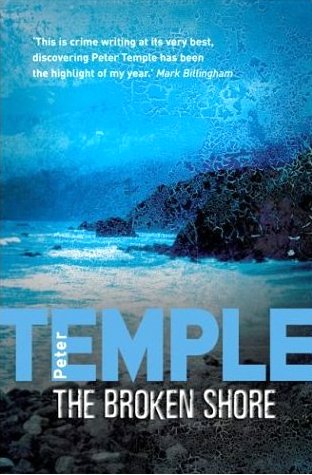
Duncan Lawrie Dagger: The Broken Shore (Quercus), written by Peter Temple (shown above)--a South African-born Australian.

The Ian Fleming Steel Dagger and CWA New Blood Dagger: Sharp Objects (Wiedenfeld & Nicholson), by Gillian Flynn--an American.

CWA Debut Dagger: The Sweetness at the Bottom of the Pie, by Alan Bradley--a Canadian.

Dagger in the Library: Stuart MacBride--a Scotsman.

Duncan Lawrie International Dagger: Wash This Blood Clean from My Hand (Harvill Secker), by Fred Vargas--a Frenchwoman.

What, no Johnny English winners?

Does that mean there’s a crisis in modern English crime fiction?

What will the vicar or the butler think?

This is why I said before that the Dagger presentation has now become a truly international occasion, the United Kingdom this year being represented by a lone Scotsman. (And yes, I already recognize that it would be technically impossible for an English novel to win the International Dagger.)

One of the highlights of last week’s event was Fred Vargas (the pseudonym of French historian, archaeologist, and author Frédérique Audouin-Rouzeau). She must have consumed rather a large volume of wine before she took to the podium to accept the International Dagger Award, for she proceeded to ramble on for 20 minutes, in what at times was a barely coherent rant, about how she had a cunning plan to next year pick up the top award, the Duncan Lawrie Dagger. I think Vargas took exception to being ineligible for that commendation (which is worth £20,000--which works out to roughly $39,000 U.S. or €29,500), as her work is in translation. She said she intended to move to England, learn English, become a naturalized English citizen, and write an English crime novel. All in order to win the Duncan Lawrie Dagger. Vargas added that she was gratified to be following in the estimable tradition of Agatha Christie and Dorothy L. Sayers, and feels deep in her heart an affinity for all things English. Audience members looked at each other in bemusement at this eccentric acceptance speech, and there were roar of good-natured laughter; but at 20 minutes in length, that had to be among the longest such addresses in CWA history.

Everyone who is anyone in British crime fiction was at this dinner, including publishers, agents, authors, members of the press, and numerous crime-fiction aficianados with guests in tow. I took particular delight in meeting the gang from Quercus and exchanging a few words with honored Aussie Peter Temple.

I was also pleased to chat with Stephen Booth, who I hadn’t seen for a while. He was a Dagger in the Library winner a few years back, and so together we congratulated the only British winner of this evening, the very funny Stuart MacBride (Broken Skin), who was genuinely shocked, after penning only three novels, to walk away with that same coveted award from British librarians. (Both authors are shown at left.) MacBride even forgave me for calling him “Stuart MacDonald” for most of the night--a consequence both of my being somewhat drunk, and of having a beared Aberdonian friend with a similar name. Thanks are due here to HarperCollins, which bought the champage with which we toasted MacBride’s victory (though it later fueled my colossal hangover).

Much of that evening was a blur. I remember talking for a time with Labour politician, lawyer, and crime writer Bob Marshall-Andrews, QC, who I first met at Dead-On-Deansgate and have learned to respect for his vigilance against right-wing attitudes in his party. I also had the chance to tip back a few beers with my dear friend Simon Kernick, only party in celebration of his new thriller, Relentless, being picked for the Richard and Judy summer-reading list. Incidentally, the London Times this week offers a special feature on Kernick. You’ll find that here.

As for the rest of this Daggers soirée … Well, I spent it networking and drinking and generally carrying on in fine style. It would take up too much space and bore the britches off most readers for me to list everyone to whom I spoke. But never fear, I shall offer a cornucopia of photographs from the event at Shots, after Mike Stotter and I return from this coming week’s ThrillerFest in New York City.

Friday, September 01, 2006

This Is Becoming a Regular Habit

Australian crime novelist Peter Temple might just have to invest in some more bookcases, should he continue to collect prizes for his writing. Last evening, he snapped up his fifth Ned Kelly Award, bestowed upon him by the Crime Writers’ Association of Australia in honor of his 2005 novel, The Broken Shore. This marks the Ballarat, Victoria, author’s fourth Kelly victory in the Best Crime Novel category (his previous book, White Dog, scored that same award); in addition, Bad Debts, the first entry in Temple’s series featuring solicitor-cum-sleuth Jack Irish, picked up one of two Best First Crime Novel commendations given in 1997.

Temple wasn’t the only one celebrating after the Ned Kelly presentations, which were made during this year’s annual Age Melbourne Writers’ Festival. The Broken Shore, in fact, shared the Best Novel win with Crook as Rookwood, by Chris Nyst, a Gold Coast lawyer turned author.

Here’s the full shortlist of Ned Kelly nominees and winners for 2006:

Best Novel (tie): The Broken Shore, by Peter Temple (Text Publishing), and Crook as Rookwood, by Chris Nyst (HarperCollins)

Also nominated: Rendezvous at Kamakura Inn, by Marshall Browne (Random House); Saving Billy, by Peter Corris (Allen & Unwin); Rubdown, by Leigh Redhead (Allen & Unwin); and Five Oranges, by Graham Reilly (Hachette Livre)

Best First Novel: Out of Silence: A Story of Love, Betrayal, Politics and Murder, by Wendy James (Random House)

Also nominated: Head Shot, by Jarad Henry (Thompson Walker); and Dead Set, by Kel Robertson (Text Publishing)

Best True Crime: Packing Death, by Lachlan McCulloch (Sly Ink)

Also nominated: You’ll Never Take Me Alive, by Nick Bleszynski (Random House); In Your Face, by Rochelle Jackson (ABC Books); Norfolk: Island of Secrets, by Tim Latham (Allen & Unwin); and And Then the Darkness, by Sue Williams (ABC Books)

Lifetime Achievement Award: Andrew Rule and John Silvester

(The original, long list of Ned nominees can be found here.)

Thursday, June 29, 2006

More Crime Across the Pond

Australian crime writer Peter Temple has a new novel out this month, a standalone called The Broken Shore. It’s the story of a homicide detective, Joe Cashin, who escapes city living to become the sole cop in his small hometown, only to have his peace upset quickly by an attack on a prominent local--a crime perhaps perpetrated by members of the area’s Aboriginal community, and sure to unearth the hamlet’s hidden past.

What’s notable here, though, isn’t simply that Temple fans have more to read, but that The Broken Shore comes from a new UK crime-fiction publisher, Quercus. I hadn’t heard much about Quercus, but Ali Karim provides some background in a short feature for Shots. It seems that Quercus was founded by “four ex-staff members from the Orion Publishing Group”--a prominent British house--“including the original founder of Orion, Anthony Cheetham.” The ubiquitous Otto Penzler, he of The Mysterious Bookshop fame, has signed on to help Quercus put together its American mystery list. One of the forthcoming works credited to Penzler’s involvement is Pulp Fiction: The Crimefighters, an anthology of pulp magazine stories from the 1920s, ’30s, and ’40s, including work from Dashiell Hammett, Erle Stanley Gardner, Cornell Woolrich, Raymond Chandler, Frederick Nebel, Paul Cain, and Norbert Davis.

Quercus’ Web site says that its crime-fiction list is to be published as a joint venture with Harcourt, a U.S. house. Yet while several of the Quercus titles, such as Thomas H. Cook’s Red Leaves (new in paperback) and Andrew Klavan’s Damnation Street (the third entry in his Weiss and Bishop series, due out in September), are also appearing under the Harcourt imprint, neither The Broken Shore nor Pulp Fiction seems so far to have a publication date in the States.

UPDATE: Peter Temple wrote to tell me that, in fact, U.S. publisher “Farrar, Straus & Giroux have bought The Broken Shore. Publication is in your spring next year. I’m delighted to be published by such a distinguished house (and by such a distinguished and charming publisher, Jonathan Galassi).”