Showing posts with label Missing Mystery Writers. Show all posts

Thursday, August 20, 2009

Missing No More

Three years ago, when I surveyed Rap Sheet readers to determine which “long-missing crime novelists” they would most like to see producing new books, I tried to contact Martha C. Lawrence. She’d published five novels over six years (beginning with 1995’s Murder in Scorpio), all featuring a San Diego private eye and parapsychologist, Dr. Elizabeth Chase. For her efforts, she received a Shamus Award nomination. But then Lawrence abruptly ... vanished. Or so it seemed. E-mail messages sent in her direction brought no further responses, and her Web page ceased to be updated. I never was able to figure out what had become of her.

On Wednesday of this week, however, a note from Lawrence suddenly reached subscribers to the DorothyL listserv, forwarded by Southern California crime-fiction reader and CrimeSpace member Suzanne Epstein. “Someone was wondering what happened to Martha C. Lawrence ...,” Epstein wrote in introduction to Lawrence’s message. “I have recently communicated with her, and she told me I can share this with you.” (Epstein explained to me in a subsequent e-mail message that “Martha is a Facebook friend of mine, although I’ve known her for many years.”) Here’s Lawrence’s explanation of what she has been up to recently:
Am I writing? you ask. Every day, actually. I’m just not writing murder mysteries.

A funny thing happened to me after 9/11. I was in the midst of writing a big, violence-filled thriller at the time those planes hit the Twin Towers. That was the same week Ashes of Aries was published. Since all the planes were grounded, I did as much of my author tour as I could by car. Two weeks later when I returned to my thriller, I had lost all enthusiasm for a story that was essentially about a gun-toting hero chasing down an evildoer. By that time there was entirely too much talk about hunting down evildoers and I didn’t want to add to that gestalt.

For the past six years I’ve been the behind-the-scenes writing partner of Ken Blanchard, author of such mega-bestsellers as The One Minute Manager, Raving Fans, and Gung Ho! In 2005 Ken was inducted into the Amazon Hall of Fame as one of the bestselling authors of all time--but that’s not why I love working with him. His books are about unleashing people’s power and potential to impact the greater good, to quote Leading at a Higher Level, one of our titles that will be re-released this fall.

Will I write more fiction? I’m sure I will. But having this opportunity to write with a) one of the seminal thinkers of our time and b) one of the most loveable, inspiring human beings I’ve ever met is just too rare an opportunity to pass up.

Please send the good folks at Dorothy L my best. I’m honored that they think of me.

Hugs,
Martha
I don’t know Lawrence well; we simply shared a nice lunch and lots of laughter one afternoon in Seattle, years ago. I liked her. And it’s good to know that she’s still out there somewhere. It gives me hope that we’ll also someday hear whatever happened to other missing mystery makers, such as Karen Kijewski, author of the Kat Colorado series, and William Jasperson, the creator of ex-baseball pitcher, fly fisherman, and sleuth Peter Boone.

Wednesday, March 26, 2008

Doing Time in the Springs

Editor’s note: Last Friday’s unexpected death, at age 62, of California novelist Arthur Lyons (shown below) sent me back into my old files, looking for a transcript of an interview I conducted with him almost 30 years ago and the subsequent correspondence between us. While searching, I also turned up an essay I penned about Lyons and his fictional private eye, Jacob Asch. I remember composing this piece, probably for Stephen Smoke’s short-lived Mystery magazine (to which I’d submitted other pieces), but don’t think it was ever published. Judging by my reference to Lyons’ approaching 36th birthday, I must have written this sometime in late 1981. It shows some of the editorial rawness of my youth, but still provides a decent overview of Lyons’ career and fictional output up to that point. I’m posting the article below, in hopes that it will inspire younger readers and others who haven’t been exposed before to this author’s once-praised stories to search them out and enjoy them now. There can be no greater tribute to a writer than to read his or her work.

* * *

As we swing through the streets of Palm Springs in his little Italian sports car, Arthur Lyons talks about the hidden side of this desert town, about the cocaine trade and high-priced prostitution.

“The tourists don’t see the half of it,” he explains, turning down a quiet street and passing a clutch of well-tanned teenagers. “They see the fancy stores and Elvis Presley’s house. They don’t see the rest, but the crime is here.”

This town presents a different image to a casual observer. On its surface, Palm Springs has all the trappings of wealth, privilege, and stability. Its streets are decorated with chic boutiques and restaurants that cater to every taste and bank balance. Society soirées up on Frank Sinatra Drive and elsewhere are well attended, usually by people you just saw on The Tonight Show and by aspiring starlets clad in more diamonds than duds. Coming in off the purgatory of the surrounding desert, this burg is a flamboyant oasis to which the rich and retired retreat, leaving sparkling slicks of suntan lotion on heart-shaped swimming pools.

The idea that such a place could have a clean face but dirt around its ankles must be appealing to somebody with a perverse picture of modern society. Somebody like Lyons. It’s a perfect spot for a mystery novelist to live, a microcosm of modern California life--nice but a little bit nutty now and then, proper yet not above testing the limits of morality when the moment suits.

Here Lyons thrives. The author of seven novels featuring private eye Jacob Asch, he needs societies with depth, complexity. In the same way that Asch wanders the streets of Los Angeles in search of murderers and bent politicians, Lyons prowls the alleys of contemporary behavior and style in search of the profound statement and the ideal analogy. Drawing on his experience in this desert microcosm, he sees with an irreverent eye. People become caricatures and cities are reduced to profane simplicity.

In Dead Ringer (1977), his client
looked as if she had pushed well into her sixties, although she was not ready to admit just how far. Her platinum hair sat on her head like a swatch of bleached cotton candy. She wore a lot of makeup, but none of it was having the effect she hoped. Her false eyelashes only made her small eyes look smaller and narrower than they were; her plucked and repenciled eyebrows drew attention to her prominent brow and the bright-red lipstick only managed to make her thin lips look even thinner. But there was something underneath the makeup and the flamboyant pink pants suit that made it all something less than pathetic. Something in the way she stood or maybe the cool, cynical confidence in the shiny, indestructible eyes that straight-armed you and said: “Don’t worry about it, buddy, I can still take care of the likes of you,” and you knew she probably could.
Earlier, in The Dead Are Discreet (1974), his first novel, Lyons writes that Hollywood in the daytime is “like a man in the advanced stages of syphilis who has been caught with his pants down.”

Evocative writing. No question about that.

What Lyons picks up from his world seems very much like what California crime novelists have been describing for the last 50 years. So, naturally, critics have likened Lyons to people such as Raymond Chandler and Dashiell Hammett. Many point to the way he uses language, his settings and his philosophies, and say, “My God, we’ve found a successor to the Old Masters.”

But while such comparisons can be made, they’re often made without due consideration or thought to the consequences. Sure, they sound good in The New York Times or in blurbs on the backs of books, but they might prove harmful in the long run, affording this author too little credit for creativity and only narrow leeway for development.

Like several other modern detective-fiction writers, including Robert B. Parker and Gregory Mcdonald, Lyons is suffering from what might be termed “The Crown Prince Syndrome.” The critical clerisy watches his work closely for flaws; they like his style the way it is, and don’t want it to change. If he slips up and writes a book of admittedly lesser quality, or dares to try reworking his hard-boiled form, those commentators might jump on Lyons faster than they would on somebody else. He is an heir-apparent to the throne of hard-boiled mysterydom, after all, and as such he’s expected to adhere to the rules of the game.

There must be some old saying to describe Lyons’ dilemma, something on the order of “Nobody can be toppled quicker than the man at the top.”

What’s worrisome is that Arthur Lyons isn’t the crown prince type. Thirty-six years old in January, he’s a muscular blond with an easy-going style and a mouth full of clever lines. On the morning I meet him in Palm Springs, he’s suffering the painful half-existence of a hangover. Last night, he went out for a good time and some casual affection. But the partying ended when a minor-league Marlboro Man tried to test his pugilistic talents. Lyons walked away from the fight, pissed off and without the lady he says he “could’ve made if I’d stayed with it.”

All of this goes to prove that Lyons isn’t Mr. Macho of the Year, no matter what he looks like. He’s just a writer and a businessman. His background is in the restaurant trade. Taking the lead from his parents, he now manages a pair of eateries in downtown Palm Springs, Lindy Lou’s and the swanker Lyons English Grille. Of course, his business hasn’t left him a lot of time for creative writing--but it hasn’t stopped him from writing, either.

His first book was a non-fiction study of Satanism and cult development. Titled The Second Coming: Satanism in America (1970), the work gained its author critical praise, the position of occasional consultant to law-enforcement agencies working cult cases, and more than one good idea for his fiction.

The Dead Are Discreet was a direct outgrowth of the research he’d done on cults and ritual murder. A well-paced, if still rather unrefined, entry into the mystery-fiction genre, The Dead Are Discreet involved the Los Angeles drug scene, kinky sex, and the occult. Private eye Jacob Asch was hired by a lawyer to discover whether his client was guilty of murder, but found more than he’d asked for in the way of brutality and deception.

Asch in that first story was a 34-year-old ex-newspaperman, divorced with no children and an uninspiring history (not unlike Ross Macdonald’s Lew Archer in his own premiere adventure, 1949’s The Moving Target). “Your father was a tailor who had a little shop down on Fairfax,” a woman reminds him in the course of that tale. “You graduated from Fairfax High School and then went on to UCLA and quit after two years. You started working for the Chronicle in 1960 and were let go in 1969 after being jailed for refusing to reveal your news sources on a story you did. Since that time, you’ve been working as a private detective.”

Asch had been incarcerated after doing a series of articles on an armed-robbery case. “I had dug up evidence that the prosecution’s star eyewitness had been sixty miles away from the scene of the crime on the day in question,” the gumshoe explains early on. Like Myron Farber, the New York Times reporter who was jailed for withholding the names of his sources in a 1978 murder investigation, Asch did the honorable and ethical thing, but isn’t remembered as a hero. He was instead blacklisted in Los Angeles press circles for long enough, that he hasn’t been all that interested in going back to a Fourth Estate job since.

“Doing time” in L.A.’s New County Jail left Asch an interesting psychological specimen. The experience seems to have weakened a bit of his confidence. He was frightened by prison (easily understood) and has no qualms about admitting to it:
I was not one who handled jail well. Spending six months in County had left emotional scars on me that split open every time I got near a cell, never mind in one. I’d never been claustrophobic before then, but six months had left me that way.
As a detective, Asch is a deliberate plodder, much as he must have been during his reporting days. Rather than fight his way through an investigation, breaking arms and bashing heads to collect information, he hangs out in county records offices and libraries, pouring over title deeds and marriage certificates in search of the clues that could break open his latest case. Still, he retains a certain unspoken toughness that clients often find helpful. “You want me on this case because you want somebody who can wade through it up to his eyeballs and not puke from the smell,” he tells one employer.

Although he avoids violence whenever possible--just like his creator--there’s an inner anger in Asch that comes out when he’s pushed too far. In Lyons’ second novel, All God’s Children (1975), the story of Asch’s pursuit of a missing girl who has fallen in with face-stomping bikers and Jesus freaks, the sleuth’s patience is tested over and again. In a final effort to regain control of his situation, Asch runs his car headlong into a biker who tries to block his path. The tough guy is flung up onto the hood of the car, and stays there for a while, clinging to the windshield wipers in desperation. All the while, Asch seems to enjoy the hazardous exhibition:
My attention was focused on the face staring at me through the windshield, shouting for me to stop. I accelerated to fifty and jerked the wheel back and forth, sadistically savoring the abject terror in the face as the car swayed from side to side.
All in all, Jacob Asch is probably a very frustrated man. Too many times his spirit has been broken and his dreams flogged. He’s tired of always fighting so hard for things and of the loneliness that seems a permanent pattern in his life.

Unlike many of his contemporaries, Asch doesn’t have phalanxes of beautiful women flinging themselves at his clean bedsheets. He rarely wakes up in the morning with the obligatory note left in reminder on his spare pillow. Only once (in 1979’s Castles Burning) do I remember him lamenting the loss of a recent lover. He doesn’t even have stunning clients waltzing through his office door. In Hard Trade (1980), for instance, Asch is hired by a “Munchkin” of a lady who wants him to run a check on her betrothed. The detective doesn’t seem to mind, though, that she is less than a looker:
Marlowe and Spade could keep the breathless blondes, I thought. They were nothing but trouble anyway. I’d take the Munchkins any day. There were no legs to get distracted by and I didn’t have to wait for the check to clear.
Asch accepts his troubles better than many of his predecessors. He isn’t always feeling sorry for himself the way others do. Well, maybe once in a while ... Most of the time, though, he directs his energies to his cases, plowing as fast as he can through the crimes, even popping speed when he needs it to keep going.

His investigations are certainly outré enough to keep him interested. In The Killing Floor (1976), he’s hired to find the co-owner of a meat-packing business whose gambling problems may have led to his sudden disappearance. Dead Ringer, which author Lyons declares to be his “best book,” places Asch in the testosterone-pumped world of professional boxing. A brassy whore wants him to protect an Argentinean prizefighter who has been receiving threatening phone calls. And in Castles Burning, the detective sets out to find the wife and son of an artist who abandoned his family eight years before. Asch traces the wife to Palm Springs, but the case doesn’t simply end there. Before the book’s closing pages, Asch is offered murder and kidnapping to spice up his life.

Just like his contemporaries, the author of these books is given to elaborate scene setting. Although often more crass and explicit than someone like Chandler, Lyons’ storytelling style is nonetheless refined and provides some wonderful imagery. The kick-off to Castles Burning, when he describes a bizarre painting, is at least equal to the much-respected opening scene in The Big Sleep (1939):
The blonde was bent over the chair, precariously balanced on ten-inch platform heels, looking at me through her legs. Her miniskirt was hiked up past the tops of her black nylons, exposing a patch of purple-pantied pudenda, and she wore a faintly surprised expression on her face, as if she had been expecting someone else. She may have been at that, but I had the distinct impression that as long as I had my wallet with me, I could have been the Hunchback of Notre Dame. She looked as if she would be a good sport about little things like that.
Lyons has been criticized for being too explicit in his image-making, for explaining just what a mutilated corpse looks and smells like, or for expressing his anger in a torrent of four-letter words. But for most of us, his blatancy is refreshing.

He makes use of short sentences and simple words to draw you quickly into a scene. “Vernon stinks,” he writes in The Killing Floor. “It always stinks.” That’s a fine base for further description.

It took years for Arthur Lyons to gain much of a following. Part of the fault for that may be that the critics, while enthusing over his California style and witty phraseology, made the books sound like nothing new in this genre, like imitation Chandler or wannabe Hammett. Who wants to read something that’s a close copy of the classics, no matter how much they might enjoy the classics? More of the fault may lie with Lyons himself. The extent of his writing and plotting talents only really began to show through with the publication of The Killing Floor. Now, he insists, he’s starting to enjoy something of a cult following. There’s even talk of a TV movie being made from Castles Burning, which might lead to a series. Maybe he can fit that in around his writing of more Asch adventures--a couple more of which he’s already noddling over.

Life for a crown prince is hectic. Between restaurant management, novel writing, and nursing the occasional hangover, there’s not much time for Lyons to be worrying about thrones. Besides, out amidst the lush palm trees and desert winds of Southern California, a crown would only make his head sweat.

* * *

A full rundown of Arthur Lyons’ Jacob Asch series:

The Dead Are Discreet (1974)
All God’s Children (1975)
The Killing Floor (1976)
Dead Ringer (1977)
Castles Burning (1979)
Hard Trade (1981)
At the Hands of Another (1983)
Three With a Bullet (1984)
Fast Fade (1987)
Other People’s Money (1989)
False Pretenses (1994)

READ MORE:Arthur Lyons, 62; Detective Novelist and Founder of Palm Springs Film Noir Festival,” by Mary Rourke (Los Angeles Times); “Last Exchange with a Literary Lyon,” by Mark Coggins (Riordan’s Desk).

Monday, March 24, 2008

Lyons Ends His Roar

Somebody said to me not long ago that the majority of her regrets pertained to things she had done during her life. I admitted to the opposite--that most of my regrets are related to things I did not do, chances I did not take, people I did not get to know better. I was reminded of that conversation this morning, as I read at Jiro Kimura’s The Gumshoe Site about the unexpected death, at age 62, of detective novelist Arthur Lyons, the creator of Los Angeles gumshoe Jacob Asch. He and I had been planning to do a telephone interview in the near future, but I’d had to put it off while trying to finish a non-fiction book about San Francisco’s history. I guess our conversation is now off permanently. The Desert Sun, covering the Palm Springs, California, community in which Lyons lived, provides the basic facts of the case:
Arthur Lyons, a man as colorful as the characters in his film noir books and films, died early Friday at Desert Regional Medical Center at age 62.

Part of the family that owns and operates Lyons English Grille in Palm Springs, he was a former city councilman, co-founder of the Palm Springs Festival of Film Noir and a popular writers conference, and a successful novelist and nonfiction writer.

His wife, Barbara Lyons, said he suffered head injuries from a fall and had a stroke this past week.

A private celebration of his life is being planned at his home.

“He’s really been a force in this community for a long time,” said Camelot Theatres owner Rozene Supple, who hosted Lyons’ Film Noir Festival.

“He was always great to work with and we hope to continue the Film Noir Festival indefinitely.”

Barbara Lyons said her husband had already booked the films for this year’s festival, May 29-June 1.

“This is going to be a tribute to Arthur,” she said. “He had everything in line.”
I was lucky enough to meet and interview Lyons in November 1980. Not long out of college, and only months after I’d taken a bus from my home in Portland, Oregon, down to Santa Barbara, California, to talk with distinguished private-eye fictionist Ross Macdonald, I hopped aboard another bus headed south. This time my destination was the chic desert town of Palm Springs. By then Lyons had written five novels featuring Asch, a half-Jewish newspaper reporter turned private eye. The most recent of those was Castles Burning (1979), but it would soon be followed by Hard Trade (1981).

The blond and muscular Lyons was then just reaching his 35th birthday, as I remember, and he greeted me cordially. My memory is that we started out talking at his well-appointed trailer home, sharing glasses of white wine, but eventually moved to dinner at his family’s restaurant. I had packed along a tape recorder, and wound up with several tapes of terrific material, most of which I published as an interview in Willamette Week, an “alternative paper” in Portland. We talked about Lyons’ early and frustrating efforts to publish science-fiction short stories. (“I wrote to a throwaway, mimeographed little magazine in Regina, Saskatchewan--I don’t even remember the name of it,” Lyons said. “And the guy wrote me a letter back saying, don’t ever send him anything again; it was the worst story he’d ever read in his life, and I had the nerve to send him this.”) We discussed the dubious value of censoring violence in crime fiction. (“To portray violence in a non-violent way, to me, is doing a disservice to people, because that’s when you start getting people responding to violence. The whole thing on TV about not showing violence, cleaning it up, is more harmful, I think, than making somebody ill with it.”) We talked about the need for at least some realism in fictional portrayals of private investigators. (“You’ll never find Asch doing anything unlikely. He will not usually find stuff through coincidence. He’s a plodder. That’s what private detection is, going through papers. All of Asch’s cases come out of paper. He works with paper more than he does people, whereas in Ross Macdonald and with most of those guys, they do it with information people tell them. But there aren’t too many people out there who are going to spill their guts to an investigator, unless the guy has a handle on what’s going on.”) And I asked Lyons at one point whether he saw a resurgence of the hard-boiled hero in detective stories. His response (most of which didn’t make it into print):
If so, it’s because people want to fight back. They’re tired of being victimized by the violence of people who have decided to be predators. That’s why we’re going to see a resurgence of capital punishment. Consequently, there probably is a resurgence of the hard-boiled hero, because people would love to punch a few faces in, and the only way most of these people are ever going to do it is through literature and through the movies. They’d be scared to do it in real life. This is not an age for Agatha Christie.

The anonymity of society also makes it worse for people. The cultic response is a searching for power. I don’t believe, like Ross Macdonald and the Freudians, that sex is the major driving force in our lives. I think it’s power. ...

There was a story I wrote into The Dead Are Discreet [his first novel, published in 1974], the best cop story ever. A guy in the [Los Angeles Police Department] with the most kills on the force, told me how he and his partner went down to El Dorado [Street], or something, where they were getting little old ladies mugged, all over 60 years old. So this guy puts on hose with hair sticking through, high heels, [and] a gray wig, and he and his partner [dressed in a similar way] get their little shopping baskets and go down there between 9 and midnight. One guy’s walking down one side of the street, the other goes on the other side.

Finally, they’re walking down and this car pulls up slowly on one of them and [the man inside] says, “Hi, honey, why don’t you get in the car?” And the cop looks in and the guy isn’t the guy they’re looking for, so he says, “Fuck off,” and he keeps walking up the street. And [the cop] says the car sat there idling for a second, then just tore away from the curb. It goes screaming up the street at about 50 miles an hour, flips a U, jumps two wheels on the other side of the sidewalk, and starts mowing down parking meters heading at the back of his partner, who’s just walking on the other side of the street. Bang, bang, bang, bang go the parking meters.

The cop says, “I grab my purse, and I shake the goddamn .357 out and go into a stance and open up. My partner hears the roar of the motor behind him, he jumps into a doorway and takes out his .357 and starts pumping into the car. You should have seen the look on this guy’s face, two old ladies opening up on him from two sides of the street.” They caught him in Hollywood five minutes later, which means he was going 120 through the city streets. They pulled him over, goddamn bullet holes all over the car, and they asked why he did it. He said he’d gone from bar to bar all night long, trying to pick up a girl, and everybody kept shutting him down. He saw this “old lady” on the street, and that was his last resort. He says, “When she told me to fuck off, I saw this other one on the other side of the street, and said, ‘I’m going to kill her.’”

That’s how ineffectual we all feel.
As I read through The Desert Sun’s account of Arthur Lyons’ life and career, as well as the reader comments attached to it, I learned several things I didn’t know before about this author. For instance, how he served for four years on the Palm Springs City Council. How he was given a star on the Palm Springs Walk of Stars last May. And that he was married--and a grandfather, to boot. When I talked with Lyons 28 years ago, he was definitely a bachelor enjoying the blessings of serial female companionship. I was reminded of his books, not only the 11 Asch novels (beginning with The Dead Are Discreet and concluding with 1994’s False Pretenses), but also his non-fiction works about Satanism and film noir. Kimura’s brief obituary recalls that during the time he was still writing the Asch adventures, he took time out to pen a couple of non-Asch novels (Unnatural Causes and Physical Evidence) with former Los Angeles County chief medical examiner-coroner Thomas Noguchi. And one of his Asch books, Castles Burning (1979)--which I chose last year, for a special Rap Sheet feature, as the “most unjustly overlooked, criminally forgotten, or underappreciated” crime novel in memory--was made into a 1986 TV movie called Slow Burn, starring Eric Roberts as Asch. I don’t think I have ever seen Slow Burn, but Lyons seemed high on it in a note he wrote me in the early ’80s:
There is additional good news. Universal [Studios] has optioned CASTLES BURNING with the view of a two-hour pilot for a TV series. They would be putting Jacob Asch in Palm Springs permanently and we would be shooting down here. I’ve come to terms with them and would be acting as script supervisor, location advisor, et. al, as well as doing the screenplay for the pilot with Joel Schumacher, who would be producing the show. (He did “The Incredible Shrinking Woman” and “Amateur Night at the Dixie Bar and Grill.”) Of course, all that means nothing if the networks don’t bite, but with Universal behind it, we’ve got a better shot. The only trouble is, all three networks’ time slots are just filled to the brim with stupid, gimmicky, pure-shit detective shows. When will they learn and go for quality and not quantity? Are we forever doomed to be subjected to “Charlie’s Angels”?
Unfortunately, despite Schumacher’s involvement, Slow Burn didn’t spark any enthusiasm with the networks. You can still buy it on videotape, however.

After hearing this morning about Lyons’ demise, I dug out my file on him, filled with newspaper reviews of his books, a pencil-marked transcription of our long-ago interview, and a profile of him and his work that I wrote but apparently never published. There were also a couple of black-and-white studio shots of him from the early 1980s, one of which I have installed at the top of this post. Back then, I imagined Lyons becoming a star of the genre, right along with Robert B. Parker, Stuart M. Kaminsky, Stephen Greenleaf, and Tony Hillerman. Yet he disappeared from the world of crime fiction during the early Clinton era, turning his attention instead to film.

Over the last two years, though, I’ve been reminded of Arthur Lyons on a number of occasions. The first time was in the fall of 2006, when we polled Rap Sheet readers to find out which long-missing crime novelist they would most like to see turning out new books again. While Lyons’ wasn’t the name most often mentioned (that honor went instead to Jonathan Valin), he ranked high among the runners-up. His name was highlighted most recently for me when author Mark Coggins (Runoff) wrote a series of posts for this page about the short-lived, 1980s resurrection of Black Mask magazine. The first issue of The New Black Mask featured a short story, “Trouble in Paradise,” by Lyons. In it, Coggins explained, “Lyons’ Los Angeles gumshoe, Jacob Asch, investigates the scuba-diving death of the son of a wealthy commodities brokerage firm owner. Although he had eight novels to his credit at the time it was written, ‘Trouble’ was the first Asch short story Lyons had written.”

During the course of my editing Coggins’ series, he and I talked about the possibility of my finding Lyons again and talking him into a new interview, 28 years after my original one. With Coggins’ help, I found an e-mail address for the author, and shot off an invitation, hoping he would remember me from Willamette Week. His reply was quick and encouraging. He said that “I am still writing, but I am writing a new character.” And though he insisted, “I hate computers and e-mails,” he gave me a telephone number at which I could call him sometime. “I would be more then happy to answer all of your questions,” Lyons wrote in conclusion. I immediately dashed an e-mail note back, saying I would be contacting him as soon as I was finished with or at least nearing the end of my San Francisco book.

I was still looking forward to doing that interview when I read of Arthur Lyons’ passing.

Detective fiction has lost a once-important contributor. Palm Springs has lost a favorite son. Film noir has lost a champion. I regret now not having jumped on the chance to interview Arthur Lyons again. And there’s nothing I can do to change that.

Talk about feeling ineffectual ...

UPDATE: The Desert Sun reports that “A celebration of Arthur Lyons’ life will be held from noon to 5 p.m. [on] April 5 at an ‘intimate gathering of special fans, friends, and family’ at the Lyons home in Palm Springs … Anyone interested in attending can RSVP at [760] 864-9760.” I wish I lived anywhere nearby, and could attend.

READ MORE:Death Noted: Arthur Lyons (1946-2008),” by Steve Lewis (Mystery*File); “Arthur Lyons, R.I.P.,” by James Reasoner (Rough Edges).

Saturday, August 04, 2007

Farewell to Rodney

Earlier this week, Essex-based crime writer Mike Ripley (creator of cab-driving P.I. Fitzroy Maclean Angel) brought the sad news that Rodney D. Wingfield, another Essex man and the author of the Jack Frost mysteries, had died. Not long afterward, Scottish writer Stuart MacBride told us how sad he was to hear of Wingfield’s passing after a long and very private bout with cancer. Later in the week, I had a chance to speak with Ripley, and I could see how devastated he was by the loss of his old colleague.

It was only right that Ripley should have written Wingfield’s obituary, which appears in today’s edition of The Guardian. After recapping the author’s hesitancy about a television adaptation of his Frost novels, starring David Jason, Ripley gives a bit of background on Wingfield and his fiction:
Born in Hackney, Rodney attended the Coopers Company school in the East End and was, along with the entire school, evacuated to Frome in Somerset during the second world war. After junior office jobs with a furniture company and in the Port of London docks, he became a clerk in the sales offices of the Fina oil company, while devoting his spare time to writing short, one or two-act plays.

In 1968, BBC Radio Drama bought his 45-minute play Compensating Error, and swiftly commissioned two more. After three well-received broadcasts, Rodney gave up the office job and for two decades provided BBC radio with a steady stream of 45- or 60-minute dramas, noted for clever plot twists and surprise endings. He also tried his hand at pure comedy, writing a radio series for Kenneth Williams (obituary, April 16 1988) in the role of a secret agent.

But it was Rodney’s reputation as a craftsman of mystery stories featuring small-time criminals and multiple plot lines that brought him to the attention of publishers Macmillan. In 1972, they offered him a £50 “non-returnable” advance for a crime novel. Rodney, who was to say later that he had been spurred on by the word “non-returnable”, duly obliged with Frost at Christmas, which Macmillan promptly rejected.

Loathe to abandon his laconic, chainsmoking detective, Jack Frost, Rodney recycled the character into his radio work in the play Three Days of Frost in 1977, with Ronnie Barker (obituary, October 5 2005) pencilled in for the lead. Television commitments meant that Barker was unavailable, so the role of Frost was taken by Leslie Sands (obituary, May 23 2001), whose performance was to remain Rodney’s favourite.
It took 12 years for Frost at Christmas to be published, as it eventually was in Canada. And by then, Ripley explains, “Rodney had used the character in another radio play, A Touch of Frost, which he turned into a second novel in 1990. There followed Night Frost (1992), Hard Frost (1995) and Winter Frost (1999), though Rodney described himself as “a reluctant author ... thoroughly disenchanted with the grind of writing full-length novels.” (A sixth entry in the Jack Frost series, A Killing Frost, will be published posthumously in Great Britain next spring.)

Having known Wingfield well, Ripley reveals in his obit a picture of the author who, to most other people, seemed an eccentric recluse:
A very private man, [Wingfield] avoided the usual round of publishing and show business parties, choosing to keep in touch with friends and colleagues by regular, often scurrilous, faxes and then emails. He was rarely photographed, and an Italian edition of one of the Frost books, following a mix up in translation, carried an author photograph on the jacket of Kenneth Williams.

Rodney had a stubborn streak, and relations with publishers and BBC radio producers could be strained. After one dispute with the BBC in 1984, he submitted the highly regarded six-part serial The Killing Season under the name Arthur Jefferson (the real name of Stan Laurel). His last broadcast play was Hate Mail in 1988, after which the Frost novels occupied him completely.
You’ll find Ripley’s full tribute to R.D. Wingfield here. And to read the London Times obituary of the author, click here.

Sunday, October 29, 2006

The Please-Come-Back Kids

So, which long-missing crime novelist would Rap Sheet readers most like to see publishing new books again in the near future?

The answer, according to a recent online survey, is ... Jonathan Valin, the Ohio-born, Shamus Award-winning author of The Lime Pit (1980) and 10 subsequent books featuring Harry Stoner, a tough, brooding, but thoroughly appealing Cincinnati private detective once touted as “the Philip Marlowe of the eighties.” Of the 105 votes cast, Valin received 18. The five closest runners-up were: Stephen Greenleaf (16), Martha C. Lawrence (15), R.D. Wingfield (14), and Karen Kijewski and Arthur Lyons, both of whom secured 12 votes apiece. (To take a gander at the complete Rap Sheet poll results, click here.)

Unfortunately, none of this is likely to convince Valin (shown above, in a photo from the back jacket of The Lime Pit) to re-enter the crime-fiction-writing game. His last Stoner book was Missing, which came out way back in 1995, and caused New York Times crime-fiction critic Marilyn Stasio to coo of Valin: “He is 100 percent dependable. He can plot a story and give it an ironic twist at the end, his characters have a kink or two, and he always tosses in a moral issue to give one pause. The voice of his narrator, a Cincinnati gumshoe named Harry Stoner, can be stern, but never mean or nasty.” The great George V. Higgins was no less effusive in complimenting Valin. “He is the best thing to emerge from Cincinnati since Johnny Bench,” Higgins once remarked. Yet Stoner himself went missing 11 years ago (somehow failing to prompt the usual APBs), and there have been only sporadic reports about his creator during the past decade. One, published in The Cincinnati Enquirer in 2000, found the novelist trying to explain why he needed to get away from his fictional P.I. after almost a dozen books:
“I had a feeling back after I finished Missing ..., that I was starting to repeat myself, that I wasn’t bringing anything new to Harry. All writers write from a mass of experience, and I wasn’t experiencing anything sitting in front of a computer night and day, day in and day out ...

“So, I left Harry with a decent shot at happiness. I had toyed with killing him, but instead I found him a woman and had him thinking about marriage. Then I went on to something else.”
That “something,” explained the paper’s Jim Knippenberg, was a music-criticism magazine Valin helped found, called Fi (“as in Hi-Fi”). “My notion was to put all types of music--classical, jazz, rock--under one tent,” the author told Knippenberg. “We were close to making it work. It was a wonderful magazine but we ran out of money.” Nonetheless, Valin continues to write about music and audio technology; he’s listed on the masthead of The Absolute Sound, an Austin, Texas-based mag, as a senior writer (though his name is misspelled, at least in the online version, “Johnathan Valin.”) And, as he told the Enquirer, he hasn’t completely given up writing novels. “I owe my publishers a novel and I’m sure they’re wondering where it is,” Valin said in 2000. “I started one four years ago, but it’s not even close. I don’t like to talk about it because, like all writers, I hate to talk about works in progress.” Unfortunately, the author explained that this very incomplete book was “a non-Stoner” novel.

So, that’s the last we’ve seen of Harry Stoner, his beat-up Pinto, and his office in Cincinnati’s Riorley Building? Maybe not. In that same Enquirer piece, Valin--who’ll turn 58 next month--said that his detective protagonist remains on his mind:
“I used to pretend he was an invention, but I realize he’s a lot like me. He’s a loner and so am I. Neither of us is particularly social. We both love the city, but it’s a love/hate thing. ...

“If he comes back, and I really think he will, so maybe I should say
when he comes back, maybe in a year or two, he’ll be older, wiser and still the knight errant. But I’ve changed and so has he.”
Change. Goddamned change. It can be a character killer. Sometimes, as with Valin, the decision to leave a popular protagonist behind is the author’s. (That might also have been the case with A.E. Maxwell, the husband-wife team who ceased writing about a Los Angeles-based troubleshooter named Fiddler after their eighth book, Murder Hurts, came out in 1993. The Fiddler novels are now set to be reissued.) At other times, though, abandoning a fictional sleuth midway through a series is the result of publisher disinterest, brought on by low or stagnant book sales. In an interview with Mystery*File, Stephen Greenleaf, a lawyer turned novelist who penned 14 novels starring San Francisco P.I. John Marshall Tanner, beginning with Grave Error (1979), explained that his “retirement” from crime-fiction writing “was more forced than elected. When no publisher was willing to bring Strawberry Sunday [1999] out in softcover, even though it had been nominated for an Edgar, I knew Tanner’s day was done. Luckily I was able to write Ellipsis [2000] as the last chapter in the saga, and allow its subtext to suggest the reason my series had come to an end. I don’t see any need (or much demand) for the Tanner series to continue.”

In a recent posting to the listserv Crime Thru Time, historical mystery writer I.J. Parker (Black Arrow) reiterated the daunting challenges facing non-best-selling fictionists:
The disappearance of series authors just when readers are beginning to catch on is a problem not only for the other sub-genres but for historical mysteries also. Without the sales, the books will not stay in print. Without reader demand, they will disappear. Publishers no longer have the patience to wait out the reading public’s slow response. And publishers do not promote, except in rare cases or for already best-selling authors. These days it’s nearly miraculous for a new series to stay in print for more than 2 books. It takes at least 5 to establish the author’s name so that a new reader will pick up a book in the store.
No wonder Rap Sheet readers, many of whom are novelists themselves, responded so enthusiastically when we asked them to choose their favorite among 10 crime writers who haven’t been heard from in a while (but also haven’t died). Like Parker, they know that you can be gathering an Edgar or Anthony one day, and be denied a future publishing contract only months later. There’s simply no guarantee of success, even if you’re as frequently touted as, say, Arthur Lyons (creator of the Jacob Asch series), or show as much promise as Martha Lawrence, who managed to produce five books featuring San Diego private eye and parapsychologist Elizabeth Chase before suddenly disappearing from bookstores.

The uplifting thing about The Rap Sheet’s first online survey was to see how many readers continue to care about these missing mysterymakers. What was discouraging was to be reminded of how many other authors weren’t included on our original list of 10. We had forgotten, for instance, about Jerome Doolittle, who turned out half a dozen books (beginning with Body Scissors, 1990) featuring a quirky, unlicensed Cambridge, Massachusetts, P.I. named Tom Bethany before hanging it up. And what of Robert Irvine, who wrote about an ex-Mormon gumshoe in Salt Lake City, Utah, by the name of Moroni Traveler (Called Home, Pillar of Fire)? Or the Shamus-winning Lia Matera, who concocted seven books around a young San Francisco attorney named Willa Jansson (the last being 1998’s Havana Twist) before falling out of sight? Or Seattle’s Frederick Huebner, who turned out five books starring attorney Matthew Riordan (the last being 1994’s Methods of Execution), plus a non-series novel called Shades of Justice (2001), before joining Matera, Irvine, and the rest on mystery’s MIA list?

Rare are the novelists, such as Timothy Harris, creator of Los Angeles private eye Thomas Kyd, who return after a decade or more to pick up with their protagonists where they left off. (In 2004, Harris introduced his third Kyd novel, Unfaithful Servant, 25 years after its predecessor had been published.) But small miracles do happen. We’ve been hearing, for instance, that R.D. Wingfield, whose last novel about grumpy British Detective Chief Superintendent Jack Frost was Winter Frost (1999), has another Frost foray in the works, in which the aging cop might finally sever his association with the police. Such stories give us hope that other absent sleuths will also someday come out of hiding.

Are you listening, Mr. Valin?

Tuesday, October 17, 2006

Back for an Encore Performance ...

As most of you probably know by now, The Rap Sheet is conducting a poll that asks readers to vote on which of 10 long-missing crime novelists they’d most like to see producing new books again.

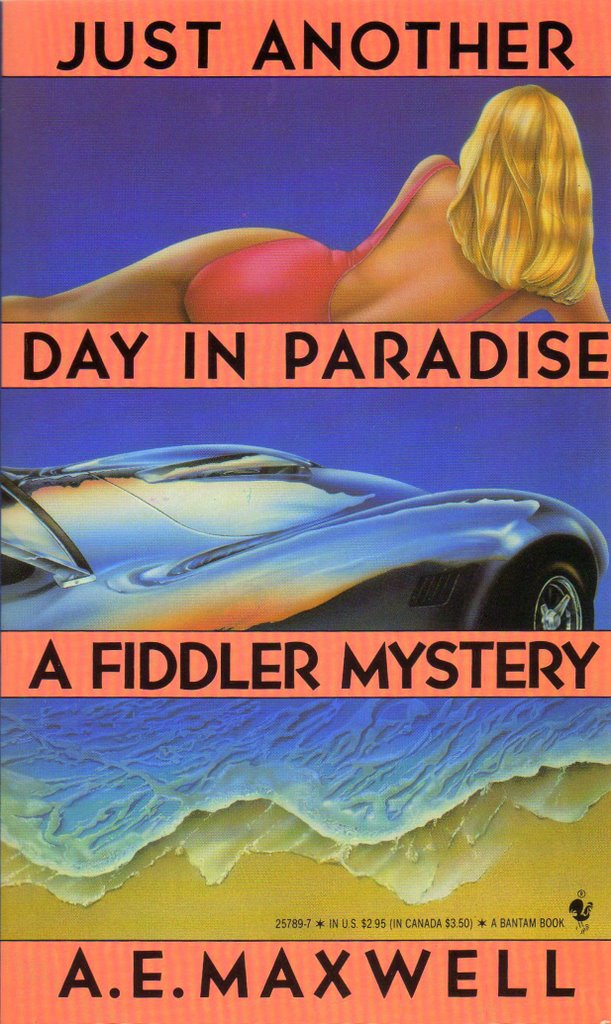
Among the choices is A.E. Maxwell--the joint nom de plume of Ann and Evan Maxwell--who published eight action-filled books about a Los Angeles-based troubleshooter named Fiddler (beginning with Just Another Day in Paradise, 1985), before effectively disappearing after the publication of Murder Hurts in 1993 (although former Los Angeles Times reporter Evan has turned out at least a couple of novels on his own since, Ann continues to write romance novels under the pseudonym “Elizabeth Lowell,” and together they’ve produced suspense stories under the name “Ann Maxwell”).

Now, however, comes word that Busted Flush Press, the Houston, Texas-based publisher best known recently for bringing to print Damn Near Dead, Duane Swierczynski’s anthology of “geezer noir,” is going to republish what BFP owner David Thompson calls the “very underrated” Fiddler novels. Explains Thompson: “My plan is to reprint all eight Fiddlers in four omnibus editions, starting with Just Another Day in Paradise and The Frog and the Scorpion in the spring [of 2007].” Might this lead to the Maxwells resurrecting Fiddler and his investment banker ex-wife, Fiora Flynn? “At this time,” Thompson explains, “they’re not interested in doing more Fiddlers, but maybe I can sell so many, they’ll change their mind.”

Which would be good news, indeed. I have fond memories of the Fiddler and Fiora novels, even if former smuggler and sometime private eye Fiddler (whose first name was never revealed, and whose moniker may in fact have derived from his onetime fondness for a certain stringed musical instrument) could be rather inhumanly tough at times; and even though “torchy” Fiora’s evolutionary re-entry into her ex’s life meant that Fiddler’s sexy dalliances with other women ended after a few installments of this series. Regardless of whether the Maxwells can be persuaded to turn out any new Fiddler novels, rediscovering their old ones could be time well spent in 2007.

Saturday, October 07, 2006

The Case of the Missing Mystery Writers

OK, so we’re experimenting with something new here at The Rap Sheet. For a while now, I have been trying to figure out how to integrate Internet polling software into the site, and I finally stumbled across a simple method, thanks to Jeri Westerson’s blog. Provided free of charge (at least for the time being) by an enterprise called Pollhost, the software makes it possible for us to post, monitor, and change at will surveys related to books, authors, and other crime-fiction-related subject matter.

My first try at what I hope will become an amusing, irregular addition to this blog can be found in a silver box at the bottom of the right-hand column. The poll there asks: Which long-missing crime novelist would you most like to see turning out new books? It’s a question inspired by a note I received recently from author Michael Newton, asking me whatever happened to California novelist Martha C. Lawrence, who penned five books for St. Martin’s Minotaur featuring a San Diego private eye and parapsychologist named Elizabeth Chase before seemingly disappearing from the scene. Her last Chase novel was Ashes of Aries, published in 2001. (For those of you who are now also wondering about Lawrence’s fate, let it be known that I’ve sent her an e-note requesting just such information. I shall report whatever I hear back.)

Newton’s query got me to thinking about other writers in this genre whose work I once found interesting, but who appear to have fallen off the face of the planet. People such as Arthur Lyons, a Palm Springs restaurateur and the creator of Jacob Asch, the half-Jewish journalist turned private eye who appeared in 11 books, including Castles Burning (1980) and False Pretenses (1994); and Stephen Greenleaf, an Edgar-nominated lawyer who produced 14 novels starring San Francisco P.I. John Marshall Tanner, the last of which was Ellipsis (2000). Likewise, whatever became of Jonathan Valin, creator of Cincinnati sleuth Harry Stoner (The Lime Pit)? Or Karen Kijewski, the Anthony and Shamus award winner who gave us Sacramento, California, detective Kat Colorado (Katwalk)? Or Anthony Olcott, the Russian studies professor whose 1981 novel, Murder at the Red October, introduced Russian security officer Ivan Duvakin? Or, for that matter, William Jasperson, who birthed former baseball pitcher and fly fisherman Peter Boone, star of two promising novels from the 1980s, Lake Effect and Native Angels? Among the missing, as well, is A.E. Maxwell (the joint nom de plume of Ann and Evan Maxwell), who published eight action-filled books about a Los Angeles-based troubleshooter named Fiddler (Just Another Day in Paradise, Murder Hurts). And what of Australian William Marshall, who gave us the Yellowthread Street mysteries (The Hatchet Man, Skullduggery), along with a couple of 1880s thrillers (The New York Detective, Faces in the Crowd) led by New York City cop Virgil Tillman? Finally, what of R.D. Wingfield, the ex-oil businessman whose five adventures of British Detective Inspector Jack Frost spawned a popular UK TV series starring David Jason? He hasn’t delivered a new installment of his series since 1999’s Winter Frost.

To the best of my knowledge, none of these people has died in the last decade. They’ve merely stopped writing crime fiction, for whatever reasons. And I wish they’d resume production. Post haste.

But what do you think? Which of the 10 authors I have listed in this first-ever Rap Sheet poll would you most like to see turn out a new book? You can vote for more than one person, if you’d prefer. And suggestions of other missing mysterymakers are welcome in the Comments section of this post.

FOLLOW-UP:The Please-Come-Back Kids,” by J. Kingston Pierce
(The Rap Sheet).

Wednesday, June 14, 2006

But Good News Travels at a Snail’s Pace

Los Angeles author (and graphics designer) Gar Anthony Haywood seemed to be on a roll there for a while. After penning two quite different crime series--one starring gumshoe Aaron Gunner (All the Lucky Ones Are Dead, 1999), which won a Shamus Award, and the other focusing on a pair of Airstream trailer owners-cum-crime solvers, Joe and Dottie Loudermilk (Bad News Travels Fast, 1995)--he shifted to writing standalone thrillers, turning out Man Eater (2003) and Firecracker (2004) under the pseudonym “Ray Shannon.” But then ... well, he pretty much disappeared, at least from the radar of reviewers. Expectations of a third Shannon thriller came to naught.

Just the other day, though, I noticed that Haywood’s Web site now provides a link to “Gar’s latest work in progress,” a novel called Cemetery Road. Describing this forthcoming book, the author writes:
Unlike [my] previous Ray Shannon standalones, CEMETERY ROAD will be a gritty urban drama in the tradition of his Aaron Gunner novels, and will appear under [my] own name upon publication.

CEMETERY ROAD tells the story of Errol “Handy” White, a man in his early fifties who makes his living fixing things no one else will touch, as he returns to his native Los Angeles after a long exile in Minnesota to attend the funeral of his old friend R.J. Burrow.

Twenty-six years earlier, Handy, R.J., and their partner O’Neal Holden were three young thieves who pulled a heist that went horribly awry, and Handy’s been waiting for something like R.J.’s brutal murder to promise payback for all three ever since. Both the police and “O’,” as Holden has always been known, seem convinced that R.J.’s death was the result of a drug sale gone sour, but Handy can’t buy it, and neither can R.J.’s widow Frances. O’ is now the slick politician Handy always knew he’d become, and he has reasons of his own to want R.J.’s murder to go away as quickly as possible. Starting with a desperate need to keep a lid on the terrible secret O’, Handy, and R.J. have been haunted by for over two decades.

Could that need have been desperate enough to bring O’ to murder R.J. himself? Or was R.J.’s killing totally unrelated to the tragedy lurking in the trio’s past? Handy won’t go back home to St. Paul until he knows one way or the other--even if it means putting himself next in line for a bullet.
Sounds terrific. But can we expect to take a ride down Cemetery Road at any time in the near future? “[I]t’s just a work-in-progress right now,” Haywood tells me in an e-mail note. “I’m not working with a contract at the moment, so Cemetery Road will be shopped on spec when it’s a completed manuscript. I’m shooting for a completion date of September 2006, and with any luck, I’ll have some sales info to give you by the end of the year. Keep your fingers crossed.” Excellent news, indeed.

* * *

Speaking of missing mysterymakers, the Ohio weekly West Life catches up today with the award-winning Les Roberts, whose last novel featuring Cleveland P.I. Milan Jacovich, The Irish Sports Pages, was published in 2002. Seems he has a new memoir out in bookstores, We’ll Always Have Cleveland, which, according to reporter Charles Cassady, “describes how the Chicago-born Roberts, after more than 30 years active in the Los Angeles movie and television industry, first came to Cleveland in 1986 for a consult on an Ohio Lottery game show (Roberts came well-prepared; he produced the classic Hollywood Squares). Something in the recession-hit, oft-punch lined Cleveland resonated with Roberts, and eventually he defied traditional migratory patterns to relocate permanently from Los Angeles to northeast Ohio. The area ignited his literary imagination as well.” Describing this latest book on his Web site Roberts explains that “It’s not an autobiography or a kiss-and-tell book, but it’s all about how Cleveland welcomed me, changed me, and turned me into a very different writer. Lots about family, friends--and a few enemies, too.”

(Hat tip to Sarah Weinman.)