Richard Hoyt holds the distinction of being the crime/thriller writer I have known longer than any other. I met him back before he was even concocting fiction, when he was still a professor of communications at
Lewis & Clark College, a private liberal-arts institution in Portland, Oregon. This would’ve been in the late 1970s, when I was an undergraduate at L&C and a resident of its compact forested campus on Palatine Hill. Hoyt joined the Communications Department during my sophomore year, and served as faculty adviser to the weekly student newspaper,
The Pioneer Log, in addition to teaching journalism courses. He was unlike any professor I’d encountered before: irreverent, habitually sarcastic, prone to raucous cackling at his own jokes, and comically eccentric in the way he twisted the ends of his handlebar mustache while either ruminating over knotty topics or slyly appreciating the assets of a

coed half his age. Although Hoyt didn’t get along particularly well with his superiors, he was a favorite of many students, particularly those--like me--who worked long, hard hours to give
The Pioneer Log a professional journalistic edge.
(Right) Richard Hoyt, 1982
His first novel,
Decoys, saw print in 1980--by which time Hoyt had already decided to abandon the academic
sphere. The book introduced readers to John Denson, a journalist turned private investigator in Seattle, Washington, who’s every bit as gonzo in his behavior and as contemptuous of convention as his creator. Kevin Burton Smith
remarks in The Thrilling Detective Web Site that Denson “marches to the tune of a different drummer.
Denson’s a thirty-something Aquarius with a yen for darts, cheap screw-top wine and raw vegetables, especially cauliflower. And he’s not adverse to a little bit of good ol’ sex, either, although he does spare us the slo-mo replays. He’s an earthy type, crude, but not rude, given to sometimes erratic behavior, but loyal to his friends. He’s been known to wear bright yellow boxer shorts with a smoking, very long-barreled gun on front. He keeps a stuffed English pit bull in his apartment who answers the doorbell with pre-recorded barks. At last, a private eye who’s not ashamed of having a good time! A nice change of pace from the usual gloom and doom.
Critics quickly labeled Denson a “soft-boiled” gumshoe, for his disinterest in guns and the humor Hoyt brought to his adventures. The P.I. went on to star in nine novels, including
30 for a Harry (1981),
Fish Story (1985),
Whoo? (1991), and the last one,
Pony Girls (2004). His cases variously involve a con man and killer at a big-city newspaper, an engineered outbreak of anthrax, Native American fishing rights, and the future of the Pacific Northwest logging industry. The early Denson books clung fairly close to the genre’s traditions, though they also made good use of the Northwest’s distinctive environment. In
The Siskiyou Two-Step (1983), for instance, the shamus is fishing the North Umpqua River in southern Oregon, when he spots what appears to be a corpse floating facedown midstream. Wading out in the water for a closer look, he gets caught in a dangerous tumble of rapids and must ride them spread-eagled atop a very naked and very dead young woman. Later books in the series find Denson taking on a Cowlitz Indian partner, Willy Prettybird, and the plots becoming more philosophical, spiritual, and surreal.
A prolific wordsmith, hungry to make a name and profitable career for himself in the book biz, Hoyt soon created a second oddball protagonist, CIA agent
James Burlane. Introduced in
Trotsky’s Run (1982), Burlane eventually featured in eight additional novels, among them
Head of State (1985) and
Red Card (1994). What depths of his writing energies still went untapped by producing those works, Hoyt brought to standalones such as
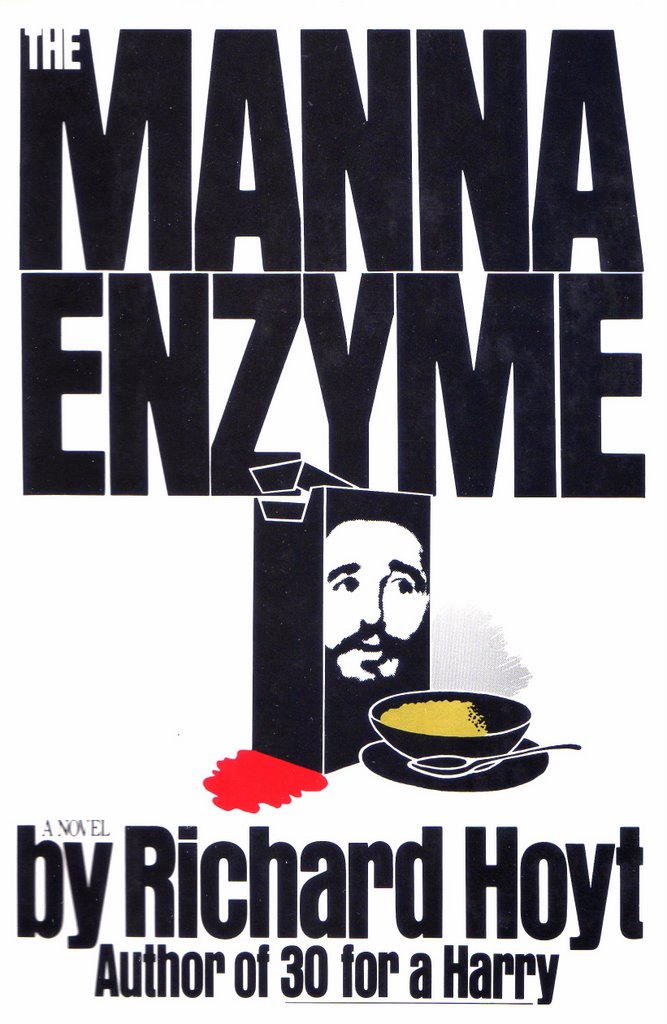
The Manna Enzyme 
(1982), a weird Amazon escapade called
Darwin’s Secret (1989), a couple of novels (1984’s
Cool Runnings and 2000’s
Vivienne) showcasing journalist-spy novelist Jim Quint, and two other books penned under the pseudonym Nicholas van Pelt. (A catalogue of Hoyt’s novels is available
here.)
But as I explain in
my latest column for Kirkus Reviews, “Hoyt’s run of good fortune didn’t last. After peddling 21 novels in 20 years, since 2001 he’s found publishers for only five more. Two of those starred John Denson, but his latest,
Crow’s Mind, welcomes a new shamus into the club: Jake Hipp.”
Hoyt calls Hipp “a jazzed-up and I think more fun version of John Denson.” Both men are stoner private eyes, fond of sexual antics and classic Volkswagen microbuses. Hipp, however, lives in a remote lakefront cabin west of Portland and is the son of “certified-on-the-lam-in-Canada hippies.” He’s given
to quoting
Heraclitus, Henry David Thoreau and Carl Jung, and is easily recognized by his ponytail and waxed handlebar mustache, as well as by uniform of choice: “Goodwill jeans, running shoes, a herringbone tweed jacket, and an Irish walking hat.” (That this description might just as easily have fit a younger Dick Hoyt surely violates the bounds of
coincidence.) In
Crow’s Mind--the first entry in what this author hopes will be a new series--Hipp investigates the killing of a statuesque stripper, whose body he stumbles across in the deep woods. It’s a
grotesque sight; she’s already been vigorously nibbled at by crows. So even before he has a paying client, our hirsute hero determines to find out who took this young woman’s life, a task that will lead him to more than a few peculiar suspects and find him a curvaceous new partner, Nehalem Indian computer whiz Willow Blackwing.
Until recently, I hadn’t corresponded with Hoyt in almost two decades, ever since he ditched Portland and moved to the Philippines, where he got married for the third time and helped rear a daughter. The release of
Crow’s Mind a few months back, though, coupled with news that the now 73-year-old author had returned to the States and settled in Vancouver, Washington, made me want to reconnect and ask him not only what had happened to him during those intervening years, but where his new novel might lead his career. I e-mailed Hoyt dozens of questions, and he responded in short order. The first part of our exchange
appears today in Kirkus, while the balance is posted below.
J. Kingston Pierce: Do I remember correctly, that you grew up somewhere in northern Oregon?
Richard Hoyt: I grew up on a small farm on the banks of the Columbia River about a mile from
Umatilla. I was by myself. No neighbors. I played by myself along the river. Maybe that’s how I came to like solitude.
JKP: Were your parents big readers? Or, when you were young, were there other people
in your life who got you interested in reading?
RH: My mother was a high school graduate. My dad made it through the fifth grade. They weren’t educated, but they were smart people. I got my atheism from them. My uncle Frank, a Communist with a young wife (shock! shock!) who was apparently under FBI surveillance (triple shock!), lit out for Mexico. Before he left, he built a small shed on my parents’ property where he stored his books, hundreds if not thousands of them. That’s where I started reading. I started reading mysteries when I drove truck during wheat harvest time outside of Pendleton. I was 16 years old. The hired hand had a huge cardboard box full of mysteries. I think I read all of
Mickey Spillane’s and
Richard S. Prather’s stories up to that point.
JKP: How early on did you entertain the notion of writing fiction?
RH: The idea of writing fiction was a fantasy, like wanting to be an astronaut or something. I knew I wanted to somehow write for a living,

which is why I majored in journalism. I was the only male in a shorthand class in high school because I thought it would be useful for a reporter.
JKP: One of the credentials you often mention is your having worked as an “army
counterintelligence agent.” When did you take on that task, and how long were you engaged in such an enterprise? What did the job entail, specifically?
RH: I joined the army [in the early 1960s] to dodge the draft. The army recruiter tried to
discourage me from taking the qualifying exam, saying it would be a waste of everybody’s time. The odds were I wouldn’t pass. I insisted on taking the exam, given at a small army post in Vancouver, and I passed.
I didn’t do anything exotic. I mostly ran background investigations on people, although I helped follow people around a few times. The army intelligence school, then at
Fort Holabird, Maryland, was fun. Great sport for somebody 23 years old. I learned all kinds of spook stuff, picking locks, installing bugs, and so on.
JKP: So you started as a journalist after your U.S. Army stint?
RH: I got out of the army, then got a master’s degree in journalism from the University of
Oregon.
JKP: Did you begin your newspapering career at the old
Honolulu Advertiser, or had you held jobs with newspapers before that?
RH: After finishing my master’s degree, I scored a fellowship at the Washington Journalism Center [in Washington, D.C.]. As part of that I served as an accredited Washington correspondent for A. Robert Smith, who then wrote for
The [Portland] Oregonian and other papers in the Pacific Northwest. I used to write stories in the Senate press gallery. The correspondent for the
Honolulu Star-Bulletin, the afternoon paper in Honolulu, used to lurk behind me,
reading my stories as I wrote them. One day he asked me if I would like to be a reporter in Honolulu. I said, yes. Hey!
JKP: How long did you work for the Hawaii broadsheets?
RH: I worked for the
Star-Bulletin for two years, then switched to the morning paper, the
Honolulu Advertiser. It was my last job as a reporter.
JKP: But your résumé also includes a turn writing for
Newsweek magazine. At what stage of your early career did you do that work?
RH: I was the Honolulu stringer for
Newsweek. I got that gig while still working for the
Star-Bulletin. My editor was in the San Francisco bureau. I wrote profiles of
Clare Booth Luce,
Arthur and Kathryn Murray, and
Wendell Phillips, among others. (Phillips, of oil company fame, was then said to be one of the richest men in the world and the last of the swashbucklers. He wouldn’t talk to the local journalists, but talked to me, never mind that I also worked for the morning paper. That interview is a novel in itself.)
JKP: You hold a Ph.D. in American Studies from the University of Hawaii. Were you working
toward that doctorate at the same time as you were writing articles for newspapers? And why choose American Studies as your field of expertise?
RH: The first week that I was with the
Star-Bulletin, my city editor sent me out to interview
Reuel Denney, a poet and professor from the University of Chicago, who went to
the University of Hawaii as a visiting professor then was given an endowed chair. He was elected to the American Academy of Arts and Letters, a great honor. When I got to his condominium at the base of
Koko Head, he had a pitcher of martinis, caviar and crackers, and was writing the libretto for an opera by
George Barati. We started bullshitting and didn’t stop. Maybe four hours later, totally blasted,

I got up, and he said, “I would like for you to study for a Ph.D. in American Studies under my direction.” I didn’t want to offend him. I said, “Sure, but I am a reporter. I have to earn a living.” He said, “I’ll take care of that with Bud”--
A.A.
“Bud” Smyser, editor of the
Star-Bulletin.
The next morning I arrived for work with a hangover. I was called into Smyser’s office. I thought I had fucked something up. He said Reuel Denney had called him. He said the paper would feel it was an honor to have one of its reporters study under Denney, and the paper would like me take time off any time of day for classes and whatever. That’s how I got started. Charmed life.
JKP: So when did you leave the Hawaiian Islands and become a professor at Lewis & Clark College?
RH: I left Hawaii in 1973, but first to become an assistant professor of journalism at the
University of Maryland in College Park. I think it was three years later that I moved on to Lewis & Clark, because I wanted to be back in the Northwest.
JKP: You taught journalism classes at L&C and served as the adviser to the college’s
newspaper,
The Pioneer Log. But as I recall, you weren’t the go-along-to-get-along type. You often disagreed with your colleagues in the Communications Department. How long did it take you to realize you might not be cut out to be a college professor?
RH: I knew almost immediately. I liked the students OK, but I didn’t like judging them. Who knew what sleepers were out there? I thought faculty politics was dumb. I used to correct the grammar of faculty notices and send them back anonymously. I think people knew it was me having a stoned giggle. I just wanted to write, not try to tell other people how to write.
While I was teaching at Lewis & Clark, I went on a trip with Reuel on Vancouver Island [in British Columbia, Canada]. We went salmon fishing on the Campbell River. We were in a bookstore in Victoria on the way back, and he bought me
Enquiry and
Bonecrack, both by
Dick Francis. He said, “Dick, I think you should be writing books like this. Teaching will rot your brain.” Correct and correct. That’s when I conned Lewis & Clark into letting me teach a course in the history of British and American suspense fiction. It was a course where freshmen were supposed to develop their writing skills. To prepare for the course, I read almost all the titles in the index of Julian Symons’
Mortal Consequences [1972]. I started with Edgar Allan Poe and Wilkie Collins and kept on reading. When I was finished, I started what would become
Decoys.
JKP: Considering your background in newspapers, let me ask: What do think about the present state of American journalism? Some people voice regret at the shrinking market for print journalism, while others see this as a “golden age” of journalism, a time when unpaid “citizen reporters” have stepped up to fill the gap left by professional news gatherers. What’s your take on our present situation?
RH: I think our best journalists are [political satirists]
John Oliver and
Jon Stewart. I am disgusted when mainstream journalists, in an effort to be “objective,” give equal time both to what they know is preposterous bullshit by right-wing morons and to sensible suggestions by people who are actually trying to govern the country. Everybody on the

Internet has an opinion. Opinions are like assholes. Everybody has one. I like journalists who ask real questions and don’t worry about offending readers or viewers.
JKP: When did you leave L&C? And what was it that finally drove you out?
RH: I left in 1982, I think. My department chairman had tried, unsuccessfully, to get me
sacked, saying that I was not a “team player” and did not attend regional academic gatherings, among other offenses. (Drinking beer with students while they put the
Pioneer Log together was
not an academic gathering?) I’ve never been a team player. I thought those meetings where people mill about with little plastic name tags on their chest and drink coffee out of Styrofoam cups are totally dumb. I was not a team player because I advised students not to declare a major until they had a
chance to take some courses other than communications. No telling what might grab their imagination. My department chairman got furious at me for doing that. We needed majors in our department for larger budgets and an additional faculty member.
JKP: It was during your time at L&C that you began composing fiction. Your first
protagonist, John Denson, debuted in
Decoys. But just two years later, you introduced another series lead, offbeat CIA agent James Burlane, in
Trotsky’s Run. Did you need a second protagonist just in order to sell more books every year?
RH: I imagined Burlane because I thought he would be fun. I didn’t want to forever write
mysteries. That’s like chewing on the same bone for year after year. Burlane is similar to Denson because they are both me (or guys that I would like to be). Their observations and way of thinking are pretty much mine. I also wanted to travel under the guise of doing research.
JKP: You certainly did do that, going to Jamaica, Brazil, Siberia, the Netherlands, and
other far-flung spots to check out settings for your future tales. But you always returned to Portland. Until the day you finally left. When was that?
RH: About 1990. I went and stayed in Hong Kong for a while, then went to Singapore, then the Philippines. It was easy living there because so many people speak English.
I wrote eight novels in the Philippines, including
Japanese Game [1995], one that I really
liked. I lived there for 12 years in all. I liked being an expat. It was fun getting blotto and bullshitting with lunatic Aussies and Kiwis and Krauts and Canucks. Guys we called Birmingham Dave or Hamburg Hans. You name it. There was this Aussie who brought these salted peanuts with him up from Down Under. They were sensational.
JKP: So, let’s talk about
Crow’s Mind. It’s a P.I. yarn again, but the protagonist this time is Jake Hipp, an Oregon-based gumshoe. Is this the same Jake Hipp who featured in
The Mongoose Man--one of your “Nicholas van Pelt” books, from 2000--as a “former American sociobiology professor turned oddball international antiterrorist agent”? Or are you simply using the same character name?
RH: I didn’t remember I had used that name before, until you mentioned it just now. It
lurked in my subconscious, I suppose. This is good for a laugh. Me be dum fuk.
 The author today, photographed by Teresita Artes Hoyt.
JKP:
The author today, photographed by Teresita Artes Hoyt.
JKP: Native American history and myth figure into many of your private-eye excursions, as
they do into this latest novel of yours. Have you done a great deal of research into those subjects?
RH: Well, no, I can’t say I have done a whole lot of research beyond what I did for my doctoral dissertation [which focused on myth and Northwest history]. If you ever get a chance, read Ella E. Clark’s
Indian Legends of the Pacific Northwest, published in the early 1950s.
Win Blevins, who was an editor at Tor and Forge Books for years, is one-half American Indian and goes to pow wows around the country as a shaman, pounding his tom-tom or whatever. He liked my stories.
JKP: One of the curiosities about
Crow’s Mind is its employment of
ornithopters, mechanical birds that--at least in your story--come equipped with guns. Have you flown such devices yourself?
RH: I’ve never flown one, no. I didn’t know they existed until I blundered onto some Internet articles. I thought, wow, I have to work those into a story.
JKP: There’s a scene late in the book that finds computer whiz Willow Blackwing guiding Hipp through a drug-assisted hallucination in which he “flies,” hoping to get a better handle on a case that is so much about birds. Have you experienced such a “flight” yourself?
RH: I certainly have. I once took a wild journey on the back of a snake that was as large as a highway. Some of my best flying took place after drinking Miss Mary’s Most Special Tea in Negril, Jamaica.
JKP: I must say, the lithe Willow is one of your most magnetic female characters, a woman who knows herself well, has no problem competing against men, but isn’t above using her feminine wiles. She performs a dance of seduction with Jake Hipp through most of
Crow’s Mind. Is Willow based on anybody in particular?
RH: She’s based on a woman that I wish I had met when I was younger.
JKP: If you’re able to write more installments in the Jake Hipp series, how do you see his
relationship with Willow progressing?
RH: They’ll be partners and lovers.
JKP: As much as I enjoyed the often madcap story line in
Crow’s Mind, I was disappointed in the number of typos, missing words, uncaught errors (“Henri Poirot,” for instance, instead of Hercule Poirot), and occasional repetitions of lines to be found in it. Was this a consequence of your
publisher, South Carolina’s Moonshine Cove, rushing the book to market?
RH: No, it is a consequence of dubious editing. This is not Random House, remember.
JKP: How long ago did you relocate from the Philippines to Vancouver, Washington? And why settle in that town north of Portland?
RH: I moved here last year so my daughter could attend Washington State University Vancouver. I’m a native Oregonian and was educated and lived there. I identify myself as an Oregonian. I landed in Washington by accident, but I like it here. It’s cool. Weed is now legal here,

so it can’t be all bad. The Seattle Seahawks won the Super Bowl last year, and the Mariners are winning some games. Amazing!
JKP: In addition to a possible
Crow’s Mind sequel, are you working on any other books?
RH: Well, hey, Jeff, I have a motherbleeping sensational novel, a thriller,
Enter the Gladiators, waiting to be read by a fancy New York agent. If you only knew what was in that book, pal. I can’t even tell her what it’s really about without giving away a spoiler that would destroy the suspense. Well, OK, it’s about a prelude to Civil War II.
JKP: What’s still your greatest weakness as an author?
RH: My greatest weakness is that I cannot imagine so-called thrillers that purport to be
“reality.” Intelligence agencies with super technology and hot-damn heroic studs like Jack Ryan who save the day. That’s a total crock. Those are not “thrillers.” That’s a joke. They are reassurers. They reassure readers. The reader expects the good guy to triumph and get the pretty girl. In fact,
fuck-ups and idiots almost always carry the day. We can spend trillions on national defense, but in the end some asshole or unexpected glitch will cause us much pain. I am sardonic by nature. I see irony everywhere. The great mass of readers don’t want that. They want “serious” that is in fact wildly comic. I cannot begin one of those “serious” thrillers or mysteries without bursting out
laughing. I know they make a lot of money. People apparently read them for the same essential reason they go to church. They want super-heroes to give them deliverance. I just cannot take such bullshit seriously. The book I have now waiting to be read is a genuine thriller. I do not expect the great
Flying Spaghetti Monster to save me from anything.
JKP: You used to be a big reader of crime and mystery fiction. In fact, you introduced me to
James McClure as well as
Maj Sjöwall and Per Wahlöö. Do you still read heavily in the genre? If so, which authors do you find yourself following most closely nowadays?
RH: I re-read
Elmore Leonard. He wrote terrific dialogue and imagined wonderful characters. I say when you’re bored, pick up an Elmore Leonard title and have some fun. He knew how the world works.
JKP: Finally, if you could lay claim to having penned any book that does not already carry your byline, what would it be?
RH: The Magic Christian [1959]. I envy Terry Southern for having imagined the scene where Guy Grand buys an empty lot in Chicago and builds a huge, raised, heated swimming pool on it. He fills the pool with cow flop and urine from the Chicago stockyards and heats it. When the yuck gets burbling nicely, he scatters $100 bills on it and drives away laughing. But hey, I imagined a dude surfing a beautiful corpse through horrific whitewater. That’s pretty cool.