For years now, I’ve been following the writing career of
Martyn Waites, a 44-year-old Londoner exiled from his roots in the North East of England. Following on such extraordinary works as
Born Under Punches (2003) and
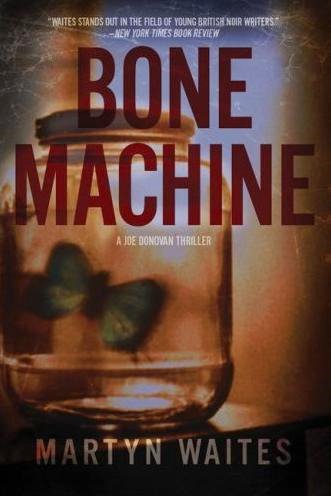
Bone Machine, his latest work is an incendiary device of a novel titled
White Riot, which until recently had been languishing in my to-be-read pile,

as I waited for an opportunity to consume it in one sitting. While I waited,
Tony Black managed to
interview Waites for the e-zine Shots. However, after I managed to get to
White Riot, I had more questions beyond Black’s that I thought deserved asking. So I rang up Waites (shown at left with the bespectacled
Mark Timlin) to chat about fictional violence and right-wing zealotry, the plotting of his eight novels thus far, the U.S. reception of his work, and why in the world he stopped blogging.
Ali Karim: White Riot, your third
Joe Donovan thriller, is as topical as ever. This time you’re using racial tension as a theme. Were you at all fearful of tackling such an explosive issue?
Martyn Waites: I wasn’t really worried, because I knew from the start what my line would be. I may not have known what the ultimate outcome would be, but I had a good idea of what kind of things I wanted to explore and how I wanted to explore them. One of the reasons crime fiction attracted me in the first place was its immediacy--its connection with contemporary issues and its popular storytelling format. I think something like the themes of
White Riot are absolutely what contemporary crime novels should be addressing. But not like some “mainstream literary” novel would do, in a dull, preachy kind of way. You’ve got to have good character and a good story or you may as well pack up and go home.
AK: Is there much racial tension in the North East? From my experience,
Geordies are very tolerant.
MW: Maybe you’ve just met the good Geordies! I think like any major British city, there are problems. My mate’s a local councilor and he tells me the problem is quite widespread. He was there for the vote-counting in the last local election and saw how many votes the BNP [
British National Party] received. It was something like 700 in his constituency, which isn’t a lot by itself, especially when my mate won by a few thousand; but that’s still 700 people in a small area of Newcastle who made a conscious decision to vote for a fascist party. Multiply that citywide and you’ve got a lot of people who, either wittingly or unwittingly, want to vote for the kind of people their grandparents fought against and, in some cases, gave their lives for in the Second World War. But as long as there are agitators, whether they be grassroots political ones writing for right-wing tabloids, radio talk-show hosts, or TV presenters who insist on telling people their lives are shit and they’re poor (because blacks/Asians/asylum-seekers/East Europeans are doing their jobs), then we’ll always have that problem. And that kind of ignorance, whether willful or otherwise, needs to be combated.
Sorry, getting political, but there you go. You did ask …
AK: The young thugs at the center of this new novel find themselves in the clutches of a right-wing group, the National Unity Party. So, tell us about the genesis of this novel.
MW: Well, I always write about things I want to try and understand or things that make me angry. This book was a perfect fit in that respect. I’ve always wondered what attracted people to extremism, what kind of excuses they make to themselves to do that. I wrote a short story, “Love,” for the
London Noir anthology, which looked at that, and I thought there was still some more mileage to be got out of that. I’d also seen a documentary on the
Weathermen, the early ’70s radical political outfit. It struck me that at the time they were considered freedom fighters, but now would be considered terrorists. That was a good starting point too.
AK: It is interesting how similar the skinheads and the fundamentalists are in terms of intolerance and the strengths of their beliefs. And this provided
White Riot with an interesting theme: how people can be manipulated. Did this theme come to you first, or did the story bring out the theme? Chicken or egg?
MW: Bit of both, really. I think that all kinds of extremism are more or less the same. They’ve got more in common than they have apart. The only real difference, as far as I can see, between religious and political fundamentalism is that people seem more willing to kill themselves in the name of God. Which leads to something I’ve been wondering about: If male suicide bombers get between 60 and 80 (accounts vary) virgins in paradise as a thank you, do female suicide bombers get the same amount of male virgins? Sixty 33-year-old obese men with halitosis who can recite the plots to every episode of
Buffy and
Star Trek: The Next Generation--I mean, where’s the incentive in that?
And I also think that people will believe anything if it suits them to at the time. I think there’s an element of willful ignorance with a lot of people. Otherwise, how do you explain the popularity of [broadcaster-writer]
Jeremy Clarkson?
But themes only really emerge as I’m writing. If the characters aren’t right and I don’t want to spend any time with them and find out what makes them tick (literally, when you’re talking about suicide bombers), then no amount of highfalutin themes are going to make my book read any better.
AK: The racial element is only the foil for a much deeper story in
White Riot. Did you have to plot this book more carefully than your last two novels? Those others felt more free-wheeling.
MW: The opposite, actually.
Mark Billingham [
Death Message], when we were talking about writing methods a while ago, said to me, when I told him I plotted my books fairly tightly, “Oh, you still do that.” So I decided for this one I wouldn’t. I would just write and see where it got me. And it got me in a bit of a mess, so I had to start again and restructure it as I would have usually done. Mind you, it’s strange that the other two felt more freewheeling.
The Mercy Seat, especially, was intricately plotted. Like
[Alfred] Hitchcock, with his meticulous storyboards, I’d planned it so tightly, I could have farmed out the writing to someone else. But where would be the fun in that?
Having said all that, I suppose I do try to plot tightly but still leave loopholes so I can take any excursion that takes my fancy.
AK: There is a lot of action as well as violence in your work. Why do you think these themes appeal to so many readers, as crime fiction is going through a real boom currently?
MW: You know, I always get asked about the question of violence in my books. And I honestly don’t think they’re that violent. I know I seem to be in a minority about that, but there you go. When you compare me to some writers (who shall remain nameless), my stuff is almost cuddly. I think why people think my stuff is violent is because of the same argument used when [Quentin] Tarantino released
Reservoir Dogs all those years ago. There was a huge outcry about [that film]--councils called for it to be banned, rather predictably
The Daily Mail was up in arms, etc. But really, there was very little violence in it. What it did show was the
consequences of violence. That if you get shot or cut or hit, it’s going to hurt. And hurt badly. And I think that’s the same with my stuff. When a character gets hit it should hurt and the reader should know that. I’m not into glorifying violence or the pornography of violence. I’ve got no time for those authors who do that. Unfortunately, I do tend to get lumped in with them because, as my agent says, “You’re just too good at it.” I think that’s a compliment.
AK: How do you see former journalist Donovan and his Albion Agency team of “information brokers” [aka private investigators] developing? And will Peta Knight, Jamal, and Donovan ever venture beyond the dark side of the North East?
MW: Well, obviously, the overriding arc of the series is Donovan searching for his son. In the [next] one,
Murdered Sons, the team (minus Donovan) are off hunting. At the moment they’re on the south coast, in Brighton, specifically. But then, as my hero
Graham Greene told us, Brighton is a town with its own dark side.
AK: How important is social commentary as a backdrop to your work? After all, Donovan faced forced prostitution and people-smuggling in
Bone Machine (2007), and pedophilia and child prostitution in
The Mercy Seat (2006).
MW: I’m not sure it is that important in those terms. I like to write about the world we live in or the world as I see it, and any kind of social subtext is just part of that. I don’t set out to look at things in an “issue of the week” kind of way. Like I said, I just write about things I want to try and understand, or that make me angry. I wouldn’t even call it social commentary, really, because, to me, that smacks of
Guardian-reading liberalism--that you can only read books that are in some way good for you. As if it’s going to be hard work to be entertained. I don’t have any answers. If anything, I just ask questions. For myself, if no one else.
AK: What has been the American reception to your work?
MW: Pretty good, I think. While I don’t seem to be troubling
Dan Brown in terms of sales, I’m lucky in that I have some very vocal and enthusiastic people on my side, especially in the crime-fiction community. Outside of Pegasus Books, who may not be the biggest publishers going but they’re certainly enthusiastic, I’ve got some great people

in my corner like
Jon, Ruth, and Jen Jordan and
Sarah Weinman. And I’m very thankful that they think well enough of my books to want to tell people about them.
AK: You’ve gone all high-tech for
White Riot. You have a
video interview up as well as a pretty slick
book-promo trailer. How did all of that come about?
MW: Well, the trailer idea came about because last summer, everywhere I went I seemed to see the
trailer for The Bourne Ultimatum. And I just thought, wouldn’t it be great to do something like that for my book? So I phoned up a mate of mine, Robert Horwell, who just happens to be an award-winning actor and director with his own set of professional film equipment, including lighting and sound, plus his own editing suite; and I asked him if he fancied doing it. He did, we got some money from the publishers, got Mark Wingett (from British soap operas
The Bill and
Eastenders) to play Donovan [and] Mike Fenton Stevens to play Whitman, and off we went. I wrote the script, Bob directed. We got the brilliant Mark Adair to score it, and we edited it ourselves. And there it is. We’ve set up a film company now to make trailers for other writers. I have to say, that even up to the night before I wasn’t convinced it was going to work. But as soon as we got into Hockley Woods in Essex, with a young Asian guy being chased by three skinheads and a slavering Rottweiler, I knew we had something good going on.
We’re also going to use it as a calling card to take ’round production companies to see if we can get financing to make a Donovan series. Unfortunately (for me not him), as soon as we’d finished it, Bob got a starring role in
Coronation Street. So he’s been up in Manchester filming that. I mean, it’s great that he’s finally got the recognition he deserves because he’s a brilliant actor, but I hope they write him out soon. I wanna make the Donovan movie with him!
AK: I see you finally have
a Web site. Tell me about setting that up.
MW: Well, that’s a story in itself. I entrusted it to a company who gave me a great sales pitch. So I gave them all the stuff they needed, expecting to hear from them within a couple of weeks--and they disappeared for six months. After lots of arguments (and I mean
lots), they finally let me off with the rest of the money and got the site up and running. Nearly a year since I first spoke to them about it! It was going all right until recently, when it was hacked by Turkish extremist Islamists who, I don’t know, seemed to be blaming me for
the Danish cartoon thing. It seems to be working fine now, though. Touch wood.
AK: And I noticed that you had
started blogging. But then you suddenly stopped. Why?
MW: Well, I really like what other writers have done with their blogs. I didn’t just want to talk about buying shoes or going to see bands, because it would be so boring. Some writers have really structured and interesting opinions and that’s great, you can get a real debate going. When you look at
John Connolly’s [blog, for instance], it’s great--interesting, witty, and informative. He talks about the writing process and the publishing process, and I wanted my blog to follow along those lines. However, since my recent dealings with my UK publishers have been largely negative, I didn’t want it to be just one long whine or rant. I’ve got a private diary for putting all that in. I will start again when I think I’ve got something interesting--or positive--to say.
AK: Tell us about your work with criminals in the prison system.
MW: My God, how long have you got? Well, it all started a few years ago when I became writer-in-residence for a young-offenders institution. I didn’t quite know what to expect, but I was part of a great team, working with some brilliant people, and together we did manage to turn some lives around. The governor gave me a two-word brief when I started: “Bring life.” And I tried my best. I then went to an adult prison for a year (again as writer-in-residence, I hasten to add) and did something similar there. I loved it, but it does burn you out. It’s such a polarized environment--things could be on a real high one day, and so low the next, you wish you were shelf-packing at [the UK merchandizing chain]
Tesco. But I wouldn’t have missed doing it for the world. I could write a book about it …
AK: And what of your work at Essex University?
MW: Quite similar, really. Except, sometimes in uni my students don’t turn up. No, I go in and do one-to-one sessions with students on any aspect of writing. And I really enjoy it. I even give the odd seminar. Getting paid to sit and talk about writing … well, I could think of worse ways of making a living. In fact, during my resting-actor years, I’ve probably done them.
AK: I see that the Philip Larkin books are being reissued. Can you tell us a little about
those tough books, which were the precursors to your Donovan series?
MW: Stephen Larkin, not Philip!
He’s the poet. Oh God, how soon they forget. ... Yeah, I did three Larkin books--
Mary’s Prayer,
Little Triggers, and
Candleland.
Allison and Busby have got them in the UK, Pegasus in the States (with some very handsome covers, too). I suppose looking back, I regard them as my apprenticeship. I learned my trade on them, how to write, really. They’re tough, fast-moving books, with the lead character of Stephen Larkin as a bit of a dry run for Joe Donovan. They’re a little rough round the edges, but good fun--in a grim, noirish, two-fisted kind of way, of course.
AK: [Laughing] Sorry, though I do consider your work poetic. But back to serious matters: What books have passed across your table recently that you’ve enjoyed?
MW: Recently? Well, I really enjoyed Ray Banks’
No More Heroes--very similar themes to
White Riot, but a different riff. I think it’s his best yet. I also loved
Tony Black’s
Paying for It and Willy Vlautin’s
Northline, which I think is my book of the year so far. Vlautin’s the lead singer with one of my favorite bands, Richmond Fontaine, as I’m sure you’re well aware, Ali. But he’s also a fantastic author, like a post-Dylan or -Steinbeck. And I’m currently reading
The Glass Books of the Dream Eaters, by G.W. Dahlquist, which is a bit of an epic but a fantastic work of the imagination.
AK: Knowing that you’re a bit of a film buff, I should also ask what movies you’ve particularly enjoyed of late.
MW: Best thing I’ve seen at the cinema recently was undoubtedly
No Country for Old Men. Just brilliant. I’m a real
Cormac McCarthy fan--he’s the writer I want to be when I grow up. I loved the book and this was a word-for-word evocation of it with stunning pictures. The sheer confidence in the storytelling, to do the whole thing without incidental music and at an unforced pace ... I was hugely impressed.
Also saw
Atonement recently. Apart from the Dunkirk sequence, it was as bad as I had thought it was going to be. British heritage chocolate box film-making. And
Keira Knightley a sex symbol? Why would anyone find a woman with the physique of a 13-year-old boy attractive?
Apart from that I haven’t seen many other films recently. I’ve been catching up on my DVDs. Indulged myself with the two-disc special edition of
Hell Drivers again. Wonderful. Plus some Hitchcock--
Rear Window,
Vertigo, and
North By Northwest--and some great box sets--
The Shield, Seasons 5 and 6;
The Wire, Season 4;
Quatermass ... absolute bliss. Should get back to some writing, really ...
READ MORE: “
The Nice Guy With the Killer Punch,” by Lindsay Jennings (
The Northern Echo).