Showing posts with label Dan J. Marlowe. Show all posts

Friday, October 11, 2013

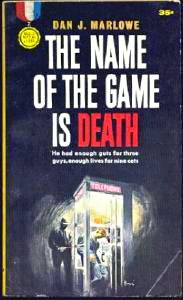
The Book You Have to Read: “The Name of the Game Is Death,” by Dan J. Marlowe

(Editor’s note: This is the 130th entry in our ongoing series about great but forgotten books. Today’s tribute comes from Jed Power, a Hampton Beach, New Hampshire-based author and an “active” member of the Mystery Writers of America. He’s already produced two crime novels featuring Dan Marlowe, a Hampton Beach bartender named in honor of an old family friend, fictionist Dan J. Marlowe. The second installment in Power’s Marlowe series is Hampton Beach Homicide, now available in both trade paper and e-book versions from Dark Jetty Publishing. A third entry, Blood on Hampton Beach, is coming soon.)

“What’s My Game?”

The innings number nine,
In this favorite game of mine,
Three bases and home plate,
A pitcher who’s top-rate

That was the beginning of a very long poem Dan J. Marlowe helped me with for an elementary-school assignment. I guess the more correct description would be that I was helping him. I’m sure the poem received an A grade. Those lines have stuck in my head all these years later; the rest of them I’ve long forgotten. I’d give anything to locate the whole original work, but it seems to have ended up in the same unknown graveyard as my large baseball card collection from that time.

Dan was my father’s close friend; they’d grown up together and been childhood schoolmates. When I was a boy, he stayed with us at our home in Woburn, Massachusetts. I knew he was a writer and I saw him pounding away on his typewriter daily. I had no way of knowing, though, that at the time he was helping me with “What’s My Game?” he was also working on what he hoped would be his breakout novel, The Name of the Game Is Death (1962).

I remember that when I inquired about what kind of books Dan wrote, I was always answered--by both Dan and my father--with the generic term mysteries. The subject was then quickly dropped. This was probably in deference to my mother who, although she liked Dan, was an Irish-Catholic schoolteacher. She was a big reader and encouraged me in that same direction during my earliest years. I’m sure now, though, that she considered Dan’s work to be overly violent and racy. And for the time, maybe it was. I was too young then to find any of his work on my own; that would come in the future--and what a pleasant surprise it would be.

I found out in later years, that Dan had come to Woburn to escape the distractions he apparently encountered while living in New York City, of which there may have been many. He must have made a good decision, because the book he eventually produced there is one of the finest hard-boiled crime novels ever written.

The Name of the Game Is Death is the story of a bloody bank robbery in Phoenix, Arizona, and its aftermath. The tale is told in the first-person by a professional bank robber and killer with more than one name. I’ll use the handle “Chet Arnold” here. During the robbery, the youngest of the three robbers is killed. Arnold himself is badly wounded. The last of the trio is Bunny, a huge mute.

They’ve made a good haul, though--$178,000. Arnold realizes that he has to hole-up locally to recuperate from his bullet wound. He trusts Bunny and sends him on to Florida, as they’d planned, with the money. Bunny is assigned the task of mailing Arnold dough every week. But after the first few deliveries, the payments suddenly stop.

Arnold suspects a rip-off, but not by Bunny. He trusts the mute implicitly. As soon as he is well enough, he sets off for Florida on a cross-country ride that you just know can’t end well for anyone at the other end, anyone who’s taken his money.

Through the fate of victims Arnold encounters during his long trip, and flashbacks showing the particulars of his violent youth, the reader learns just how dangerous this man is. When Arnold arrives in Florida, he uses his other skill as a tree surgeon (of all things) as a front to conceal his real reason for showing up there.

Arnold isn’t completely devoid of decent qualities. He has a love of animals. Also, he has a strong sense of loyalty to those very few people he gets close to. In addition to his criminal accomplice, Bunny, he forms positive relationships in Florida with a local deputy sheriff/real-estate agent, Jed (yes, he named that character after me), and Hazel, a kindhearted bar owner. Arnold is a good man to have as a friend; otherwise, not so good.

Chet Arnold is a cold-blooded killer, and in Florida many folks find this out in the worst possible ways, as he searches for his dough and his friend Bunny. The bodies stack up. Still, the multidimensional Arnold remains a sympathetic character, because many of his victims seem deserving of violence. There are no innocent ones here.

The problematic sexual side of Arnold’s character is also explored in this novel, and it’s fascinating. However, that side of Arnold’s character may have been watered down in revised editions. So, if possible, read the original or an exact reprint of it.

What makes The Name of the Game Is Death stand out so far above other crime novels of its day is the skill Dan Marlowe brought to his typewriter. His plot, characterizations, and story depth are fantastic. There isn’t a slow page in the whole damn book. It’s a great read. And for any wannabe hard-boiled crime writer--this is the work you want to tear apart and dissect. Figure out how the hell the man did it.

To say anything more about Marlowe’s novel (and there are lots of good things I could say) might spoil the reader’s future enjoyment of the work. Let’s just end here with the dedication Stephen King included in his 2005 crime novel, The Colorado Kid:
With admiration, for Dan J. Marlowe, author of The Name of the Game Is Death: Hardest of the Hardboiled.
To learn much more about Marlowe, I recommend you pick up the 2012 biography Gunshots in Another Room: The Forgotten Life of Dan J. Marlowe, by journalist Charles Kelly.

READ MORE:Playing With Fire: Dan J. Marlowe, Al Nussbaum, and Earl Drake,” by Josef Hoffmann (Mystery*File); “Mystery Man: Dan J. Marlowe,” by Charles Kelly (Allan Guthrie’s Noir Originals); “Whodrewit? Doorway to Death, by Dan Marlowe,” by J. Kingston Pierce (Killer Covers).

Sunday, March 11, 2012

The Pulpy Saga of Dan J. Marlowe

Author and Los Angeles Review of Books contributor Charles Kelly offers a quite fascinating look back at the career of frequently overlooked author Dan J. Marlowe. Just the opening paragraphs should convince you to devour Kelly’s piece:
Hollywood is for the young and tough, a place where you must be beautiful simply to survive, let alone prosper. God help you if you’re homely, aging, and physically beaten. Double that if you’ve lost the creative skills you’ve counted on, and forgotten much of your life and all the people you’ve known. Double that again if you’re a writer. Let’s say it’s 1978 and you are Dan J. Marlowe, once one of the hottest suspense novelists of your day, author of such hard-boiled Fawcett Gold Medal paperbacks as The Name of the Game is Death, The Vengeance Man, Never Live Twice, and the Operation books, featuring a bank robber turned international agent. It’s 1978, yes, and the market for that kind of book has evaporated. You’re 64 years old, suffering from amnesia, glaucoma, and the consequences of a stroke. It’s painful for you even to lift your hands high enough to type.

Though you’re chubby and unathletic and wear dark, horn-rimmed glasses, in the past you’ve been hell with the ladies. Now those ladies are ghosts to you. You’ve spent more than 15 years living in Harbor Beach, Michigan, a picturesque, isolated town on the shore of Lake Huron. You made a good living, served on the city council, partied with the Rotary Club. And you found time to indulge in your own secret sexual quirkiness. Now you’re broke and short of options. So you’re moving to the City of Fallen Angels to share an apartment with a former bank robber. To try to put your writing life back together, maybe even get movies made from your books.

You’re a Hollywood Untouchable because you’re a lousy money-maker, and you’ll stay that way. People hear your name and confuse you with Philip Marlowe, Raymond Chandler’s iconic detective, or with your mystery-writing contemporary, Stephen Marlowe. You’re the wrong Marlowe, in the wrong time, the wrong place. So what are the chances you’ll be remembered with fondness? What are the odds that nearly four decades later, megastar horror writer Stephen King will honor your talent by dedicating a novel to you? Well, you’ve always been a gambler--a professional one for seven years. You’ve played long shots and won. Maybe you’ll do it again.
Convinced? Then go off to read the whole article here.

Tuesday, July 11, 2006

Crime Fiction’s Other Marlowe

For a true crime-fiction fanatic, few enterprises are quite so satisfying as flicking through a thoughtful, slightly arcane database of writers and their works. Kevin Burton Smith’s The Thrilling Detective Web Site (currently on hiatus) is such a resource, as is Steve Lewis’ Mystery*File, the latter of which has just added to its contents a fascinating piece about Dan J. Marlowe (1914-1986), a former accountant and later a small-town Michigan politician, who, after his wife died in 1956, moved to New York City and turned to crime writing. As Josef Hoffmann recalls in Mystery*File, Marlowe’s first five novels, including Doorway to Death (1959), featured a hotel dick named Johnny Killain, “a character very typical of the ‘hard-boiled detective story’: of massive physique, aggressive, cool, reckless, a survivor. He is bubbling with sarcastic wit and, of course, is a great man for the women.” However, it was Marlowe’s 1962 novel, The Name of the Game Is Death, introducing killer, bank robber, and definitive “anti-hero” Earl Drake, that really launched his career.

Bill Pronzini has said that Name of the Game is “about as good as original paperback writing can get.” It was that same gangster story-cum-detective yarn that brought Marlowe to the attention Al Nussbaum, an early 1960s bank robber serving a 40-year stint in federal stir. Explains Hoffmann: “[Nussbaum] was so impressed by the book that he got in touch with the author through the publishers. After his arrest he wrote to Marlowe from jail. Marlowe then visited Nussbaum, got to know him, and wrote about him. This resulted in a life-long friendship.” According to Mike Ashley’s The Mammoth Encyclopedia of Modern Crime Fiction (2002), “in a succession of letters, [Nussbaum gave Marlowe] the inside dope on safe-cracking, ballistics, alarm systems--the works. Thereafter, [Marlowe’s] books became so authentic that he had to dumb them down rather than be charged with writing a do-it-yourself bank-robbing guide.” The Endless Hour (1969), which reintroduced Drake--after having undergone cosmetic surgery, and now pitting himself against the Mafia (Ashley calls him “an honorable villain, if there is such a thing”)--clearly demonstrates the influence of this newly gained criminal knowledge. In Flashpoint (1970), which won an Edgar Award for Best Paperback Original, Drake becomes an undercover agent for the U.S. government, a job he then held through eight more books--until author Marlowe suffered a major stroke in 1969 that “damaged his memory. He no longer knew who he was, where he lived, what he had done before, etc.,” writes Hoffmann. “All of his personal memory was gone.” However, Marlowe’s “writing and language abilities ... were still intact,” and allowed him to continue penning short stories, if not longer novels--with Nussbaum’s assistance.

For Mystery*File, Hoffmann recounts in much further detail Marlowe’s now largely forgotten career, while Bill Crider offers a companion piece exalting this author’s history as a “seriously under-rated Gold Medal writer.” Both are well worth reading, especially if (as is the case for me, I confess) you’ve never read Marlowe’s work.

* * *

By the way, readers interested in pulpish mysteries and Cold War-era spy fiction should check out Bruce Grossman’s “Bullets, Broads, Blackmail & Bombs” column, featured on the Bookgasm site. While his latest installment looks at Donald Hamilton’s Matt Helm books, previous columns have focused on Mickey Spillane, James Bond-less espionage novels (see here and here), and some very readable books with trashy covers.

READ MORE:The Name of the Game Is Marlowe,” by Duane Swierczynski (Secret Dead Blog); “Dan J. Marlowe’s The Name of the Game Is Death,” by Steve Lewis (Mystery*File).