Part of a series honoring the late author and blogger Bill Crider.
Running Scared, by Gregory Mcdonald (Signet, 1973). Mcdonald, of course, wrote the very popular Fletch series, three books from which have been adapted for film and TV. Running Scared (published originally in 1964) was his first novel, and also served as the basis for a movie, a 1972 feature starring Robert Powell and Gayle Hunnicutt. Cover art by Stanley Borack.
(Editor’s note: This is the 181st installment in The Rap Sheet’s continuing series about great but forgotten books. It comes from Tim Maleeny, the multiple award-winning author of the Cape Weathers mysteries, which include Stealing the Dragon, Boxing the Octopus, and his latest, a global art heist calledHanging the Devil. He lives and writes in New York City. His last piece for The Rap Sheet looked at Ross Thomas’ 1978 novel,Chinaman’s Chance.)
Many readers of this site are probably familiar with the character Irwin Maurice Fletcher, or Fletch to his friends, from having seen two Chevy Chase movies in the ’80s, or perhaps from watching last year’s Confess, Fletch, a comedy-drama starring Jon Hamm in the titular role that is currently streaming on television.
All three movies are fun, and Hamm isn’t bad casting for the character, but none of the films comes close to capturing the lyrical genius of the Fletch novels written by the late Gregory Mcdonald. If you’re a mystery fan, you owe it to yourself to pick up one of these books, arguably the smoothest, fastest, and most delightful whodunits ever written.
As with any great crime series, you can read the Fletch novels as standalones in whatever order you wish. The first one, Fletch (1974), and its sequel, Confess, Fletch (1976), both picked up Edgar Awards (for best first novel and best paperback original, respectively)—back-to-back wins that stand unmatched.
Sometimes a movie can amplify reader interest in a book, but when a movie gets mass distribution and is produced after a series has ended, often the source material is eclipsed in the public consciousness. In the case of Mcdonald, all the Fletch books are still in print, so here’s hoping the renewed film interest will put them back in a place of prominence on bookstore shelves.
Plotted with the precision of a Sherlock Holmes puzzle and written with the commanding cool of an Elmore Leonard heist, the Fletch stories almost seem effortless to the reader, but are a masterclass in plotting, pacing, and dialogue.
Recently I reread Confess, Fletch because that second novel finds Fletch, formerly an investigative journalist, moving up in the world and working as an art critic. I had finished writing a novel of my own about art theft, forgery, and museum heists, and knowing I’d be asked about art mysteries when my book hit the shelves this year, I decided to read and reread any novels dealing with the art world. (A big topic we’ll save for another column.) Though I’d read all the Fletch novels before, after one chapter into Confess, Fletch, I was once again stunned by the speed at which the story unfolds.
There are a handful of writers who turn dialogue into action, using any verbal exchange between characters to bring tension and movement to a plot, as if the conversation was a car chase or tug-of-war. Authors such as Elmore Leonard, Ross Thomas, Joe R. Lansdale, and Loren D. Estleman are deservedly admired for packing personality into every set of quotation marks.
Nobody writes dialogue better than Gregory Mcdonald, though. Somehow he manages to carry entire chapters with unattributed dialogue, the normal “Fletch said” or “she said” tags unnecessary because the back-and-forth is so tight.
In the very first chapter of this second novel, Fletch discovers a dead body in the living room of his apartment, and after placing the compulsory call to the police (which doesn’t go as you’d expect), the story takes off like a rocket. In less than 20 pages, Mcdonald introduces no fewer than five characters, including the inscrutable Inspector Francis Xavier Flynn, an Irish cop as sharp and eloquent as his prime suspect, Fletch. Although physical descriptions are minimal, the prose is so pointed, you easily visualize each character, and the banter carries a subtext that simultaneously makes you smile even as you begin to fear for the safety of your protagonist.
These books are fast, fun, and full of surprises sufficient to keep any mystery maven guessing. The writing is so clean it’s almost too easy to take the craft for granted, but the genius of Gregory Mcdonald should never be forgotten.
• For the last 20 months, New York City bookseller and editor Otto Penzler has been counting down, in the electronic pages of CrimeReads, a sometimes idiosyncratic list of what he says are the 106 “Greatest Crime Films of All Time.” This week he finally cracked the top five (thanks to The Godfather: Part II and The Godfather), with just three more picks to go. If you haven’t been keeping up, click here to find links to all of Penzler’s write-ups, from Sleuth (oddly numbered at 107) through Bullitt, The Hound of the Baskervilles, The Killing, Strangers on a Train, Harper, To Kill a Mockingbird, Mystic River … and well, I’m not going to run through the whole lot here. The question now is, what three big-screeners will round out Penzler’s rundown? Chinatown and The Maltese Falcon, maybe? What else?
• Speaking of 1974’s Chinatown, I had forgotten—until reading Max Allan Collins’ latest blog post, devoted in large part to its sequel, The Two Jakes—that the Paramount Pictures presentation “originally had what is said to be a lousy score, and Jerry Goldsmith was brought in at the last minute to write (in a little over a week) what is now considered one of most memorable film scores of all time.” Interestingly, Phillip Lambro’s initial soundtrack was not always derided, according to the blog J.J. Gittes Investigations (named for Jack Nicholson’s P.I. protagonist). It recalls that, early on, “Robert Evans, Paramount’s head of production and Chinatown’s producer, was impressed with [Lambro’s] music, requesting even more and hinting at a possible Oscar for the score …” A later audience preview-screening, though, “was a disaster, and the one solution everyone seemed to agree on was replacing the score.” Goldsmith, who by that time had created music for TV shows such as The Man from U.N.C.L.E., Voyage to the Bottom of the Sea, and Room 222, and for movies including Our Man Flint, Planet of the Apes, and Tora! Tora! Tora!, was brought in to replace Lambro’s score. Nonetheless, Lambro’s music survived in “the theatrical film trailer, TV commercials and radio spots.” Below is, first, Lambro’s proposed main title theme for Chinatown, followed by Goldsmith’s better-remembered opening music.
Eight years ago, Lambro’s Chinatown score was released in CD format by Perseverance Records under the title Los Angeles 1937. “It’s interesting,” concludes Collins, “but not a patch on Goldsmith.”
• The story of Lambro’s missing music reminds me of another episode about which I’ve previously written: How composer Alex North’s soundtrack for the big-budget 1968 science-fiction film 2001: A Space Odyssey was replaced only in post-production by “a variety of classical works, among them Richard Strauss’ ‘Also sprach Zarathustra,’ which served as the main title theme.”
• This is most welcome news: Deadline reports that PBS-TV’s Masterpiece “is set to co-produce and broadcast [the] murder mystery Magpie Murders, a six-part drama series based on Foyle’s War creator Anthony Horowitz’s best-selling novel.” Like my colleague Ali Karim, I loved Horowitz’s 2017 whodunit, and am pleased to hear that the author will pen the screenplay for Magpie Murders, which “revolves around the character Susan Ryeland, an editor who is given an unfinished manuscript of author Alan Conway’s latest novel, but has little idea it will change her life.” Deadline quotes Horowitz as saying, “Magpie Murders is my most successful novel and it wasn’t easy to adapt. But I think the result
is a completely original drama that will delight and beguile audiences in equal measure.” The series will stream in Britain on BritBox UK.
• While no air date has yet been announced for that small-screen adaptation, we do know that Horowitz’s print sequel to Magpie Murders, titled Moonflower Murders, is due out in the UK in August from Century. A U.S. edition will appear in November from Harper.
• I still haven’t warmed up to Will Davenport, the Anglican vicar-cum-sleuth—played by Tom Brittney—who replaced James Norton’s Sidney Chambers in Season 4 of Grantchester. He’s a far less well layered figure than Chambers, and his inconsistent reluctance, in Season 5, to engage in a romantic relationship with enticing newspaper reporter Ellie Harding (Lauren Carse) tested the bounds of credibility. Nonetheless, I’m pleased to hear learn that this 1950s-set series has been renewed for a sixth season. Maybe more time spent in the company of the great Robson Green, who plays Detective Inspector Geordie Keating on the show, will polish Brittney’s presentation.
• Also given extended life is HBO-TV’s Perry Mason, though it’s still only five episodes into its eight-installment premiere season. The Hollywood Reporterquotes Francesca Orsi, HBO programming executive VP, as saying: “It has been an exciting journey to work with the immensely talented team behind Perry Mason. Viewers have relished being transported back in time to 1930s Los Angeles each week, and we are thrilled to welcome the show back for a second season.” As far as I’m concerned, the jury is still out on this rebooted Mason. I like the period setting and the corrupt fragrances of pre-World War II L.A. that flood through it. I’ve enjoyed, too, watching the immensely talented John Lithgow play a veteran but troubled attorney; Chris Chalk portray African-American policeman (not yet shamus) Paul Drake; and Tatiana Maslany serve up an engagingly melodramatic performance as a religious evangelist and celebrity cut from the same con artist’s cloth as Aimee Semple McPherson. But screenwriters Rolin Jones and Ron Fitzgerald appear more interested in supplying their principal players with unexpected back stories (Mason as once a heavy-drinking, low-rent private investigator living on his family’s decrepit dairy farm; Della Street as a closeted lesbian and aspiring attorney) than they do in capturing the essence of Erle Stanley Gardner’s storytelling. Up to now, at least, this show has only nominally been Perry Mason. Last week’s episode, however, found actor Matthew Rhys’ Mason finally passing the bar (even if we were witness to none of his studying for that qualification), so he can commence his defense of Emily Dodson, a mother allegedly complicit in the abduction and killing of her only child. Maybe over the final three episodes Mason can prove himself worthy of his moniker. If so, I’ll be happy he has another season in which to develop his courtroom prowess.
• TNT-TV’s The Alienist: Angel of Darkness, the eight-episode mini-series follow-up to last year’s acclaimed Victorian-era thriller, The Alienist, was supposed to have premiered tomorrow, July 26. Instead, its kickoff was moved forward by one week, though TNT didn’t explain why other than to say it was “an effort to continuously bring consumers thrilling, event television at a faster pace.” The opening two installments of Angel began streaming last Sunday, though I’ve only had the chance to watch one so far. Collider explains that this sequel, based on Caleb Carr’s 1997 novel The Angel of Darkness, finds “Sara Howard (Dakota Fanning)—previously a secretary for Theodore Roosevelt—now head[ing] up her own detective agency. Meanwhile, John Moore (Luke Evans), previously an illustrator, is now a reporter for The New York Times; and Dr. Laszlo Kreizler (Daniel Brühl) … well, Dr. Kreizler is still putting his expertise as an alienist to good use. When a kidnapped baby turns up dead and displayed in grisly fashion, followed by the kidnapping of another baby, Sara suspects a serial killer may be on the loose. She reconnects with Laszlo and John to try and find this recently kidnapped child before it’s too late, and as happened in the show’s first season, their investigation leads them down some shady paths.” Two more episodes should drop tomorrow.
• Adrian McKinty’s haunting child-abduction thriller, The Chain, was recently named as the 2020 Theakston Old Peculier Crime Novel of the Year, and now it’s bound for cinematic adaptation. Deadline reports that “In a seven-figure deal, Universal Pictures has optioned The Chain … Baby Driver helmer Edgar Wright will direct, while Jane Goldman (Kingsman:
The Golden Circle and X-Men: First Class) is writing the script. The novel had been in talks to be acquired by Paramount before it was published last July by Little, Brown/Mulholland, but the deal never crossed the finish line. It has come together quite nicely in this new iteration. Working Title’s Eric Fellner and Tim Bevan will produce alongside Complete Fiction’s Nira Park and Wright, and The Story Factory’s Shane Salerno.”
• Blogger B.V. Lawson brings word that Mad Men alumnus Jon Hamm “is set to star in and produce a feature film reboot of Fletch, the brazen investigative reporter from Gregory Mcdonald’s 1970s and 1980s Fletch mystery novels. The new film adaptation will specifically be based on the second book in the Mcdonald series, Confess, Fletch [1976]. In a mysterious chain of wild events, Fletch finds himself in the middle of multiple murders, one of which implicates him as a prime
suspect. While on a quest to prove his innocence, Fletch is tasked with finding his fiancée’s stolen art collection, the only inheritance she’s acquired after
her father goes missing and is presumed dead. Zev Borow, consulting producer of the Lethal Weapon TV series, will be penning the feature adaptation.”
• This is coincidental, I’m sure, but less than a week after The Columbophile blog completed its countdown of what it says are “The 100 Greatest Columbo Scenes of the 1970s,” The New York Times’ Elisabeth Vincentelli is out with a delightful essay contending that “Columbo was all about sticking it to the man.” She opines:
“Columbo” is one of the very few American series fueled by class warfare. Whether they are driven by coldblooded entitlement, delusions of grandeur or simple greed, the murderers treat the self-deprecating, ostentatiously low-grade cop with seething annoyance, willful condescension or hypocritical benevolence.
It is hard to overstate how satisfying it is to see smug criminals get caught right now. Imagine the joy of seeing a rebooted Columbo go after hedge-fund managers, big-game hunters, studio chiefs, YouTube influencers, real-estate magnates or celebrity chefs who picked killing as an acceptable problem-solving method.
• It’s been more than a few years since I last sat through the 1974 disaster flick The Towering Inferno. But Andrew Catmel’s recent appreciation post about that Stirling Sillipant-scripted picture makes me think a rewatch might be in order.
• Here’s a bit more nostalgia: To get us through the COVID-19 lockdown, CrimeReads recommends digging into an “iconic” 1970s crime-fiction series, whether it be Robert B. Parker’s Spenser yarns, the Kate Fansler stories by Amanda Cross (aka Carolyn Heilbrun), Donald Goines’ four Kenyatta novels, Manuel Vázquez Montalbán’s Pepe Carvalho books, or half a dozen other choices.
• Are you missing the surprises and camaraderie of crime-fiction conventions? This may be the next best thing. As In Reference to Murder explains, “The virtual Harrogate Festival, ‘HIF Weekender,’ will be available for free this weekend.
Events will include interviews with Ian Rankin, Val McDermid, and Mark Billingham; a panel celebrating debut authors; the live-streaming of the Theakston Old Peculier Crime Novel of the Year Award, and much more.”
• Who knew there was a Japanese term for “a person who owns a lot of unread literature”? Not that I’m guilty of tsundoku …
• Two podcasts worth tuning in:Episode 53 of the Paperback Warrior Podcast looks back at Kendell Foster Crossen, who—under the pseudonym M.E. Chaber—penned 23 novels starring insurance investigator Milo March. (Steeger Books is currently in the process of re-releasing all of those works in both paperback and e-book formats.) And in her latest edition of Shedunnit, the remarkably sweet-voiced Caroline Crampton considers the many instances of detectives undertaking investigations whilst on holiday.
• One cannot help but wonder at the provocation behind a new “Code of Conduct and
Anti-Harassment Policy” from organizers of the annual Bouchercon convention, and applying to “all attendees at future Bouchercon events.” An
e-mail note sent out by registration chair Teresa Wilson cites “recent events,” but provides no specifics. Nonetheless, the policy seems clear. It reads, in part:
For over fifty years, we have observed all applicable laws and regulations, and have practiced strict adherence to the highest standards
of conduct. Harassment of any kind will not be tolerated. We view harassment as any behavior, whether physical, verbal and/or emotional, that threatens,
alarms, or makes someone uncomfortable. Examples may include, but are not limited to the following: verbal or written comments and/or innuendos of a
sexual or violent nature, unwanted physical and/or sexual contact and/or advances, ethnic and/or racial slurs or epithets, recording or photographing
individuals without consent, following or stalking and/or unwanted coercive behavior of any kind.
Any member who believes that they have been or are being subject to a violation of Bouchercon’s Code of Conduct & Anti-Harassment Policy, or who witnesses a violation, is encouraged to immediately report any such violation to the event organizer or a Bouchercon® Board member. Contact with the hotel, convention event space owner and/or operator or police is also encouraged. All such reporting shall remain confidential. In the event there is a formal legal investigation, all contact information shall remain confidential and protected against unnecessary disclosure—including the identity of the accused individual, the individual reporting the violation, and that of any witness. Should they desire to do so, individuals may consent in writing to Bouchercon® event Local Organizer Chair(s) to disclose their identities.
Any attendee asked to stop any behavior deemed to be harassing, is expected to comply immediately. If the situation is of an urgent nature, such as the fear of immediate, physical danger, the victim of the harassment should immediately contact hotel staff, convention event leaders, or the police.
Taking advantage of a limited-time discount deal, I registered for Bouchercon 2021, in New Orleans, way back in March, but was asked only earlier this week to study the new Code of Conduct and respond “with a simple statement saying you’ve read and agree” to its provisions. (Updated procedures now make such compliance part of the regular registration process.) I had no qualms about agreeing. But this all leaves me curious as to what went wrong at some previous gathering to make such a document necessary.
• While others (including yours truly) announced their favorite 2020 crime and mystery novels—so far—in June, two familiar contributors to the MysteryPeople blog waited until now to weigh in. Meike Alana offers her 10 top choices, among them Scott Phillips’ That Left Turn at Albuquerque, Jennifer Hillier’s Little Secrets, James Ziskin’s Turn to Stone, and Mexican Gothic, by Silvia Moreno-Garcia. In the meantime, Scott Montgomery’s 11 picks range from Amy Engel’s The Familiar Dark and Joe R. Lansdale’s Of Mice and Minestrone to Kathleen Kent’s The Burn and Walter Mosley’s Trouble Is What I Do.
• Looking for some crimes in cooler climes to get you through the depths of this coronavirus summer? In The New York Times Book Review, Tina Jordan and Marilyn Stasio recommend works by more than 40 Scandinavian noir writers.
• Canadian journalist Dean Jobb revisits an 1882 murder, in Chicago, that took place at one of that town’s swankest hotels, pitted a singer turned prostitute against the scion of an Illinois banker, featured claims of insanity, and—unusual for the Gilded Age—put not only the accused murderess on trial, but also “her abusive lover,” the deceased. A terrific piece, one that I wish I’d written!
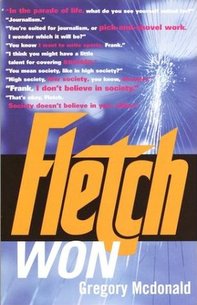
The first novel I read featuring investigative reporter Irwin M. “Fletch” Fletcher was 1985’s Fletch Won. I fell in love within the first few pages, as I read about how an eager young Fletch was just starting out in journalism, writing obituaries, and his editor had to tell him that he shouldn’t be totally honest in what he writes. Fletch’s crime? While researching an obituary about a recently deceased woman, he’d discovered that she didn’t have a great career, or much of anything else in her life, so he wrote that she had accomplished nothing. Rude? Yes. Inappropriate? Hell, yes. The truth? That too.
You see, you can’t always tell the truth in journalism. It’s not sexy. It won’t make you friends. It won’t sell papers. That was a fact back in the 1970s and ’80s, when the bulk of Gregory Mcdonald’s Fletch stories took place, and it’s even truer in our present era, when too many reporters are in the tank with politicians, and many of them practice journalism to win awards, rather than to educate or enlighten the public.
Mcdonald’s death last month, at age 71, reminded me of how much I appreciated his work. I still go back now and then to read his Fletch books--11 of them in all, from Fletch (1974) to Fletch Reflected (1994)--as well as his two series featuring Boston Police Inspector Francis Xavier Flynn (Flynn, 1977) and charmer Skylar Whitfield (Skylar, 1995). But I also love his 1991 standalone, The Brave, a truly bleak story about a man who agrees to appear in a snuff film, after being promised quite a lot of money. It’s a twisted, chilling horror story, and it will give even the toughest readers nightmares.
Over the last few years, publisher Vintage/Black Lizard has reprinted the Fletch stories--which had long been out of print--in sleek paperback form. Mcdonald must have been pleased. A real maverick in publishing in the ’70s, he’d insisted that his work be issued in paperback originals, so that as many people as possible could read them. His intent wasn’t just to make more money that way, though it’s not a sin that he prospered; but he also had important things he wanted to say, frequently about journalism, and he said them in a way that was quick-witted and intelligent. Mcdonald could wink and chuckle his way through Fletch yarns without ever losing sight of the gritty world in which they were set. The Fletch novels have a rare quality: while they perfectly capture the era of their original publication, they also feel completely modern--because lies, greed, humor, and corruption just don’t age.
After pondering how I might best pay tribute to the late Gregory Mcdonald, I decided that he should be honored through the words of his fellow writers. Many were pleased to respond to my call for their opinions, so fond had they once been of this author’s oeuvre.
What can I say? I’m just sad. We all are. We owe the man a lot.
Craig McDonald, author of Head Games:
Thank God I didn’t let that Chevy Chase film dissuade me from picking up my first Fletch novel in the mid-’80s. Gregory Mcdonald’s deceptively breezy style hooked me and I quickly devoured all the other Fletchs I could find, but there were only so many and I reluctantly moved on. About three years ago, Ken Bruen sent me a copy of Mcdonald’s The Brave. Expecting a Fletch-like romp, I was left unsettled and shaken by that book--a nightmarish, fever dream of a narrative 180-degrees out of phase with Fletch’s world. I can’t say I enjoyed The Brave in any sense, but I remain floored that the same author who wrote those wonderful, funny crime novels could deliver this other twisted, chilling vision of an innocent man’s horrific and needless self-sacrifice. Though I’d hesitate to urge The Brave on anyone, its mere existence reveals Gregory Mcdonald as a fierce and fearless writer possessing a range only our finest crime authors can rival.
Robert Ward, author of Red Baker and Four Kinds of Rain:
Years ago, I was living out in a funky house on [New York’s] Napeague Bay with my girlfriend and our dog Byron. I was writing on a deadline for Dick Schapp at Sport Magazine, and I swore I would not do a damned thing until I finished this long article. I’d been working all morning, so I made some lunch, and casually picked up Fletch, by Gregory Mcdonald. Never heard of the guy, but the book looked kind of cool. I started reading while eating my grilled cheese. Big mistake. In spite of my deadline, I read on and on and on. Meanwhile, Dick’s secretary is calling, and I’m lying and say I’m having a little trouble with the piece (Piece? What piece?). I just had to find out what the hell happened to Fletch. Eventually I did, and finished the piece in time too. So what if I had to stay up all night? Fletch was worth it, and so was Confess, Fletch [1976]. They were great crime novels, brilliantly plotted, witty, and super hip. Just as cool today as they were back when. Just don’t read them if you’re on a deadline. Farewell to Gregory Mcdonald, whom I never met but admired. Fletch, his greatest invention, will live on.
Bill Bryan, Shamus Award-nominated author of Keep It Real:
Gregory McDonald opened a lot of people’s eyes--including mine--to the fact that exciting, involving plots and gut-busting laughter are not incompatible. It took me quite a few years to act on this revelation, but without it I never would have written a novel. So thanks, Gregory. You kept us all riveted and entertained for a hell of a long time.
Corey Redekop, author of Shelf Monkey:
Like most people my age, I came to Gregory Mcdonald via Chevy Chase. Fletch was a fun movie (mind-blowingly fun to a 14-year-old), but the book was so far beyond the movie in terms of dialogue and style that I didn’t really appreciate it at the time. After a few years, I revisited Fletch, and summarily devoured the canon, plus the Flynn books. Mcdonald was the personification of streamlined writing--a no-nonsense, straight-ahead plot with superb dialogue. Reading Mcdonald is like taking a master’s class in how to tell a story, pared down to its most basic elements. And damn, was he funny. I don’t write like Mcdonald, not at all, and wouldn’t even try.
Not only was he one wonderful writer, and deceptively so, but he truly introduced the whole concept of mystery being fun and hugely enjoyable. He was a master of his art, and like all true gifted writers, he made it seem so easy.
He is irreplaceable and the world is truly dimmer without the light of his uplifting spirit and work.
Tim Maleeny, author of the P.I Cape Weathers series:
Gregory Mcdonald was one of the first authors who made me want to write crime fiction one day. His books are pure inspiration, [with] infectious plots carried almost entirely by dialogue, lightning fast but funny, even hilarious at times despite the serious subject matter. He’s still one of the few writers that I’ll go back and read again, even though I know so many of his books by heart. His words live on in all of us, as readers, writers, and eternal fans.
The Gregory Mcdonald Fletch series is the first mystery series that I actually spent my own money on. Up until then, I read whatever my mom read (great books, make no mistake). I ran across Fletch while spending one of my first paychecks. There were three books out at the time and I was hooked from the first page. Mcdonald had a wonderful ability to combine great action with a superb mystery, and add humor that wasn’t forced and still holds up to this day.
Gregory Mcdonald’s Fletch series was the catalyst and inspiration for my very first novel (it was an unpublishable mess, but still, I was 15 and it was a start). Mcdonald’s gift for moving a story along through witty, cut-to-the-quick dialogue is unparalleled, and most of us who try to emulate it seem to fail miserably. He just had that magic touch and will be greatly missed.
I came on Fletch in a used bookstore when I was 16. I opened it on a whim, having liked the movie. Thirty minutes later, I was 50 pages in and no longer a fan of the film.
Like so many dorky teenagers, I came to the character Fletch via the films. I’ll let others rehash the argument that the films were nowhere near as good as the books, etc. But I will contend that it was the films that brought Fletch to the public in a big way and confirmed his influence on the pop-culture lexicon. In high school, it seemed there was a time my buddies and I communicated almost exclusively through movie quotations. Lines from Fletch played a big part in our daily lives. Whenever one of us was broke, we’d invariably say, “Charge it to the Underhills.” And of course the films could not exist without Mcdonald’s novels.
Both Mcdonald and Fletch (whether he looks like Chevy Chase in your mind or not) will live on as pop-culture icons.
Let William Campbell Gault’s quote that “the best revenge is good writing” be one of Gregory Mcdonald’s epitaphs. For my money, he mastered what the practitioners of the crafts of both fiction and boxing aspire to: clean punches.
Fletch was the first mystery novel I read for pleasure. Fast-paced and full of wit and substance, it started a run of more than 15 years during which I’ve read mysteries almost exclusively, [and] during which only a handful have spoken to me as clearly and immediately as Fletch. I will miss Mcdonald, yet in a sense I never will. His style is so much what I look for in other writing, and my own.
Ace Atkins, author of a critically acclaimed series featuring blues historian Nick Travers, and also author of the forthcoming historical thriller Devil’s Garden:
Gregory Mcdonald was a massive influence on my life and career. I found the Fletch books when I was in high school, and they helped me to become a crime reporter and crime novelist. The books were so damn funny and sharp. His dialogue had a Hemingway brilliance about it, so spare and natural, it didn’t look like writing. I learned a great deal from Mcdonald and always thought I’d get a chance to meet him. Fletch really changed my life.
When I first began to read crime novels, in the early 1970s, the holy trinity of mystery writers consisted of the three M’s: Ross Macdonald, John D. MacDonald, and Gregory Mcdonald. All three belong in the pantheon. Gregory Mcdonald’s fast and clean narrative style was so ahead of its time, he’s still contemporary. He was the most modern mystery writer of his times--and also the funniest.
Like many British readers, I came to Gregory Mcdonald’s work through the 1980s film of Fletch. I found a book which, on the page, almost resembled a film script--starting off my own interest in reading film scripts alongside novels. His dialogue was distilled into a very pure essence, indeed.
Craig McGill, award winning journalist and author of Human Traffic: Sex Slaves and Immigration:
Mcdonald was a true writer of the people, concerned with that one thing that matters most to those who write for the purest of reasons: to have others read his words. He risked the ire of almost as many people as his most famous fictional character when he took a break from hardback publishers and went straight to paperbacks. And while he may be remembered for more than Fletch, it was this character that earned him the most praise, and rightly so: there are few creations out there that can make even cynical hacks want to enjoy being a journalist again. Fletch was that man and Mcdonald was his creator.
Will Beall, author of the critically acclaimed novel L.A. Rex:
Greg Mcdonald’s Fletch moved through Mcdonald’s novels with the same easy courage and almost supernatural aplomb that Bugs Bunny had strolling through those Warner Bros. cartoons. Errant Knight and recalcitrant smart-ass, Fletch spoke truth to power, brought low the mighty, and championed the weak--with dialogue sharp enough to cut glass. Mcdonald, and Fletch--for my money, his finest creation--will be sorely missed.
This has been a tough time in our little tribe, losing both Gregory Mcdonald and James Crumley.
The thing that always struck me about Gregory Mcdonald with Fletch was the way Mcdonald could portray a character who was larger than life and yet infuse him with a kind of grounded authenticity that made him seem real. As much as I love so many of the great characters of our genre, Fletch was the first who I believed might exist in the real world. I loved that feeling as a reader, and hope that I have been guided by it as a writer.
A great loss for all of us, readers and writers alike.
“I actually learned to write dialogue by reading Mcdonald’s ‘Fletch’ books. If you read his stuff, it reads like one of my screenplays. They’re very dense with dialogue, and spartan in descriptive passages (just the way I like ’em).” -- Award-winning director Kevin Smith, who once sought to adapt Fletch Won for the silver screen
Former Boston Globe reporter and novelist Gregory Mcdonald has died. He passed away yesterdayat his farm in Giles County, Tennessee. Mcdonald was 71 years old and had been diagnosed with cancer.
I am still stunned. We lost a major literary giant, one whose works not nearly enough people knew about or read. Many people knew him only because of the admittedly funny 1985 film adaptation of his novel Fletch (1974).
Gregory Mcdonald (born February 15, 1937 in Shrewsbury, Massachusetts) is an American mystery writer best known for his Fletch character, as played by Chevy Chase in the movie of the same name. The Fletch series, currently consisting of nine novels, also spawned the “[Boston Police Inspector Francis Xavier] Flynn” series, as well as the “Son of Fletch” series. Two of the Fletch books have earned Edgar Awards from the Mystery Writers of America: Fletch was named Best First Novel in 1975, and Confess, Fletch won for Best Paperback Original in 1977.
You see, when you opened up a novel by Mcdonald, usually one starring investigative reporter I.M. “Fletch” Fletcher or his eventual son, John Fletcher Faoni, you were in for quite a ride. Eschewing flowery narration, his novels were told in third-person and consisted mostly of dialogue. He was quick and to the point, and the man could hook a reader like few others. For example, here’s an excerpt from the first page of Fletch:
“What’s your name?”
“Fletch.”
“What’s your full name?”
“Fletcher.”
“What’s your first name?”
“Irwin.”
“What?”
“Irwin. Irwin Fletcher. People call me Fletch.”
“Irwin Fletcher, I have a proposition to make to you. I will give you a thousand dollars for just listening to it. If you decide to reject the proposition, you take the thousand dollars, go away, and never tell anyone we talked. Fair enough?”
“Is it criminal? I mean, what you want me to do?”
“Of course.”
“Fair enough. For a thousand bucks I can listen. What do you want me to do?”
“I want you to murder me.”
The black shoes tainted with sand came across the oriental rug. The man took an envelope from an inside pocket of his suit jacket and dropped it into Fletch’s lap. Inside were ten one-hundred-dollar bills.
That’s poetry, pure and simple. Told with the pace of a 1940s screwball comedy, or to be more modern, the speedy dialogue of Gilmore Girls, Mcdonald was a true economist with words and didn’t waste any time telling you things you didn’t need to know. Who wouldn’t want to read the rest of that book, after learning that somebody wants Fletch to murder them ... and Fletch even agrees to it? What follows is a shockingly short novel, at only 208 pages, that is filled with so much plot that it would put most novels that are twice as long to shame. Grittier and darker than the Chevy Chase vehicle, the book also is much funnier. (One running gag has Fletch completely unable to remember the complicated multi-syllabic alias he gave himself on a spur-of-the-moment whim, so it gets more and more unlikely each time he hauls it out--and no one seems to notice.) And it’s freighted with a biting satirical edge about the state of modern cities and the business of journalism.
Somehow, Mcdonald never lets all the balls he juggles drop. He writes a carefully choreographed dance and plans every step, every move--no word wasted, and no excess fat.
A true maverick, Gregory Mcdonald believed books should be read by as many people as possible. He insisted that his work be published in paperback, angering many writers who felt he was devaluing the genre. His Fletch timeline also jumped all over the place; for example, Fletch Won, a prequel, was actually published as the eighth book in the series. You never really knew what you would get when you opened a novel by Mcdonald, but you could be sure to expect a good time, with enough great dialogue that you’d be bugging friends and family by repeating it to them, insisting that they read Mcdonald’s books as well.
I want to keep this short, detailed but punchy, in the spirit of the great man himself. May he rest in peace. God, I’ll miss him.
Just a day after I dissed Chevy Chase’s performance in two movies, Fletch and Fletch Lives, based on Gregory Mcdonald’s popular comic thrillers about an investigative journalist named I.M. “Fletch” Fletcher, ComingSoon.net brings news that the character is destined for more movie adventures. Only this time without Chase’s involvement.
The site reports that “Spin City co-creator and Scrubs creator Bill Lawrence will write and direct the next two Fletch films for The Weinstein Company, of which the first remains Fletch Won,” based on Mcdonald’s 1985 novel of the same name (the eighth in a series that began with 1974’s Fletch). Screenwriter/director Kevin Smith (Clerks, Dogma) had previously been associated with the project, but has apparently tossed it over. ComingSoon adds, “Smith had wanted to cast My Name is Earl star Jason Lee in the title role, but Scrubs star Zach Braff was reportedly also a frontrunner for the role. Now that Lawrence is indeed on board, Braff definitely has an edge over other actors.” Shooting on the film--Lawrence’s first big-screen effort--is expected to begin in April 2007, while the producer is on hiatus from Scrubs.
It’s always dicey to translate a character familiar from books onto the screen, and Chase--while I respect much of his work--didn’t measure up to my vision of Fletch. He was broadly comic, rather than understatedly so, as Mcdonald’s tales really demand. I could see Lee in the part, sure, with his look of perpetual bewilderment at being caught up in the whirlwind of life. But I can imagine, too, Braff stepping into Fletch’s shoes. Although he strikes me initially as rather too young-looking, his role in Scrubs over the years has helped distinguish that NBC-TV sitcom as a smarter-than-average example of a pretty atrocious breed. What’s more, his work with the lovely Natalie Portman in Garden State (2004) shows he has the chops to pull off the sort of nuanced performance that could set Fletch Won apart from its more slapstick predecessors.
Send Us News:
The Rap Sheet is always on the lookout for information about new and soon-forthcoming books, special author projects, and distinctive crime-fiction-related Web sites. Shoot us an e-mail note here.
Check out our selection of more than 400 works of mystery, crime, and thriller fiction—from both sides of the Atlantic—scheduled to reach bookstores between now and Labor Day. Click here.
The Rap Sheet has now been around long enough that some older posts may include links to stories or Web sites that no longer exist. If you encounter such broken links, try searching for the original material via the Wayback Machine, an invaluable archive of digital content.
Also, we’d be very grateful if you could let us know where those inoperable links can be found. We’ll update them as soon as possible.
If You Can, Please Help The Rap Sheet to Survive and Thrive
Your Vigilance Is Welcome
Those of us responsible for The Rap Sheet try to get everything right, and we work to keep our Web links up to date. But we’re not perfect. So, if you spot any errors (typographical or otherwise) in this blog, or discover links or embedded videos that aren’t functioning properly, please let us know via e-mail.
The Rap Sheet Faithful
Disclosure Notice
The Rap Sheet accepts books sent free of charge from publishers, publicists, and authors. Those works may inspire comments on this page. However, in no case is there any promise given that a book will be the subject of an endorsement or review, either positive or negative.
Back in the fall of 1971, NBC-TV introduced its most successful “wheel series,” the NBC Mystery Movie. Look for our anniversary posts here.
Videos Disclaimer
From time to time, The Rap Sheet features short video clips. Use of these is for historical and entertainment purposes only, and is not meant to establish ownership of such materials. Rights to those clips stay with their owners/creators.
The One Book Project
In honor of The Rap Sheet’s first birthday, we invited more than 100 crime writers, book critics, and bloggers from all over the English-speaking world to choose the one crime/mystery/thriller novel that they thought had been “most unjustly overlooked, criminally forgotten, or underappreciated over the years.” Their choices can be found here.
In the Beginning ...
Before The Rap Sheet was a blog, it was a monthly newsletter in January Magazine. To find all the old editions of that newsletter, just click here.