• French-Canadian director and screenwriterDenis Villeneuve (Blade Runner 2049, Dune and Dune: Part Two) has been tapped to helm the next, 26th James Bond film. “Some of my earliest movie-going memories are connected to 007,” he is quoted as saying. “I grew up watching James Bond films with my father, ever since Dr. No with Sean Connery. I’m a die-hard Bond fan. To me, he’s sacred territory. I intend to honor the tradition and open the path for many new missions to come. This is a massive responsibility, but also, incredibly exciting for me and a huge honor.” As The Spy Command observes, this will be “the first Bond movie since Amazon gained creative control of the franchise earlier this year.” There’s no word yet on a title for this picture or when it might be released to theaters.
Rachel Brosnahan (The Marvelous Mrs. Maisel) will lead Apple’s legal drama Presumed Innocent for Season 2. The series hails from multi-Emmy Award winners David E. Kelley and J.J. Abrams, and executive producers Jake Gyllenhaal, Rachel Rusch Rich, Erica Lipez, and Matthew Tinker. Led by Gyllenhaal, Season 1 was inspired by Scott Turow’s courtroom thriller of the same name and tells the story of a horrific murder that upends the Chicago Prosecuting Attorney's office when one of its own is suspected of the crime. The book was published in 1987 and was turned into a 1990 feature starring Harrison Ford as Rusty Sabich, the same role Gyllenhaal took on. As reimagined by Kelley, Presumed Innocent will explore obsession, sex, politics, and the power and limits of love, as the accused fights to hold his family and marriage together.
• A hat tip to that same blog for sharing the news that Matthew McConaughey “is in talks to star in Skydance’s feature film based on the iconic private eye, Mike Hammer, from a script by Nic Pizzolatto, who collaborated with the actor in True Detective.” Deadlineadds, “Skydance acquired the rights to Mickey Spillane’s and Max Allan Collins’ Mike Hammer franchise with plans to develop and produce the bestselling book series into a feature film. … Collins [who continued the Hammer series after Spillane’s death in 2006], will executive produce with Jane Spillane [Mickey’s widow] serving as co-producer.”
• Since May, when I mentioned on this page that host Barry W. Enderwick showcased the Officer Bill Gannon Sandwich (of Dragnet fame) on his YouTube series, Sandwiches of History, I have been checking up on Enderwick’s channel, well, pretty much every day. His latest episode takes us back to Dragnet, this time to sample the Officer Bill Gannon Garlic Nut Butter Sandwich.
• Finally, Lee Childwill headline England’s inaugural Whitby Literary Festival, to be held in that North Yorkshire seaside town from November 6 through 9. During a public interview with TV personality and author Rob Rinder, Child plans to talk about Exit Strategy, the 30th Jack Reacher novel (penned with his brother, Andrew Child), set for publication on both sides of the Atlantic come November 4. Also up for discussion will be Child’s “first-ever autobiographical collection,” Reacher: The Stories Behind the Stories, due out on September 9.
(Above) The movie trailer for Blue Christmas. Charles Dickens could have had no inkling, when he penned his 1843 novella, A Christmas Carol, how durable or popular that tale about the grumpy skinflint Ebenezer Scrooge and a quartet of invasive night spirits would prove to be. The English novelist and journalist published myriad other yuletide yarns during his career, as well as further ghost stories. Yet most are long-forgotten, and not one of the others has been as oft-adapted for the theater, radio, and television as has Carol—or provided such rich inspiration for derivative fiction.
Case in point: “A Wreath for Marley,” which Iowa author Max Allan Collins concocted during a professional low point, in 1992, and first saw published four years later. “Marley” melded A Christmas Carol with Dashiell Hammett’s The Maltese Falcon into a story—set in Chicago in 1942—that introduced Richard Stone, a dick of a private dick who, as Kevin Burton Smith remarks in The Thrilling Detective Web Site, “needed a little ghostly comeuppance and a spectral visitation or three.” Smith goes on to explain the tale’s set-up: “It’s Christmas Eve, and Stone is tying one on at his office Christmas party, celebrating his dodging of the draft thanks to a well-placed bribe, much to the disapproval of his secretary/girlfriend, Katie Crockett, whose brother is fighting overseas in the Pacific Theatre, while his squeaky-clean young op Joey is none too happy about all the divorce cases he’s been stuck with. Stone is also marking the one-year anniversary of the murder of his partner, Jake Marley—a murder he couldn’t even be bothered trying to solve.”
You pretty much know where this holiday fantasy is headed. But Collins’ elaborations on Dickens’ Victorian plot line—especially his casting substitutions of John Dillinger and Elvis Presley for two of the original yarn’s phantoms—lend “Marley” both intrigue and humor. “I am not by inclination a short-story writer,” Collins wrote in his blog a couple of months ago, “but as soon as I’d finished it, I knew ‘Marley’ was special.” So special, in fact, that he thought his novella could succeed as a movie. Unfortunately, other projects got in the way, and it was only last year that he finally began work on what he calls a “not-at-all lavishly budgeted” big-screen version of the story, retitled Blue Christmas. That one-hour, 19-minute feature saw its theatrical debut last spring, and is now available in both Blu-ray and DVD formats. (Alternatively, you can watch it online here.)
Although the picture isn’t quite so polished as many modern Hollywood blockbusters (reviewers have likened it to “a community theater production”), it has won its share of critical plaudits. The Aisle Seat, for instance, writes that it “outperforms its low budget with an effective script,” while Overly Honest Reviews says that Blue Christmas “offers a potent mix of suspense, humor, and nostalgia, promising to engage viewers with its compelling tale of personal redemption and the enduring power of the holiday spirit.”
‘Tis the season for films such as Blue Christmas, but that project is certainly not the only one on which the prolific Collins has been working lately. He also has a second film in the works, a final collaborative installment in Mickey Spillane’s Mike Hammer series due out just three months from now, a sequel to Hammett’s The Maltese Falconrecently completed, and True Noir: The Assassination of Anton Cermak—a multi-part audio drama adapted from True Detective (1983), his Shamus Award-winning first novel starring Chicago gumshoe Nathan Heller—set to drop its initial three episodes this coming Friday.
I took the opportunity earlier this month to ask Collins about all of these subjects. The results of our exchange are below.
J. Kingston Pierce: You’ve said before that the 1996 novella “A Wreath for Marley,” from which your film Blue Christmas is adapted, is “probably my favorite piece of fiction I ever wrote.” You’ve written a lot of fiction. Why does this yarn stand out so?
Max Allan Collins: That was probably an overstatement on my part—“A Wreath for Marley” is my favorite short fiction I’ve written. I am not known as a short-story specialist, and in fact I’m not even the best short-story writer in my house—that would be my wife, Barb. I’m a novelist by nature, and it took me a while to sell “Marley,” because Ellery Queen Mystery Magazine, for example, liked it but found it too long for their purposes. Probably the most prominent place where it’s appeared is in Otto Penzler’s Big Book of Christmas Mysteries. And of course it’s in my collection Blue Christmas and Other Holiday Homicides [2001].
JKP: I hear that A Christmas Carol is your favorite Charles Dickens story, at least in part because you so enjoy the 1951 Alastair Sim movie version, Scrooge. Had you long considered ways to re-conceive that story with a crime-fiction angle?
MAC: No, it was something that occurred to me at a specific time, an idea I knew was special and pursued it immediately.
I have told this story frequently, but it’s necessary to tell it again. In early December (or maybe late November) 1992, I was fired from writing the Dick Tracy comic strip by the new editor at the Tribune Syndicate. He and I agreed on only one thing: that we hated each other. The day I received word of my firing (after a very successful run on that strip) I heard from my agent that my current Nate Heller contract had been cancelled by Bantam. This was right after a Heller novel, Stolen Away, won the Best Novel Shamus Award, so to say I was blindsided is an understatement.
I went into a brief period of not writing (not writer’s block exactly, but the lack of a project to drive me) and was understandably at a low ebb. On Christmas Eve 1992, after everybody but me was tucked in their wee little beds, I wrote “A Wreath for Marley” in a fever pitch. In one sitting, I wrote the entire 50-page novella. And after that my juices were flowing again. I started doing short stories for Ed Gorman and Marty Greenberg, who were doing theme anthologies that my wife was contributing to, and Michaela Hamilton at Dutton picked Nate Heller up. Heller is now at his fifth publisher, Hard Case Crime, a bit of a Christmas miracle of itself in this market.
I should add that the Alastair Sim Scrooge and Hammett’s The Maltese Falcon represented two narratives I loved, and somehow something in my brain saw the way their core concepts could be combined.
JKP: Did you ever consider making “Marley” a Nate Heller story, rather than enlisting a new Chicago P.I., Richard Stone? There are definite similarities between those two protagonists. But was there something Stone brought to the plot that Heller didn’t have going for him?
MAC: Heller was never an option. Richard Stone is more of a stinker than Nate, and the novella needed a third-person approach, not the Heller first-person one. And Heller is always fact-based, and “Marley” was a hard-boiled fantasy. Also, the protagonist needed a rural, very homespun Americana-type background, which Stone had rejected.
JKP: Wasn’t it long ago that you first wrote the screenplay version of Blue Christmas? When was that, exactly, and what made you think the tale would satisfy a film audience?
MAC: When we did my first movie, Mommy, in 1994—which brought [actress] Patty McCormack back to her Bad Seed persona, but as an adult—it was part of my seeking a replacement in my working career for Dick Tracy. I loved The Bad Seed, both the [1954] William March novel and Patty’s film, and thought an adult variation on that kind of character would have appeal in a psychological, blackly comic thriller.
When our effort did well—we had a respectable indie budget (at the time) of half a million bucks—and we became a chain-wide Blockbuster buy and a prime-time movie on Lifetime, I knew we could move forward with another project. That was originally to be Blue Christmas—the script was written, locations were scouted, and preliminary casting was underway. But there was demand for a Mommy sequel, and that was fine with me—I had a notion of how to do a sequel that was its own thing, not a rehash. It didn’t do as well—Lifetime turned it down, though Blockbuster again bought it chain-wide—and some financial malfeasance on my producer’s end stalled my indie movie-making badly.
We did a few more projects on criminally low budgets—Eliot Ness: An Untouchable Life, Real Time: Siege at Lucas Street Market—and I made a couple of documentaries, and sort of moved on, occasionally managing to sell a screenplay (The Expert, The Last Lullaby).
I still thought Blue Christmas (as I titled the film project from “Marley”) would be a natural with audiences, combining a Christmas theme with a noir mystery, and tried a couple of times to get it done as a movie or as a stage play. But nothing came of it.
JKP: So you stuck that screenplay away in a drawer, only to more recently pull it out and finally turn it into a film. What motivated you at this stage in your life to venture back into movie-making?
MAC: A couple of years ago I was approached to do a radio-style Dick Tracy play as a fundraiser for the local arts center. I said no, that ship had long since sailed; but I offered them Encore for Murder, a [Mike Hammer] radio-style play I’d written for Stacy Keach to do as an audio presentation. I was invited to co-direct, and attended the first rehearsal expecting Amateur Night at Dixie but finding some really strong local talent. I took Barb along to the second rehearsal, to see if I was imagining things, and she said, “No, they’re very good.” I asked Gary Sandy, who had played Mike Hammer in two [stage] presentations of Encore for Murder (one in Kentucky, another in Florida) if he’d consider coming to Muscatine, Iowa, to help us out. I expected him to say no, but he generously said he’d love to do it. Gary, famously the star of WKRP in Cincinnati, had been in my movie Mommy’s Day.
Gary did a fantastic job, and as a last-minute thing we shot a dress rehearsal and the one performance, then edited it into a bonus feature for a re-do/updating of my Mike Hammer’s Mickey Spillanedocumentary on Blu-ray. The video company decided also to release the radio play as a separate DVD. Suddenly I was making indie movies again.
The editing for Encore was done at the local community college, where I saw their Black Box theater and thought, “This is a lot like a movie soundstage.” And just sort of automatically the notion of doing Blue Christmas in a one-set format came to mind. Previous versions, with bigger budgets in mind, would have followed the detective to various Chicago locations. The new version would stay at the office where, after a night of heavy office-party drinking, the detective falls asleep and the Christmas Carol-like dreams/visions ensue.
JKP: You had hoped for more money to make Blue Christmas, including support from Greenlight Iowa. That didn’t happen. You decided to go ahead and make do with a “micro-budget,” instead. What concessions were you forced to swallow in order to produce this picture?
MAC: We were going to bring Gary Sandy back in to play Marley. We’d have had more overtly period-specific costumes and better props and, not a small thing, my producer, d.p. [director of photography], and myself would have got paid. We would have shot more second-unit footage—hallways of the office building, etc., and perhaps used two (adjacent) sets, the office and Stone’s apartment. Ultimately I like the way it works on the one office set—where all the visions play out.
JKP: I recently decided to re-read “A Wreath for Marley,” and was surprised at just how closely the film follows that novella’s plot and dialogue. One major change, though, was that Stone’s first spirit guide in the original story was the colorful American bank robber John Dillinger, while in the film it’s another bandit, Bonnie Parker, who—with her partner, Clyde Barrow—was gunned down by law enforcement in the same year as Dillinger, 1934. Why the switch?
MAC: Re-reading the screenplay as originally written, I felt we needed another strong female role. And I think Bonnie and Clyde may be more famous now than Dillinger. A real consideration was the possibility of landing Alisabeth Von Presley to play Bonnie. Alisabeth is sort of a Midwest superstar—she was on American Idol and American Songwriting Contest, and is a fabulous performer. I wrote it with her in mind and, with the help of my lead actor, Rob Merritt (like Alisabeth a Cedar Rapids resident), got her to agree to play the role. She won a Best Actress award for it from the Iowa Motion Picture Association.
JKP: What’s been the reception like so far of Blue Christmas?
MAC: We’ve had the opportunity to screen it at a few actual theaters, though it was designed for streaming and physical media, and audiences took to it warmly. Of course we had hometown advantage on the court. The reviews have taken an interesting turn. We’ve had mostly very good reviews and several raves, but the couple of bad ones were really bad. Hey, it’s an $8,000-dollar micro-budget movie on mostly a single set. The cast is led by a couple of pros, Rob and Alisabeth, but the rest are from Quad Cities dinner theater and the same local talent used on Encore. If you meet our little movie on its own terms—as a bittersweet noir fantasy—you’ll have a good time. If you are expecting Wicked, you’ll be disappointed.
JKP: You have written that your work on Blue Christmas inspired you to try your hand at making a second holiday-themed film, Death by Fruitcake. This one brings to life the main characters from the Trash ’n’ Treasures mystery series you’ve been working on with your wife for the last two decades (all the titles of which begin with Antiques), and publishing under the joint nom de plume Barbara Allan. What’s the status of Fruitcake? Will it be available by next Christmas?
MAC: My wife, Barb, is a key element in my moviemaking, but she swore Blue Christmas would be her last film project. So I kind of tricked her back into it by doing an Antiques movie with our characters Brandy and Vivian Borne (we’re at 19 entries in the series). Over the last 10 years or so, several top TV showrunners have taken the property out for a possible series, and we’ve come very close but not caught the gold ring. We decided to show how effective and fun the Trash ’n’ Treasures mysteries could be on screen.
I’m proud of Blue Christmas, but there’s no question Death by Fruitcake is a step up. We have Alisabeth back (as Brandy) and Quad Cities broadcasting legend Paula Sands is Vivian. Paula had just retired from Channel 6 and was available (she also appears in Mommy’s Day) for a new kind of project. Both of them are terrific. Our Stone, Rob Merritt, plays recurring character Chief of Police Tony Cassato. And we have a bigger budget this time—a whopping $24,000. We did a two-night premiere at the local multi-plex and packed the house both nights. We haven’t taken it out to market yet, but it should easily be out there for Christmas 2025.
JKP: What did you learn from Blue Christmas that was helpful in putting together another modestly budgeted film, Death by Fruitcake?
MAC: Frankly, I wanted (and got) even more control. The six-day shoot of Blue Christmas found me leaving things to the director of photography while I focused on performance and story, just so we could make time. We had two weeks and some second-unit days on Fruitcake, and I was much more in auteur mode.
JKP: Do you think Death by Fruitcake might earn you more attention from hardened crime-fiction enthusiasts who believe the Trash ’n’ Treasures books are just too cozyish for their tastes?
MAC: I hope so. It’s a funny movie, with a share of dark comedy, that may introduce new audience members to the Antiques novels, which are after all on some level a spoof of the cozy genre and on another a two-detective approach not entirely unlike Rex Stout’s Nero Wolfe.
JKP: While I have your attention, let me ask about a couple of other works you have in the hopper, the first being Baby, It’s Murder, which is due out this coming March from Titan Books. After penning 14 previous Mike Hammer novels, finished by you from material Mickey Spillane left behind when he died in 2006, this is to be Hammer’s last novel-length outing. Why end the series here?
MAC: Titan and I were at the point where I would have to start writing strictly original Hammer novels. The object had always been to complete the unfinished projects from Mickey’s files. The first eight or so were from substantial manuscripts. By the end I was using synopses he had jotted down. If there’s a movie or something, I’d consider putting Mike back out there. But for now, our goal of completing what Mickey left behind has been met.
Baby, It’s Murder has some special poignancy and is a good stopping place. Wait till you read the last line!
JKP: This is going to be a short novel (just 192 pages long, according to Amazon), but it must have been a very significant one to you. What have you learned about either Spillane’s storytelling methods or Mike Hammer’s character that you didn’t know before you started trying to bring the last of Mickey’s fiction to the reading public?
MAC: There’s enough Spillane in my native style to just ramp it up a little on these novels. I am strictly a Hammett/Chandler/Spillane boy—no other private-eye writers have influenced me a whit. I concentrate on the Hammer character, getting him right, and let the books write themselves. I do think there’s more humor in my Hammer, or if not more, then a slightly different style of humor—less Howard Hawks in tone. And I allow Mike to show a tad more humanity than Mickey did, although my take is probably just as tough—I think it’s scarier when a guy with a certain sensitivity does something really violent and vengeful.
JKP: What do you think you’ve added to our understanding of Hammer that we didn’t know by the time Black Alley—the final Hammer novel Spillane wrote by himself—reached print in 1996?
MAC: Mickey was struggling with Velda toward the end. He wanted Mike and Velda to be full partners, including sexually, but his conservative religious beliefs sort of hamstrung him. He would find excuses for them not having sex, and started denying that they’d ever had sex, though that was the pay-off of The Snake. So I made it clear that Velda and Mike were full partners. There’s a lot more full-blooded Velda in my collaborations with Mickey. Maybe that comes from writing the Ms. Tree comics character for a decade and a half.
JKP: In addition, you finally gave Velda a last name, Sterling.
MAC: That was Mickey’s last name for Velda, never revealed till I became involved. In the movie of The Girl Hunters, an “S” bracelet is shown. And, by the way, the last name of Patty McCormack’s Mommy character, in those films, is Sterling.
JKP: Although you won’t be writing any more Hammer novels, do you think the character might figure into future short stories?
MAC: Possibly, though there’s one major Hammer project left to do—a science-fiction-oriented one that needs to be set apart from the canon somewhat. Mickey called it Time Cycle, but I’m hoping to call it Mickey Spillane’s The Time Machine.
JKP: Now let’s talk about The Return of the Maltese Falcon, your sequel to Dashiell Hammett’s famous 1929 detective novel. How long have you been thinking about writing this book?
MAC: Oh, I have been thinking about doing it for maybe 15 years. Keeping an eye on the public domain clock. [Falcon is one of “thousands of copyrighted works from 1929 (that) will enter the U.S. public domain” beginning in 2025.]
JKP: What do you say when people dismiss the need for such a sequel?
MAC: Well, it isn’t necessary. But a surprising number of readers, and fans of the John Huston-directed movie, would have liked another ending. Even Bogart (who apparently came up with it) added a different last line. I think a good case can be made that Hammett’s ending is perfect, though. That doesn’t stop me from wanting more Sam Spade.
It’s disappointing to me, but not surprising, that some Hammett fans resent this project. Don Herron, whose The Dashiell Hammett Tour guidebook was a major reference for my novel, has made it clear in his Internet column that he won’t be reading the novel. He actually made fun of the idea. I was only half-way through writing Return and I already had a bad review!
JKP: Before we move on, just what was the different last line Humphrey Bogart proposed for The Maltese Falcon?
MAC: Technically, it’s “huh?” Spoken by the cop, Sergeant [Tom] Polhaus. But before “huh,” Bogart says, “The, uh … stuff that dreams are made of.” Hammett’s tag, an additional scene, has [his secretary] Effine Perine disenchanted with him and [his late partner’s wife] Iva Archer lurking to step in.
JKP: So can you tell us a little something about the plot of Return? Do you pick up right on the heels of Hammett’s tale, or is this a story set later in the Depression? And other than Sam Spade, which characters from the original book are you bringing back?
MAC: It takes place in December 1928, within two weeks of the end of the action in The Maltese Falcon. Most of the characters I use are either in the original novel (Brigid O’Shaughnessy, Joel Cairo) or are characters referred to in the original but who were never on stage (General Kemidov, Dixie Monahan). Rhea Gutman, who is in the original but was left out of the Huston film, is a major player. The idea was to work as much as possible within the confines of the Hammett novel—to make that the world.
JKP: In addition to The Maltese Falcon, Hammett penned three Sam Spade short stories. Now that you’ve made his San Francisco gumshoe your own, can you see using Spade again in your future short fiction?
MAC: Not short fiction necessarily, but possibly—if Return is well-received—another Spade novel or two. You make a necessary point: Hammett used, perhaps conceived, Spade as a series character. He was on that path when he stopped writing. Spade was of course [the star of] a very successful radio series, if a rather spoofy one, that Hammett licensed.
JKP: As if you didn’t have your fingers in enough pies already, you have also been working on a major Nate Heller project this past year.
MAC: Yes, a 10-part immersive, full-cast audio drama based on the first Heller novel, True Detective. Because of the HBO show, we couldn’t use the book’s title, so we decided upon True Noir. I’ve adapted [my story] myself, into a 400-page script. The episodes are each a bit over half an hour. Robert Meyer Burnett, who is a major YouTube presence but also a film and TV director, is directing and editing the production. Rob has been great to work with—having me sit in on all the recording sessions and offer my input, which is not usual director behavior. Our cast is unbelievably stellar—David Straithairn (as Frank Nitti), Vincent Pastore, Katee Sackhoff, Bill Smitrovich, William Sadler, Jeffrey Combs, Adam Arkin, and that’s just scratching the surface. Our casting director, Christine Sheaks, and Rob Burnett came up with the cast, though I also got my friends Bill Mumy and Patton Oswalt to participate. Nate Heller is played by Michael Rosenbaum, of Smallville fame, and he nails the character. Just great.
This is a dream come true for me, essentially a movie without pictures that really brings my vision to life. The initial three episodes will be “dropped,” as they say, very soon, followed by weekly, podcast-style distribution of the other seven episodes. Stay tuned.
You can now purchase True Noirhere. JKP:True Noir reminds me of an old-time radio drama, with sound effects and everything. Are you a fan of radio mystery series?
MAC: I am a fan of old radio, though Barb and I lean more toward Fibber McGee and Molly and The Great Gildersleeve. Of the non-comedies, we like Dragnet. In my ways, including subject matter, True Noir is a big advancement over the traditional old-time radio dramas, which have their charm but can sound hokey to a contemporary audience. True Noir has first-rate sound effects and a wonderful, complete score.
JKP: What happened to Todd Stashwick (Star Trek: Picard, 12 Monkeys, The Riches). Wasn't he slated to voice Nate Heller in your forthcoming audio production?
MAC: Todd was hired to do the proof-of-concept mini-episode, with an eye on him doing True Noir. He did a fine job but we had some scheduling and creative issues we couldn't get past. We looked at some very big names for Nate Heller, and finally just auditioned a few people. Michael Rosenbaum knocked it out of the park—the moment Rob Burnett and I first heard Michael, we knew we had our man.
JKP: If True Noir is a hit, would you then adapt other Heller novels? I remember you’d actually thought initially to adapt Stolen Away first.
MAC: Yes, we’d do more, although we hope it leads to a long-form streaming TV series. We’re discussing The Million-Dollar Wound [first published back in 1986] at the present.
JKP: So what’s next on your writing plate?
MAC: Barb is working on her draft of Antiques Round-up. She’s almost done, so I’ll be starting that the first of January (or thereabouts).
JKP: Finally, I can’t leave off without inquiring about your health, as you often write about that in your blog--and it’ts affects your production as a fiction writer. How are you doing?
MAC: I am doing fine. The recurring joke around here is, “I’m in great health for somebody with this much wrong with him.” Doing a full two-week shoot on Death by Fruitcake was a sort of test to see what I can still pull off. The biggest problem for me, and anyone my age writing the kind of things I do, is the shrinking markets. My editors, even my publishers, are heading into well-deserved retirements. But I don’t know what to do with myself but write.
Mickey Spillane’s New York City private eye Mike Hammer has featured in multiple films over the years, both on the big screen and on television. Now that rough-edged and relentless protagonist may be headed back for yet another working over by Hollywood—thanks in part to author Max Allan Collins reviving his career in a series of books following Spillane’s demise in the early 2000s.
Deadline reports that California production company Skydance Media “has acquired rights to Mickey Spillane’s and Max Allan Collins’ Mike Hammer franchise with plans to develop and produce the bestselling book series as a feature film based on the iconic character.
Entertainment 360 joins as a producer with Skydance’s David Ellison, Dana Goldberg and Don Granger producing with Guymon Casady producing for Entertainment 360. Benjamin Forkner and Ken F. Levin will also produce. Collins will executive produce, with Jane Spillane serving as co-producer. Carin Sage will oversee the project for Skydance. ...
The producers have the rights to the Hammer catalog which includes dozens of stories, books and graphic novels authored by Mickey Spillane as well as those co-authored by Spillane and his friend the best-selling author Collins ...
As savvy Rap Sheet followers know, Spillane batted out 13 Mike Hammer novels during his 88 years on Earth, from I, the Jury (1947) to Black Alley (1996). Iowa author Collins, to whom Spillane entrusted his unpublished and unfinished works, released his first “collaborative” Hammer novel, The Goliath Bone, in 2008. Since then, he’s completed another 13 novels, plus a 2016 collection of Hammer short stories, A Long Time Dead. His latest joint venture with Spillane is Dig Two Graves, which was originally due out this month from Titan Books, but has been postponed until mid-September.
(Above) Mickey Spillane himself starred as shamus Mike Hammer in 1963’s The Girl Hunters, opposite Shirley Eaton.
Of previous Hammer movies, Deadline recalls: “The Mike Hammer novel Kiss Me, Deadly was adapted into the classic 1955 film directed by Robert Aldrich and starring Ralph Meeker as Hammer. In 1999, it was selected for preservation in the United States National Film Registry by the Library of Congress.” The site goes on to say that “The character has not had a chance for any feature film treatment thanks to a long-winded rights dispute. Spillane passed away in 2006, one month after the death of his manager Jay Bernstein. Bernstein’s estate claimed ownership of the Hammer character. Levin spent several years in court before the rights came back to the author’s estate and a clear title could be delivered for a movie deal.”
It’s high time Hammer, his barking firearms, and his sexy partner, Velda Sterling, were rediscovered by filmgoers. Let us hope the present strikes by both Hollywood screenwriters and actors doesn’t cause serious delays to this production.
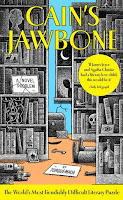
• It seems that British comedy writerJohn Finnemore (Cabin Pressure), one of the few people known to have solved the literary puzzle Cain’s Jawbone, has penned “an official sequel” to that work. As The Guardian’s Sarah Shaffi explains, the Cain’s Jawbone murder mystery was originally published in 1934, and was created by Edward Powys Mathers (aka “Torquemada”), the “cryptic crossword compiler” for Britain’s Observer newspaper. Mathers’ puzzle “can only be solved if readers rearrange its 100 pages in the correct order,” says Shaffi. “It became a literary phenomenon after book fans on TikTok discovered it.” About the contents of Finnemore’s sequel—set for release next year—The Guardian provides the following:
A locked room mystery, Finnemore’s new whodunnit hinges on a person found stabbed to death in the study of a complete stranger. The room was securely locked from the inside, but no weapon—or murderer—has ever been found, and the police investigation discovered no credible suspects or likely motive.
The murderer keeps, safely locked in a drawer, a box of 100 picture postcards. If arranged in the correct order and properly understood, these postcards will explain the murder in the study, and nine others that took place the same year. Readers need to re-order the postcards, one side of which features text, the other an image which is also a clue, in sequence to correctly solve and explain the 10 murders.
For now, Finnemore’s book, due out from crowdfunding publisher Unbound, is listed only as Untitled Mystery. However, Shaffi reports that “the title will be revealed to those who pledge during the crowdfunding campaign.” As of this writing, that campaign has 1,061 supporters at various reward levels.
• Crime Fiction Lover reports that the popular ITV-TV crime drama Unforgotten will return to British airwaves on Monday, February 27. This fifth season of the show finds Irish actress Sinéad Keenan stepping into shoes vacated by Nicola Walker, whose character, Detective Chief Inspector Cassie Stuart, was killed suddenly in a car crash at the end of Series 4. (Walker subsequently went on to headline the Alibi network’s Annika, which has been renewed for a second season.) Keenan has been cast as DCI Jessica James, who joins series regular DCI Sunil “Sunny” Khan (Sanjeev Bhaskar) in managing a team of London police detectives who specialize in solving cold cases. Their initial investigation together will, of course, be a “devilishly tricky one,” CFL explains. “During the renovation of a period property in [the West London district of] Hammersmith, a body is found bricked into the chimney. At first, Jessica is sceptical and warns that with its tight resources the team can only afford to investigate cases that have consequences in the here-and-now. After all, there’s the suggestion that the body could date as far back as the 1930s.” As usual, Season 5 will comprise six episodes. The UK blog What to Watch notes that “A U.S. release date has still to be announced.”
• Meanwhile, the ninth and concluding season of Endeavour—a prequel to the long-running Inspector Morse—is scheduled to begin its run on the same British network, ITV, come Sunday, February 26. There will be just three 90-minute episodes this time out, concluding on March 12. Although The Killing Times says Season 9 “plot details are currently embargoed,” Radio Timesobserves that the program’s “fans are bracing themselves for some sad scenes in the final three episodes, which will reveal how Morse (Shaun Evans) came to be estranged from his crime-solving partner, Fred Thursday (Roger Allam).” The PBS-TV Web site supplies nary a clue as to when this last season of Endeavour might become available to American viewers, but it does offer a brief video that recaps scenes from Evans’ decade spent in the role of Detective Sergeant Endeavour Morse.
• Speaking of Shaun Evans, it appears he will star with Anna Maxwell Martin (Line of Duty) in a four-part ITV adaptation of Delia Balmer’s 2017 true-crime memoir, Living with a Serial Killer. The story, according to Deadline, will focus on Balmer, a nurse “who fell for murderer John Sweeney (Evans) and overcame a horrific attack to provide vital evidence in the prosecution against her former lover.” Using a script by Nick Stevens (The Pembrokeshire Murders), filming on this mini-series is expected to begin next month.
• Season 2 of the HBO-TV seriesPerry Mason, starring Matthew Rhys, is slated to premiere on Monday, March 6. I haven’t seen much information about what to expect from those eight new episodes, but the Web site FedRegsAdvisor states they’ll be set in 1933—the last year of America’s failed Prohibition experiment—“with the protagonist’s law company taking on civil issues as opposed to criminal justice cases.” After the offspring of a powerful oil company exec is slain cruelly, and Los Angeles’ Depression-era “Hoovervilles” are searched for “the most obvious suspects, … Perry, Della [Street], and Paul [Drake] find themselves at the center of a case that reveals vast conspiracies and forces them to consider what it means to be truly guilty.” A most promising trailer for Season 2 is available here.
• A final TV note: The UK channel BBC One has released early images from Wolf, an upcoming crime drama based on the late author Mo Hayder’s novels about Detective Inspector Jack Caffery. English actor Ukweli Roach will be portraying Caffery.
• Because I have committed myself to attending this year’s Bouchercon, I’ve been on alert for news about that event. Which is why I noticed this generous offer. From In Reference to Murder: “A new Bouchercon Scholarship Award Program has been established to help mystery fans and writers with a financial subsidy. This subsidy covers registration fees for the annual Bouchercon convention, scheduled to be held in San Diego in 2023, as well as travel and lodging costs, reimbursed up to $500.00 (for up to five awardees). Interested applicants will need to write a 300- to 500-word essay on the applicant’s interest in attending Bouchercon and in the mystery genre and be willing to volunteer for no less than four hours at the event. The deadline is May 1st, with scholarship winners announced June 1.” Click here to find applications specifics.
• Nero Wolfe fans will find something extra to like about this San Diego Bouchercon. A banquet in honor of their favorite fictional sleuth has been scheduled for Friday, September 1, at Morton’s Steakhouse on J Street, “a 2-minute walk from the convention hotel, with shuttle rides available.” The cost is $175 per person, and it looks as if attendance is limited to members of the Wolfe Pack literary society.
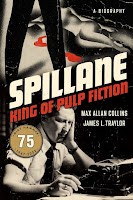
• Max Allan Collins and James L. Traylor have been scoring plenty of favorable press coverage for their new, first-ever Mickey Spillane biography, Spillane: King of Pulp Fiction (Mysterious Press). That includes a joint interview with the Web site Bookreporter, from which we learn, for instance, why Spillane took a decade-long hiatus from writing after Kiss Me, Deadly was published in 1952. My humble contribution to these kudos is a short critique I posted earlier this week in January Magazine. Here it is in its entirety:
“The chewing gum of American literature” is how crime novelist Mickey Spillane described his books, which typically blended eye-for-an-eye justice with risqué innuendos and granite-chinned philosophizing (“Too many times naked women and death walked side by side”). And boy, did readers eat up his fiction, making his first Mike Hammer private-eye yarn, 1947’s I, the Jury, into a best-seller that spawned a dozen sequels and turned its protagonist into a radio, film, and TV fixture. Spillane developed his own media persona along the way, part-Hammer (he portrayed his Gotham gumshoe in a 1963 film, The Girl Hunters) and part-ham (he spoofed himself in a succession of Miller Lite beer commercials). In this enlightening biography, fellow writers Collins (his friend and posthumous collaborator) and Traylor make the most of their extraordinary access to Spillane’s personal archives, delivering incisive perspectives on his comic-book years, his multiple marriages, his pugnaciousness and wont to embellish the facts of his life, his surprising conversion by Jehovah’s Witnesses, his vexation with Hollywood, and his eventual recognition by peers who’d earlier condemned him as “a vulgar pulpmeister.” This book’s paramount success, though, is in casting Spillane as a trendsetting stylist, who recognized early the value of paperback publication and helped shape late-20th-century detective fiction.
• Until recently, I knew Mark Dawidziak mainly as the author of a fine 1989 TV retrospective, The Columbo Phile: A Casebook. But he is the man, too, behind a new biography that features prominently on my must-have list: A Mystery of Mysteries: The Death and Life of Edgar Allan Poe (St. Martin’s Press). In a CrimeReads extract from that book, Dawidziak recounts the “ongoing fascination” with Poe’s death, in Baltimore, at the tender age of 40—a subject that A Mystery of Mysteries addresses in some detail. Also posted recently in CrimeReads was Dean Jobb’s terrific look back at Poe’s 1843 horror story, “The Black Cat,” and the real-life murder that inspired it.
• Dammit! As I mentioned here last month, I have been looking forward to watching Marlowe, an adaptation of Benjamin Black’s 2014 Philip Marlowe continuation novel, The Black-Eyed Blonde, which debuted in theaters last week. Unfortunately, The A.V. Club’s Ray Greene is rather less than enthusiastic about this Liam Neeson film. As he remarks in a review, “Marlowe has seen it all—he’s a voyeur of the very worst human behaviors, and he’s world-weary to a fault. Liam is just plain weary—laconic, not iconic. Where Bogie and even a comparably aged Robert Mitchum were able to convey Marlowe as a man who at least remembers what caring felt like, Neeson is going through the motions of going through the motions. And the age thing doesn’t help. The only time Neeson’s Marlowe seems truly vulnerable is when he talks about the possibility of regaining his police pension. ‘I’m getting too old for this’ he moans after a fistfight, tempting audience agreement with the very phrase.” I’ll still plump for tickets to Marlowe, but go into it with lowered expectations.
• Thanks to the release of Poker Face on the Peacock streaming service, a 10-part “howcatchem” crime/comedy series that has garnered plenty of comparisons to Columbo, Peter Falk’s iconic L.A. police lieutenant has been enjoying a recent wave of reconsideration in critical circles. In this piece for the Web site of Boston’s WBUR-FM radio, Ed Siegel recalls an interview he had over dinner with Falk in the mid-’80s. In the meantime, Slate’s Cameron Gorman explains how the Internet turned Columbo “into a sex symbol and queer icon.”
• I am dearly hoping that this celebration of crime novelist Peter Robinson’s life and literary endeavors, to be held at England’s University of Leeds in early April, will be broadcast live via the Web. Robinson, you’ll recall, died last October at age 72.
• Tomorrow is Presidents’ Day here in the States—time to pour through Janet Rudolph’s extensive collection of mysteries that guest star or are built around American chief executives. You might also wish to revisit this article I wrote for CrimeReads about novels featuring authentic or imagined U.S. presidents.
• Subjects covered in Mike Ripley’s latest“Getting Away with Murder” column for Shots range from his long-ago stroke to the 1951 espionage film Decision Before Dawn and Steven Powell’s biography of James Ellroy, plus mentions of brand-new works by Stephen O’Shea, Kathleen Kent, David Brierley, Karen Smirnoff, and others.
• Worth checking out as well is the new, Winter 2013 issue of Deadly Pleasures Mystery Magazine, which is stuffed full of “best crime fiction” choices from the year that just was—selected both by DP critics and outside sources. Among this edition’s other contents are a wrap-up of Depression-era mysteries; reviews columns from such regulars as Ted Hertel, Meredith Anthony, and Kristopher Zgorski; and news that DP has added four contributors to its stable, all refugees from the recently closed Mystery Scene magazine: Kevin Burton Smith, Robin Agnew, Hank Wagner, and Craig Sisterson. Subscribe to this quarterly, or buy the Winter 2013 issue alone, by clicking here.
• And isn’t this interesting. Ramona Emerson’s 2022 crime/horror thriller, Shutter (Soho Crime), has moved up to the shortlist of titles vying for this year’s PEN America Literary Awards. It’s been nominated for both the PEN Open Book Award and the PEN/Hemingway Award for Debut Novel. Winners are to be announced on March 2 during an evening ceremony at The Town Hall in New York City.
• Meanwhile, the British site Crime Time is up with its own “books of the year” choices. As is true also of CrimeReads’ lists, there are few unexpected picks among Crime Time’s top 10. But if you read down a bit further, into the preferences of individual contributors, there are some more interesting suggestions, among them Andrew Williams’ Witchfinder, Robert
Jeffrey’s Man at the Window, Ray Celestin’s The Mobster’s Lament, and Laura Shepherd-Robinson’s Blood & Sugar (which I highlighted in my own top-five rundown).
• Abby Endler, author of the blogCrime by the Book, provides Criminal Element with a catalogue of 12 titles—one chosen from every month of 2019—that she believes deserve
particular applause. Winning her approval are Alex Michaelides’ The Silent Patient, Alice Feeney’s I Know Who You Are, Riley Sager’s Lock Every Door, Sara Shepard’s Reputation, and eight others.
• MysteryPeople, the crime-fiction department of Austin’s famously large and commercially independent BookPeople store, is up with its “five favorite Texas crime novels of 2019.”
• The various contributors to Crime Fiction Lover are still in the process of announcing their “top five books of 2019.”
• And in its concluding episode of 2019, the Paperback Warrior podcast “revisit[s] the greatest books we read this year.” Keep in mind that the Paperback Warrior blog’s focus is on older works (predominately crime and thriller fiction), so don’t expect any overlap between its “greatest books” and those mentioned above.
• Mystery Fanfare’s Janet Rudolph reports that “with just days to go before it would have to close its doors forever, San Diego’s science fiction, fantasy, young adult, mystery, and horror bookstore Mysterious Galaxy has found a new location and new owners: Jenni Marchisotto and Matthew Berger have bought the store and will run it at its new home, 3555 Rosecrans St., Suite #107, San Diego, CA 92110. Everyone’s keeping their jobs, too. It’s a Christmas miracle.”
• Back in August, we alerted you to the start of the third annual Six-Word Mystery Contest, sponsored by the Rocky Mountain Chapter of Mystery Writers of America. It offered prizes to writers who could condense a crime story into just half a dozen words. The victors in five categories have now been announced, but the overall winner is Jeffrey Lockwood, an author and professor of natural sciences and humanities at the University of Wyoming. His punchy submission:
36D, 44 magnum, 20 to life
A press release says that “forty writers from 10 states and Australia submitted 211 six-word mysteries to this year’s competition.”
• Actor Danny Aiello may be remembered best for his roles in movies such as Moonstruck (1987) and Do the Right Thing (1989), but when I heard that he died last week at age 86, my thoughts jumped immediately to his 1997-1998 CBS-TV crime drama, Dellaventura. Yes, that 13-episode series—in which he played Anthony Dellaventura, a former New York City police detective turned private eye, who “rounds up a bunch of crackerjack crime-fighters to right wrongs that are beyond the reach of the criminal justice system”—was derided variously as a knock-off of either The Equalizer or Telly Savalas’ Kojak. However, the Daily News’ Denis Hamil argued in 1997 that the Dellaventura role was “a perfect fit” for Aiello. And as you can see in this episode of the program, “Above Reproach” (the only one I could find on YouTube, with a guest appearance by Tony Franciosa), it boasted an engaging dark air leavened by moments of humor. Aiello seemed fully comfortable leading a cast that also included his son Ricky and Anne Ramsey from Mad About You. And the opening title sequence—featuring a version of Dion DiMucci’s classic “I Was Born to Cry,” and embedded below—set the show’s tone splendidly.
• While searching around for Dellaventura installments, I stumbled across this video collection of memorable clips from the 1984-1987 CBS series Mickey Spillane’s Mike Hammer, in which star Stacy Keach catches too-brief looks (in multiple episodes) at an alluring young brunette—referred to simply as “The Face”—“who popped into frame and just as quickly popped out again, much to the chagrin of Mike Hammer, who was dying to meet her.” As the blog TV Character Nicknames reminds us, “The general public was also kept in the dark as to her identity until her credit line appeared on an episode of ABC’s Perfect Strangers. It revealed that ‘The Face’ was model-actress Donna Denton. Finally, after three years of just glimpses, Mike Hammer got to meet the mysterious woman in the spring 1987 episode entitled ‘A Face in the
Dark.’” (Actually, the title was “A Face in the Night,” and it was broadcast originally on May 13, 1987). Of all the women Keach’s Hammer knew—or, in this instance, didn’t know—Denton’s persistently elusive lovely remains my favorite.
• A very sad change for Seattle: First and Pike News—formerly Read All About It—a newsstand landmark in the city’s historic Pike Place Market, is slated to close on December 31 after four decades in business. Back in the days when I covered the media business for Seattle Weekly, this corner shop was one of my most regular stops, a place where I could pick up not only U.S. magazines and newspapers, but also foreign publications. Want to learn more about that enterprise? Read all about it here and here.
Universal Pictures is developingTapping the Source, based on the “surfer noir” novel by Kem Nunn. The story follows a man who heads to Huntington Beach [California] to look for his missing sister and for the three men who may have murdered her—a search that takes him on a journey through a twisted world of crazed Vietnam vets, sadistic surfers, drug dealers, and mysterious seducers.
You can check out Rap Sheet contributor Steven Nester’s review of Nunn’s 1984 first novel by clicking here.
• A note in Elizabeth Foxwell’s The Bunburyist leads us to a post on the British Film Institute’s Web site in which freelance writer Pamela Hutchinson selects “10 great whodunnit mysteries,” suspect-packed pictures “in which the audience plays sleuth.”
• The site Best Thrillers has named what it contends are “The 21 Best Legal Thrillers of the 21st Century,” including Michael Connelly’s The Lincoln Lawyer, Marcia Clark’s Blood Defense, Max Allan Collins’ Supreme Justice, and Lisa Cottoline’s Corrupted.
• If you’re planning to attend next year’s Bouchercon in Sacramento, California (October 15 to 18), consider registering by December 31. Until then, the cost is $200; on January 1, it will climb to $225.
Acclaimed screenwriter and Endeavour creator, Russell Lewis, has adapted two of international bestseller Peter James’ award-winning novels for ITV from the Roy Grace series, starring John Simm in the lead role of the tenacious detective.
Entitled Grace, the two feature-length screenplays will narrate the first two stories in the series, Dead Simple and Looking Good Dead, which introduced Brighton based Detective Superintendent Roy Grace, a hard-working police officer who has given his life to the job.,
• Lastly, yesterday added a sad but necessary event to America’s timeline: the impeachment of Donald John Trump. Sad, because the office of the U.S. president is traditionally due respect, but Trump’s corrupt and unconstitutional efforts to pressure a foreign country (Ukraine) to interfere in the 2020 presidential campaign for his personal gain, and then his going to extraordinary lengths to cover up that perfidy, brings shame upon the office. Necessary, because as House Judiciary Committee Chairman Jerry Nadler (D-New York) put it, “We cannot rely on the next election as a remedy for presidential misconduct when the president threatens the very integrity of that election. He has shown us he will continue to put his selfish interests above the good of the country. We must act without delay.” I didn’t vote for Republican Trump in 2016, and I never shall; I don’t believe he’s fit, either emotionally or intellectually, to fill the position he holds. What I have learned about him over the last few years—that he’s a bigot, a misogynist, a narcissist, and a serial sex abuser; that he cheats on his wives and demands loyalty from others, but will turn on anyone when the going gets tough; that he’s a braggart and a bully, a whiner and a con man; that he’s petty and paranoia, driven by grievance and a sucker for conspiracy theories; that he’s a habitual liar—none of those characteristics commends him as a leader or a role model, or even as a man. Trump’s mendacity is particularly pernicious. It drew special attention earlier this week, when The Washington Postcounted the lies he’s told over the last three years, and came up with 7,688. One of those became Politifact’s 2019 Lie of the Year: his assertion that the still-anonymous whistle-blower who first drew public attention to Trump’s Ukraine scandal was “almost completely wrong.” A more honorable, more thoughtful, and more experienced president would not be due such condemnations.
• Among the six shortlisted nominees for this year’s Baillie Gifford Prize for Non-fiction are two books familiar to true-crime fans: Furious Hours: Murder, Fraud, and the Last Trial of Harper Lee, by Casey Cep; and The Five: The Untold Lives of the Women Killed by Jack the Ripper, by Hallie Rubenhold. The winner will be announced on November 19. Victory brings £50,000 in prize money.
• Mystery Fanfare’s Janet Rudolph spreads the sad news that nurse, artist, and author Bette Golden Lamb has died. “Bette and [her husband] J.J. Lamb,” recalls Rudolph, “have written novels that include a female serial killer who thinks she’s on a noble mission to save barren women from a life of despair (Sisters in Silence) and the Gina Mazzio RN medical thriller “Bone” series (Bone Dry, Sin & Bone, Bone Pit, Bone of Contention, Bone Dust, Bone Crack, Bone Slice, Bone Point). … Bette’s most recent novel, The Russian Girl, was based on a true story of a woman who escapes from a high-security nursing home during the hottest day of the year. Her delirium reveals a harrowing story of a young immigrant Russian girl forced to come to America in the early 1900s. Her turbulent life is filled with upheaval, lost love, and activism in a crushing, brutal 20th-century journey.”
• Farewell, too, to prolific actor Jerry Fogel, who may be best remembered for having co-starred in the sitcom The Mothers-In-Law and in the later drama The White Shadow. Terence Towles Canote notes, in A Shroud of Thoughts, that Fogel died this last Monday, October 21. He was 83 years old and “had been diagnosed with non-Hodgkin's lymphoma in 2008.” In addition to the aforementioned two series, Fogel won roles in The Bold Ones, The New Perry Mason, Police Story, Barnaby Jones, Ellery Queen, and Lou Grant.
• A story from earlier this week, about Mattel teaming up with National Geographic magazine to produce “Photojournalist Barbie,” put me in mind of Bouchercon 2019, which will commence in Dallas, Texas, on Halloween. So what’s the link? A distinctive but quite peculiar version of America’s favorite female doll, “Bouchercon Barbie” (below), that I chanced across recently. That unique plaything was evidently auctioned off 16 years ago to benefit the French Red Cross. A photo cutline identified it as “part of the Barbie Jewelry 2003 Collection,” and described it this way: “A water nymph with a serpent necklace of white gold set with diamonds and
sparkling emerald eyes, a black gold serpent bracelet set with emerald and diamond eyes. The entire assembly required 250 hours of work in the Place Vendome Workshop.” Has anyone else heard of this? And the 2003 Bouchercon convention was held in Las Vegas; what did that have to do with the French Red Cross?
• Max Allan Collins reports that his next collaboration with the now very late Mickey Spillane, Masquerade for Murder—Collins’ 12th Mike Hammer novel—will be published next March. “This is the second Hammer I’ve written from a Spillane synopsis,” Collins explains, “with only two scraps of Mickey’s prose to work into the book (including the
opening, however). That’s an intimidating prospect, but I think it came out well. The novel takes place in the late ’80s and is a follow-up (not a sequel)
to Mickey’s The Killing Man. Like the preceding Spillane/Collins Hammer novel, Murder, My Love, the synopsis may have been written by Mickey as a proposed TV episode for the Stacy Keach series. This means I had fleshing out to do, and I hope I’ve done Mike and the Mick justice.”
In a New York Times profile, author John le Carré revealed that his sons’ production company, The Ink Factory, is plotting an epic new TV series about his most famous
character, spymaster George Smiley. The Ink Factory now plans to do new television adaptations of all the novels featuring Cold War spy George Smiley—this
time in chronological order. Le Carré says that his sons are interested in casting the British actor Jared Harris (Chernobyl, The Man from
U.N.C.L.E.). Harris was originally cast in Tomas Alfredson’s 2011 le Carré adaptation, Tinker Tailor Soldier Spy, as MI6 chief Percy Alleline,
but had to drop out due to scheduling conflicts with Sherlock Holmes: A Game of Shadows, in which he played Professor Moriarty.
• I, for one, have fond memories of NBC-TV’s Ghost Story. For more about that short-lived, Sebastian Cabot-hosted series, click
here.
• The Library of Congress blogcarried a story this week about how James M. Cain’s most famous crime novel, The Postman Always Rings Twice (1934), started out with the “limp noodle” title,
Bar-B-Q.
• Was Michael Crichton “the Arthur Conan Doyle of the 20th Century”? Brian Hoey endeavors to make that case for Books Tell You Why.
• Members of Britain’s Detection Club have conspired to produce Howdunit, a book “about the art and craft of crime writing,” slated for publication by HarperCollins next June. Martin Edwards explains: “The contributors will include almost all the current members of the Detection Club, including Ian Rankin, Val McDermid, Ann Cleeves, Mick Herron, James Runcie, Peter James, Sophie Hannah, Peter Robinson, Felix Francis, Elly Griffiths, Peter Lovesey, Mark Billingham, and Len Deighton, to whom the book is dedicated—given that this year, Len celebrates 50 years as an enthusiastic member of the Club. They will offer a marvellous range of insights into the writing life, including personal reminiscences, practical tips for aspiring writers, and an insight into the realities of being a writer—there are terrific pieces, for instance, about ‘imposter syndrome’ and ‘improvisation techniques’ as well as thoughts on social media, writing for radio, and the experience of having your work adapted for TV and film. … The book will also include shorter pieces by a number of illustrious Detection Club members of the past, from G.K. Chesterton onwards.”
• Thanks to a bit of rezoning, Stephen King’s Victorian mansion in Bangor, Maine, has been cleared to become an archive of the author’s work, with an adjacent writers’ retreat. Rolling Stone magazine quotes King on Facebook as saying: “We are in the very beginning of planning the writers’ retreat at the house next door, providing housing for up to five writers in residence at a time. … We are one to two years away from an operating retreat. The archives formerly held at the University of Maine will be accessible for restricted visits by appointment only. There will not be a museum and nothing will be open to the public, but the archives will be available to researchers and scholars.”
• For the vintage illustration lover on your Christmas list:Eva: Men’s Adventure Supermodel, edited by Robert Deis and Wyatt Doyle. It’s described as “a lushly illustrated book that showcases the unique career of the blonde Swedish model and actress Eva Lynd, … well known to fans of men’s adventure magazines (MAMs) as the model for scores of [mid-20th0century] MAM cover paintings and interior illustrations.” Ron Fortier adds, in a review, that “What is captivating here is Ms. Lynd actually narrates the book in her own words as she recalls many of her experiences vividly with charm and melancholy. It truly was a simpler time in many ways and she describes it with an honest sincerity that infuses the volume with a special, elegant grace.”
• “George Lazenby, the one-time film James Bond, is returning to the espionage genre,” writes Spy Command blogger Bill Koenig. “Lazenby stars as Dr. Jason Love in an audio adaptation of author James Leasor’s [1964 novel] Passport to Oblivion.”
I just returned from a few days away, spent in a place where (thank heavens!) I had absolutely no access to computers but plenty of opportunities to shop used bookstores. In other words, it was a most welcome break. But now it’s time to return to business, starting with this compilation of curious and interesting Web links.
• Lest we forget: “Friday is Global James Bond Day,” mentions Bill Koenig in The Spy Command, “the event that was invented six years ago for the 50th anniversary of the premiere of Dr. No.” One obvious way to celebrate this occasion is with a rewatching of the 1962 Sean Connery film based on Ian Fleming’s original novel. But Koenig suggests, instead, taking in a handful of episodes of Hawaii Five-O and The Man from U.N.C.L.E. that boast “significant 007 connections.” Not a bad idea.
• Peter Stone, author of the new young-adult novelThe Perfect Candidate, has selected what he calls “12 Essential Political Scandal Thrillers” for CrimeReads. His choices include Margaret Atwood’s The Handmaid’s Tale, Jason Matthews’ Red Sparrow, and William Shakespeare’s Macbeth. They’re quite different from the books featured in another list, one that I put together for CrimeReads a few months back, of U.S. presidential mysteries and thrillers.
• This is certainly good news! New Mexico mystery-fictionist Steve Brewer (Cold
Cuts) and his wife are preparing to open a new independent bookstore in Albuquerque this coming November. As he explains in his blog, “Kelly and I signed a lease yesterday for space in the historic Nob Hill Business Center on Route 66. In keeping with Nob Hill’s all-natural hipster vibe, the independent bookstore will be called Organic Books. Our two sons, Max and Seth, will work at the store, so it’ll truly be a family business.” Brewer says the store will “feature new books by New Mexico authors as well as a curated selection of thousands of used books.” (Hat tip to Mystery Fanfare.)
• January Magazine reports that Israeli actress Gal Gadot (Wonder Woman) has joined the cast of Kenneth Branagh’s Death on the Nile, his film adaptation of Agatha Christie’s 1937 Hercule Poirot novel of that same name. The movie, a box-office sequel to Branagh’s Murder on the Orient Express (2017)—best recalled for Branagh’s scene-stealing ’stache—is set for release in December 2019.
• I confess, I haven’t yet watched any episodes of Strike, the BBC One TV series based on J.K. Rowling’s novels (which she writes as “Robert Galbraith”), featuring modern-day London gumshoe Cormoran Strike. However, I see in The Killing Times that more episodes of that drama, starring Tom Burke and Holliday Grainger, are to be made. This time, it’s Rowling’s Lethal White that will be adapted for the small screen, in four parts. The Killing Times explains that the plot finds “Billy, a troubled young man, com[ing] to private eye Cormoran Strike’s office to ask for his help investigating a crime he thinks he witnessed as a child … While Billy is obviously mentally distressed and cannot remember many concrete details, there is something sincere about him and his story. Strike and Robin [his assistant, played by Grainger] set off on a twisting trail that leads them through the backstreets of London, into a secretive inner sanctum within Parliament, and to a beautiful but sinister manor house deep in the countryside.”
• In Reference to Murder alerts us to news that “Emmy-nominated writer and producer Frank Pugliese (House of Cards) has been set as showrunner for TNT’s The Angel of Darkness, a limited series based on the sequel to [the] best-selling The Alienist by Caleb Carr. The Alienist’s lead cast, including Daniel Brühl, Luke Evans, and Dakota Fanning, will return for The Angel of Darkness with a new story line that finds Sara Howard (Fanning), who has opened her own private detective agency, enlisting the help of Dr. Laszlo Kreizler (Brühl) and John Moore (Evans) to hunt down an elusive killer.”
• Eight years ago, I put together a small succession of posts for The Rap Sheet called “Killed in the Ratings.” My focus was on “American TV crime dramas that debuted with fanfare, but are now largely forgotten.” One of those programs was Griff (1973-1974), starring ex-Bonanza patriarch Lorne Greene as a Los Angeles police captain turned P.I. At the time, I was unable to track down the opening title sequence from Griff; I wound up including in my post just a short video clip from one of the episodes. But recently I finally found on YouTube the hard-charging theme from Griff. I understand it was composed by Elliot Kaplan, though the version at the link comes from John Gregory & His Orchestra. I’ll add this to my original post at some point.
• Speaking of YouTube finds, a poster calling herself Izolda Orlovskaya has uploaded there two hour-long episodes—to be found here and here—from the
1965 CBS-TV legal drama For the People. Broadcast a year before the debut of Star Trek, For the People also starred William Shatner, only in this latter series he had the role of David Koster, an assistant district attorney in New York City. Among the cast, too, was Jessica Walter, who played Koster’s wife, Phyllis (and would much later re-team with Shatner in the underappreciated 1974-1975 NBC Mystery Movie series Amy Prentiss).
• One more video treat: “The Murder Game,” the December 15, 1972, episode of Banyon, a largely forgotten NBC-TV series that imagined Robert Forster as a gumshoe in 1930s L.A. “The Murder Game,” which guest-starred Skye Aubrey and Kaz Garas, was the 13th episode of Banyon; only 15 were shot in total. As I always recommend when dealing with YouTube, watch this show soon, because you never know when the YouTube police will find cause to delete it.
• From Down These Mean Streets: “Of all the actors to play private eyes and gumshoes during the Golden Age of Radio, William Gargan may have been the most uniquely qualified. Ironically, while success as a detective seemed to elude him, he enjoyed a great deal of success by playing detectives on film, television, and radio. Chief among his sleuth shows was Barrie Craig, Confidential Investigator—the adventures of a sardonic private eye that premiered on NBC today in 1951.” If you are interested, you’ll find episodes of Barry Craig by clicking here, here, and here.
• Although the Seattle Mystery Bookshopclosed a year ago, members of its former staff continue to produce a blog—updated once a month, so far—that’s filled with mini-reviews and tidbits of interest to readers of crime, mystery, and thriller fiction. For instance, the October “newzine” passes along this link to a BBC story about how Agatha Christie shaped the way the world now sees Great Britain.
• Another once-a-month offering is Mike Ripley’s delightful “Getting Away with Murder” column for Shots. His October wrap-up includes word of CrimeFest’s move to a different venue in 2019; a crowd-funding project to republish Adam Diment’s vintage Philip McAlpine thrillers (e.g., The Dolly Dolly Spy); new novels by Dominick Donald, Robert Galbraith, and John Simpson; and forthcoming works by the likes of Jane Harper, Christian White, and Ben Pastor.
• Max Allan Collins is touting a brand-new edition of Primal Spillane: Early Stories 1941-1942 (Bold Venture), “a much expanded collection of Mickey’s comic-book filler prose stories, written in the early to mid-’40s, mostly for Timely, the precursor of Marvel.” I could have sworn that I owned a copy of the 2003 edition of Primal Spillane, which Collins edited with Lynn F. Myers Jr., but I’ll be damned if I can find it anywhere. I might have to resort to buying a copy of this revised edition, especially since Collins says that it contains a never-before-published Spillane filler piece.
• And while we’re on the subject of Mickey Spillane, let me point out that Evan Lewis has posted the Mick’s first two Mike Danger comic stories in his blog. He explains that they were “written in 1946, but unpublished until 1954, after Mickey had hit the Big Time.”
Send Us News:
The Rap Sheet is always on the lookout for information about new and soon-forthcoming books, special author projects, and distinctive crime-fiction-related Web sites. Shoot us an e-mail note here.
Check out our selection of more than 400 works of mystery, crime, and thriller fiction—from both sides of the Atlantic—scheduled to reach bookstores between now and Labor Day. Click here.
The Rap Sheet has now been around long enough that some older posts may include links to stories or Web sites that no longer exist. If you encounter such broken links, try searching for the original material via the Wayback Machine, an invaluable archive of digital content.
Also, we’d be very grateful if you could let us know where those inoperable links can be found. We’ll update them as soon as possible.
If You Can, Please Help The Rap Sheet to Survive and Thrive
Your Vigilance Is Welcome
Those of us responsible for The Rap Sheet try to get everything right, and we work to keep our Web links up to date. But we’re not perfect. So, if you spot any errors (typographical or otherwise) in this blog, or discover links or embedded videos that aren’t functioning properly, please let us know via e-mail.
The Rap Sheet Faithful
Disclosure Notice
The Rap Sheet accepts books sent free of charge from publishers, publicists, and authors. Those works may inspire comments on this page. However, in no case is there any promise given that a book will be the subject of an endorsement or review, either positive or negative.
Back in the fall of 1971, NBC-TV introduced its most successful “wheel series,” the NBC Mystery Movie. Look for our anniversary posts here.
Videos Disclaimer
From time to time, The Rap Sheet features short video clips. Use of these is for historical and entertainment purposes only, and is not meant to establish ownership of such materials. Rights to those clips stay with their owners/creators.
The One Book Project
In honor of The Rap Sheet’s first birthday, we invited more than 100 crime writers, book critics, and bloggers from all over the English-speaking world to choose the one crime/mystery/thriller novel that they thought had been “most unjustly overlooked, criminally forgotten, or underappreciated over the years.” Their choices can be found here.
In the Beginning ...
Before The Rap Sheet was a blog, it was a monthly newsletter in January Magazine. To find all the old editions of that newsletter, just click here.