Showing posts with label Rap Sheet Favorites 2022. Show all posts

Friday, December 23, 2022

Favorite Crime Fiction of 2022,
Part VII: J. Kingston Pierce

J. Kingston Pierce wears an abundance of hats. He’s the editor of both The Rap Sheet and Killer Covers, the senior editor of January Magazine, and a contributing editor of CrimeReads.

The Goldenacre, by Philip Miller (Soho Crime):

Every year brings at least one crime novel I can’t wait to give to everybody on my holiday gift list. Last year it was Chris Whitaker’s We Begin at the End; in 2022, it’s The Goldenacre, the third book from Scottish journalist, poet, and author Philip Miller. This tale introduces us to Thomas Tallis, an art authority from London, who’s come to Edinburgh, Scotland, to confirm the provenance of a captivating watercolor, worth a fortune: the final work credited to renowned, real-life artist Charles Rennie Mackintosh. That painting is currently owned by Olivia and Felix Farquharson, but they hope to donate it to the city’s public gallery, and thereby offset some of the inheritance taxes they owe on their lately deceased father’s estate.

Tallis seems to be a man at the end of his tether. He was dismissed from his previous art-curating post under not entirely clear circumstances. He’s now embroiled in a bitter divorce, is trying desperately to speak with his beloved 7-year-old son, and is having still greater difficulty reaching his father, a former intelligence chief who seems to exist only at the cool remove of a phone-message system. Tallis is also having to deal with an impatient superior, who wants him to finish his authentication and hurry home, and isn’t happy to entertain suspicions about the Mackintosh canvas.

Shona Sandison is barely better off. A scrappy, refreshingly foul-mouthed senior reporter for the Edinburgh Post, a daily paper under attack by a new editor with inflated cost-cutting and digitization dreams, she’s assigned to cover the suspected murder of an acclaimed local painter found beaten to death in his residence. When that’s followed in short order by the similar brutalization of a city councilor, one who’d stood firmly in the way of an extensive but questionable real-estate development, even a journalist less seasoned than Sandison could catch the scent of a juicy story. An on-the-job injury that has left her to walk with a cane doesn’t slow her down any, as she pursues her inquiries, eventually linking the slayings with The Goldenacre’s rushed and rather mysterious donation.

The Goldenacre offers a slow-building but beautifully rendered amalgam of deceit, disappointments, and tragedy, delivered with noir stylings and a gasp-producing dénouement. Even at the end, there remain questions, and the administration of justice is credibly incomplete. A sequel is probably too much to hope for, but if Miller has more books in him, he can count on my reading them.

Hot Time, by W.H. Flint (Arcade CrimeWise):

New York City was hell on earth in early August 1896, when a 10-day “hot wave” plagued the crowded metropolis, killing some 1,300 residents, mostly tenement dwellers packed into the Lower East Side. Daytime temperatures climbed to 90 degrees and above, with high humidity, and stubbornly refused to drop below the 70s at night. Beyond general fear for public health, officials worried the oppressive conditions might spark violence among the poor.

It’s crimes of a different sort, though, at the heart of Hot Time, a twisty, high-tension thriller by W.H. Flint, the pseudonym of historian and critic Gerard Helferich. In the summer of 1896, Theodore Roosevelt is in his late 30s, but already New York’s police commissioner, with plans to expunge corruption from the department, much to the disgruntlement of officers who’ve benefited from more slipshod supervision. He and his special assistant Otto “Rafe” Raphael—one of the first Jewish NYPD officers—are summoned to an audience with corporate financier J.P. Morgan, who demands Roosevelt shut down a blackmail-through-innuendo scheme being employed by William d’Alton Mann, owner of the scandal sheet Town Topics, that has victimized many members of the city’s silk-stockinged Four Hundred. Soon after that, the commissioner meets privately with Mann, but is overheard threatening the publisher. Mann’s subsequent slaying, supposedly during an alleyway robbery, leads Rafe to wonder whether his boss and mentor might have had a hand in the man’s murder.

Working both with and around Roosevelt, Rafe—facing bigotry from his primarily Irish colleagues, and untrained in homicide investigation—determines to solve this killing, aided by an intrepid orphaned newsboy named Dutch, and Minnie Gertrude Kelly, Roosevelt’s young bicycle-riding stenographer. The author proves to be a dab hand at re-creating Gilded Age Gotham, with its corrosive poverty, ivy-shrouded brownstones, horse-drawn delivery wagons, and clanging trolleys. Although the pugnacious Roosevelt makes a habit of stealing scenes, Hot Time nicely fills out the characters of Rafe and his cohorts, and shifts the spotlight occasionally to historical figures such as muckraking journalist and photographer Jacob Riis, businessman-turned-Republican kingmaker Mark Hanna, and Democratic presidential candidate William Jennings Bryan, at whose Madison Square Garden rally this novel’s cat-and-mouse finale takes place.

Because of their shared backdrop, Hot Time reminds me of William L. DeAndrea’s The Lunatic Fringe (1980). Yet Flint/Helferich brings to this mystery drama, compassion, and humor all his own. Let’s hope for Rafe Raphael’s return at some point in the near future.

Blackwater Falls, by Ausma Zehanat Khan (Minotaur):

According to the American Civil Liberties Union, hate crimes are generally down in the United States as compared with previous years, yet “they are up against American Muslims.” So the decision by author Khan (Among the Ruins, A Dangerous Crossing) to make anti-Muslim hostility the focus of her latest novel—the opening entry in a new series—is timely as well as a powerful reminder of how much work the United States must still if it’s ever to fulfill the Constitution’s promise of being a nation where “all men are created equal.”

Detective Inaya Rahman is a half-Aghan, half-Pakistani member of the Denver, Colorado, police department’s compact Community Response Unit, charged with enforcing accountability in cases that involve cops under review for brutality. She’s been sent to a crime scene in Blackwater Falls, a (fictional) town in the Rocky Mountains not too distant from the capital, where she also lives. A Syrian refugee student, Razan Elkader, has been found “nailed to the door of a mosque in a gruesome emulation of the Crucifixion,” her hijab stripped from her head. There are concerns that the town’s hard-line, middle-aged sheriff, Addison Grant, may harbor too many sexist and xenophobic opinions to handle this inquiry assiduously. Those doubts are heightened by the fact that a couple of Somali girls have recently gone missing, too, and Grant simply dismisses them as “runaways.” Rahman and her Palestinian-Iranian supervisor, Lieutenant Waqas Seif, must contend with a surfeit of negative complications—a motorcycle gang of white supremacists, an intolerant and deceptive evangelical church, etc.—as they dig for motives behind the multiplying horrors. Are they dealing with a series of manifest hate crimes? Or could the answers be hiding in the business affairs of a local meatpacking plant and an ambitious tech research firm? Equally concerning: Does Seif’s hesitancy to back Rahman in some endeavors suggest a hidden agenda?

Not everyone in this book is who they appear to be, but author Khan portrays Inaya Rahman quite clearly. Twenty-nine years old, earnest but not fearless, she’s a lawyer turned cop who still believes it’s possible to change the inequities of policing from inside the system, and who takes great pride in her work. She must frequently face the disappointment of her mother, who thinks Inaya ought to be starting a family by now and has turned instead to her younger sisters for satisfaction in marrying off one of her children. And as we learn in Blackwater Falls, our heroine is finding it difficult sometimes to fit in, seeking to maintain her identity as Muslim but substituting a more anonymous tight French braid for a traditional headscarf.

I’d says Khan’s latest series is off to a promising start, indeed.

Death in Blitz City, by David Young (Zaffre UK):

Racism again raises its ugly head in this atmospheric yarn, set in 1942 in Kingston upon Hull (or simply Hull), a port city that suffered more harm than any other in England during World War II. Blitzkrieg raids by the German Luftwaffe between 1940 and 1945 damaged or leveled most of Hull’s buildings, and caused more than 1,200 deaths.

David Young is most familiar for his East German thriller series, beginning with 2017’s Dagger Award-winning Stasi Child. However, he’s no less skilled at bringing rubble-strewn Hull to life on the page. We meet here Detective Chief Inspector Ambrose Swift, a onetime cavalry officer who’s been left with a prosthetic arm as a result of his service in World War I. Because of his campaign on behalf of London’s Metropolitan Police Service to infiltrate a band of British fascists, he has been posted to Hull for his own protection. Now he’s tackling cases alongside a pair of working-class locals: part-time knuckle boxer and full-time giant Sergeant Jim “Little” Weighton; and Kathleen Carver, a farmer’s daughter and a particularly bright member of the Women’s Police Auxiliary.

The year is 1942, and as this mystery kicks off we see Swift and Weighton being called out to a bomb site, where they find the corpse of a 20-something white woman, her heart “literally ripped out” of her chest. She’s no casualty of war, but instead a murder victim, one the inspector learns had been dating a Black American soldier stationed in the area. Before long, more sadistic slayings take place. Swift and his team follow every lead they can, but are stymied by U.S. Army officials, who resist their requests to search records and interview servicemen, and insist on dealing themselves with crimes perpetrated by their troops on British soil. As Swift links the atrocities to a Ku Klux Klan offshoot in America and subterfuge among prominent politicians, WPCA Carver is suddenly abducted, and the likelihood of imminent execution hangs over an African-American suspect Swift believes is innocent.

Young’s portrayal of Swift is particularly effective. The inspector tours the damaged town atop his own white horse; he doesn’t get along with his superior; he can be burdened with self-doubt, but is full of compassion for others. Details about how women police volunteers were treated in the early 20th century, and the challenges of wheeling a police vehicle around the countryside in a period of gas rationing and blackouts add to the book’s verisimilitude. For a reader like me, who gobbles up stories of ordinary crimes being probed during extraordinary wartimes, Death in Blitz City is a first-class find.

WAKE, by Shelley Burr (Morrow):

Nannine is an erstwhile outback boomtown in New South Wales, Australia, that’s been reduced to a proliferation of padlocked stores and a minimum of essential businesses. It’s a wonder the place even bothers to exist anymore; as Burr remarks, “its primary industry now was stubbornness.” Had Nannine not been the site, 19 years ago, of pretty schoogirl Evelyn McCreery’s still-enigmatic disappearance, chances are nobody would remember its name.

That broken burg is where we still find Evelyn’s twin, Mina, who’s never really been able to move beyond the terrible night her sister was supposedly snatched from their shared bedroom. The mystery has since become Internet fodder, argued over by lonely people in their pajamas who theorize endlessly about the crime, one popular hypotheses being that Mina was behind it all. (There’s even an acronym that at once stresses Mina’s “rather striking resemblance to Christina Ricci’s Wednesday [Addams]” in the 1993 film Addams Family Values, and pins her as the culprit: WAKE, or “Wednesday Addams Killed Evie.”) For years, the twins’ mother tried to keep law-enforcement agents on Evelyn’s trail; since her death, Mina’s self-protective silence on the matter has only fueled suspicions that she was complicit in Evelyn’s fate. The last thing Mina, now a semi-recluse in her late 20s, wants is for a private detective to come snooping around, hoping to reopen that case … but that’s exactly what Lane Holland has in mind. A specialist in missing-persons investigations, he is convinced it’s possible to find clues to Evelyn’s vanishing that eluded others—and he can sure use the $2 million reward for solving this puzzle. Trouble is, he’ll need Mina’s assistance to accomplish his goals, and she shows no immediate inclination to provide it. Holland perseveres, though, and slowly gains her trust, in part by helping a friend of Mina’s to locate her own lost sibling.

What she doesn’t realize is that Holland has ulterior motives for wanting to identify Evelyn’s kidnapper. Those will eventualy propel the sleuth to take risks that he as well as Mina come to regret.

An early version of this novel won the British Crime Writers’ Association’s Debut Dagger award in 2019. The favorable reception its publication received this year (The New York Times Book Review called WAKE “politically savvy, cleverly plotted … the kind of book that invites the ravenous language of binge reading”) suggests we will see additional fiction from Shelley Burr very soon.

Other 2022 Favorites: A Traitor’s Heart, by Ben Creed (Welbeck UK); Under a Veiled Moon, by Karen Odden (Crooked Lane); Yesterday’s Spy, by Tom Bradby (Atlantic Monthly Press); Queen High, by C.J. Carey (Quercus UK); and The Life of Crime: Detecting the History of Mysteries and Their Creators, by Martin Edwards (HarperCollins).

Thursday, December 22, 2022

Favorite Crime Fiction of 2022,
Part VI: Kevin Burton Smith

Kevin Burton Smith is the Montreal-born founder and editor of that essential resource, The Thrilling Detective Web Site, as well as the Web Monkey for The Private Eye Writers of America and a contributing editor of Mystery Scene. He’s currently hiding out in Southern California’s High Desert region, where he’s still working on a non-fiction book about married detective couples with his wife, mystery author D.L. Browne (aka Diana Killian and Josh Lanyon), and waiting for the end of the world.

Racing the Light,
by Robert Crais (Putnam):


Other private eyes may be darker or trendier or offer more wokeful nutrients, but nothing satisfies my P.I. jones more than high-fiving an old friend—and you can’t get much friendlier than Robert Crais’ Elvis Cole, the affable Hollywood dick with the loud shirts and the Pinocchio clock in his office. Crais has never let me down, but this one ranks right up there with 1999’s L.A. Requiem in the series; a hard-boiled thriller with more genuine heart than a truck load of Harlequins. That’s right—this one finally (at least for now) resolves the whole shit-or-get-off-the-pot Lucy relationship. I know, I know—some readers have a disdain for Lucy Chenier that reaches almost Susan Silverman levels, but not me. Either I’m too sensitive, or else I’m getting soft, but I like my detectives to have some sort of grown-up emotional life, preferably with someone boasting a little more depth than a potato chip, and who isn’t just a convenient plot point. An accomplished Louisiana lawyer, a single mom, and the survivor of a genuinely toxic marriage, Lucy and her son, Ben, are coming for a visit in this book—but that’s just a sidebar to the rollicking main event, because Elvis and his eternally fierce partner Joe Pike are in the midst of a complex missing-persons case that’s threatening to go completely off the rails. They’re hired by an eccentric woman with plenty of secrets of her own to find “Josh Shoe,” her muckraking podcaster son, who seems to have vanished while researching a story—as has a young sex worker he’d previously interviewed. Everyone dismisses Josh as just another social-media doofus trolling for likes, but soon enough, bodies start to pile up, and Elvis and Joe realize somebody out there is playing for keeps.

Robert B. Parker’s Bye Bye Baby, by Ace Atkins (Putnam):

While the quality of continuation novels keeping the late Robert B. Parker’s other creations “alive” has fluctuated wildly, Atkins’ steady hand on Spenser has remained as constant as the North Star, offering sincere and faithful tributes to a much-loved character, while somehow breathing some new life into the apparently ageless Boston private eye’s literary career. So, how to mark Atkins’ 10th and allegedly final installment? Atkins goes out with a bang, not a whimper, leaving it all on the field, with the full roster of usual suspects in attendance: Hawk, Susan Silverman, Frank Belson, Gerry Broz—even Spenser’s former apprentice, Z Sixkill, drops by to help out. And Spenser may need every ounce of assistance he can get, as he jumps into the political and cultural septic tank of our times to protect a mouthy young Congressperson, Carolina Garcia-Ramirez, while she campaigns in a Democratic primary election despite a barrage of threats. But who’s behind those? Her older rivals, whom she bested in the previous contest? Or maybe a band of white-power mouth-breathers? And what’s with all the organized-crime yahoos poking around? As one can expect, Spenser eats, cooks, drinks beer, spars with Hawk, flirts with Susan, walks Pearl the Wonder Dog, cracks wise, annoys various good and bad guys, and even allows that Hawk and he aren’t quite as young as they used to be. But even 50 years on, Spenser and company remain great company—smart, entertaining, still able to engage and even surprise. Atkins doesn’t reinvent the wheel here—nor would we want him to. But over the course of 10 books, Atkins has kept that wheel spinning straight and true; not so much cash-cow pastiche as an honest, respectful continuation; more canon than cannon fodder, with a true fan in the driver’s seat. Something for which Spenser enthusiasts all over the world should be grateful. Thanks for the ride, Ace.

Random, by Penn Jillette (Akashic):

What’re the odds? I’m not sure exactly what Penn Jillette (the motormouth half of Penn & Teller) is trying to say in Random, but I definitely enjoyed him saying it. Anyone who’s caught the duo’s act, live or in countless TV appearances (including their brilliant but cancelled, myth-puncturing documentary series, Penn & Teller: Bullshit!), will know what to suspect. Random is a profane and perverted speed-rap, a crude and rude shaggy dog tale, a meandering ode to the fickle finger of Fate, delivered the way only Jillette could tell it—as a breakneck-paced, digressive rant that gleefully topples sacred cows and kicks narrative expectations in the backside. The story spins around a young Las Vegas flake, Bobby Ingersoll, who, after a bizarre streak of luck saves him from being killed on his 21st birthday, decides to base every decision, major and minor, in his life on a roll of the dice. (Shades of Luke Rhinehart’s darker The Dice Man!) I’m not even sure if Random qualifies as a crime novel, really, although there are plenty of touchstones here for fans of the genre: homicidal dirtbags, leg-breakers, hookers, card cheats, magicians, con artists, showgirls, killers, strippers, private detectives, and other miscreants all wander through a shape-shifting, picaresque yarn that switches direction with every role of Bobby’s dice. As he heads towards (or is it away from?) his comeuppance, you’ll start to wonder if the author used a similar method to plot this thing. All of which means you’ll either love the book, or hate it. But I’m betting you won’t forget it. Roll the dice.

The Old Woman With the Knife, by Gu Byeong-mo, translated by Chi-Young Kim (Hanover Square Press):

What a drag it is getting old … Hornclaw, the heroine of South Korean author Byeong-Mo’s first novel translated into English, is a stone-cold killer; a feisty 65-year-old assassin nearing retirement. Only thing? She’s not ready to go. Not just yet. She is beginning to feel her years, though, and it doesn’t help that Bullfight, a smug young male rival, seems intent on openly challenging her competency, casting aspersions on her emotional ability to continue doing her job. Is he just another callous jackass with no respect for his elders, or is there something else behind his behavior? And why does Bullfight keep showing up? Even more troubling for Hornclaw, however, is that—after decades of a locked-down, compartmentalized life—she’s starting to feel something akin to … empathy. Empathy for a handsome young doctor who helped her out of a jam once. For his aging parents. For his young daughter. For a homeless dude who collects old cans. Even for her aging rescue dog, Deadweight. The Old Woman With the Knife is doled out in a Stark (as in Richard), matter-of-fact tone, pinned against a grim, unforgiving South Korea that’s far from the air-brushed cotton-candy world of K-Pop. It’s a slow burner, laced with pitch-black humor and take-no-prisoners observations on aging and how society (not just of the Korean variety) treats the elderly, leading to a white-knuckle, action-film-ready climax that plays out like a re-imagined, smarted-up Die Hard—as unexpected as it is satisfying.

Hell and Gone, by Sam Wiebe (Harbour):

Beautiful British Columbia, my ass! Vancouver, B.C., has long been touted as one of North America’s most gorgeous cites, but Sam Wiebe’s series featuring young, idealistic local private eye Dave Wakeland and his partner, Jeff Chen, has always shone an unflinching and unflattering light on a Vancouver that visitors (with any luck) never see—and that the tourist industry certainly doesn’t mention. Beneath the peaceful, postcard-ready façade lies a simmering underworld of organized and unorganized crime, and multiple layers of money launderers, drug dealers, swindlers, gangs both local and international, and of course, homicide. Not that Dave and Jeff really want to deal with such things—particularly not the always ambitious, businesslike Jeff, who has great plans for the agency. Dave doesn’t want to get involved with the rough stuff, either—at heart, he just hopes to help people. But all of that changes when Dave, working alone in their agency’s Chinatown office, witnesses a bloody shootout on the street outside, and everyone wants to know if he can identify the gunmen. Not wishing to become any more involved than he already is, Dave plays dumb. However, the cops, local bikers, various gangsters, retired Triad members, a shady international security company, and even Jeff all insist that Dave spill the beans. He stands firm, though—at least until some of the shooters themselves are killed, and Dave realizes silence is no longer an option.

Other 2022 Favorites: Bad Actors, by Mick Herron (Soho Crime); Secrets Typed in Blood, by Stephen Spotswood (Doubleday); Knock Off the Hat, by Richard Stevenson (Amble Press); Follow Me Down, by Ed Brubkaer and Sean Phillips (Image Comics); and Secret Identity, by Alex Segura (Flatiron).

Tuesday, December 20, 2022

Favorite Crime Fiction of 2022,
Part V: Ali Karim

Ali Karim is The Rap Sheet’s longtime British correspondent, a contributing editor of January Magazine, and the assistant editor of Shots. In addition, he writes for Deadly Pleasures Mystery Magazine, Crimespree Magazine, and Mystery Readers International.

No Plan B, by Lee Child and Andrew Child (‎Delacorte Press):

As this 27th Jack Reacher yarn kicks off, our favorite fictional avenger finds himself in the usually quiet town of Gerrardsville, Colorado. Usually quiet, that is, until Reacher witnesses a murder: a man pushes a woman, one Angela St. Vrain, under a bus, then steals her handbag and makes his escape amid the ensuing commotion. After pursuing and dispatching the assailant, Reacher retrieves items belonging to the dead woman that he’d been trying to conceal in a black bin-liner. It seems the deceased worked at the privately operated Minerva Correctional Facility in Winson, Mississippi, and she was carrying a letter penned by a reformed gangster who’s scheduled for imminent release. Unfortunately, before Reacher can learn more, he’s almost run down by a car wheeled by the hit man’s associate, and the handbag disappears.

The local police chief doesn’t want to hear Reacher’s version of events; he has another witness who claims Angela’s death was an accident, or suicide.

But of course, the ex-military cop can’t leave this mystery alone. He learns that the Mississippi prison where Angela worked has rooms without windows, and that she’d recently come back to Colorado to report the situation there to her former boss. That said boss had passed away from a reported heart attack less than a day before Angela perished only raises Reacher’s suspicions further. So in company with that dead boss’ ex-wife, he sets off for the South, not aware of the deadly opponents awaiting him there, determined that our oversized hero never learn the troubling truth behind Angela’s murder.

Released 25 years after Reacher debuted in Killing Floor, No Plan B is a classic tale of Child’s protagonist facing off against conspiracy and corporate greed. The story traverses several U.S. states, offers subplots about a boy in California trying to locate his biological father and a father seeking revenge for his son, and features plenty of bone-crunching action (some of it altogether cathartic).

Ian Chapman, whose parents persuaded British publishing house William Collins to add the soon phenomenally successful thriller writer Alistair Maclean to its stable of authors, has said, “Alistair thought of his novel writing as a formula. I think that’s to diminish his ability.” Lee Child and his younger brother, Andrew (the latter of whom is set to take over the Reacher series), also have their formulas. But as No Plan B proves, plenty of novelty, adventure, and excitement can still be wrung from those conventions.

Desert Star, by Michael Connelly (Little, Brown):

In this fifth outing for Los Angeles police detective Renée Ballard and Connelly’s longtime protagonist, Hieronymus “Harry” Bosch. (following 2021’s The Dark Hours), the now-retired Bosch joins his colleague as a volunteer with the LAPD’s recently rebooted Open-Unsolved Unit. Among other cold cases, Ballard is hoping to take a second crack at the 1994 slaying of 16-year-old Sarah Pearlman, a tragedy that was greatly obscured by the murder, just one day later, of footballer/broadcaster O.J. Simpson’s wife. Meanwhile, Bosch wants to amass new evidence regarding the 2013 killing of industrial contractor Stephen Gallagher and his family, a crime that has haunted him ever since (and which reminds this reader of Connelly’s earlier City of Bones). That he was not able to close that case represents a failure to him, because a psychopath remained free to roam society and strike again.
Bosch is feeling his years in this story, annoyed by the medicines he must take to stay active. Yet his mind remains as sharp as ever. Which is good news for Ballard, as her investigation proves to be both more surprising and more problematic than either of them had expected. Bosch’s own struggle to pin the Gallagher homicides on Finbar McShane, who vanished in their aftermath, is comparatively methodical and less dramatic, but familiar for Bosch’s intensity and his pathological attention to detail. This is Bosch at his most Bosch-like.

Desert Star, taking its title from a tiny white desert flower, is a masterwork of intricate plotting and careful character development, with a dénouement as rewarding as it is stunning. It’s a fine reminder that Connelly is a professional among more amateur rivals.

Lying Beside You, by Michael Robotham (Sphere UK):

I recall remarking, in my review of Robotham’s first Cyrus Haven novel, Good Girl, Bad Girl (2019), that “there are unanswered questions [here] I hope the author with flesh out, as this novel cries out for an encore.” The Australian writer has since given us two sequels, 2020’s When She Was Good and this year’s Lying Beside You, the latter of which goes a long way in fleshing out British forensic psychologist Haven’s life and painful past.

In these pages we find Haven being summoned by Detective Lenny Pavel to a bloody crime scene in Nottingham, England. A pensioner has been savagely attacked in his residence, and his daughter, Maya Kirk, is nowhere to be found. Pavel wants to know whether Maya could have been complicit in the carnage. Clues, however, suggest a break-in, and that Maya fled to protect herself. Can police find her before she, too, loses her life? And might that pensioner’s demise be linked to the concurrent mystery of an apparently intoxicated woman who Evie Cormac, Haven’s brilliant but damaged young ward, tried one night to help find a share ride home—but who never reached her destination?

As all of this plays out, we also watch Haven grapple with the imminent release of his elder brother, Elias, from a secure psychiatric hospital. Twenty years ago, Elias murdered the remainder of their family during a schizophrenic episode. Although he still harbors doubts as to whether he can forgive his sibling for ruining their childhood, Haven—ever determined to save lost souls—has agreed to take the man into his home while Elias acquaints himself with a world now unfamiliar to him. Robotham offers a split narrative here, delivering both Haven’s viewpoint on developments, and the perspective of 21-year-old Evie, whose skills as a “truth-seer,” someone who can tell when people are lying, will come in very handy as this tale progresses.

This may be the third Cyrus Haven novel (due for release in the States in February), but it reads like a standalone thriller, making it a reasonable entry point for anyone wishing to break into the series. Just beware: Lying Beside You is Robotham’s darkest work yet. It’s not for the faint of heart, but it might prove to be a strong contender for one or more of next year’s crime-fiction awards.

The Furies, by John Connolly (Hodder & Stoughton UK):

How is it possible that this book is the 20th to feature Portland, Maine, private investigator Charlie “Bird” Parker? It seems like just a few years ago (rather than 23!) that Irish journalist-turned-author Connolly welcomed into the world his disturbing debut novel, Every Dead Thing, for which he earned the Private Eye Writers of America’s Shamus Award—making him the first non-American to be so honored. Connolly has gone on since to prove he is no one-trick pony, concocting tales outside the limits of crime and mystery, and scoring prizes to encourage his audacity in trying new things.

The Furies is a coda, a continuation or rather an expansion of work he did during the modern plague we call COVID-19. It pairs two novellas. First comes The Sisters Strange, which Connolly wrote serially during the pandemic, rolling out 64 daily installments on his Web site, while his readers hunkered down inside their homes, fearful of the deadly, headline-grabbing contagion that spread around them. That tale introduces the eponymous Strange Sisters: Dolors and Ambar Strange, who operate a Portland coffee shop and both once romanced Raum Buker, an evil ex-con recently returned to town. A lumber company exec, now sweet on one of the sisters, wants Parker’s aid in protecting her from Buker. That assignment leads the P.I. to suspect Buker of involvement in a theft of valuable coins, which are connected to the murder of a collector found choked to death with his own ancient booty. The second novella, The Furies, has Parker employed by a mobster’s widow, who’s being harried by her husband’s ex-associates, because they think she knows the whereabouts of a good deal of stolen money.

These twinned narrative works share a sense of claustrophobia, a decided air of urgency, and a feeling of doom, thankfully leavened to some degree by the presence of Parker sidekicks Angel, Louis, and the Fulci Brothers. As ever, Connolly evokes the supernatural in his stories, and his use of language paints pictures in the mind that may occasionally leave the reader in a fugue-like state. Odious characters come and go, rubbing shoulders with the innocent, but all the while the reader is forced into contemplation as the narratives progress. Anyone interested in dark yarns outside the traditional boundaries of crime fiction should give Connolly’s Parker outings a try.

The Accomplice, by Steve Cavanagh (Orion UK):

Make no mistake: this is not your average serial-killer novel. First off, the repeat offender—identified as ex-hedge fund manager Daniel Miller, better known by his appellation, The Sandman (a reference to his grotesque modus operandi)—has been horribly successful, taking almost 20 lives in just over a year’s time. Second, he’s vanished from view despite a frantic FBI manhunt. As the media ramp up pressure on New York law-enforcement agencies to do more in ending this murder spree, a decision is made to arrest and prosecute Miller’s wife, Carrie, despite her protestations that she doesn’t know what her husband is up to and can’t say where he is.

With public opinion and the wheels of the U.S. legal system determined to incarcerate Carrie as her husband’s willing abettor, New York City-based con man-turned-attorney Eddie Flynn (last seen in 2021’s The Devil’s Advocate) is asked by Carrie’s family lawyer to take over her defense. As we all know by now, Flynn only accepts clients he’s convinced are innocent, no matter what crucial evidence seems stacked against them. It takes some convincing before he accepts Carrie Miller’s case, especially as there are only days left before her trial commences, but he finally believes her. And then, once he signs on as her advocate, things really get dicey. Carrie’s husband, still in the wind and not at all hesitant to employ violence, learns of her predicament and comes out of hiding in order to hunt down prosecution witnesses and apply unpleasant pressure on Flynn to secure his wife’s release.

The Accomplice’s engaging premise—its “hook”—makes it one of 2022’s best crime novels. Multiple narrative threads are presented and wound together in deliberately unsettling fashion, until Northern Irish lawyer/novelist Steve Cavanagh (aka Stephen Mearns) finally untangles them for readers, delivering a whiplash climax. To call this thriller “fast paced” is to do it—pardon the pun—an injustice, because the narrative velocity is light-speed. However, packed within its pages are deeper themes and meticulous research that provoke thought and insight as to the relationship between good and evil.

Other 2022 Favorites: The Book of the Most Precious Substance, by Sara Gran (Faber and Faber UK).

Monday, December 19, 2022

Favorite Crime Fiction of 2022,
Part IV: Stephen Miller

Stephen Miller was a regular contributor to Mystery News, writing the “In the Beginning” column about new crime-fiction writers for several years. He has also penned posts for The Rap Sheet and reviews for January Magazine. Originally from Central Ohio, Miller now makes his home in Massachusetts with his wife, Leslie, and spends his days as an independent consultant in the insurance industry and as an on-air host at public radio station WICN-FM.

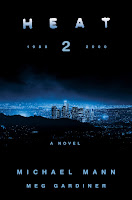
Heat 2, by Michael Mann and Meg Gardiner (Morrow):

I’m one of those people who consistently rolls his eyes whenever he hears the word “prequel”. Even though I have been pleasantly surprised from time to time (Exhibit A: AMC-TV’s Better Call Saul), I always consider this to be an especially heavy lift. That was certainly the way I felt when I learned that Michael Mann and Meg Gardiner would be releasing Heat 2, based on the best heist movie of all time.

In fact, Heat 2 is a prequel and a sequel. Mann and Gardiner toggle between what occurred before the action of the 1995 film as well as what came after. Readers see inside the Neil McCauley crew, the scores they took down in Chicago before arriving in Los Angeles, as well as what became of thief Chris Shiherlis (played by Val Kilmer), the only principal character—SPOILER ALERT!—who survived the end of the iconic film.

Shiherlis, consumed with guilt and anger over the demise of his partner McCauley, and vowing revenge upon LAPD Lieutenant Vincent Hanna (Al Pacino), has been spirited out of L.A. to the ultimate free-trade zone of South America, working for a Taiwanese crime syndicate, and ultimately joining an international cartel that extends to Asia.

Running parallel to this is the backstory of not only the McCauley gang, but also of Vincent Hanna, the obsessed hunter of robbery crews. We learn about his origins in Chicago and his pursuit of one particularly sadistic gang, which specializes in breaking into affluent homes while their residents are sure to be present.

This novel has much to recommend it, the most impressive component being how Mann and Gardiner are able to revisit and inhabit the characters created for a single film nearly three decades ago. The cadences of Hanna’s dialogue sound just like Pacino’s rhythm in the movie, and the novel’s set pieces can easily be visualized with Mann’s signature directorial haze-and-darkness style. Supporting characters such as those played in the picture by Danny Trejo and Jon Voight are on hand. You wouldn’t ever want to run into those characters in a darkened alley, or inside a bank, but from the safety of your favorite reading chair, it’s fun to reconnect.

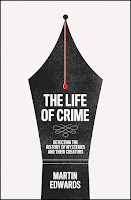
The Life of Crime: Detecting the History of Mysteries and Their Creators, by Martin Edwards (Collins Crime Club):

The current renaissance in classic detective fiction owes a great deal to British author Martin Edwards. In addition to being a first-rate novelist and short story writer, Edwards is president of the Detection Club, a frequent anthologist, and the creator of some of the most noteworthy crime-fiction historical documents of recent years. The Golden Age of Murder won him a trophy case full of awards following its publication in 2015. Howdunit, his master class in mystery construction, was warmly received in 2020. Now comes the culmination of decades of writing and reading: The Life of Crime.

Dipping into this book can be a bit intimidating. At more than 600 pages long (not including its bibliography and indices), and spanning 55 chapters, the breadth and depth of the work is staggering. It seems that no one of significance has escaped Edwards’ attention and erudition. Covering English, American, and international authors, books and themes, The Life of Crime is both an exhilarating survey course and a graduate-level seminar in the genre. And yet, despite its length and level of detail, the book is immensely readable. By taking the reader’s hand in his collegial style, Edwards almost lets you believe it was you who discovered such bygone writers as Frank Froest and Anthony Wynne (the latter being a Scottish enthusiast of the locked-room mystery—a specialty of this book). While there are some readers, I suppose, who will tackle The Life of Crime cover to cover as they would a novel, I preferred to consume a handful of chapters a week as an appetizer to whatever else I was enjoying. This allowed me to remember that crime fiction is a continuum, stretching from the past to today. By conveying its treasures in such delightful fashion, Edwards guarantees his book’s place in the pantheon of popular-culture historical works.

Other 2022 Favorites: An Honest Living, by Dwyer Murphy (Viking); and Dangerous Rhythms: Jazz and the Underworld, by T.J. English (Morrow).

Sunday, December 18, 2022

Favorite Crime Fiction of 2022,
Part III: Jim Napier

Jim Napier is a crime-fiction critic based in Canada. Since 2005, more than 600 of his reviews and interviews have appeared in newspapers and on various crime-fiction and literary Web sites, including on his own award-winning review site, Deadly Diversions. Legacy, the first entry in his Colin McDermott mystery series, was published in 2017; a sequel, Ridley’s War, came out in 2020 from FriesenPress.

A Heart Full of Headstones, by Ian Rankin (Little, Brown):

A new book from Ian Rankin is always a source of joy. Over the past three and a half decades that Scottish author has dominated the international crime-writing scene, perfecting a subgenre that has come to be known as Tartan noir. His protagonist John Rebus personifies the independent yet dedicated copper who always seems to be squeezed between the corrupt and the corrupted, as he struggles to achieve a tiny bit of justice in the gloomy streets of Edinburgh.

To the consternation of everyone around him, Rebus is his own man, and plays by his own rules (the term “loose cannon” comes to mind). Colleagues and senior offices alike are left to cope with the consequences, and he’s never far away from a reprimand, or suspension, or worse.

In A Heart Full of Headstones (the first book in a two-novel deal with UK publisher Orion), things are very much worse. Now retired and suffering from poor health, but still working, Rebus finds himself in the dock, accused of murder. His prospects are bleak.

The ex-detective inspector had earlier been drawn into an investigation going back to his days as a young detective assigned to Tynecastle, a local nick infamous for its misconduct and misfeasance. A detective there, one Frances Haggard, is facing charges of spousal abuse, and in a bid to avoid the consequences of his actions, is threatening to go public with some of the dirty laundry at Tynecastle Station—unless his mates can find a way to make the charges go away. There are a lot of skeletons in Tynecastle’s closet, so it comes as no surprise when Haggard is soon after found stabbed to death. That only serves to intensify the investigation into the corrupted station house.

Having previously been assigned to Tynecastle, Rebus becomes a person of interest, and his own past actions are placed under the microscope. It’s not giving too much away to say that before this novel is over, more people will die—and Rebus will face the possibility of spending the remainder of his days in lock-up.

John Rebus is one of the most fascinating and complex characters in modern crime fiction, carving out a tortured path between legal justice and cosmic justice, often annoying his friends and enraging his enemies. Yet he somehow emerges from the tumult victorious in the end. This time, though, even Rebus’s own doggedness may not be enough to keep him on the streets.

Not Your Child, by Lis Angus (Wild Rose Press):

Susan Koss is enjoying a rewarding life as a consulting family psychologist and single parent, rearing her 12-year old daughter, Maddy, in Ottawa, Ontario's upscale Glebe district, when her comfortable world is suddenly turned upside down. An elderly man named Daniel Kazan has spotted Maddy on the street. Convinced that she is his long-lost granddaughter, who vanished after her parents were killed in a vehicle accident more than a decade earlier, Daniel follows Maddy home and tries to get closer to the family. He is clearly obsessive, and Susan fears for her child’s safety.

Susan is also made personally uncomfortable by these developments. After all, she is Maddy’s birth mother, and they have been together for her daughter’s entire life. But when Susan suggests DNA tests to resolve the issue, she receives not one surprise, but two: the results indicate that Susan is not Maddy’s mother, and even more ominously, they don’t rule out the possibility that Daniel might be Maddy’s grandfather after all. This is all bad enough, to be sure, but things get a whole lot worse when Maddy suddenly disappears from the family home, and despite a thorough police search, there is no sign of her. It seems Susan’s comfortable world has finally come crushing down.

Not Your Child is among the strongest debut novels I’ve read. It is original and polished, with believable dialogue and an impressive sense of atmosphere. The characters are engaging and nuanced; the author is particularly effective in portraying the obsessed grandfather in a partly sympathetic light. With a crisp pace that keeps readers engaged until the very end, this tale is highly recommended.

Going to Beautiful, by Anthony Bidulka (Stonehouse):

Toronto, Ontario: celebrity chef, author, and restaurateur Jake Hardy, together with his husband, successful fashion designer Eddie Kravets, are living a dream life. Comfortably ensconced in spacious digs on the top floor of a fashionable apartment building, they go from success to success, pausing only to realize just how fortunate they are.

But even dreams aren’t perfect. In one morning’s early hours, Jake is awakened abruptly by the police, who break the news that his partner’s body has been found on the ground just below their balcony. Eddie Kravets is dead.

Over the weeks that follow, Jake and the closest of those around him wrestle with a toxic mix of well-meaning sympathizers, nosy gawkers, and online gossip-mongers, all of them having the effect of ripping a bandage off the fresh wound that is now Jake’s daily reality. He finds only a tiny measure of solace in sifting through Eddie’s left-behind things. Ever the planner, Eddie had made a list of places he wanted his ashes spread. They include, enigmatically, the single word Beautiful. Further searching reveals that the word in not simply a placeholder, but an actual place in rural Saskatchewan.

Determined to honor Eddie’s final wishes, Jake begins his odyssey. He will discover along the way that, far from living up to its name, the small prairie town of Beautiful harbors more than its fair share of dark secrets—and more than one murderer.

With its richly textured and layered plot, nuanced characters, and sometimes brooding environment, Going to Beautiful moves between being a lyrical celebration of life and an unflinching exploration of the dark recesses of twisted souls. It offers an inventive and evocative journey that will keep you enthralled throughout. If you’ve never before encountered the work of Anthony Bidulka, creator of the Russell Quant private-eye series and a multiple winner of both the Arthur Ellis and Lambda Literary awards, you’re in for a real treat.

Blind Date, by Brenda Chapman (‎Ivy Bay Press):

Successful Canadian crime writer Brenda Chapman (Shallow End, Closing Time) recently launched a new series, this one featuring an engaging amateur sleuth named Ella Tate.

Blind Date finds Ella attempting to mark out a new career for herself. Formerly a journalist working the crime beat for an Ottawa newspaper, she’s now gone online with a true-crime podcast. She’s already amassed quite a following, when an intriguing case falls into her lap. A young teacher, Josie Wheatly, has been assaulted. After leaving the hospital prematurely, she’s found in her apartment, murdered by hanging. It just so happens that the apartment where this tragedy took place used to belong to Ella, and the deceased looks remarkably similar to her. Josie even appropriated Ella’s name for online dating purposes. The implications are impossible to miss: Could Josie’s killer have mistaken that other woman for Ella herself? When two other people close to the podcaster are also victimized by violent crime, the answer seems all too clear.

Ella strives to connect the dots here, but is frustrated at every turn. Then she begins to receive ominous messages, some on her podcast, then, more ominously, on her cell phone: “You’re next, bitch.” Does the solution to all of this lie somewhere in the podcasts she’s been airing, which expose peoples’ wrongdoing? Or should she be looking closer to home? Like Angus’ Not Your Child, this yarn is set largely in Ottawa’s Glebe area, and the city has seldom looked so threatening.

Never at a loss when it comes to creating a spellbinding thriller, author Chapman draws on her considerable skills to weave a credible, well-crafted plot that will leave readers hungering for more.

L.A. Burning, by D.C. Taylor (Crooked Lane):

From former movie and TV screenwriter David C. Taylor, L.A. Burning is a gripping read that draws upon events rooted in the real world of Hollywood in order to paint a picture altogether less glamorous, and a great deal more disturbing, than that imagined by fans of the silver screen.

Ex-street kid Cody Bonner has just been released from a five-year stretch in prison for bank robbery, and she’s a gal on a mission. While she was locked up, her twin sister, Julie, had been brutally murdered, her body washed up on a beach in Malibu. The two had been especially close. Now Cody is committed to finding out how Julie died, and why. The trail will lead her into the dark recesses of Tinseltown, a world of sleazy agents and even sleazier movie moguls. Throughout her investigation, Cody will also have to navigate the Byzantine world of her mother, a fading film star who seems less concerned about her daughter’s death than her own tenuous position in the ephemeral heights of the Hollywood firmament. Cody, though, has two things going for her: the skills she picked up while behind bars, and her own dogged determination to solve her sibling’s slaying.

L.A. Burning is a riveting tale that turns on the seamy underside of an industry built on image, power, and to some extent, perversion. Seamlessly plotted, and with compelling characters and crackling dialogue, this novel is guaranteed to satisfy.

Fenian Street, by Anne Emery (ECW Press):

This immersive tale—set in Dublin, Ireland, during the turbulent years between 1969 and 1975, and ripe with both historical detail and real-life characters—introduces us to Seamus “Shay“ Rynne. He’s the son of Thomas “Talkie” Rynne, a former Irish Republican Army supporter who’d been interned during the Emergency—known elsewhere as the Second World War. Shay was born shortly after that war ended. Now a young man, he has come under the wing of Colm Griffith, a detective sergeant in the Garda Síochána, the Irish police force. With his support, Shay joins the Garda as a police constable.

In the impoverished neighborhood where he grew up, one filled with public housing and bent toward animosity against government officials, to be a cop is viewed as only one small step above being an informer. Shay must therefore work extra hard to earn his friends’ respect. So when Rosie McGinn, a young woman he knew from his schooling, turns up dead at the hotel where she worked, her neck bruised with fingermarks, Shay resolves to bring her killer to justice, even though it means going up against some intimidating local figures.

On the strength of that success, Shay is promoted to detective, and thereafter joins DS Griffith in tackling the case of Darragh McLogan, a member of the Irish parliament, who was found brutally murdered in his back yard following a party held there the night before. Shay’s inquiry will plumb the depths of the local power structure and even lead him to Hell’s Kitchen in New York City. This is a knotty case, made still more complicated by the fact that Shay’s own father emerges as a prime suspect in the politician’s demise.

Readers benefit from the research Emery did before penning Fenian Street. She integrates Shay Rynne’s story expertly into the larger drama of 1970s Irish politics, and delivers both with prose that fairly leaps off the pages. A propulsive and gripping mystery, to be sure.

Other 2022 Favorites: Like a Sister, by Kellye Garrett (Mulholland); When It Was Cold, by Howard Shrier (e-book, short stories); and Call Me a Cab, by Donald E. Westlake (Hard Case Crime).

Saturday, December 17, 2022

Favorite Crime Fiction of 2022,
Part II: Fraser Massey

Fraser Massey is a journalist in London, England. A former columnist for Radio Times, Now, and Real People, he is also a regular contributor to The Times. An early draft of his not-yet-published neo-noir thriller, Whitechapel Messiah, was shortlisted in the New Voices category at the inaugural Capital Crime Festival Awards in 2019.

Maror, by Lavie Tidhar (Apollo UK):

In expansive moods I can talk for hours about America’s most significant contribution to modern culture. Sometimes I argue it’s jazz. Sometimes the western. But maybe it’s really the hard-boiled novel. Jazz these days is at home all over the world, and the legendary Italian movie auteur Sergio Leone long ago proved you don’t have to be within tobacco-juice-spitting distance of Monument Valley to create classic westerns. But the hard-boiled novel has remained quintessentially American, unlike its close cousin, the noir thriller. You can add “noir” to the name of any geographic region or to any national allusion in order to identify a non-American form of the genre—thus, Scandi noir, Tartan noir, etc.

The former kibbutz-dwelling sci-fi and fantasy novelist Lavie Tidhar’s first crime novel, Maror, could perhaps be labeled “Jewish noir.” Or even “kosher noir.” But it’s really the first great Israeli hard-boiled novel, comparable to works from today’s leading U.S. stylist in that field, James Ellroy.

Maror—the title refers to the bitter herbs placed on Passover seder tables—is a sprawling epic set against the backdrop of the building of the state of Israel. Tidhar’s story darts between 1967 and 2003, stopping off at multiple, often far-flung points in-between. Cohen, a corrupt police intelligence officer with a straight razor, a mouth full of Bible quotes, and a dubious approach to morality, keeps the peace in his own way throughout. He rises through the ranks of law enforcement, cultivates power, and turns increasingly cynical. While he is supposed to be solving crimes, Cohen also serves as our guide through Israel’s turbulent birth and evolution as a nation, its history filled not merely with idealists and visionaries, but also with gangsters and corrupt politicians and gun-runners.

Australian critic Clive James once advised, “If you can’t quell your urge to make predictions, don’t make them about the future.” So, I’ll refrain from forecasting that Tidhar’s Maror may usher in a welcome wave of other hard-boiled novels around the globe.

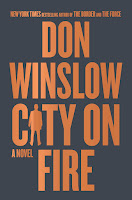
City on Fire, by Don Winslow (Morrow):

When young Irish dock worker Danny Ryan sees a beautiful stranger emerge from the sea at a beach resort in Rhode Island, he can tell right away that she’ll bring trouble. Danny’s not there, you understand, to gaze at long-legged lovelies. He’s on holiday with his heavily pregnant wife and their extended Irish-American family, who run half of all the illegal rackets in and around the capital city of Providence. But he knows just how tense things are between his people and the Italian-American mobsters who run the other half, and that it won’t take much to spark a feud.

The woman in the waves is visiting her new Italian gangster boyfriend. When one of Danny’s Irish relations hits on her, it sets off a chain of events that will ultimately lead to a bloody crime war.

Winslow’s use of small scenes to ratchet up tension is a sign of a master storyteller hitting his stride. In a tiny vignette, for instance, one of the Italian thugs roughs up a customer who’s late in making a debt repayment. “Jacky made him stick his right hand into the car door and then kicked it shut,” the author writes. “Then, with the guy’s hand still in the door, he drove the car around the parking lot.”

You can feel the bones crunching in that hand.

City on Fire is the first entry in a trilogy of Danny Ryan novels. As soon as I’d finished it, I raced to find out about the next volume, City of Dreams. It’s due next April. I’m already counting the days.

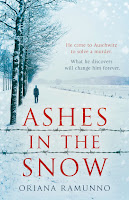
Ashes in the Snow, by Oriana Ramunno (HarperCollins UK):

There’s no real puzzle as to why locked-room, Christmas-centered murder mysteries became the popular subgenre they are today. Anyone who has spent days during the holidays in unwanted close proximity to relatives they’ve spent the rest of the year skillfully avoiding, can certainly understand why contemplating the perfect murder makes for an entertaining diversion.

Italian author Ramunno’s debut work is no traditional locked-room whodunit, though. Her setting, while definitely under lock and key, is no single room. Instead, it’s a Nazi concentration camp: Auschwitz, in occupied Poland, during the 1943 Christmas season. And there’s nothing at all cozy about this tale. In Chapter One, we witness an SS major stomp a Jewish baby to death in front of his mother.

Countless prisoners perished without investigation at Auschwitz during World War II. Yet after a young Jewish boy named Gioele Errera discovers the corpse of a slain German doctor in his office, camp authorities are quick to call in a Kriminalpolizei detective from Berlin, one Hugo Fischer. The task of figuring out the killer’s identity won’t be simple, as the deceased’s wife is hesitant to cooperate. Gioele might prove to be helpful, but in exchange Fischer will have to aid him in locating the family from which he’s become lost. Complicating matters further, the detective is under pressure to solve this case while keeping secret the fact that he suffers from a degenerative illness, one that would make him a target of the Nazi regime.

Ramunno’s story was apparently inspired by her great uncle, a concentration camp survivor, who told stories about German staff members who risked everything trying to make life at least somewhat easier for the prisoners. You’d imagine such an environment would curdle the milk of all human kindness. But apparently it didn’t.

Although it might be the bleakest of midwinters before you would think to crack open Ashes in the Snow to put you in a festive mood, it’s actually an unexpectedly uplifting pleasure.

Even the Darkest Night, by Javier Cercas,
translated by Anne McLean (Knopf):


Towards the end of Javier Cercas’ deep and satisfying police procedural, his chief Barcelona detective, Melchor Marín, is dragged before a dying Mexican drug baron, who tells him: “Other people’s happiness is irritating.” The line is merely an aside. It’s what the drug baron says next that reveals the motive behind the brutal murders that set this story in motion. Yet it’s an aside that any reader put off by the hype surrounding this novel might find themselves agreeing with.

For those who don’t already know, Even the Darkest Night is the book that in 2019 received the richest literary prize ever awarded to a work of crime fiction: Spain’s Premio Planeta, which came with a check for €1,000,000 (a cool $1,037,710 today).

I confess, I might have been a little bit jealous of, rather than “irritated” by, Cercas’ good fortune. I might even have approached this novel, hoping to be able to pick fault with it and declare it not deserving of all the hoopla. Instead, it won me over. Cercas earned every bit of “happiness” the award may have brought him. He’s a worthy prize-beneficiary, even if the size of his award is questionable in today’s straitened financial climate.

At its core this novel is a whodunit with a well-developed plot, involving the slaying of a wealthy couple in a far corner of Catalonia. It really puts its engaging and complex protagonist—Marín, the ex-con son of a prostitute—through his paces. But perhaps the biggest mystery here, is why it took three years for a yarn this good to be made available in English translation.

Trespass, by Clare Clark (Virago UK):

Bad crime novelists draw attention to how monstrous the villains stalking their books are. The good ones know readers can work that out for themselves. Clare Clark establishes herself in this psychological suspense novel as one of the very best.

Tess is a former environmental protestor, who years ago embarked on a relationship with an older, magnetic fellow activist, Dave Taylor, only to see him turn aggressive and unpredictable before he vanished altogether. He left Tess pregnant, though, and alone to rear their child, a daughter she named Mia.

Now, as Mia approaches her 13th birthday, a relative’s passing raises uncomfortable questions about Tess’ family and her daughter’s father. It becomes clear that Dave Taylor was not who he had claimed to be, that he’d stolen his identity and was actually an undercover police officer tasked with infiltrating protest groups, spying on them and disrupting their activities. While Tess, in these pages, plumbs her memories and tries to untangle the mysteries surrounding the man she once loved, young Mia engages in a parallel, but sometimes clashing campaign to understand who her father really was.

Meanwhile, the author employs Taylor as another of her narrators, allowing him to reveal his true self in vivid and villainous three dimensions. It helps that Taylor is a real person. Well, almost. Trespass carries the regulation disclaimer about being “a work of fiction,” but Clark includes an author’s note revealing that he’s based on the shadowy eco-warrior Mark Stone. Stone was unmasked in 2011 as undercover police officer Mark Kennedy, who embedded himself in the entirely legal climate-change movement, seducing other activists to build his cover story and even impregnating one of them. A tribunal last year awarded extensive damages to a women who’d been involved with him. This year the affair figured into Scots comedian Frankie Boyle’s debut murder mystery, Meantime, as well as the BBC’s excellent crime drama Sherwood (a rare foray into television by playwright James Graham). But Clark’s latest novel, fueled by her barely suppressed rage at how women were used, abused, and betrayed by employees of a state that’s supposed to protect its citizens, is far more powerful than either of those.

Other 2022 Favorites: Notes on an Execution, by Danya Kukafka (Morrow); A Killing in November, by Simon Mason (Riverrun UK); Portrait of a Thief, by Grace D. Li (Tiny Reparations); Counterfeit, by Kirstin Chen (Morrow); and The Berlin Exchange, by Joseph Kanon (Scribner).

Friday, December 16, 2022

Favorite Crime Fiction of 2022,
Part I: Jim Thomsen

Jim Thomsen is a book editor for Blackstone Publishing, and also runs his own manuscript-editing business. His crime-centric fiction and non-fiction has appeared in Noir City, Switchblade, Mystery Tribune, Pulp Modern, Shotgun Honey, and West Coast Crime Wave, as well as The Rap Sheet. A former newspaper reporter and editor, Thomsen is a Pacific Northwest native who makes his home with his wife, Sue, in Kingston, Washington. He is also a dedicated Seattle Mariners fan and Seventiesologist, who can be found in his free time watching episodes of Quinn Martin productions, tracking down their tie-in novels, or listening to the beautifully excruciating music of Harry Chapin.

It’s been another good year in crime fiction, if judging only by the difficulty I had picking just five books for my personal “Best of 2022” list. But after much mental hand-wringing, here’s what I came up with:

Other People’s Secrets, by Meredith Hambrock (Crooked Lane):

There’s no character I love more in literature that the loser, through poor choices and poorer circumstances, with a hidden higher gear that’s revealed only when they’re threatened with the loss of what little they have left. Baby, the heroine of Hambrock’s debut novel, is a classic such character. Born in a dumpster and scraping out a daily subsistence existence not so removed from the trash bin nearly three decades later, Baby finds her calling when the rundown lakefront resort she works at—and illegally squats in—is targeted for big changes that appear designed to leave her and her loser friends behind. And when she learns that the closure is part of a conspiracy by developers in league with local drug kingpins, god help anybody who gets in Baby’s way. Most of all herself.

Blackout, by Erin Flanagan (Thomas & Mercer):

Erin Flanagan came onto my radar in a big way with Deer Season, the richly deserved winner of this year’s Edgar Award for Best First Novel. Blackout, her second novel, is a completely different beast, but no less assured than her debut. It’s a highly original twist on the unreliable-thriller trope. Maris Heilman, a college sociology professor and recovering alcoholic, is suffering blackouts that endanger herself and the stability of her family, and she seems unable to convince anyone that she isn’t drinking again. The truth, though, is that she is the target of a monstrous conspiracy involving some seriously weird science. But what Maris knows and what she can prove to anyone’s satisfaction are two very different things, and the gap between them may be too impossible to cross.

Gangland, by Chuck Hogan
(Grand Central):


After nearly a decade away from crime fiction, the author of The Town (2010) returns with an exhilarating mash-up of 1970s fact and fiction centered on organized crime in Chicago. Nicky Passero, aka Nicky Pins, is the ultimate mob middle-manager, subject to the whims and rages of those above him, and answerable to the screw-ups of those beneath him. And when the serfs go to war with the vassals, Nicky’s room to satisfy all parties, let alone save his own life, becomes all but impossible to manage. This novel starts with Nicky murdering real-life mob figure Sam Giancana (no spoiler, seriously) and does nothing but maintain a sleek dark glide from there. Nicky’s predicament is as well-constructed as his personality is winning.

A Thousand Steps, by T. Jefferson Parker (Forge):

I’ll admit it: I’ve never been a fan of most of Parker’s work, even as I admire his sheer competence and high style. That changed with this novel, which is a big change for Parker as well. Here he trades in the stylized torture-porn of most of his past work for a sweet and sincere reckoning with his own history. Like Matt Anthony, the novel’s narrator and hero, Parker was 14 years old in 1969, and reared in Matt’s hometown of Laguna Beach. His dad has left the family, his hippie mom has checked out on drugs, his brother is in Vietnam, and now his sister is gone as well—as in, disappeared, possibly kidnapped and even murdered. The more Matt searches, the more he opens himself up to being used for the dark purposes of others, and the more he is unable to convince anyone of what he believes. Parker has real skin in Matt’s game, and you will too. (This one fits neatly with my other favorite kind of book: stories about teens that are not Young Adult novels.)

Beneath Cruel Waters, by Jon Bassoff (Blackstone):

There’s no damage more lasting than damage inflicted by family in one’s formative years, and that’s what Holt Thompson, a middle-aged drifter, has to face down as he returns to his small Colorado hometown in the wake of his mother’s suicide. He tugs on a thread of lies that unravels several decades of horrors, all the products of bad choices made with good intent, until it leads to those responsible for the destruction of his family. This novel is as sturdily plotted as it is emotionally shattering, and every piece of the puzzle fits with a crisp click and a crisp punch to the gut—to the reader as much as to Holt. (Full disclosure: This novel was published by my new employer, but I read and reviewed it before I even knew about the job.)

Other 2022 Favorites (any of which could have been in my top five): City on Fire, by Don Winslow (HarperCollins); The Devil Himself, by Peter Farris (Arcade Crimewise); Damnation Spring, by Ash Davidson (Scribner, 2021); Twentymile, by C. Matthew Smith (Latah, 2021); and It Dies with You, by Scott Blackburn (Crooked Lane).