Showing posts with label Roger N. Morris. Show all posts

Monday, April 09, 2018

Mentioned in Passing

• The folks behind the Spybrary podcast (“for fans of spy books and spy movies”) are looking for help in creating a Spybrary Shelf of Fame. Fans of the genre are invited to choose from dozens of pre-Cold War, Cold War-era, and post-Cold War tales, written variously by John le Carré, John Buchan, Eric Ambler, Len Deighton, W. Somerset Maugham, Joseph Conrad, Ian Fleming, Peter O’Donnell, Charles McCarry, Ted Allbeury, Graham Green, Jason Matthews, Alan Furst, and others. Polling is scheduled to remain open through Friday, April 20. Click here to make your preferences known.

• Note, too, that Spybrary host Shane Whaley has produced a “field report” from the inaugural Spy Con in Atlanta, Georgia.

• The Audio Publishers Association has announced the finalists for its 2018 Audie Awards. There are 26 categories of prizes, including two of likely interest to Rap Sheet fans. Among the Mystery and Thriller/Suspense contenders are David Lagercrantz’s The Girl Who Takes an Eye for an Eye, Ann Cleeves’ Telling Tales, John le Carré’s A Legacy of Spies, and B.A. Paris’ The Breakdown. Click here to see all of the rivals in those divisions. Winners will be declared on May 31.

Here’s a curious tidbit of history, plucked from the Web site Books Tell You Why: “Centuries before Ian Fleming would write James Bond into existence, another man signed letters with ‘007.’ That man, John Dee, was a mathematician, astronomer, and (some say) magician. He was also a trusted member of Queen Elizabeth I’s court. Some historians say that Dee was a spy for Elizabeth, thus making him an even more fitting inspiration for Ian Fleming’s hero.”

• William Henley Knoles (1926-1972) “was the greatest unknown writer of our time,” books historian Lynn Monroe asserts here. Under the pseudonym Clyde Allison, California writer Knoles produced an abundance of “spy-fi smut” novels during the 1960s and ’70s, many of them starring Trevor Anderson, Agent 0008. “The idea here, of course, is a sleaze riff on James Bond, or possibly even a riff on the many imitators of Bond,” explains Pulp International. “The dominant literary motif is satire, but as a wise man once said, just because it’s satirical doesn’t mean it’s smart or good.” Pulp International recently showcased the 20 installments from Knoles’ Agent 0008 series, the titles of which (Nautipuss, For Your Sighs Only, The Sex-Ray, etc.) do more than hint at their suggestive contents.

• More info on Knoles can be found in Killer Covers.

• BookRiot calls pulpish paperbacksthe clickbait of the ’50s,” explaining: “The standard cover used a realistic illustration and combined a shocking title, a scantily clad woman, and an intriguing front-cover blurb. These covers were the main selling point for a title. … One of the defining features of clickbait is also present in pulp novels: you don’t always get what you were promised.”

• CrimeReads looks back at how, during the mid-20th century, fresh editions of crime/detective novels that actually predated the era’s taste in salacious book fronts were given “ridiculously sexified covers … that were far racier than the actual book.”

• And Crime Fiction Lover picks “10 of the best pulp crime books.”

• In case you were wondering, Electric Lit’s Janet Frishberg reassures us, “it’s okay to give up on mediocre books.” Once “a compulsive book finisher,” she writes that two realizations helped her get over that behavior. “One, I realized literally NO ONE cares if I give up on a book except me. … Two, I realized that I’m going to die.”

New York magazine’s pop-culture Web site, Vulture, looks behind the scenes at “how 50 famous female characters were described in their screenplays.” Contributors Kyle Buchanan and Jordan Crucchiola explain that “Not every screenwriter takes the time to pen such a vivid character introduction—some include few details other than an estimated age or a few quick adjectives, preferring instead to let their dialogue do the talking—but many of our most famous screen women were originally created in those carefully composed sentences that few besides the actress, her writer, and their crew were lucky enough to read.” Below, for instance, is how Nora Charles was imagined for the 1934 film adaptation of Dashiell Hammett’s The Thin Man:
NORA CHARLES, Nick’s wife, is coming through. She is a woman of about twenty-six … a tremendously vital person, interested in everybody and everything, in contrast to Nick’s apparent indifference to anything except when he is going to get his next drink. There is a warm understanding relationship between them. They are really crazy about each other, but undemonstrative and humorous in their companionship. They are tolerant, easy-going, taking drink for drink, and battling their way together with a dry humor.
• Elizabeth Foxwell draws attention to this interview with Laura Thompson, author of the biography Agatha Christie: A Mysterious Life, conducted by From the Bookshelf’s Gary Shapiro. Foxwell mentions that “Thompson calls Christie’s six novels under the pseudonym Mary Westamacott ‘gold,’ singling out Absent in the Spring (1944); calls Christie’s Five Little Pigs (1943) her best novel; and addresses Christie’s 11-day disappearance in 1926.” Listen here.

• While were on the subject of author interrogations, here are four more you really ought to check out: Speaking of Mysteries’ Nancie Clare talks with Sebastian Rotella about the third novel in his Valentine Pescadore series, Rip Crew; Dirty Books blogger Tom Leins quizzes Andrew Nette about his recently re-released novel, Gunshine State, which Nette calls “a very Australian take on the classic ‘heist gone wrong’ story”; for Unlawful Acts, David Nemeth goes one on one with L.A. Sykes about the latter’s “strong and savage book,” The Hard Cold Shoulder; and BookPage’s Cat Acree fires a few questions at Max Allan Collins, who edited The Last Stand, a pairing of two previously unpublished (and very different) works by Mickey Spillane.

• I read the first three novels in R.N. Morris’ Detective Inspector Silas Quinn series, set in Britain in the lead-up to World War I, so I was intrigued to hear that he has a new Quinn novel out in Britain, The Red Hand of Fury. That book is due out in the States in June.

• Finally, Sarah Weinman has a nice piece in CrimeReads recalling Howard Haycraft as mystery fiction’s “first great historian.”

Tuesday, February 05, 2013

A World in Upheaval

Today, in my Kirkus Reviews column, I look at three new novels set either immediately before or during World War I. All of them use crime fiction to illuminate that era’s social, commercial, and political changes. Best of all, they’re lively, suspenseful reads, not academic works. You will find my column here.

Monday, January 14, 2013

The Story Behind the Story:
“The Mannequin House,” by R.N. Morris

(Editor’s note: This 41st installment of The Rap Sheet’s “Story Behind the Story” series brings back into the spotlight British novelist R.N. “Roger” Morris, who has been interviewed on this page several times and has also contributed pieces to the blog. [Click here to find those posts.] Today, Morris supplies some background about his new historical mystery, The Mannequin House, which has already been released in Great Britain, and is scheduled for publication this spring in the United States.)

“Where do you get your ideas from?” is one of those questions that authors are supposed to get asked all the time. Actually, I can’t remember ever being asked it. That could mean one of two things. Either the source of my ideas is so obvious that the question is redundant. Or my ideas are such that people would rather not know where exactly they come from.

The Mannequin House (Creme de la Crime) is the second of my novels to feature the detective Silas Quinn, an inspector in the fictional “Special Crimes Department” of New Scotland Yard in 1914. Before starting my Silas Quinn series, I had written four novels featuring Porfiry Petrovich, the investigating magistrate from Fyodor Dostoevsky’s Crime and Punishment. I suppose part of the motivation in creating Quinn was to show that I could write a book around a character of my own. In constructing that character, I wanted to play a little with some of the clichés of a fictional detective. So, yes, he is a detective with a troubled past, and a dark side, as well as being a brilliantly successful investigator. To some extent, I think he uses his police work as a kind of therapy. It just so happens that what makes him feel good and whole is giving in to an impulse to kill, or at least to shoot first and ask questions later. It’s a trait that led one critic (Mike Ripley) to describe him as “a sort of Edwardian Dirty Harry.” I’m not sure how accurate that description is, but it’s one that amuses me.

I have enjoyed embracing, and perhaps subverting, the archetype; I hope readers will enjoy the weird kinks that have emerged in Quinn.

The novel is set in 1914, before the outbreak of the First World War. All the horrors of the 20th century lie ahead, so it’s generally held to be an era of innocence, I think. This is an idea I challenge. It’s the Golden Age of detective fiction, but also a period when art movements such as dada and surrealism were starting to come through. A crucial phase in the development of psychoanalysis, too. And time of social upheaval, as well as political turmoil, in Britain and in Europe, with the war brewing and trouble in Ireland. A period of anxiety and stress, as I imagine it. All of which makes it an interesting time in which to set a book or two.

If I try to trace my fascination with the period, I find myself drawn to a painting called The Menaced Assassin, by René Magritte. Like a lot of teenage males of my generation, I was into surrealism, enough to possess a large art book on the movement. This was one of the paintings in the book. It depicted some bowler-hatted police officers lying in wait for the fictional master criminal Fantômas. I loved the mood of the painting, and the idea of Fantômas, and when the Pierre Souvestre and Marcell Allain novels were released in English by Picador in the 1980s I got hold of a few and read them. I even had a go at writing my own Fantômas novel, my first venture into literary fan-fiction, and in many ways an apprentice piece for my Porfiry Petrovich series. I was struck by the fact that Souvestre died in 1914, so the books they wrote together had a decided pre-war feel. My own Fantômas novel was written with the retrospective knowledge of what was to come, a sense of historical irony.

That Fantômas story of mine was never published, but I felt there was something in the dramatic potential of that specific period. Like most writers, I parked the idea in the back of my brain and let it cook.

Some years later, I was asked to write a screenplay based on G.K. Chesterton’s 1908 novel, The Man Who Was Thursday. Nothing came of the project (except for an unproduced screenplay sitting on my computer’s hard drive), but that strange, surreal book, together with the research I did around it, rekindled my interest in the period. With its themes of alienation and distrust, coupled with a dreamlike narrative, the book struck a chord with me and seemed strikingly modern.

So I had the idea of writing a series of crime novels set perpetually on the eve of the Great War, in which a series of increasingly outlandish crimes--occurring within an improbably condensed time frame--would be investigated. The crimes in the books would presage the terrible destruction to come. Silas Quinn emerged from that strange idea as a suitably peculiar detective.

Crime fiction has always struck me as a sub-genre of surrealism, perhaps because I came at it from a painting by Magritte. My new series takes me deeper into that territory. For inspiration, I turned again to G.K. Chesterton, this time immersing myself in his Father Brown stories, some of which are decidedly surreal (I’m thinking particularly of his story “The Secret Garden,” in which--SPOILER ALERT--a decapitated head from one body is found next to a headless corpse belonging to someone else). Inevitably. perhaps, I decided to incorporate a locked-room mystery, with bizarre elements.

I was also attracted to the idea of setting each novel within a different, defined milieu, which is a standard trope of detective series. You take your detective and plunge him into a world that is alien to him, which he then explores and reveals as he conducts his investigation. The first Quinn novel, Summon Up the Blood, dealt with the world of homosexual male prostitutes, or “renters.” This second novel is set in a fashionable department store.

The theme again feeds into my ideas about the surrealism of mystery and detective fiction. I had this notion of a department store where almost anything could be bought, where every desire could be satisfied in a consumerist dream. While I was researching the story, I read Whiteley’s Folly, Linda Stratmann’s biography of William Whiteley, the founder of Whiteley’s, a big department store in West London. I already had an idea of a character who would be the founder of my own fictional department store, who would be a womanizer and a tyrant. When I discovered that the real William Whiteley shared those attributes, I became intrigued. The fact that Whiteley was shot and killed in his own store by a man claiming to be his illegitimate son clinched it for me. History was trying to tell me something. I knew this was the setting I had to use, this was the story I had to write. All I needed to do was throw in a monkey in a fez.

By a strange coincidence, there have recently been two period dramas on UK television, both with department store settings: The Paradise on BBC and Mr. Selfridge on ITV. So maybe there is something in the air at the moment that makes early department stores especially appealing. I have a theory that it is linked to the approach of the centenary of the outbreak of World War 1, the moment when the world lost its innocence forever. The promise of wish fulfillment and gratification that a place like The House of Blackley (the fictional department store in my novel) seems to hold out could never truly be believed in again. And yet it is a promise we can’t quite give up on, one we keep nostalgically returning to.

Tuesday, May 17, 2011

Death and Causes

For my Kirkus Reviews column this week, I interviewed British historical novelist R.N. “Roger” Morris, whose fourth thriller starring Porfiry Petrovich--the investigating magistrate borrowed from Fyodor Dostoevsky’s famous 1866 novel, Crime and Punishment--has just been published by Faber and Faber in the UK. Titled The Cleansing Flames, it takes place in 1872 and finds Porfiry, along with his junior associate, Pavel Pavlovich Virginsky, probing the discovery of a corpse in St. Petersburg’s Winter Canal and efforts by radical intellectuals to foment revolution in Tsarist Russia.

You’ll can read that interview here.

* * *

Because Kirkus prefers that its posts ring in at not too much over 1,000 words in length, I had to cut out some parts of my exchange with Morris. But there’s no sense in letting those go to waste. So here’s what didn’t make it into the finished piece:

J. Kingston Pierce: How has your perspective on Crime and Punishment--or, perhaps, on Dostoevsky himself--changed since you began writing this series?

R.N. Morris: Interesting question. I think I’m even more in awe of it, and him, than I was to begin with. As well as being extremely grateful to him, and it. And it’s only now that I’ve written the four books, that I really understand how insane my original idea was. So I think if I’d had the attitude to Dostoevsky then that I have now, I would probably not have attempted it.

Many people think of Russian novels as downbeat and turgid. With the Porfiry series, it seems you’ve sought to incorporate a flavor of Dostoevsky’s style without trying to copy it. Am I right?

Actually, I think there’s a lot of humor in Dostoevsky, maybe not so much in Crime and Punishment, but there’s certainly social satire in The Idiot, for example. I haven’t tried to copy Dostoevsky’s style--I couldn’t, because essentially my only experience of his style is through translation. I’m not a Russian speaker, or reader even, so I’m reliant on translation. The New York Times said that Gentle Axe felt like a translation of an overlooked book by one of Dostoevsky’s contemporary imitators. I think that’s pretty fair, and pretty much the effect I was going for. I imagined myself using his literary palette, trying to stick to the mood and atmosphere of his work, using some of his themes. But essentially my intention has been simply to write some entertaining mystery stories.

Only the first two Porfiry novels have been published in the United States. Are there any plans to release the latter pair here as well?

I’d love for the other two books to be published in America but, so far, no publisher has offered to do that. It’s a shame, because I think as a writer I’ve improved over the series. In my own view, the books do get better. And I do get some lovely e-mails from American readers who have enjoyed the first books and want to continue the series.

Wednesday, June 09, 2010

Tending the Fruits of Fyodor’s Garden

We have now taken the opportunity to interview English author Roger (or “R.N.”) Morris on three separate occasions. The first time, my wife, Daniela, and I invited him to come to Italy and speak about his work at 2008’s Trevi Noir Festival. That wasn’t long after the publication of The Gentle Axe, Morris’ first novel featuring mid-19th-century Russian detective Porfiry Petrovich (a character originally created by Fyodor Dostoevsky for Crime and Punishment). Axe had garnered some excellent reviews, and we wanted to meet its author. As it happened, that was the first time Morris and his wife, Rachel, had visited the Umbria region, and afterward they decided to come back with their children for a summer holiday in 2009. On that second occasion, Daniela, Roger, and I discussed historical crime fiction (and the second Porfiry novel, A Vengeful Longing) before an enthusiastic audience on a roasting-hot August afternoon in Perugia.

The reader should be warned, perhaps, that we have since become friends. We’re scheduled to meet with Morris yet again on July 15 during Bodies in the Bookshop, the annual get-together of enthusiastic readers and dozens of crime writers, organized by bookseller Richard Reynolds at Heffers Bookshop, in Cambridge, England.

Still, as I began reading Morris’ third and newest Porfiry mystery, A Razor Wrapped in Silk, which was released in Britain this spring (and has no U.S. publication date as of this writing), I realized that a great deal remained to be said. It took little prompting to convince the author to answer a few questions about how he operates within Dostoevsky’s fictional world, how he develops his plots, and his literary explorations across class boundaries in the Porfiry tales.

Michael Gregorio: A Razor Wrapped in Silk--that’s a really great title, Roger. Alliterative, and very seductive. Swishy, like a flashing cut-throat razor blade. Where did it come from? Did you write the story, then search for a title, or was the story somehow inspired by the phrase?

R.N. Morris: The title is a phrase in Dostoevsky’s novel The Idiot. It occurs in a letter written by the complex and troubled Nastasya Fillipovna. The context is quite complicated and I can’t really begin to explain it. Basically, she’s shacked up with this guy Rogozhin, of whom she writes: “I am convinced that hidden in his drawer is a razor, wrapped in silk, like that murderer in Moscow; he too lived in the same house with his mother and had wrapped a razor in silk to cut a throat with.” When I read that I just knew that I had to write a novel called A Razor Wrapped in Silk. I hope the book lives up to the title! Rogozhin does, indeed, fulfill the role she seems to be urging on him, and he becomes her murderer.

MG: Has your “purloining” of it added to, or detracted from, Dostoevsky’s intentions?

RNM: Ha! Good question. Whenever I go back to Dostoevsky, I’m struck by how much more complex, rich, and profound his books are than mine! This is one such case. His psychological depth and insight is breathtaking. But I hope my purloining hasn’t detracted from his intentions. His work still stands, obviously, independent of mine. I’m like a literary flea on a great beast’s back. The great beast continues undeterred. Our intentions are very different. I can say that. Mine are simply to create entertaining mystery stories. That’s hard enough for me!

MG: I find your endless “tweaking” of Dostoevsky fascinating. Whenever I come across a new name in one of your novels, I consult the Web immediately to see if the person mentioned already has a “prior” role or character in the Dostoevsky literature, or whether he or she is a “Morrisonian” invention. I’m thinking particularly about the origin and the names (and your elaboration of the personalities) of secondary characters such as Ratazyayev, Bykov, Bakmutov. I suppose I’m asking how constant and consistent you are in referring everything back to Dostoevsky’s work.

RNM: I take pretty much all my surnames from Dostoevsky. But they are not, generally, meant to be the same characters; the great exception being Porfiry Petrovich himself, of course. Actually, his surname is not given in Crime and Punishment, though I make a guess at it in A Razor Wrapped in Silk. (Petrovich is not his surname--it’s his patronymic.) There is a character in Crime and Punishment who is described as Porfiry’s cousin, so I made a leap, with the encouragement of a Russian émigré writer called Mark Budman, and imagined them being cousins on their fathers’ side. That would mean they’d have the same surname. I shall leave it to readers to go back to Dostoevsky, or read A Razor Wrapped in Silk, to discover which character I’m talking about.

MG: Book by book, I admire the central figure of Porfiry Petrovich more and more. He appeared fleetingly in Crime and Punishment, though I think of him now as your detective. After all, you have allowed him to solve crimes, while Dostoevsky was not so generous. It isn’t simply the fact that Porfiry has filled out as a character from the original Dostoevsky sketch, but he now has a personality and a range of quirks and tastes that he never had before. How did this persona evolve? Is he now the property of Roger Morris, or does he still owe something to his original?

RNM: That’s very flattering, Mike. Of course he owes a lot to his original. He’s certainly not my property! The fact is that I couldn’t attempt to write my own books by constantly referring back to some template of a character that I had consciously extrapolated from the original novel. I think I did start writing the first book with such a template in mind. I’d homed in on a couple of passages in Crime and Punishment which I felt were particularly suggestive and I used them as the foundations for a character construction. But I had to let him come alive in my imagination, which meant, necessarily, that he would depart from the original in some way. And the more he came to life, the less able I was to control what he turned into. I can’t say exactly how he evolved, he just did.

MG: How difficult for you as a writer is this grafting-on to characters which have already been outlined? It seems to me a bit like the cut-outs used by busy artists during the Renaissance, such as the Perugino workshop, for instance; the basic form or “stereotype” was laid down by an apprentice, while the “character” was created within that bare outline by the great artist himself, who painted in the features, faces and expressions, employing colors and nuances which differed every time.

RNM: I like that analogy, although it doesn’t quite work. In this case, Dostoevsky is the master and I am the apprentice. I found it difficult to begin with, very stressful, because I felt this great weight of responsibility. It was as if Dostoevsky was looking constantly over my shoulder, or, if not him, the army of purists who have taken it upon themselves to police and protect his literary heritage. But then I had to tell myself that I was not engaged in some kind of academic exercise. I was trying to write crime novels. I had to do what was necessary to make them work, on their own terms, and to the best of my ability. The more I was able to relax, the easier it was and--I think--the better the result.

MG: As a consequence of this re-working, does plotting come about within the limits of given characters like Porfiry or [Pavel Pavlovich] Virginsky, his assistant? Or have they expanded and developed because of the stories in which you have chosen to involve them?

RNM: My God, you do ask good questions! But good questions are difficult to answer. I think that there are almost two stories running concurrently in a murder-mystery novel. One is the story of the particular investigation, and how the mystery unfolds, which largely concerns a set of characters external to the central characters of the detective and his associates. This first story is the story of the victim and the murderer--or victims, if he is a prolific killer. The second story is that of the investigators, and is really the story of how the crimes they are looking into impact on them. I think what’s interesting is when you have thematic overlaps between the two stories--it’s essential, really. Of course, the detective cannot but be affected by what he uncovers.

So to answer your question, I would say the answer is probably the latter.

MG: Looking back on the first three Porfiry novels, and looking forward to the fourth, which you have now consigned to [publisher] Faber and Faber, how satisfied are you with what you have achieved? In A Razor Wrapped in Silk, for example, you move effortlessly between the high and low “worlds” of St. Petersburg, between notables who mix socially with the Tsar and the court, those who serve in the army, and those who work in treadmill factories and grinding poverty. Can we expect to see other Russian “worlds” in the next Porfiry investigation?

RNM: Thank you for that “effortlessly”! I think there’s something about the writer’s temperament--this writer’s temperament, at least--that makes us focus more on our reasons for dissatisfaction. But when I think back to the first meeting I had with my editor, I feel that I have come a very long way. Actually, at that meeting, he wasn’t yet my editor. It was kind of an interview, I think. Faber and Faber were sounding me out. One thing they wanted to clarify was whether I would be interested in writing a series. At that point, I had just one completed manuscript. As it happened, I’d gone into the meeting with outlines prepared for three more books. My editor seemed very happy with this, of course. The following day I think it was, an offer came through for the first two books, with the promise of the other two to follow in the future. Then it struck me what a monumental task lay ahead of me. It was impossible, at that moment, for me to imagine getting to the other side of that writing mountain. But now I find myself in the strange position of having written all the books that I originally set out to write. I do feel a tremendous sense of satisfaction in that.

As for the other part of your question, about the next Porfiry book [The Cleansing Flames], it is set against the milieu of pre-revolutionary politics. It’s about the intellectuals of the period, radical journalists, and revolutionary cells. It’s a slightly different kind of story to the other three. I think the setting is even more sharply focused. Virginsky comes a little more center-stage, and he is tested to the extreme. Also the ideological differences between Virginsky and Porfiry that have been touched upon in previous books come to a head and their relationship comes under strain. I won’t say any more than that, except I hope it’s an exciting read!

MG: Finally, it would be selling short A Razor Wrapped in Silk if we didn’t mention its outstanding literary quality. I love the way that you use language, Roger, especially the way that you manipulate it. The dark, delicious vein of humor underlying, for example, the deadly serious interrogation of the suave and evasive moneylender, [Ivan Iakovich] Bakmutov, is a lesson in composition. Daniela reckons it’s because you are a Classicist, while I believe that you have a taste for words, and enjoy the playfulness of argument. What’s your take on it? How hard do you have to work on dialogue to get it just right?

RNM: I think studying any foreign language does give you more acute consciousness of how language in general works, so Daniela may be onto something there. I sometimes wonder why I didn’t study English, like most other writers do. Some streak of perversity, I suppose. But I think having looked into the way Latin prose is put together, and Latin poetry too, it does give you a real sense of the flexibility and potential of your own language. (I was never very good at Greek!) My ideal in writing is to write in a way that is both precise and unexpected. That’s what I aim for. The unexpectedness does open the door to a certain playfulness, and possibly that comes through most in the dialogue. I try to have the characters say things that surprise the reader--sometimes they even surprise me, and possibly themselves! I enjoy writing dialogue, so I don’t really think of it as hard work. Sometimes it comes a little too easily, and then you have to be on the alert. Cutting back so that you prevent it becoming flabby is crucial.

Which may be as good a place as any to end this interview.

READ MORE:R.N. Morris on Switching from Thrillers to Arias” (Bookdagger); “CSI: St. Petersburg--The Historical Mysteries of R.N. Morris,” by J. Sydney Jones (Scene of the Crime).

Friday, April 16, 2010

“I Was Drawn to the Combination
of Russian Angst and Axe-Murdering”

Crime Scraps blogger Uriah Robinson (aka Norman Price) has spent much of the last week posting his terrific four-part interview with British author and Rap Sheet contributor R.N. “Roger” Morris. I was lucky recently to procure a copy of Morris’ new, third Porfiry Petrovich historical mystery, A Razor Wrapped in Silk (Faber and Faber), which has been keeping me up--pleasurably--over the last few nights. And reading this interview in installments provided a fine accompaniment to the book.

In the course of their exchange, Morris tells Robinson that he was always destined to become a crime-fictionist:
I loved writing stories as a child. And I loved those complicated imaginative games where you make up characters and situations and adventures. I was always pretending to be someone else.

I really wanted to be called Napoleon, after Napoleon Solo from The Man from U.N.C.L.E. I thought he was the coolest person in the world and I really felt badly let down by ...my parents for not calling me Napoleon. It took me quite a time to get over that.

The Avengers were a big influence on me too. I remember dressing up as Steed. I've seen my kids play similar games. Sometimes they’ve gone on for days. But also I loved reading. From a very young age it occurred to me that writing was the best job on earth. It just took me an awful long time to get there.
Part I of the Morris interview can be found here; Part II is here; Part III is here; and the final segment is available here.

Tuesday, September 08, 2009

Porfiry Does Perugia

Regular readers of The Rap Sheet will undoubtedly recognize the name Roger (or “R.N.”) Morris. He’s not only an infrequent contributor to this blog, but he’s also the author of a pair of novels that feature the fictional mid-19th-century Russian detective, Porfiry Petrovich, introduced in Fyodor Dostoevsky’s Crime and Punishment (1866): 2007’s The Gentle Axe (published in Great Britain as A Gentle Axe) and 2008’s A Vengeful Longing.

This author was born in Manchester, England, and studied Classics at Cambridge. He worked for many years as a freelance advertising copywriter, while simultaneously penning fiction. He has composed a horror story, “The Devil’s Drum,” which became a short opera, and was performed at the Purcell Room in London. His first novel, Taking Comfort (Macmillian, 2006) was a contemporary urban thriller. Building on the popularity of his first two Porfiry Petrovich yarns, Morris has recently submitted to his publisher the third book in that series, A Razor Wrapped in Silk.

Morris’ prose is polished, his plotting is superb, and he has a refined sense of black humor. He’s a writer from whom other writers might learn. So, when Morris and his family arrived on holiday recently in the Umbria region of central Italy, we asked him to speak to readers in the local capital of Perugia. The temperature at that time was in the mid-30s, which we feared would put off all but the most enthusiastic fans. Fortunately, though, almost three dozen people turned up to hear us ask Morris questions (and ask a few questions of their own) about The Gentle Axe (which was published in Italy as Il Giudice Porfirij), his evolution as a writer, and his associations with the land and literature of Russia.

Michael Gregorio: Tell us about the curious dedication which introduces A Gentle Axe: “For my mother, Norma, who likes a good murder.” Surely there’s a story there.

R.N. Morris: My mother was a keen reader of what we would probably call “pulp.” She liked nothing better than a good thriller. A good murder, too. I suppose that’s where my own interest in the genre springs from. There were always crime books scattered round the house, and it was inevitable that I would start to read them sooner or later.

MG: What kind of thing were you first drawn to?

RNM: Well, initially, I suppose, Agatha Christie and the Sherlock Holmes mysteries, but even before that I had got a taste for suspense by reading Enid Blyton. Do you remember the series of books that she wrote for children featuring the Secret Seven and the Famous Five, where a minor mystery turns into an adventure for the kids who stumble on it? I really loved those books!

MG: So, how did you graduate, let’s say, from reading to writing about crime?

RNM: It all started at school. I always seemed to love writing, and I liked telling stories. And then at secondary school, we had an English teacher who gave us homework at the weekends, and often we had to write a short story. Well, that was fine by me. I didn’t attach much importance to it, until, one day, our teacher was absent, and another teacher sat in with the class and decided that we ought to read our stories out loud. “Who shall we begin with?” he asked the class, and all the kids called out in a single voice, more or less: “Roger, Roger Morris!” That was when I began to wonder whether I might eventually become a writer ...

MG: How did you eventually become a writer?

RNM: Well, it all comes down to mum again. As well as crime novels, she used to read women’s magazines, like Woman and Woman’s Own, and so on, and they all contained short stories. I’d pick them up and read them, and I suppose I learnt from them because I began trying to write stories along the same lines. Inevitably, I began to submit them, too. But I just kept getting rejection after rejection ...

MG: But that changed, too.

RNM: Well, yes. I suddenly realized that I was trying to write for older women, and that maybe I wasn’t ready for it. I also realized that there were other magazines aimed at teenagers--mainly girls, again--and I had a go at writing for them. And finally, one of my stories was published. That was a real thrill for me. Well, I did some more of those while I was studying at university, and, of course, the next step was to think about writing a novel.

MG: Which you did.

RNM: Well, I did, but they didn’t really go anywhere. I have a suitcase full of unpublished novels under the bed. Eventually, I found myself an agent, and the books were sent out to publishers, and they came back again, and all with the same result. Zilch!

MG: Just like us! Mike [aka Michael G. Jacob, the English half of the husband-and-wife writing team who publish as “Michael Gregorio”] has had three agents, Daniela [De Gregorio] has had two, and we have the same stack of old papers hidden away somewhere. What about you, Roger?

RNM: I’ve had two agents, as well. The second one, my present agent, Christopher Sinclair-Stevenson, did the rounds with the books, and it was just the same, they didn’t really seem to be going anywhere. He was on the point of giving up, I think, but then I had this idea for a crime novel featuring Porfiry Petrovich and St. Petersburg. His eyes lit up at that and I could tell I was on to something.

MG: People in Italy don’t really understand how important a literary agent is. Here, they hardly exist, you know, because so much fiction--over 90 percent--is imported from America and the European countries. OK, Roger, so you had an agent, you were writing novels, and suddenly you got a break. Well, in fact you got two breaks!

RNM: Yeah, that was funny, really. I wrote the first Porfiry book, A Gentle Axe, my agent sent it out, and [publisher] Faber and Faber expressed an immediate interest. At almost the same moment, Macmillan were keen to take on a literary novel--let’s call it a novel of “contemporary interest”--which I had written, entitled Taking Comfort. Well, that caused a bit of confusion. I didn’t want to tell either publisher in case they both pulled out.

MG: And thus, you published both books. One as R.N. Morris, the other as Roger Morris. So, in a sense, you were free to choose the direction that you wanted to take after that experience. Why did you concentrate on crime-writing?

RNM: Can I say “for the money”? It wasn’t only that, of course. When Faber bought the first Porfiry book, A Gentle Axe, the contract was for two books, so I was lined up straight away to write a second one, and I already had ideas for four novels featuring him … Also, I was fascinated by the prospect of working in the crime genre; I saw it as a real challenge. I wanted to know if I could do it.

MG: Where did your interest in Porfiry Petrovich come from?

RNM: Well, I had started reading the Russians in English translation, and I picked up a copy of Crime and Punishment from the library. I was taken in by the amazing blurb on the back cover, really. It concentrated almost entirely on the figure of Porfiry, who was described as being “one of the very first detectives in fiction.” It made the book sound like a crime novel--which it was, of course--though when I read it, I realized how minor a role Porfiry actually plays. Still, I was fascinated by the book, hooked by the crime that Dostoevsky described, the leaden atmosphere and the crushing poverty of the time, as well as by the huge religious and philosophical ideas in the book. I saw a lot of scope in the character of Porfiry Petrovich, too, and I dreamt of doing something with him. At the same time, it all seemed a bit daunting. I didn’t speak Russian, I hadn’t been to Russia. I didn’t really know how to go about it. The more I thought about it, however, the more I wanted to do it. In the end, I sat down and I tried.

QUESTION FROM THE AUDIENCE: How did you go about researching the book?

RNM: Mainly through reading Russian novels of the time, particularly Dostoevsky, of course. Also, I studied street maps of St. Petersburg, did a lot of reading, used the Internet. It was more complicated than it sounds, because so much had changed--the names of streets and squares, for example--as a consequence of the [1917 Russian] Revolution. Finally, I thought, well, it’s all there, Dostoevsky knew the place, and it worked for him. I sort of followed the topography as he had laid it out ...

QUESTION FROM THE AUDIENCE: And you’d never been to Russia?

RNM: Not then. I went on holiday shortly after the first book was published, and while I was writing the second novel, A Vengeful Longing. I was amazed, you know. It was a surreal sort of experience. Very dreamlike. I seemed to know the place like the back of my hand, it matched up pretty well with what I had imagined and written. And with what I’d read of Dostoevsky, obviously. I met a Russian guy--a genuine St. Petersburgian called Andrey--who was on my flight over. We got chatting on the Metro into St. Petersburg. He told me his life story and offered to take me on a walking tour of the city. I gave him a copy of A Gentle Axe and he contacted me after he had read it and told me he was struck by “the strong Russian, St. Petersburg feel of it.” I think he had been a bit skeptical, with me being an Englishman.

MG: And there’s more of Porfiry Petrovich in the pipeline, right?

RNM: Well, I have just submitted the third novel in the series, and I’m pretty pleased with it. It is entitled A Razor Wrapped in Silk, and it features the abduction of a child factory laborer and the sensational murder of a society beauty--two crimes from opposite ends of the social spectrum.

MG: It sounds fantastic. We look forward to reading it, and to seeing the Italian translation of A Vengeful Longing, which should be appearing soon in Italy. A final question, Roger: Will A Razor Wrapped in Silk bring the Porfiry Petrovich series to an end?

Sunday, April 27, 2008

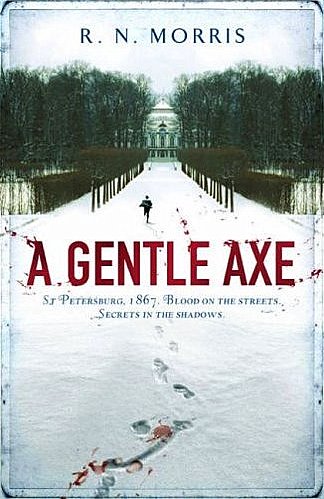
Book Covers We Love, #2

Title: The Gentle Axe, by R.N. Morris
Publisher: Penguin Books (U.S.), 2008
Designer: Blacksheep

One of the results of my visiting Vancouver, B.C., last weekend was that I finally picked up a finished copy of Roger (or “R.N.”) Morris’ A Vengeful Longing, which was released earlier this year in Britain, but won’t be available in the States until mid-June. Longing is of course Morris’ second historical mystery to employ as its protagonist Porfiry Petrovich, the St. Petersburg investigating magistrate who was introduced in Russian novelist’s Fyodor Dostoevsky’s Crime and Punishment (1866). Its predecessor, The Gentle Axe (or A Gentle Axe, as it was titled in the UK), ranked among my favorite crime novels of 2007.

In looking closely at A Vengeful Longing’s cover, I realize that it, like the front of Axe, was created for UK publisher Faber and Faber by a London design group called Blacksheep, which has been responsible in the past for the fronts of books by David Lawrence, Reg Gadney, R.S. Downie, and Graham Hurley. Both of these Morris jackets are particularly affecting, but The Gentle Axe remains my favorite. It also apparently won over the bright marketing folks at the U.S arm of Penguin, who chose to substitute Blacksheep’s design in place of a much more staid cover concept (by Gabrielle Wilson) that was featured on Penguin’s American hardcover edition of Axe. The cover above is of the U.S. paperback edition, released in March of this year.

It’s actually a composite of several images. The first is a stock shot from Seattle, Washington-based Getty Images, titled “Snowy entranceway to an estate near Saint Petersburg.” (To find the original photo, go to the Getty Images main Web page and type this shot’s catalogue code, “ngs0_4425,” into the Search box.) Unfortunately, the name of that estate isn’t given, but perhaps somebody more familiar than I with the historical architecture of St. Petersburg, Russia, can supply such information. In any event, the original shot shows a woman with some sort of bag in her right hand, walking calmly through the snow toward that manse, between precisely planted, parallel rows of trees. In Blacksheep’s slight refashioning, the woman has been removed, and in her place we see a running boy, trailed by blood-dappled footprints. This combination suggests that the story to be found within offers both pursuit and murder, as it certainly does. (Taglines on the front of the British hardcover edition--“St. Petersburg, 1867. Blood on the streets. Secrets in the shadows.”--were completely superfluous.)

Significant here, too, is the use of a simple, vertically oriented, sans-serif typeface for this book’s title. It pops out nicely (in part because it picks up the deep red of the blood spatters), and stands in notable contrast to the visual complexity of the Russian estate as well as to the smaller, serif-bearing type used elsewhere on this paperback cover. All in all, a successful combination of image and typography, attracting an audience in search of crime fiction with a dark but thoughtful demeanor.

British author Morris reports that he has at least two more Porfiry Petrovich novels in the works: A Razor Wrapped in Silk, which he says “draws heavily” on Dostoevsky’s 1869 novel, The Idiot; and what he describes as “[t]he final book in my intended quartet,” inspired by 1872’s The Devils (aka The Possessed). If those can maintain the quality and investigative intensity of this series’ first two installments, they should do well. Especially if Blacksheep is given the commission to design their covers.

Sunday, April 15, 2007

Double Identity

So why, you may be wondering, do I use two names, one for each of my novels so far? It seems to suggest that I will generate a new variant of my name for every future book I may see published. Actually, the use of two slightly different names, Roger Morris and R.N. Morris, distinguishes two very different strands in my writing. My first novel, Taking Comfort (2006), written by Roger, is contemporary in setting and, I think it’s fair to say, experimental in style. Whether it qualifies as a literary novel, I don’t know. The UK-based site It’s a Crime! (or a Mystery ...) has described it as a thriller in disguise, claiming that it does indeed sit within the modern crime genre, the boundaries of which are being constantly tested. There’s certainly a dead body in it and some criminal behavior. Gentle Axe, written under the name R.N. Morris, is a historical crime novel--an unashamed genre piece. It has a detective and a number of dead bodies. It’s a Crime! characterized it as “a classic whodunnit.”

My work on these two books overlapped. Both were a long time in the planning--and were projects that I would put down, then return to. They were written in quick succession and in submission simultaneously. Taking Comfort went to one British publisher who was initially very enthusiastic, so much so that it seemed an offer was a mere formality. But then an editorial meeting killed it. In the meantime, Gentle Axe was finished and doing the rounds. Taking Comfort languished. Then I found out about the launch of the Macmillan New Writing imprint and submitted the book directly to the people there, leaving my agent free to concentrate on selling Axe.

I was hoping that I might get lucky with one book or the other. I never imagined that they would both find homes (at least in the UK; Taking Comfort isn’t yet available in the States). However, that is indeed what happened, and within a few months of each other. It was a complicated and slightly embarrassing situation. But having two names was not an attempt to pull a fast one on either publisher--both of whom were very understanding. I was advised that having two books issued so close together might be confusing, not so much for readers as for bookshops, which would have a hard time figuring out where to place me. I don’t know whether there is any truth in that. But I did like the idea of having a second identity, not just to reflect a different style, but to facilitate it. When writing as R.N. Morris I can become R.N. There’s something liberating about writing under those mysterious, and gender non-specific, initials. So maybe it’s ultimately for my benefit.

I’ve talked on this page already about my debt to Dostoevsky with respect to Gentle Axe. But Taking Comfort also was written under the influence of Crime and Punishment. The central character is taken over by an obsessive idea that propels him into a transgressive spiral. In trying to take the reader into Rob Saunders’ head, I was influenced and inspired by Dostoevsky’s treatment of Raskolnikov.

I’ve also talked about Gentle Axe being a last throw of the dice, as far as getting published was concerned. Well, actually, there were two dice in my hand--Taking Comfort and Axe. I played for high stakes both times, I think. I took risks in the writing of Taking Comfort which have made it a book that not everyone will get on with, but I’ve been gratified to discover that there have been readers who have understood perfectly what I was trying to do.

Recently, I’ve been concentrating on being R.N. I’ve spent the last year writing my second Porfiry Petrovich novel. And as I said in a previous post, I have a total of four storylines planned, one for each season in St. Petersburg. I’ve never written a crime series before. That’s what makes it interesting, of course.

I’d like to go back to being Roger at some point. To be true to the distinction that has been put upon me, I suppose I ought to make all Roger Morris books edgy, contemporary, urban novels. Though to be honest, I think I would rather reserve the right to write what I damn well like under my own name!

Thursday, April 12, 2007

My Debt to Dostoevsky, Part II

Last August I made a pilgrimage to St. Petersburg. One of the places I visited was the Dostoevsky Museum at 5 Kuznechny Lane (shown below). It’s housed at the address of Fyodor Dostoevsky’s home from 1878 to his death in January 1881, the place where he wrote his last work, the masterpiece The Brothers Karamazov.

Again (see my earlier post), there is something heroic in the writing of this book. The family decided to move to the new apartment after suffering a terrible loss. Anna Dostoevskaya, the author’s wife, wrote in her memoirs: “On May 16, 1878 an awful tragedy struck our family: our youngest son Lyosha passed away.” The 3-year-old boy died of epilepsy which he had inherited from his father. The loss was a profound blow to Dostoevsky, who was devastated by the thought that his son had died of “his disease.” It’s significant that he gave his son’s name to the hero of the novel that came out of the tragedy.

The courage and strength to go on undoubtedly came from a pilgrimage Dostoevsky made to the monastery of Optina Pustyn, where he was consoled by a famous monk called Father Ambrose. This individual provided the model for the elder Zosima, the spiritual father to his dead son’s fictional namesake, Alesha Karamazov.

When I came to write my own Dostoevsky-inspired novel, The Gentle Axe, I couldn’t resist including an episode set at the monastery of Optina Pustyn, including a character that Virginia Rounding described in her review for Britain’s Independent newspaper as “the statutory holy monk on his deathbed.”

Rounding also noted the presence of “forbidding tenements, ominous stairwells and dank courtyards familiar to readers of Dostoevsky,” as well as “a tender-hearted prostitute (no Dostoevskian novel would be complete without one).”

The image I have of what I was about here is based on an analogy with painting. I imagined Dostoevsky as a painter. I imagined myself walking into his studio, picking up his palette, on which he had already laid out his characteristically somber colors, and painting my own picture with his brushes. Monstrously cheeky of me, I know, but I was motivated, I believe, by a sincere desire to pay homage.

I like to think of it as a collaboration, admittedly one in which Dostoevsky had no say in whether he participated. But I believe Dostoevsky was a writer of great humanity, and unexpected humor, so I like to think he might have been more indulgent than one or two of my critics have turned out to be. Besides, he was a devout Christian. Forgiveness was part of his creed.

In common with all of Dostoevsky’s homes, the apartment at Kuznechny Lane was in view of a church, symbolizing the centrality of Dostoevsky’s faith in his life as a man and a writer. To do justice to this aspect of Dostoevsky (which is perhaps the hardest one for some modern readers to take on board), in developing my Porfiry Petrovich--a character taken from Dostoevsky’s novel Crime and Punishment--I deliberately made him a man of faith, giving him a concern for the souls of those who commit crimes, as well as a wooden crucifix around his neck. So there is something of Dostoevsky, in addition to the characteristics I borrowed from his fictional creation, in my Porfiry Petrovich. It seemed to me, too, that the role of investigating magistrate, Porfiry’s job title, is akin to that of confessor.

The character of Porfiry Petrovich is “on stage” for just about three chapters of Crime and Punishment; his presence is felt, however, in Raskolnikov’s obsession with him from the moment his name is first mentioned. Obviously, I read those chapters closely, picking up clues that would help me flesh out my own Porfiry--and indeed to flesh him out enough that he could become the protagonist in his own novel. I’ve been teased by The Washington Post for my attention to Porfiry’s eyes: “nowhere else in the world's literature have I encountered such closely observed eyes.” The reviewer, Patrick Anderson, admits that he cannot say “[w]hether all this is Morris’s invention or that of Dostoevski.” I feel I did take my cue from Dostoevsky--the sense Raskolnikov has of Porfiry watching him closely (he “did not once take his eyes from the guest”) was something that evidently made a big impression on me. The watchfulness--and observational skills--of Porfiry are key to his role as a detective. I think that the motif is consistent with the period and setting too, when the paranoia of being watched, the possibility that anyone could be a spy, must have been very keenly felt.

Dostoevsky’s characters, though they often originate as the embodiment of ideas, or intellectual positions, soon become remarkably alive. They are elusive, contradictory and difficult to pin down. What one character says of another is often at odds with how that second character in fact appears to us, the readers. We must make our own minds up about them, a little like the people we meet in real life. His villains, like the nihilistic suicide Svidrigailov, are fascinating and complex.

In Crime and Punishment, Porfiry is said to be something of a prankster. In fact, his reported unreliability and mischievousness precede his appearance in the novel. Apparently, he once pretended to be getting married and even purchased a wedding suit. At another time he claimed to be about to enter a monastery. There turned out to be nothing in either story. In my novel, this comes out in his psychological manipulations, which at times may seem quite cruel. In addition, there is the sense that no one, not even his colleagues, quite trusts him. The games he plays, though, are all in the service of a higher end: to discover and thereby bring about the salvation of the perpetrator.

I admit that I was highly delighted when the San Francisco Chronicle observed that “The story is told ably in the classic whodunit twisty-arc style, reminiscent of the sleuthing of Nick Charles, Sherlock Holmes and Columbo.” I was certainly influenced by the last two, being an avid reader of Conan Doyle at about the time I first attempted Crime and Punishment, which also happened to be more or less the time that Columbo was on television. It’s common knowledge that the character of Columbo was based on Porfiry Petrovich. I will confess that I had Lieutenant Columbo in mind when I came to re-create my own Porfiry.

I can reveal exclusively to readers of The Rap Sheet that a second R.N. Morris Porfiry Petrovich novel is already written and has, in fact, gone into production with my UK publisher, Faber and Faber. When I first pitched the idea of using Porfiry in my own tales years ago, I had four story lines mapped out. Faber (and Penguin U.S.) have so far committed to the first two, though I have had discussions with my UK editor about what will happen in future books. If the first two go OK, I think there is a willingness from Faber at least to take the series on.

Some of you might be thinking that a person can perhaps be forgiven for writing one novel using somebody else’s character, but four? Isn’t that pushing it just a wee bit? You may have a point. However, for me Porfiry Petrovich is such a great character that he deserves more than just a three chapter walk-on, and the Dostoevskian universe is so rich and fertile a bed of criminality, that I feel there are plenty more tales to be told. Besides, I’m having fun. And for that I will make no apology.

When I visited the Dostoevsky Museum last year I had a quiet moment with the great man’s ghost. I found myself humbled, a little ashamed--my face became hot and flushed. I felt close to tears. But I also felt an incredible warmth and understanding coming back at me. I may be deluding myself, but I had the definite feeling that we’re cool, Fyodor and I.

(Part I of this essay can be found here.)

Wednesday, April 11, 2007

My Debt to Dostoevsky, Part I

Fyodor Dostoevsky isn’t just a great writer. He’s a heroic writer.

Here is a man who was sentenced to death in 1848 and reprieved just as the firing squad lifted its rifles. As Richard Freeborn tells it in his brief biography of the Russian writer (Dostoevsky, Haus Publishing, 2003):
His brush with death reverberated through the rest of his life. Shackled though he was and in chains, he returned to his cell full of life at having been given back his life. He had little to celebrate in fact, for he had been sentenced to four years of penal servitude followed by service in the ranks ... His career had been ruined; lesser men might have been crushed. Instead Dostoevsky appeared reborn out of the disaster.
Freeborn then goes on to quote from a letter Dostoevsky wrote to his brother at the time:
As I look back on the past I think how much time I have wasted, how much of it has been lost in errors, in mistakes, in idleness, in an inability to live properly; how little I treasured it and how often I sinned against my heart and my spirit--and my heart is overwhelmed. Life is a gift, life is happiness, every minute can be a lifetime of happiness. ... Now in changing my life I am being reborn in a new form. Dear brother, I swear to you that I will not lose hope and I will keep my spirit and my heart pure! I will be born again for the better.
Incarceration in a Siberian penal settlement gave him an opportunity to observe criminals first-hand, an experience which some modern crime writers might wish to duplicate. Whether they would want to do so under the conditions Dostoevsky suffered, though, is debatable. It can’t have been easy for him, a gentleman stripped of his rank, in amongst peasant convicts who certainly didn’t understand him, and more than likely hated him. The rough treatment that Raskolnikov endures at the end of Crime and Punishment (1866) may have been informed by Dostoevsky’s experiences:
He himself was disliked and avoided by everybody. In time they even began to hate him. Why, he did not know. Men who were far more culpable than he despised him and laughed at his crime.

“You are a gentleman!” they said. “You shouldn’t have gone to work with an axe; it’s not at all the thing for a gentleman.”
Dostoevsky’s crime, incidentally, was political. He was convicted of reading out this letter (from the critic Belinsky to the writer Gogol) to what was more or less a private debating society. Unfortunately, that group of liberal-minded intellectuals had been infiltrated by a government spy.

But his time in “the house of the dead” was undoubtedly formative for Dostoevsky the writer, even if it was destructive to Dostoevsky the man (he suffered ill health, and the epilepsy that plagued him for the rest of his life may have developed as a result of the treatment he endured). To quote again from Freeborn:
He was appalled and fascinated by the evidence of evil he encountered in the criminals with whom he daily brushed shoulders. The lack of remorse encountered by the worst of them for the unspeakable crimes against children and women--not to mention the mass murderer, Orlov, who was steely and self-controlled beyond belief--directed Dostoevsky’s thoughts inevitably to crime and its psychological meaning. In all of his future major fiction he made murder the focus of his attention and criminality a central issue.
If that isn’t the definition of a crime writer, I don’t know what is.

Of course, Crime and Punishment is the Dostoevsky book which most explicitly concerns itself with the subject of murder (and which inspired my own new novel, The Gentle Axe).

The difficult conditions under which that novel was composed again justify the use of the word “heroic.”

Dostoevsky’s first wife and his beloved brother, Mikhail, had both recently died within three months of each other. He took on all of his brother’s debts, as well as the journal Epoch that he and his brother had founded. With an energy that would shame even the most prolific of today’s bloggers, he worked day and night to keep the journal afloat. But in vain. Epoch folded in 1865 and the debts mounted.

As Richard Freeborn puts it: “He was forced to beg for funds from all manner of sources, always to his shame, and, more shamefully still, became closely acquainted with the grubby world of St. Petersburg moneylenders.”

I can’t help wondering whether this informed his choice of murder victim in Crime and Punishment.

Part of Dostoevsky’s greatness is his understanding of human frailty, as well as criminality. The character of the drunkard Marmeladov in Crime and Punishment is evidence of this. Dostoevsky himself suffered from an equally damaging addiction: gambling. One of the wildest gambles he ever played took place around this time. He entered into an agreement with a rather dodgy publisher called Stellovsky. For a promised advance of 3,000 rubles he undertook to deliver a new novel by the end of November 1866. If he failed to deliver, he would forfeit the rights--and all payment--on anything he might write for the next nine years. Talk about a deadline!

“With this additional threat hanging over him," Freeborn writes, "and such funds as he had raised already, he went abroad in late July 1865 with fewer than 200 roubles in his pocket. It was his earnest hope to improve his health and have time to write, but most of all he planned to cover his debts by winning at the gaming tables of Wiesbaden. Five days later he had lost everything ... Refused food, confined to his [hotel] room and with only poor quality tea to sustain him, he had reached rock bottom. By some miracle far more munificent than any roulette wheel he conjured into being a plan for a masterpiece.”

That masterpiece was of course Crime and Punishment. Significantly, Dostoevsky did not offer this to Stellovsky, thereby putting himself under pressure to write an additional book (appropriately titled The Gambler) in barely a month. With the help of his future second wife, Anna, who served as his stenographer, he just about pulled it off.

I’ll take a closer look at Crime and Punishment in a future post. By the way, for anyone who’s interested, the text of Crime and Punishment is available to download for free here, here, and, in Russian, here.

(Part II of this essay can be found here.)

Monday, April 09, 2007

R.N. Morris Makes His Mark

Today The Rap Sheet is delighted to welcome its third “guest blogger,” following James Ellroy and Megan Abbott. He’s British author Roger Morris, or “R.N. Morris,” as his byline appears on A Gentle Axe, his new novel, set in St. Petersburg, Russia, in 1866 and starring none other than detective Porfiry Petrovich from Fyodor Dostoevsky’s classic novel Crime and Punishment).

Morris was born in Manchester, England, in 1960 and now resides in North London with his wife and two young children. He peddled his first short story to a magazine for teenage girls while he was still a student at Cambridge University, where he read Classics. He went on to make his living as a freelance copywriter, composing text for British Airways, Penguin Books, The Guardian, and even Lexus automobiles. Yet he continued to pen fiction as well, although it was only occasionally published. His story The Devil’s Drum was turned into a one-act opera, which was performed at the Purcell Room in London’s South Bank neighborhood. Another of his tales, Revenants, saw print in the form of a comic book. His novel Taking Comfort, a semi-thriller about a corporate cog, observer, and collector of mementoes from the disasters he witnesses, was published in 2006 (by Macmillan New Writing) under the byline “Roger Morris.”

As we’ve explained before on this page, A Gentle Axe (retitled The Gentle Axe in Britain) sends investigating magistrate Porfiry Petrovich out to untangle the apparent murder-suicide of a burly groundskeeper and a dwarf translator, who’ve been found in a St. Petersburg park by a light-fingered former prostitute. It doesn’t take long for the Columbo-ish sleuth to link these horrors to a dreary whorehouse, a pornography ring, and a starving lawyer-wannabe--and incite resistance from his superiors. Morris’ delving into the squalid corners of tsarist Russia, as much as his quirky players, makes this novel a thoroughly absorbing read.

Roger Morris’ first post will appear here presently. We hope he’ll follow that over the next few days with remarks about the expanding world of historical fiction, his encounters with some of the other crime writers who live near him in London, his future novel-writing projects, and his impressions of the master from whom he has so artfully “stolen” his protagonist, Fyodor Mikhailovich Dostoevsky.

Feel free, as we go along, to weigh in on the topics Morris brings up or to ask him questions in the Comments section of each new post.

(Author photograph by Simon Nicholls.)

Wednesday, January 31, 2007

There Are No Saints in St. Petersburg

One of the historical crime novels I’ve been looking forward to most this winter is R.N. Morris’ A Gentle Axe. It imagines analytical police detective Porfiry Petrovich (resurrected from Fyodor Dostoevsky’s Crime and Punishment) tackling the murders of a peasant and a dwarf, their bodies found in a park in St. Petersburg, Russia, in 1866. So far, no kind publicist has sent me the book, but I hold out hope. In the meantime, I can dine gratefully on two new entries on the UK blog It’s a Crime! (or a Mystery ...): a lengthy interview with Morris (who has also written a previous novel, Taking Comfort, as “Roger Morris”) and a review of his new book.

My favorite two parts of the interview come when Morris says that the tale he’s concocted in Axe isn’t meant to remind readers of anything familiar from the present-day ...
“I didn’t want to come up with an abstract murder story that could have happened at any time, in any setting and was then just inserted into the setting. I wanted it to be something that came out of the ideas and themes of the time. However, it’s true, I think, that every generation re-interprets the past according to its own priorities and preoccupations, in the same way that every generation re-imagines the future. But it was not a conscious aim of mine to write something that had a contemporary relevance. I’m sure though, being a person of my time, that what I have chosen to focus on in this story somehow reflects the society I’m a product of. I just can’t tell you how!”
... and when Morris says he’s used Crime and Punishment only as a literary springboard, creating his own story using Dostoevsky’s setting, plus a character or two:
“Basically I’ve nicked a character from a masterpiece of world literature and taken massive liberties with him. If I ever do get to meet Dostoevsky in another place (though I don’t think I’ll be let into the bit he’s no doubt residing in) I will obviously be very ashamed of myself. I will have to get down on my knees and beg forgiveness. I know he has a sense of humour, though--I mean, I think he can be a very funny writer, which is sometimes overlooked because people tend to have this idea of his work being relentlessly grim. He is an incredibly humane writer and humour is part of humanity. Anyhow, it’s meant to be a playful idea, you know. And I would hope that he would appreciate that aspect of it.”
You can read the whole interview here.

A Gentle Axe has just been released in Britain by Faber and Faber. Unnecessarily retitled The Gentle Axe, it’s due out in the States from Penguin Press in late March.

Sunday, November 19, 2006

Please, Give Me the “Axe”

Drat! I knew, when compiling my list of crime novels I most want to read over the coming winter months, that I would forget to note a book. Or perhaps two. And, indeed, Karen Meek’s Euro Crime blog has reminded me that I failed to mention R.N. Morris’ A Gentle Axe, due out in Britain in February (but not to be published in the States till March). Morris, whose previous novel--published under the byline Roger Morris--was 2006’s Taking Comfort, follows what’s becoming a common pattern of modern writers adopting the characters of previous novelists, and placing them in new situations. In the case of A Gentle Axe, Morris uses as his protagonist Porfiry Petrovich, the persistent detective from Russian novelist Fyodor Dostoevsky’s 1866 novel, Crime and Punishment. Of the plot, Amazon UK explains:
St. Petersburg, Winter, 1867 -- Two frozen bodies are found in an isolated corner of Petrovsky Park. The first--that of a dwarf--has been packed neatly in a suitcase, a deep wound splitting his skull in two. The second body, of a burly peasant, is hanging from a nearby tree, a bloody axe tucked into his belt. The detective Porfiry Petrovich, in his first murder case since Dostoevsky’s “Crime and Punishment”, suspects the truth may be more complex than others wish him to believe. His investigation leads him from the squalid tenements, brothels and drinking dens of the city’s Haymarket district to an altogether more genteel stratum of society. Atmospheric and tense from its dramatic opening to its shocking climax.
I read Crime and Punishment sometime in the 1970s, after hearing that television’s Lieutenant Columbo was partially inspired by the character of Porfiry Petrovich. And it remains one of my favorite classic novels, a brilliantly dark examination of egomania, murder, and guilt. So I’m hoping author Morris can give new life, and unique dimensions, to Dostoevsky’s patient crime-solver. Maybe we’ll read more about what he has in mind on his blog, as the pub date for A Gentle Axe draws nearer.