Showing posts with label Ken Bruen. Show all posts

Tuesday, April 01, 2025

Remembering Ken Bruen

By Peter Handel
I never met Ken Bruen in person, but to a small extent, I feel like I knew him. Our paths crossed initially in the early aughts—it may have been when I was the San Francisco Chronicle’s crime-fiction columnist, or later during my stint with the now long-defunct Pages Magazine. At around that same time, we actually chatted on the phone and even made a tentative plan to meet up when he was visiting Northern California from Ireland.

Alas, that encounter never occurred, and years passed, me reading the occasional Jack Taylor blend of brutality and humanity, and Ken—writing, writing, writing.

In March of last year, I had the genuine pleasure of interviewing Ken about his then-latest Jack Taylor detective novel, Galway Confidential, for a profile that appeared in CrimeReads. I sent him a preliminary list of questions that he quickly answered. That led to additional queries, and soon it felt like some kind of Galway floodgate had opened: one of the most enjoyable back-and-forths with an author that I could have ever imagined began. Before long, Ken was sending me little stories, tidbits, and hilarious remarks—unsolicited.

Most of them had to go in the piece—they were too fucking good to leave out!

Over the past year, for various reasons, I remained in touch with Ken via e-mail. If I had a question, he answered it. When I asked the boss of this blog if I could review Galway’s Edge, his new, 18th Taylor book, I got the green light. I didn’t reach out to Ken right away, but as I finished my review, I remembered he had said last year that one more Jack Taylor novel was coming, that it was written already and was to be called Galway’s DNA.

Hmm. I shot an e-mail off to Ken and asked, Is this a different book than what was to be called Galway’s DNA? And is this in fact the final Jack Taylor story? His reply, from March 14, was typical Ken Bruen (and like all of his e-mail correspondence, it was “written” in his inimitable style). It read, in part (and concludes the review):
Peter,

lovely to hear from you.
Galway DNA became Galway’s Edge as I wrote the book and it mutated it’s own self.
For now, there is no jack taylor on the horizon but I’m open to Jack talking to me.
warmest wishes.
Ken
I wrote back and asked, Can I use this?
use anything Peter that helps

Warmest wishes
Ken
After the review ran on March 26, I naturally sent it to Ken, and frankly, could not wait to hear from him. But silence ensued, and I wondered why. I continued to check my e-mail all last weekend … until I saw the news of his (I assume) unexpected death in a Galway hospital on Saturday the 29th.

The mystery/crime fiction world has shrunk. Significantly. Dramatically. I cherish my interactions with Ken. We weren’t friends, but we did indeed have a wonderful relationship. I’m closing here with part of one of the notes I got from Ken after the CrimeReads profile ran. (He was pleased, and gracious, as always.) To me, it truly typifies what kind of a person Ken Bruen was. It reads, in part:
Do please stay in touch and if there is anything I can do
for you, tis done.
Warmest thanks
Ken
That was Ken.

Sunday, March 30, 2025

Irish Author Bruen Passes On

This is terrible news for a Sunday morning: “The hugely popular Galway crime writer Ken Bruen has died at the age of 74.”
Best known as the man behind the Jack Taylor crime series, he was the author of more than 50 books over a stellar career that made him one of the most prominent Irish crime writers of the last two decades.

He was a past winner of the prestigious Shamus Award for best crime novel of the year; he also won the Macavity Award, the Barry Award, the Edgar Award — an award he was also shortlisted for earlier in his career.
More information is available from Ireland’s Connacht Tribune.

READ MORE:Is This the Last of Jack Taylor?” by Peter Handel (The Rap Sheet); “‘A Great Loss’—Tributes for ‘Pioneer’ Galway Crime Writer Ken Bruen as Author Dies Aged 74,” by Jessica Mercer (Irish Independent); “The Crime Lady: Remembering Ken Bruen,” by Sarah Weinman; “Ken Bruen (1951-2025),” by Dana King (One Bite at a Time); “Remembering the Bleak, Beautiful Poetry of Ken Bruen’s Noir,” by Scott Montgomery (CrimeReads).

Wednesday, March 26, 2025

Is This the Last of Jack Taylor?

By Peter Handel
When reading a Jack Taylor novel by Ken Bruen, one has two options: A) devour it in its entirely—scarf that story in one fell swoop—or B) take it in small bite-size pieces—chunklets, if you will. Either way, the end result is the same, a crime-fiction reading experience to savor. In Galway Confidential, the previous Taylor novel, the story ended with a teaser about the rise of a local, mysterious group called “Edge” and an appearance by Jack’s potential new lover, Rachel Worthington, during which we learned her backstory and why she came to know about Edge.

Galway’s Edge (Mysterious Press) is Bruen’s new, 18th excursion through an only-in-Ireland mélange that includes a slightly devious Mother Superior, über-wealthy, sadistic upper-class cretins, and Rachel, who is now a “conduit” to Edge as well as Jack’s potential, if conflicted female companion. And then there’s Jack, once again uncomfortably helping certain members of The Church … this time to formally investigate Edge, which is described in the opening pages as
a cabal who effectively ruled [Galway], stepping in when normal issues needed to be resolved. They discovered early that secrecy and subterfuge were powerful tools. ... Rumours were their stock in trade. Gathering information, collecting sordid acts, wielding power from a city that didn’t know they were. By stealth and money, they managed to exist as a rumour masquerading as a fact.
Guard-turned-gumshoe Taylor is visited one afternoon by a very large man, Father Richard, who describes himself as “Special envoy to the Archdiocese of Galway ... The powers that be decreed I should contact you as you have been of considerable assistance to Mother Church, not to mention, somewhat controversial.”

Father Richard, after a bit of liquid lubrication, goes on to say, “We have become aware of a group named Edge who are anti-Catholic ... Among this group it is rumoured they have a priest ... we need you to locate this individual [a Father Whelan] and dissuade him of his activities.”

Soon, Jack has a list of the five members of Edge, all part of the Galway elite, including Father Whelan, a literary agent, a real estate “mogul,” a billionaire, and a high-profile author. In the end, a group of keep-your-hands-clean vigilantes—the upper-class team. (Which is typically Bruen, ironic: Jack is a vigilante himself, if anything, but not remotely upper class; in fact, one with no class.)

He visits Father Whelan, but leaves unsatisfied. It’s the same result with all of the others on the list he contacts. But: the next day, the (not) good Father is found hanging from a tree, an “E” written in the dirt below him.

Additional vigilante killings occur, Father Whelan’s fate setting the tone. Father Richard soon sends Jack to see a man named Benson, who reputedly wanted to join Edge. The encounter doesn’t go well, and Jack is thrown out of Benson’s house by his private security minder.

It’s then on to the pub, where the detective runs into a former priest, Ciaran. “He was probably around fifty,” Bruen explains, “but looked eighty, dressed in black, but no white collar.” Jack asks him, “Are you familiar with Edge?” A long pause, followed by Ciaran’s reply: “Stay away from them, they are darkness in action.” He goes on to say, when asked if he knows of Benson, that “Benson is demonic.” He adds: “Edge is a group of people who claim to step in and right injustice, but they use that as a cover for all kinds of malignancy and to enrich themselves. Benson wanted to become part of their crew, but they rejected him. So he vowed to erase them, I’m sure some of them have already met violent ends.” As Jack is about to leave, Ciaran “reached into his jacket, produced a small crucifix, handed it to me.” Jack starts to refuse it, but Ciaran smiles and says to him, “Jack Taylor, you need all the protection you can get, both corporal and metaphysical.”

Indeed.

Numerous subplots also play out as this tale moves forward, including: increasing conflict with Rachel (can she be trusted?), and an incident involving a Guard member whose much-abused wife has asked Jack to intercede with her husband—a man who takes umbrage at Jack even talking to him, and who lands a blow to his face that puts our man in the hospital. These are among many tangential yet relevant aspects of Bruen’s brilliantly woven storyline.

As is the case with all the Jack Taylor novels, Bruen’s dialogue, his often hilarious, biting asides, and his protagonist’s big heart concealed beneath a façade of drinking and drugging (and the not-so-heartful use of his “hurley” to mete out his own unique brand of justice) all combine for a reading experience to relish. (A “hurley,” by the way, is broad-bladed, netless stick used in “an Irish game resembling lacrosse.”)

The back-and-forth banter between the ubiquitous Father Richard and Jack as they sit down to eat in a nice restaurant owned by a woman friend of Jack’s, Ger, is perfectly evocative of Bruen’s approach to dialogue and his wicked, devilish sense of humor. They are meeting to discuss how Jack might proceed in dealing with Edge. After parking, they enter the restaurant. Jack narrates the scene:
“Inside, Ger gave me a warm hug, she looked at Richard who said,

“I can do a hug.”

She did.

She didn’t comment on his girth but did provide us with a family table.

Discretion.

A waitress came, greeted us effusively, and gave us menus. Richard ordered a ton of food and I said,

“Whoa, I’ll never eat all that.”

He snarled.

“That’s for me, you order your own.”

I said to the waitress,

“He’s eating for two; one of them is Orson Welles.”

Richard fumed.

“You have a very nasty side.”

True.

I ordered a steak and a pint.
The jibes continue; it’s as though Jack—already a classic self-sabotager—has to stick the knife in during any conversation, casual or not. Bruen excels at crafting these exchanges. His books are riddled with argumentative, practically theatrical asides no matter who he’s talking to—from the Mother Superior, to the dangerous fat cats who employ sadistic bodyguards, to the abusers of women, be they members of the Guard or simply rank men with bad attitudes.

(Right) Author Ken Bruen.

His conversation with Father Richard turns from wisecracks to matters more serious:
My steak arrived and a fresh pint of Guinness, joy to the world.

I asked,

“So how did you become so big?”

I paused then.

“Sorry about big, I meant major player in such shark-infested water?”

He had finished one of his main courses, and was now on the second, and seemed to relish every bite. He wiped his mouth, said,

“I was a lowly curate in the Italian countryside and a chance encounter with a cardinal led me to being transferred to the Vatican. I learnt fast that doing favours for the elite was the fast track to high office.”

I considered this and he added,

“Primarily, I play dirty.”

My steak was good, and I focused on that as he said,

“I like you, Jack; you amuse me but we both know you’re basically a dipso.”

Who needed this shite, I stood up.

“Something for you to remember, I play dirty my own self.”

He didn’t stop eating, said,

“You’re a small-time private dick with notions way beyond your abilities; now sit down, I have instructions to issue.”

Jack leaves him sitting at that.
Bruen keeps the plot turning. A diamond-encrusted gold crucifix is stolen from the Mother Superior, and she wants Jack to take it back—from Mr. Benson. Even more characters become involved, including a thief acquaintance of Jack’s named Jordan. A young tech whiz, Jessie, is enlisted by Jack to hack (“disable”) bad man Benson’s computers. A hand is severed, child porn is planted, guns are fired, Jack ends up in the hospital with a broken nose. Members of Edge die in a variety of brutal ways. Bruenian violence percolates throughout this story.

In an interview with Bruen that yours truly conducted of behalf of CrimeReads, back when Galway Confidential was first published, the author said that 2024 release was the “penultimate Jack Taylor novel,” and that Jack’s final appearance would be in Galway DNA, which he’d already written. But things change ... Galway DNA became Galway’s Edge, and it doesn’t quite feel like that’s the end of the series. Is it?

Asked in an e-mail message to clarify matters, Bruen says, “Galway DNA became Galway’s Edge as I wrote the book and it mutated its own self. For now, there is no jack taylor on the horizon but I’m open to Jack talking to me.”

Well, at least Jack doesn’t die to conclude this remarkable series! Undoubtedly, Bruen has something further and exciting up his sleeve—which will include Jack Taylor or not.

Wednesday, January 19, 2011

Fade In

Over at the Mulholland Books site, Irish author Ken Bruen and film development executive Russell Ackerman today introduce the first part of their serialized story, “Black Lens.” The schedule calls for posting one new chapter every week, though there’s no word on exactly how many chapters exist. Maybe Bruen and Ackerman don’t know yet. Maybe they’re still writing, as in the old style of serial yarns. We shall see.

In any event, Chapter 1 is here, with art by Jonathan Santlofer.

Friday, September 12, 2008

The Book You Have to Read:
“Rilke on Black,” by Ken Bruen

(Editor’s note: This is the 22nd installment of our ongoing Friday blog series highlighting great but forgotten books. Choosing this time is Tony Black, the Australia-born, Edinburgh-based author of Paying for It, the opening entry in a series starring “hack turned investigator Gus Dury.” A follow-up, Gutted, is currently being subjected to the editing process. It should be out in the summer of 2009.) I’ve had some dodgy jobs in my time, but it’s been quite a few years since I was a press officer for a Scottish water authority, tasked with getting the media interested in new sewage pumping stations ... shit job, oh yeah. It was round about this time, on one of my precious lunch-break strolls, that I picked up a book by an author I’d never head of. It name-checked Rainer Maria Rilke in the title and carried a quote on the cover that recalled three more literary heavyweights. GQ proclaimed the work a fusion of
the paranoia of a Jim Thompson or David Goodis with the sparse vernacular style of an Andrew Vachss.
I was already sold. The reviewer wasn’t finished, though …
The most startlingly original crime novel to emerge this decade …
And, that still wasn’t all …
… from either side of the Atlantic.
The author was Ken Bruen and the novel was Rilke on Black (1997). Not a big book--it ran to only 150 pages--but a huge book in the development of the new wave of crime fiction which would come to be epitomized by its author. The novel announced the arrival of a bold new voice, a poetic, maddeningly original stylist who would burn a ferocious trail in the years to come. From the opening lines I knew at once I was in for one hell of a ride.
I’m not a criminal. I’ve done my share of dodgy things but they managed to slide under the legal line. Then I kidnapped a man, a black man. Even criminals despise this branch of the business. It smacked of cowardice and worse, stupidity.
Set in South London, Rilke on Black--if you haven’t already guessed--is a kidnap caper. Prime crime territory. However, uninitiated to the genre as I was then--and with a head full of Kafka and Camus--I could have sworn it was literary. With the depth of character exploration, and the complex interpersonal narratives that stalk the main plot, I’d stick to that assessment today, but would probably append the term “classic” as well. Not that it’s lacking in crime. Nick is an ex-bouncer with a father in the gutter; Dex, a class-A nutter; and Lisa, a druggie femme fatale with a bad mouth. When they decide to take hostage a club owner who has a taste for the poetry of Rilke, the ensuing chaos was like nothing I’d read before. Every page burst with style and substance, poetry and street patois, anger and adrenaline. All of it told with an ease of skill that is the mark of a true original.
       The pub was humming. Bonny was at the counter. A middle-aged guy pulling chat on her. No wonder as she was wearing        a short black dress        black tights        black patent heels, killer high        the whole                “hey-wanna-fuck-me-stupid-fellah”        outfit.
The conventions of grammar, punctuation, and sentence structure had been thrown out with the rest of the writing “rules.” And boy, was the book better for it. Bruen wasted nothing. His prose so bare, yet so full-to-bursting with incident, development, conflict, and character that after only a couple of pages I found myself turning back, disbelieving I had taken in so much, that such quantity could be delivered to the reader in so few words. It was beyond economy. Like gorging on haiku. It was clear Bruen was a learned writer, but all of his characters’ intellectual outpourings were well-earned; not one got away with literary grandstanding. There was an obvious link to Hemingway--the book’s author knew that the “erudition shouldn’t show,” that the best place for a message was a Western Union depot. So, when the kidnap victim quotes from Rilke, for example, its effect is to ratchet up the tension, and to contrast the character’s sangfroid with the rapid unraveling of his captors.
       Fixed some food for the guest. He was in a yoga position, the picture of tranquillity. He said, “Do I remind you of the panther?”        “What ’cos you’re black?”        “Rilke’s panther … listen … can you hear him … see                ‘As he paces in cramped circles                over and over, the monument of                his powerful soft strides                is like a ritual dance                around a centre in which                a mighty will                stands paralysed.’”        “Give it a rest, eh.”
The situation unfolds like a game of cat and mouse, with the roles reversed and then reversed again and again. As a reader, you’re never quite sure where your true sympathies lie. As Bruen’s later works, such as the multi-award winning Jack Taylor detective series (which kicked off in 2001 with The Guards) show, this is one of his true talents: to make us think about a criminal act from multiple viewpoints, to test our perceptions, make us examine our assumptions, and, to put it simply, think. No mean feat, for any writer. But Bruen was clearly not just any writer. I soon learnt to ration the pages of Rilke on Black. Think I managed a whole week of lunch-hour escapes to Bruen’s madcap, bruised world of thuggery and poetry. It would be a bit longer before I escaped the shit job, but a love for the work of Ireland’s own battered genius would never leave me.

Monday, May 12, 2008

Knock, Knock, Knockin’ on Hell’s Door

I moderate a mystery-reading group, the obviously titled Murder Ink, at the local Barn O’ Novels, here in sleepy, sunny Palmdale, California. It’s a fun group, a monthly break from the routine, although most months I’m the only guy in the group. And most of the ladies lean toward the lighter end of the spectrum (or at least profess to).

Still, stubborn cuss that I am, I keep trying on occasion to slip some harder, darker fare into the mix--a Raymond Chandler or Dashiell Hammett here; a Robert B. Parker or Walter Mosley there. And we try to mix things up a bit, ranging from new or newish writers to old classics (Arthur Conan Doyle, Dorothy L. Sayers, etc.), to off-the-beaten-track cross-over stuff (Elizabeth Lowell, Isaac Asimov).

So, when someone suggested we “do” a Ken Bruen novel (“that Irish guy you’re always talking about”), I jumped at the chance. Jack Taylor, the alcoholic ex-Guard turned Galway eye, the gumshoe with all the heart and hurt of a dozen dead poets, is the star of one of my favorite P.I. series--a literate, uncompromising stroll to the abyss and back that gets me every time. And so I oh-so-subtly led my group to one of the Taylor novels I hadn’t yet read, figuring it would be a good way for me to both catch up on the series (and revisit Galway, the “dirtiest city in Ireland”) and maybe ruffle a few smug suburbanite feathers.

Oops.

The Taylor stories have always been on the dark side, but Priest (2007), the fifth in that series, is something else again, a bruising, brutal blast of sustained white-hot rage and bottom-of-the-glass despair that’s as bleak and black as it gets. Taylor doesn’t so much go for a look at the abyss this time--he jumps in and does a few laps. This isn’t slipping into darkness; it’s a headlong dive.

In fact, the book kicks off with Taylor just finishing up a little dip, and he’s dripping wet. He’s fresh out of the looney bin, his mind short-circuited by prolonged abuse and raging guilt over the death of a child, with few prospects and fewer friends, facing a hollow and hopefully (but probably not) alcohol-free future. Meanwhile, a nun has just discovered the severed head of a priest in the confessional--a priest recently accused of child molestation.

And then things really get dark. Before the book is finally nailed shut, there will be murder done and a grisly sort of reckless, wild justice meted out, hearts and lives shattered, drinks drunk (or not drunk) and blood spilled, and poetry and music (Springsteen, Cash, Zevon) evoked. And souls forever fucked.

Taylor’s (and Ireland’s) complicated relationship with the Catholic Church, the lies and wreckage left behind by Ireland’s economic success, and the detective’s own thundering despair--they’re all here, all ratcheted up to ear-bloodying volume. I thought The Magdalen Martyrs, a previous book in this series, in which Taylor took on the Church’s systemic abuse of unwed mothers and his own tormented relationship with his mother, was fierce, but this entry screams like the mother of all banshees.

What was I thinking?

And Taylor’s a far cry from an affable character. In the hands of a weaker writer than Bruen, he’d probably be detestable and utterly unreadable. But Bruen does it with seeming ease. His is one of the freshest, most distinct voices in crime fiction today. He doesn’t so much have style as an M.O.: the plots in the Jack Taylor series seem almost assembled, not written, each a swirling jangle of stream-of-consciousness rants, random encounters, chance meetings, out-of-nowhere lists, fever dreams, newspaper clippings and poetry snippets, and even, sometimes, a little detective work. Holding it all together is Bruen’s skill and fierce vision, and of course Taylor, a black hole of a hero if there ever was one.

So, yes, Taylor can be obnoxious and a bully, stupid and mean-spirited and nasty to those who would try to love him, a mostly charm-free, self-pitying grade-A fuck-up whose tragedy is that he knows he’s a fuck-up, but can’t seem to keep the decks from tilting. Nonetheless, there’s something about him worth appreciating. And there’s always a tiny, tiny sliver of hope, of redemption, a compassion in each book that keeps me reading.

Of course, that tiny splinter invariably and inevitably becomes infected and has to be lanced. But hey, this ain’t no Lifetime movie.

Long before George W. Bush and Dick Cheney made torture fashionable, Taylor was doing it to himself.

He’s a one-man weapon of self-destruction; a guy whose adult life has been one long Sunday morning coming down, punctuated by lost weekends and bad choices. Because his real battle, of course, is not with the Church or the powers that be, with corrupt cops or Celtic Tiger criminals in their shirts and their ties, but with himself. Taylor’s alcoholism, his obsessions with past crimes, real and imagined, his burning guilt as he slowly circles the last exit to Hell--rarely has someone conjured up such a vivid and poetic sense of noir and somehow managed to transform it into an ongoing series. And it ain’t that pretty at all.

But therein, maybe, lies its beauty.

I can hardly wait to see what the ladies’ reactions will be. May God have mercy ...

Tuesday, January 08, 2008

The King Sings

New on In for Questioning: Angie Johnson-Schmit talks with the storied “pope of Galway,” Irish novelist Ken Bruen. The show, she explains, has Bruen talking “about his Jack Taylor series (and how Inspector Brant is threatening to take over), the swans in Galway, and some of his more, uh, colorful book events. He also reveals (and answers) the one question he hasn’t been asked that he really wants to answer--namely, what he really thinks of the Irish police.”

Listen in here.

Tuesday, April 03, 2007

His “Cross” to Bear

Three months ago, long before Ken Bruen Appreciation Day, I wrote here about how fond I am of his latest private eye Jack Taylor novel, Cross. Last week, I had the opportunity to meet once more with Bruen himself, when he visited London (from his home in Galway, Ireland) to help celebrate the launch of Cross.

It was a lively affair, held in Kilburn (North London) at the Prince Albert Pub. Transworld, Bruen’s UK publisher, had reserved a bar area for the festivities. Among those in attendance was American actor-musician David Soul (former star of the TV series Starsky and Hutch). It seems that the Irish wordsmith and he have become close friends over the years, and Bruen dedicated Cross to Soul (“For ... a Beautiful Mind”). There’s even a rumor that Soul is interested in bringing Jack Taylor to the big screen. (Click here for details.)

Also on hand were London-based writers Cathi Unsworth, Martyn Waites, and Nick Stone. This was the first time that Stone and Bruen had met in person, yet it was Bruen who (during last year’s launch of his 2006 book, Priest) had tipped me off to Stone’s mesmerizing debut novel, Mr. Clarinet. I reduced Bruen to fits of laughter when I told him how outraged I was by the fact that he, and not I, had first “discovered” Stone--since it’s technically my job to find such new and exceptional talent. In turn, though, Bruen admitted that I had bested him this year, by tipping him off to Michael Marshall’s The Intruders, which he had only just finished--and which had enchanted him with its chillingly paranoiac look at reality.

I’ve known Bruen for a number of years now, and have always been struck by how his kindly demeanour is at sharp odds with the grim, despairing world he portrays in his fiction. This dichotomy is very evident in a video clip of him reading the brutal opening chapter from Cross. I was able to capture this video (hosted by Crimespace) during his most recent London appearance. Click here to see and hear the man from Galway in action. But be warned: this is noir at its darkest, with brutality and harsh language right from the start.

If you’ve not read this award-winning novelist, pick up Cross, or maybe Priest--his most recently published novel in the States. When it comes to Irish existential angst and Irish atmospherics, Ken Bruen’s your man.

BONUS: Click here to find a video introduction to Cross.

Monday, March 12, 2007

Raise a Glass of Jamie ...

Today, as noted elsewhere, is Ken Bruen Appreciation Day. And believe me, few people appreciate Ken more than I do. I’m probably not the only writer to say that.

I actually met Ken before I read him. We were introduced via Teh Intrawebs by Ray Banks right after Ray’s book, The Big Blind, came out in 2004. I hadn’'t read him yet, but I’d heard the buzz. Ken was one of the exceptions to my rule of never asking for a blurb from an author I haven’t read. (The other was MacBeard, whom I’ve long since been reading. Maybe on Bearded Author Day, I’ll tell you about it.) I asked Ray if he thought Ken would take a look at Northcoast Shakedown. Ray said he’d ask, but don’t be surprised if he hates it. Ken does not suffer fools gladly.

A man after my own heart already.

To be honest, I expected nothing from this. It was one of those “Hey, worth asking, isn’t it?” deals. Instead, I got a blurb. A very good blurb. I thanked Ken for it and made a point of telling him I’d buy him a drink at Bouchercon that fall.

So, Bouchercon rolled around. I was given a baptism of fire by having to do a panel five minutes after I arrive in Toronto. That done, the members of our panel went off to see Ian Rankin make Laura Lippman and Karin Slaughter blush, then attend the opening ceremony. I got to meet several people for the first time, including Lee Goldberg. It was while chatting with Lee that someone came up behind me, put a hand on my shoulder, and said, “Jimmy, lovin’ the blog. Ya wanna get a beer?”

It was Ken, who dragged me over to the nearby Overdraught several times that weekend.

OK, the man blurbed me and got me seriously drunk. Plus, I sat next to him during the Shamus Awards presentations when he won for The Guards. (That was rough, considering I sat between Ken and Steve Hamilton, who’d been helping me along as well at that point.) On the way back, I made it a point to pick up The Guards.

It’s one thing to be blown away by someone’s personality. It’s quite another to be floored by their writing. The only bad review I’d read of The Guards still lavished praise on the style, poetic and sad and darkly humorous. I immediately put The Killing of the Tinkers and The Magdalen Martyrs on my bookshelf. I have an original UK edition of Priest on my to-be-read stack. But it was my trip to New York City to cover the Dublin Noir launch where I picked up his collaboration with Jason Starr, Bust. Violence was never so funny. I read most of it on the flight home.

I also made a point of picking up American Skin. Devoured it. It was Ken, all right, but it was different, just as Bust was different. In fact, I reviewed it on my own blog in spite of my rule against blogging close friends. And Ken, in spite of my moody, temperamental artist fits, has become a close friend. (I keep expecting him to ask me what I’m so pissed off about, but then Ken’s got a better perspective on rage than most people.) American Skin was too good not to review. Plus, we all know how well I handled a street corner preacher’s dis of Ken.

It would be enough for me to talk about his writing. Everything you want to know about Ken is in those pages. The page is where Ken sends all his demons. And he’ll take a few of yours with him when you read him.

But I have to take this opportunity to thank him as well. He took an unknown writer from Ohio--a man he’d never met before--under his wing, cojoled him, encouraged him, listened to him whine, and, when it looked like the whole rollercoaster ride was coming off the tracks, sent him to the woman who would become his new agent.

And it’s a story I hear about Ken over and over again. With Ken Bruen, you have to pay it forward. Because the man gives too much to pay him back.

Monday, January 29, 2007

Sage of the Old Sod

“I’ve fallen for the work of few crime novelists as quickly and completely as I have that of Irish author Ken Bruen,” writes John Kenyon at Things I’d Rather Be Doing. “From a first dip into his work in late 2004 with The White Trilogy that gathered the first three books about his character Brant, through to the point of being pretty well caught up with all of his U.S.-released work to date, I have blazed through 16 novels without finding one clunker in the bunch.” Now, Kenyon has the chance to interview Bruen, and the two discuss everything from rage as a work-motivator, to how Bruen alternates his series stars, to his collaborations with Jason Starr.

Read their exchange here.

Monday, January 08, 2007

Trouble Bruen in Galway City

While I was in Ireland during the holidays, catching up with my to-be-read pile, I had the privilege of reading a pre-publication copy of Cross, the sixth and latest Jack Taylor private-eye novel from the award-winning Irish scribe Ken Bruen. (The book is scheduled for a UK release in early April.) Cross follows close on the heels of several acclaimed Bruen book debuts in the States--American Skin, Calibre, Bust (his Hard Case Crime collaboration with New York City novelist Jason Starr), and Dublin Noir, a collection of short stories he edited for Akashic Books. On top of all that, Bruen has a story, “Words Are Cheap,” in the debut edition of Murdaland.

If you’ve ever wondered how such a gentle and highly educated man could pen such dark, disturbing tales, let me point you to a few Web-available articles that will shed light on the more noirish corners of Bruen’s history. The 55-year-old wordsmith would probably like to forget some of his grimmer memories, but they played a major role in making him the melancholic and powerful author he is today.

Following the release of his first Taylor novel, The Guards, in 2001, Bob Flynn of Britain’s Guardian explained:
[T]he stark truth is that Bruen began writing novels--focusing on what his wife calls “the stabbing books”--as a cathartic therapy, expunging the nightmares that had haunted him since he was wrongly imprisoned and tortured for four months in Brazil. In 1979, Bruen accepted a teaching post in Rio de Janeiro, but soon after his arrival he was arrested, along with four other Europeans, after a fight broke out in a bar.

“The first night the jailors put my head in a bucket of excrement, just to wake me up. The second night they came for the rape sessions. There’s not enough alcohol or Valium in the world to wipe out those memories, and there’s the odd night when I’m back in the cell,” Bruen says. “After a couple of sessions I went into a kind of catatonia and they gave up on me. I was six stone when I came out, very traumatised, and they put me on a plane to London. I tried to keep in contact with the four other guys. But I’m the only one still functioning: two are dead and two are missing.”

After his release, Bruen based himself in
Brixton, where he started work on his first novel, Funerals, about an Irish boy who attends funerals as if they were football matches. It was published [in 1992] within a year of his return, and he resumed teaching at a school for marginalized children. Three more “mad, tormented books” followed before he embarked on all-out crime fiction with “The White Trilogy,” three blackly comic books about two near-psychotic policemen in Brixton, a kind of anti-Morse world that Channel 4 has optioned as a two-part series.

The edgy, pitch-black humour in all of Bruen’s crime novels springs, he is convinced, from a combination of his Irish background and the dark days of his imprisonment. “What saved me was what they call the bad drop in Ireland,” he says. “The little drop of bad blood in you that kicks in when you are up against the wall. I didn’t know I had it. I seriously considered suicide after I came back from Brazil, but something in me said, ‘If I do that, those fuckers have won.’ So I decided to write books, just to prove to myself that I was still alive if nothing else.”
I must give thanks to British novelist Donna Moore, the author of ... Go to Helena Handbasket (one of January Magazine’s favorite books of 2006), for bringing Bruen to my attention. I was in Ireland in the summer of 2002, when I read an article he’d penned in The Irish Times about his relationship with his young daughter, Grace. A moving piece, it convinced me to buy The Guards (which Moore had already been suggesting I read). I whipped through that novel in a matter of hours, drawn along by the beauty of Bruen’s prose. The following year, at Bouchercon 2003 in Las Vegas, I had the significant pleasure of meeting Bruen in the flesh at a party thrown by St. Martin’s Press. A friendship quickly flowered. One of the most memorable events of that convention was a night of rather serious drinking, during which the two of us were joined by Chris Mooney, Eddie Muller, and others. Bruen and I then met up the following day for a “pub crawl” along the storied Vegas Strip, which culminated in our being detained and questioned by casino security officers.

Having come to like the man, I tracked down his backlist of books and eventually interviewed him about his work. Although Bruen’s early writings are available in A Fifth of Bruen (2006), it’s his P.I. Taylor novels that have struck a particular resonance in me. I guess the reason might be that I’ve spent so much time in Ireland over the years, as I have family there; perhaps, also, what connects with me is the way that Bruen maps the changes in Ireland, where these stories take place. (Taylor plies his trade--what there is of it--in Galway, on Ireland’s west coast.)

Bruen has become a larger-than-life figure within the worldwide crime-writing community, a man who certainly knows his Glock from his Jameson. Craig McDonald, author of last year’s Art in the Blood and a well-recognized editor and interviewer, credits Bruen as “the undisputed King (and probably creator) of ‘Irish noir,’” a man who puts all of himself into his novels--“books populated by literate lowlifes and studded with stray lyrics and epigraphs pulled from other crime novels, poems, philosophers and songwriters spanning Bruce Springsteen, Kris Kristofferson and Tom Waits.” (The author was evidently grateful for McDonald’s attentions, for he has made the interviewer a minor character in Cross.)

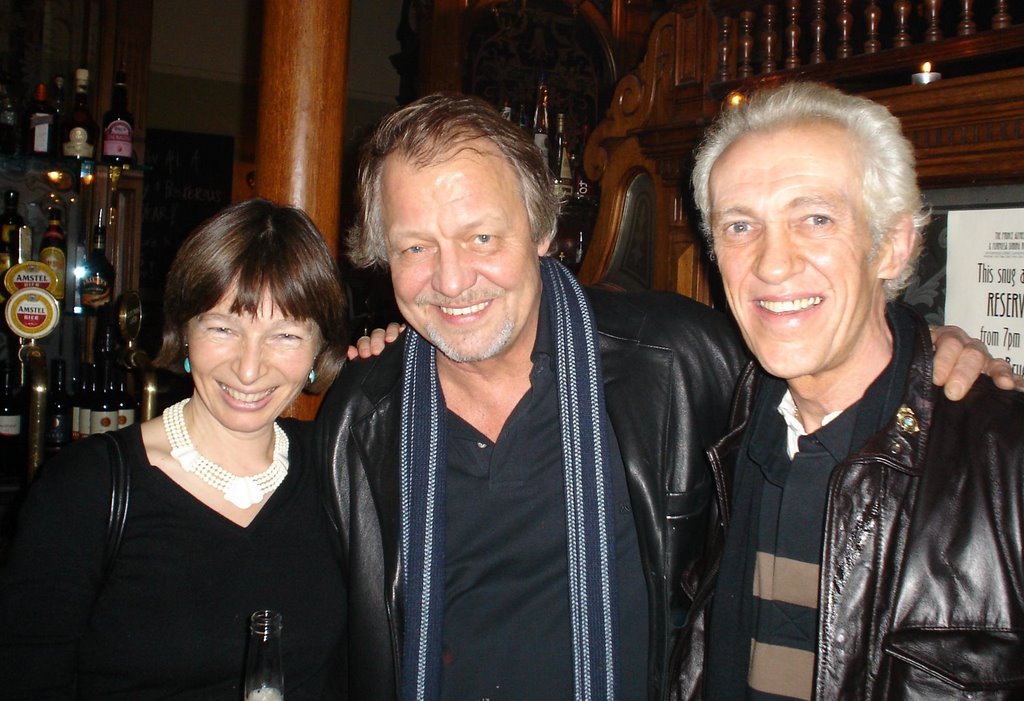
He’s also turned into a hot property. Last year, Bruen switched UK publishing houses, abandoning Jim Driver’s independent The Do-Not-Press and Pete Ayrton’s Serpent’s Tail in favor of giant Transworld Publishing, a division of Random House--taking Jack Taylor with him. Bruen’s first release from Transworld was Priest, a novel made timely by sexual-abuse scandals in the Roman Catholic Church. (Priest was Taylor’s fifth adventure, preceded by The Guards, The Killing of the Tinkers [2002], The Magdalen Martyrs [2003], and The Dramatist [2004]). Transworld was only too happy to add Bruen to its stable. A year ago, the company’s publishing director, Selina Walker, organized a launch party for Priest in North London, that drew not only writers and editors, but also such notables as Starsky and Hutch co-star David Soul (pictured above, flanked by Walker and Bruen).

It was from Walker--a big figure herself within this popular genre--that I acquired my advance copy of Cross. This sixth Taylor novel starts out right where Priest left off, with Bruen’s Irish gumshoe still seeking redemption for the death of a child who tumbled from a balcony, and for a decapitated priest trapped in the shadow of child abuse. Readers worried that they should plow through previous Bruen tales before tackling this one need not worry; Cross throws you slap-bang into its story, no need for preambles. It finds our hero mooching around his customary haunts--the bars of Galway--buying drinks, immersing himself in the aroma of spirits and the colorful atmosphere of the pubs, but not letting himself drift back into the grip that alcohol once had on his life. Early on, he’s told by Ridge, his old colleague from the Garda (aka the police force of the Republic of Ireland), that a young boy has been found crucified; Taylor is also hired to track down a missing dog. Meanwhile, Cody, the kid Taylor considers to be his surrogate son, lies in a hospital ward, trapped in a frightening coma.

The P.I. finds himself at something of a crossroads. The city he calls home, Galway, is changing fast, like the rest of Ireland. No longer is it a sleepy European backwater; rather, today it’s a bustling gateway, transformed by economic expansion and property speculation. Once upon a time, Ireland was a place from which people fled in order to survive; now, it’s a land into which immigrants flood, hoping to share in newfound wealth. These great changes have brought to the nation crime in its many brutal guises--a good thing for Taylor’s business, but not for his psyche.

Bruen’s writing in Cross has a beguiling quality. The story is told in very intimate first-person, allowing us to crawl right into the tightest corners of Taylor’s mind and poke around in his thoughts. We acquire a good view of Jack Taylor’s existential thoughts about life, death, and whatever is meant by the word “humanity.” I can tell you, happiness is not something that crosses P.I. Taylor’s path often; and as he tackles the cases presented to him in these pages, a dark shadow falls over his few friends.

If you like your crime thrillers to challenge the way you think, then Bruen’s your man.

* * *
While you’re waiting for the April release of Cross, check out one of Bruen’s short yarns, “To Have and to Hold,” published last spring in the online mag Hardluck Stories.

READ MORE: Cormac Miller, author of An Irish Solution and The Grounds, has compiled a list of 51 Irish crime novelists--everyone from Liz Allen and John Banville to Ian Sansom and Paul Williams. A very useful and instructive resource. Click here for the full rundown.

Tuesday, June 13, 2006

Bruen and Starr Go “Bust”

Anthony Rainone’s review of Bust, the new crime-fiction collaboration between acclaimed Irish novelist Ken Bruen and New York writer Jason Starr, was posted this morning in January Magazine. You’ll find it here. “I have to state immediately,” Rainone remarks in his excellent critique, “that this book is laughable--literally. Bust is a black-comedy caper of the darkest and raunchiest order, and the comedic team of Bruen and Starr is one to be reckoned with, along with the historic likes of Dean Martin and Jerry Lewis, or perhaps Cheech Marin and Thomas Chong. These two authors will have readers laughing at the vilest of moments, making those readers concerned for their own sanity, if not the authors’. Don’t dismiss Bust as not having bona fide mystery aspirations, however; there are several vicious murders in these pages, as well as a heaping helping of blackmail intrigue, a love interest and a pair of plodding detectives who would feel right at home in the meatiest of crime-fiction offerings.”