Showing posts with label Dick Adler. Show all posts

Tuesday, November 22, 2011

“A Man of Great Enthusiasms”


Dick Adler on vacation in Venice, Italy

(Editor’s note: Last week, when we announced the passing of critic Dick Adler at age 74, we also invited his son Dan, who lives in San Francisco, to contribute a few short thoughts on his father to The Rap Sheet. Following this last weekend’s memorial service for friends and family in Arcadia, California, Dan sent us the note below.)

Richard Adler, my dad, was a man of great enthusiasms. He loved music, movies, food, and books--the last particularly, and in the later years of his life, crime fiction most of all. He spoke often and fondly of The Rap Sheet and its cronies, and so thank you for the pleasure that you gave him.

He died in the early morning on November 11--Veterans, Armistice, or Remembrance Day, whichever you prefer. He was drawn to stories of people struggling against their circumstances and admired the fortitude of those in the service, so the day was appropriate. He had been sick a long time with many complications from diabetes, and he beat several of them against all known odds. Heart disease finally won, and he said, to our surprise, “I just can’t do it again.” He went peacefully, and he was ready.

When he liked something you would know about it. Books came in from all the corners of the world and filled his office, his bedroom, the hallway, elsewhere. Somehow he seemed to read them all--this one’s fun, this is great, take it. If he didn’t like something, he’d tell you precisely why--he respected the craft, and the writer, enough for that, at least. His favorite thing was to find and herald something new. A new voice with promise became his project.

Family and friends, including some of you good people, sang his praises and got soppy this past weekend, in a manner he would have favored. He was a fan and critic to the end. So keep your writing sharp, because he’s probably still reading it.

Monday, November 14, 2011

Dick Adler Passes Away

I received some very sad news this morning: Dick Adler, who for a decade and a half was the crime-fiction critic of the Chicago Tribune, died last Friday, November 11, at age 74.

Although I never had a chance to meet Dick in person, he was a longtime contributor to The Rap Sheet. In fact, his first post appeared here in the same month the blog launched, back in May 2006. Dick subsequently sent me reviews and occasional observations on culture for posting. In 2007, he began writing a serial novel in The Rap Sheet called Men’s Adventure, inspired by his years as an editor at Argosy magazine (beginning in 1956), but had to give up that project just two months later due to what he described, very vaguely, as “major problems” with his health. Not long after that, he relinquished his Chicago Tribune post, but continued to pen material for The Rap Sheet. In the fall of 2010, he launched another serial novel online, Forget About It: The First Al Zymer Senile Detective Mystery, and as near as I can tell, got as far as Chapter 77 before taking a break in June of this year. (The first sections of Forget About It can be found in this archive, with more of the story available here.)

Even though we knew each other only through e-mail correspondence, I enjoyed Dick’s wit, shared his appreciation for crime fiction and TV crime dramas (he’d been a contributor to TV Guide back in the 1970s, writing about everything from Dragnet creator Jack Webb to Richard Roundtree’s Shaft), and was always glad to receive his recommendation of a new novel--often something that had never even caught my attention before. And he was also there to boost my spirits on those occasions when I was feeling overworked and under-appreciated at the blogging game.

Because I didn’t know him well, I was interested to read an obituary that appeared this last weekend in the Los Angeles Times:


(Click on this image for a more-readable enlargement.)

I’d known previously that he was the author of an e-book called The Mozart Code (1999), and that he wrote, with former California Governor Edmund G. (“Pat”) Brown, a non-fiction work called Public Justice, Private Mercy: A Governor’s Education on Death Row (1989). I was also aware that he’d been honored for his mystery-fiction reviewing with the coveted Ellen Nehr Award. But I wasn’t aware that he had two Maggie Awards from the Western Publishing Association for his editing, or that he’d composed, with Anatole Verbitzky, an account of the infamous, 1980s Richard Miller espionage case. It’s amazing what you can learn from reading obituaries, but it would be far better to have learned those facts of his history from Dick himself.

Now, that’s no longer possible.

* * *

Below, I am going to post tributes sent my way by authors and critics who appreciated Dick Adler’s years of service to the crime-fiction community. Others who would like to pitch in their own tributes should send them to me here: jpwrites@wordcuts.org.

Tom Nolan, the Southern California author of Ross Macdonald: A Biography and Artie Shaw, King of the Clarinet: His Life and Times, is also a frequent contributor to The Wall Street Journal’s book-review and arts pages:

I knew Dick Adler first as the writer of an excellent 1967 profile (in the Los Angeles Times’ West magazine) of Ross Macdonald, then in the 1970s as a West Coast magazine editor, then as a friend, and last but not least as a book reviewer who was more than generous to my published efforts.

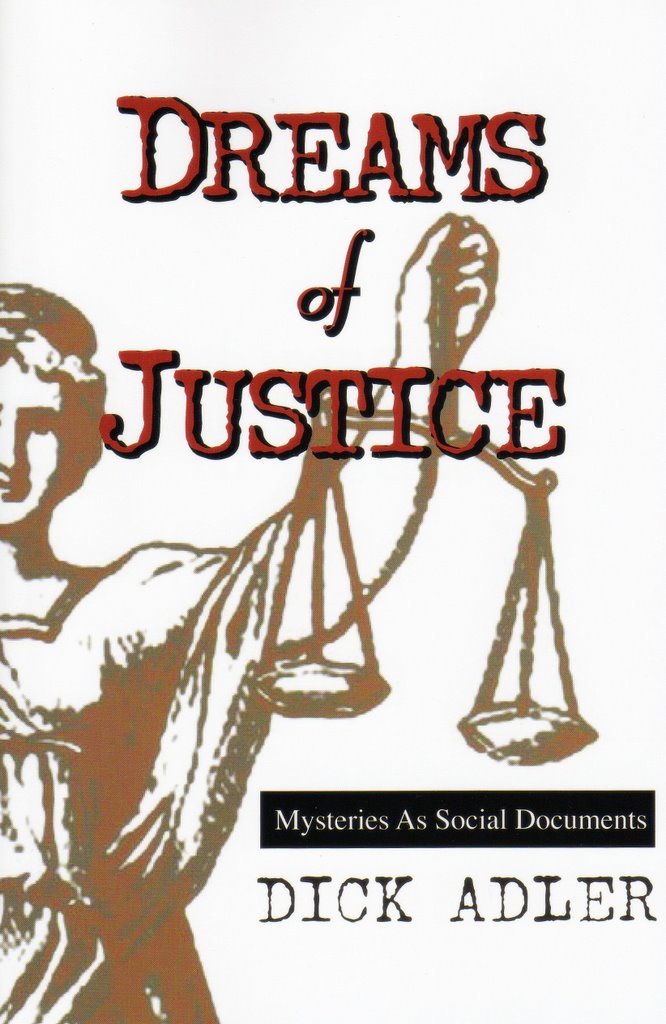
Some of Dick’s fine reviews were gathered a few years ago in Dreams of Justice: Mysteries as Social Documents (Poisoned Pen Press), a volume whose preface I was honored to write.

To paraphrase what I said then:

No writer who came under Dick Adler’s scrutiny could fail to appreciate his knack for seeing and celebrating the best a book had to offer. And no interested reader could help but benefit from Dick’s educated guidance. He had a diesel-strength love for good writing and was blessed with what Isaac Singer called “the greatest gift of all: the gift of enthusiasm.”

He expressed that enthusiasm in a style worthy of the books he explicated.

He was open to all subgenres; but he preferred to write about and bring attention to newer writers. When he did assess a veteran, he took the time and had the knowledge to analyze a late work in the context of an entire oeuvre.

Whatever Dick reviewed, he could always pinpoint what made an author special.

To describe the premise of a novel or thriller in a way that conveys its charms without giving away its secrets, to state your opinion in a non-egotistical way, and to convey a book’s flavor through your own written prose are the marks of a great reviewer. Dick was that, and then some. Like Anthony Boucher, he wrote not just for the moment but for the ages.

I know I’m going to be referring to his book for years to come.

And I can never repay his personal kindness.

Sarah Weinman is news editor for Publishers Marketplace, and was, until early 2011, the proprietor of the crime- and mystery-fiction blog Confessions of an Idiosyncratic Mind. Her work has appeared in publications on both sides of the border and across the Atlantic:

The world of crime fiction is truly diminished with Dick Adler no longer in it. He wrote and reviewed for a great many places, but by the time I heard of him he was deep into a long, productive stint as the Chicago Tribune’s mystery and thriller critic. His pieces were thoughtful and considered, eager to highlight rising stars (he was, for example, early on the Olen Steinhauer bandwagon) as much as champion the greats or explain why a book didn’t quite work--for him, or generally.

Though Dick and I never met--a real regret of mine, exacerbated by being on opposite sides of the country--his presence was huge in my life. If a piece of mine ran somewhere, there came the ping of my Inbox with a kind note from him. I know he did the same for so many other fellow reviewers and writers. The greatest pleasure came from working alongside him and Oline Cogdill for the two successive stints we judged the Los Angeles Times Book Prize. I hear complaints about the process, its difficulties, and the fights between principals, but that wasn’t us. We disagreed on choices, sure, but the debates were lively and spirited, involving mutual respect and admiration. And a lot of laughter.

I hadn’t heard from Dick in a few months, and life being what it is, the time flew by. He had a great many health problems, but he’d managed to overcome some of the worst and return to his first and greatest love, writing fiction (exemplified by the serial, Men’s Adventure, that ran on this very site a couple of years ago). And with him gone it’s too late for me to drop him a note or give him a call to express how much I admired and thought the world of him. I’m not alone in thinking that. I hope it’s some comfort to his family that Dick was well loved in the mystery world.

Gary Phillips is the Shamus Award-nominated author of The Underbelly and the Ivan Monk private-eye series, as well as the writer of Moonstone’s new Derek Flint graphic novel series:

It was my great pleasure to be friends with Dick Adler for a number of years. How could I not be buddies with a guy who did a pretty damn good imitation of Sydney Greenstreet and shared my vice for a fine cigar? Dick was a longtime fan and reviewer of crime and mystery fiction as well as a writer of such in his own right. Several of us, including John Shannon and Dick Lochte, would gather now and then at the Farmer’s Market here in L.A. This was before it got to be a hipster hangout, but we’d come together as the Suicide Club, named for the infamous underground league of rogues created by Robert Louis Stevenson.

We did not plot the actual demise of ourselves or anyone else, except on the page, as we discussed ideas, old movies, new books and bemoaned the current state of the writing game--all the while having coffee and a beignets or two ... or three. Tonight I’ll light a Macanudo on my desk here and belt down a couple of blasts of Scotch. I’ll think about those times with Mr. Adler and not be sad about his passing so much as glad we got to spend some time together.

Rest easy, man.

Dick Lochte is president of the Private Eye Writers of America, the co-author (with Al Roker) of The Talk Show Murders, and the author of the forthcoming Blues in the Night:

I met Dick Adler many, many years ago, at a luncheon for contributors to Los Angeles magazine. At the time, along with other journalistic gigs, he was doing a sort of Page Two gossip column for the Herald-Examiner in which he’d recently written a few snarky lines about something I’d put in my book column in the L.A. Times. I was not all that happy to be seated next to him. That attitude lingered for at least a minute. Dick was one of the truly great dining companions. A witty, knowledgeable raconteur who could converse on any number of subjects--though movies, travel, opera and, of course, books were at the top of his list. He was, as he often put it in a better-than-fair imitation of Sydney Greenstreet, “a man who likes talking to a man that likes to talk.”

Thinking about it now, I realize that the five or six times we’d meet each year were always at table and the conversation, if not the food, was always excellent. The last time was a few months ago when Dick was feeling well enough for visitors. John Shannon and I drove to the sprawling home about 40 minutes out of the city where he and his wife, Jane, lived in the middle of a lemon grove. Dick had undergone a series of brutal medical procedures that had slowed him down physically. But his conversational and critical faculties were in fine form. He was still a man who liked talking. He was a good friend.

John Shannon is the creator of the Jack Liffey mystery series, the latest installment of which is A Little Too Much:

I met Dick for the first time for lunch right after he had reviewed one of my first mysteries. I had a personal policy of bribing all reviewers after the fact with a lunch, and I found out that despite writing for the Chicago Trib, he lived in L.A. My very first impression of Dick, which turned out to be dead wrong in the first minute, was that he was going to be a bit overpowering, since he looked a lot like Sidney Greenstreet (and could do a passable impression, too). But Dick turned out to be one of the sweetest men I’ve ever met, always full of life, always supportive, and always entertaining, and we started meeting for lunch regularly.

Later I told him I’d heard of a breakfast club in Marin founded by work-at-home computer nerds and maybe we could try something similar to help socialize us stay-at-home writers. Dick started recruiting folks with a mystery and journalism background, and so was born the Suicide Club, which met for late breakfast about once a month for years, eventually ending up in front of the Cajon stand at the Farmer’s Market. Dick was the core of it and he named it after the Robert Louis Stevenson novel about a tontine (look it up).

The club faded a bit when Bruce Cook (pen name Bruce Alexander) died and then collapsed when Dick moved out to Ventura for his health. I visited out there as much as I could and it was heartening to watch Dick struggle mightily against gathering debilities. Few people could so faithfully follow Dylan Thomas, though I rarely saw Dick rage. He just told the gods that he refused to budge.

No one could fill a room with his remarkable and lovable presence like Dick, and the whole world as I know it is much smaller with him gone.

Linda L. Richards is the author of Death Was the Other Woman and Hitting Back. She also edits January Magazine:

So sorry to hear about Dick! If I may say, he always struck me as the perfect critic as he came to the genre with a passion so real, it was visible in every word he wrote. A wonderful blend of auteur and fanboy whose trenchant commentary on our evolving genre will be deeply missed.

David J. Montgomery is the thriller/mystery critic for The Daily Beast and the Chicago Sun-Times:

For several years Dick Adler was the mystery critic at the Chicago Tribune, while I held the same position at the Sun-Times. We were a far cry from Siskel & Ebert, but I was very proud to be the cross-town counterpart of such an esteemed critic. Dick reviewed mysteries for decades, and he was a man of fine taste and judgment. He mostly wrote round-up columns and could always be counted on to highlight a worthy book that might otherwise have been overlooked. As such, he was a definite influence in my own career. He did a great service to both readers and writers with his time in the critic’s chair, and his hard work will be missed.

Marcus Sakey, author of The Two Deaths of Daniel Hayes:

I did not know Dick intimately, but I always found him to be a real gentlemen, all class. And of course one doesn’t need to know him to know what a massive impact he had on the crime-fiction field. He was more than a critic; he was a passionate fan. He’ll be missed.

Sunday, November 21, 2010

Stieg, We Hardly Knew You

Is there anyone left in the known world (with the possible exception of my elderly aunt Hannah) who hasn’t read at least one of the books in Stieg Larsson’s monumental Millennium Trilogy, starring superhacker Lisbeth Salander and her friend and occasional squeeze, editor Michael Blomkvist? If you haven’t, what are you doing here? Start reading!

My own holiday gift season began last week, when a splendid boxed set of three beautiful Larsson hardcover editions, designed by Peter Mendelsund, arrived from publisher Alfred A. Knopf. I had reviewed and discussed the three Salander-Blomkvist novels for everything from the Chicago Tribune to my daughter Katie Shinden’s book group. But tucked inside the slipcase of this boxed set was a fourth, much smaller book, as good as gold: On Stieg Larsson, a previously unpublished collection of essays about, and correspondence with the late author from five Swedish colleagues who knew him best.

The incredible world success--literary and financial--of Larsson’s trilogy has generated some intelligent, in-depth coverage, especially from The Rap Sheet’s Ali Karim and CBS Sunday Morning, which last month aired a fine piece in which Larsson’s heirs bared their teeth over royalties. But On Stieg Larsson offers many new and touching moments, such as these quotes from Jonas Sundberg, who was a friend of Larsson’s and a co-founder of Expo magazine, which became the model for Blomkvist’s Millennium in the novels:
Stieg received me at his office at the TT News Agency ... He had a hint of an accent from Northern Sweden and seemed a little bit reserved ...

I found him very humble, yet aware of the quality of his own knowledge and brilliant thinking, peering at me through his round glasses ...

He had made serious arrangements to conceal his home
address ...

I became more aware of the risks involved when Stieg showed us a 9-mm bullet he had received in the post ...
Expo was founded in 1995, Sundberg tell us, “and its accuracy seemed to scare the extreme right. Newsstands selling Expo had their windows smashed, printers were terrorized, [and the magazine] was about to go under, when Sweden’s major dailies stepped in to support it.”

In 2003, Larsson walked into Sundberg’s office and said, “I’m working on my pension insurance, you know!” He explained to his friend that he was finishing work on a crime novel. A few weeks later, Larsson announced that he’d sold the book “for real money! Not jubilant, but with that sort of quiet pleasure he had when a plan of his worked out well.”

Elsewhere in On Stieg Larsson, Eva Gedin, the author’s editor at Swedish publisher Norstedts, moves us to tears with this statement: “To think that his wildest dreams would come true. For despite his reserved air, there was also a measure of natural self-assurance about him that suggested he had a premonition that his crime novels might possibly become something truly significant.”

Larsson died in 2004, at the age of 50, after a massive heart attack. The first three of his novels (and possibly others) were finished and edited, but had not yet seen print. They’ve since become publishing phenomena, even though they haven’t won over everyone. When my colleagues, Sarah Weinman and Oline Cogdill, and I tried to choose The Girl with the Dragon Tattoo as the Best Mystery of 2008, officials of the Los Angeles Times Book Awards told us that no dead authors need apply.

No matter. Larsson has had his revenge on critics who doubted what he could accomplish. For anyone who hasn’t yet discovered his work, or wants to enshrine it on their bookshelves, Knopf’s wonderful new boxed set is the answer. It carries a hefty $99 retail price tag, but Amazon will release it on November 26 for a slightly more reasonable $49.95.

READ MORE: “The Man Who Created The Girl Who ...,” by Peter Rozovsky (Detectives Beyond Borders); “A Larsson Gift for the Reader in Your Life,” by Ali Karim (Existentialist Man); “Man of Mystery: Why Do People Love Stieg Larsson’s Novels?” by Joan Acocella (The New Yorker).

Monday, November 08, 2010

Oh, You’d Better Watch Out

Cozies have never been my crime-fiction subgenre of choice, and I generally avoid holiday-oriented cozies with the same ardency that I would a Tea Party rally. But there was something about this one that caught my interest. Certainly the title--The Fat Man: A Tale of North Pole Noir (Dutton)--seemed to have my name on it. So I thought I would read a few pages, just to see what interest it might hold ...

And I was immediately hooked. Like Louise Penny, John Lescroart, and Steve Hockensmith (all of whom provided jacket quotes), I found Ken Harmon’s debut mystery starring a 2-foot-3-inch-tall, 1,300-year-old elf called Gumdrop Coal to be a sheer delight: hilarious, touching, and amazingly inventive.

Gumdrop’s troubles begin early, when he is fired from his centuries-long job as captain of the Coal Patrol, the elves who deliver lumps of carbon to naughty kids. Then he’s framed for murder, and realizes that not all is cool at the North Pole. Even Kris Kringle himself could be on his way out.

A headline in the local paper, The Marshmallow World Gazette, says it all: “Gumdrop Coal Fired from Coal Patrol--Santa’s Dark Elf is Out on His Ear.” That newspaper story was written by one Rosebud Jubilee, a sexy girl with a thing for elves, and it explains that Gumdrop has been replaced by Charles “Candy” Cane, an arch-villain who wants to take over the keys to Kringledom.

Harmon has the tremendous gift of taking what we’ve known all our lives and giving it a mighty spin. Here’s a small collection of tidbits from narrator Gumdrop to savor:

• “Truth is, there aren’t that many places for elves in the world to go. Despite what you may have read, Middle Earth is really for outlaws. Middle Earth elves and dwarfs are desperadoes who are looking for a hole to hide in and maybe score a quick treasure.”

• “Munchkins are elves, but they’ll try and tell you different. Munchkins are elf elitists, and if their Lollipop Guild puts the kibosh on your application, they’ll pretend they never knew you. ... They make their life sound all yippy skippy and ding-dong the witch is dead, but they don’t tell you the Flying Monkeys are still around.”

• “The other poop you need to be wise to is that our world, Kringle Town, is in a different dimension than your human world, hovering at the edge of what you can see and hear. Kringle Town is always there, just out of sight. It’s how we see you when you’re sleeping, know when you’re awake.”

And then there’s the Island of Misfit Toys, where things that never worked but have acquired a life of their own are stored away. The only access to that island is provided by a barge piloted by Tiny Tim, who “was lonely, forgotten except for when Christmas needed a sad, saintly cherub to tug at the heartstrings.”

I could go on like this for pages, but I don’t want to spoil any of the pleasures to be had from picking up a copy of The Fat Man yourself. I can’t wait to see what Harmon has in his basket for Easter.

Saturday, August 28, 2010

EBay, Here I Come!

Carolyn Kellogg, the lead writer for the Los Angeles Times’ books blog, Jacket Copy, has a habit of brightening my days. And what do you know, she managed to do it again on Friday--just in time for my 73rd birthday today--by choosing some of her current favorites among the many author-related items for sale on eBay, where I already spend far too much time and money. Here’s one item I’d like to be able to show off to friends and colleagues.

Wednesday, July 14, 2010

Penning Pals

There was a very nice item yesterday in Jacket Copy, the Los Angeles Times’ books blog, written by Carolyn Kellogg. It begins:
Are your characters as snazzy as James Bond? Are your sentences lyrical as those in “Lolita”? Pop a few paragraphs into the website I Write Like to find out if you write like Ian Fleming or Vladimir Nabokov. You might find your prose is as eerie as Edgar Allen [sic] Poe’s or witty as Oscar Wilde’s.

Beware: If you enter a blog post, you may just discover that you write like Dan Brown. I know. It happened to me.
So I entered two paragraphs from my work-in-progress, Forget About It, the first Al Zymer Senile detective mystery, and received this reply:


How did the computer know that Jack is one of my idols?

POSTSCRIPT: Another Rap Sheet contributor, novelist Mark Coggins, also tried this “statistical analysis tool that analyzes the word choice and writing style from a sample you provide to suggest a famous writer whose style is closest to your own.” You can see what answers he received here.

Sunday, December 06, 2009

Mother of Mercy, Is This the End?

Bryant & May on the Loose (Bantam), the seventh installment in the series, could be the last book Christopher Fowler ever writes about Scotland Yard’s weirdest and most endearing fictional duo.

With their special Peculiar Crimes Unit shut down, mostly because of budget cuts, Detective Arthur Bryant is feeling withdrawn and depressed, while his partner, John May, is considering taking on work as a private investigator. May is the more affable of this pair, while the socially inept Bryant takes every opportunity to anger his bosses at the Yard. When a former team member stumbles on a beheaded corpse in London’s King’s Cross neighborhood, May uses the discovery to gain the unit a brief new lease on life. He persuades the higher-ups that unsolved gang crimes in the area could threaten the economic benefit anticipated from the 2012 Summer Olympics. Given one week to solve the case, without any official sanction or access to police resources, May pulls Bryant out of his doldrums and reassembles the unit. To May’s dismay, his colleague is more interested in reports that a man wearing a stag’s head has been seen in the area.

Issued in tandem with Bryant & May on the Loose is the paperback edition of The Victoria Vanishes (Bantam), my favorite book in this under-appreciated series, first published last year. In that story, Bryant watches a popular pub disappear during the course of his chasing after a serial killer who preys on middle-age women in London’s most popular watering holes. He and May discover a connection between the victims, but the most critical clues, it turns out, are embedded in the histories of the saloons themselves (including the long-gone Victoria Cross, where Bryant swears he saw one of the victims just moments before her death).

Fowler’s Bryant and May series comprises seven novels so far, including 2003’s much-lauded Full Dark House. If anyone can keep these two grand geezers alive, it’s their British creator. Let’s all keep our fingers crossed ...

READ MORE: “Golden Years of Detection,” by Sarah Weinman
(The Barnes & Noble Review).

Tuesday, July 28, 2009

The Movie You Have to See

With thanks to The Rap Sheet’s Jeff Pierce and blogger-author Patti Abbott, who invented the “Book You Have to Read” (aka “forgotten books”) feature, I offer this cinematic version.

Chinatown (1974) arguably presented Jack Nicholson’s best movie role, director Roman Polanski’s best work, and Robert Towne’s best writing. John Huston and Faye Dunaway weren’t too shabby, either, and Jerry Goldsmith’s music, John A. Alonzo’s cinematography, and Sam O’Steen’s editing were all superb.

I saw Chinatown for the second time this weekend, after watching a preview of a terrific, forthcoming PBS-TV documentary about Los Angeles’ newspapering Chandler family, who--with help from engineer William Mulholland--stole water from Southern California’s Owens Valley and diverted it to the San Fernando Valley. That theft lay at the heart of Towne’s fictional story, and Polanski and his crew created an evocative picture of 1930s Los Angeles to bring it to life.

If you haven’t seen Chinatown recently, do your good taste a favor and rent it. The movie trailer is here.

Wednesday, May 13, 2009

“Spade & Archer”: Can You Dig It?

My long-awaited (at least by me) review of Joe Gores’ most recent novel, the Maltese Falcon prequel Spade & Archer, has been posted on the Barnes & Noble Review page.

Wednesday, February 04, 2009

Calling a Spade a Gem

Only Joe Gores, the former private eye whose 16 fine novels include Hammett (1975), would have the guts to write Spade & Archer, the brand-new prequel to Dashiell Hammett’s famous 1929 novel, The Maltese Falcon--a feat akin to writing a new first volume of the Book of Genesis. And his story works, showing how the San Francisco private-eye firm came together and what Miles Archer was really like, and including many snazzy plot twists.

READ MORE: “Joe Gores on The Maltese Falcon,” by Nathan Cain (Independent Crime); “Even Death Can’t Keep Hammett Down,” by J. Kingston Pierce (Rap Sheet).

Thursday, June 19, 2008

The Siren’s Song

For reasons best known to themselves (as my late British mother-in-law used to say), I’ve been asked by editors at the Los Angeles Times to be a judge in the mystery/thriller category for their next annual book awards. My fellow judges are the divine Sarah (Weinman) and the brilliant Oline (Cogdill). So here I sit, like a thorn between two roses, reading tons of stuff that comes in daily so as not to miss anything. Suggestions are welcome, and I’ll do my beleaguered best to pass on tips about great stuff coming up. Such as Siren of the Waters, by Michael Genelin, to be published next month by Soho Crime.

Olen Steinhauer has written many fine books about the police in a country very much like Romania. Now comes Genelin, whose protagonist, Jana Matinova, has climbed to the rank of commander in the police force of Bratislava, the capital of Slovakia. Her rise to her present position has cost her a lot, though, and now she’s in charge of an investigation into a deadly human-trafficking ring. She’s a tremendously interesting character, totally believable (and with the same aura of sad determination as the hero of Child 44), facing a truly frightening villain named Koba.

Add this one to your must-read list.

Saturday, March 29, 2008

Citizen Phillips & Co.

The creator of private eye Ivan Monk, that fine Los Angeles crime writer Gary Phillips--who is currently writing a serial novel called Citizen Kang at The Nation magazine’s Web site--is the best person in the world to have put together Politics Noir: Dark Tales from the Corridors of Power, a sharp collection of new stories about the link between crime and politics. He might not have invented Eliot Spitzer or the mayor of Detroit, but he could have.

Phillips’ own contribution to this timely anthology is a thing of beauty. “Rudy Garza broke a shoelace as he tied one of his Botticellis,” Phillips writes at the start of “Swift Boats for Jesus,” a wonderful tale of crooked cops, bent politicians, warring gang leaders, and assorted hustlers like Garza, all doing their worst to protect their own part of the L.A. dream.

John Shannon, Mike Davis, Twist Phelan, and Sujata Massey are among the other topnotch collaborators in Politics Noir. Shannon, whose newest Jack Liffey book, The Devils of Bakersfield, is due out from Pegasus at any minute, offers up a story here about the real price of illegal immigration, called “The Legend of Bayboy and the Mexican Surfer.” Davis, best known for his non-fiction (City of Quartz is arguably the best political history of Los Angeles), offers “Negative Nixons,” a jaunty look at the reviled former president. Phelan, certainly the fittest member of our original Suicide Club, has a wise and funny story about a 40-ish female Secret Service agent. And Massey shows that Iraqi politics are as vicious as the homegrown version in “The Mayor’s Movie.”

I hope that Phillips has remembered to send Senator Barack Obama a copy of Politics Noir.

READ MORE: “Tales of Power (Senor?),” by Kevin Burton Smith (The Thrilling Detective Blog).

Monday, February 04, 2008

Back from the Edge

It was almost a year ago that we started ... and then abruptly had to stop running Chicago Tribune book critic Dick Adler’s serial novel, Men’s Adventure, due to the author’s illness. At the time, Adler told us that he had “just been in the hospital with some major problems,” and was unable to continue with his writing. It wasn’t long after that that relinquished his Tribune post, as well.

Since then, we’ve received periodic inquiries about Adler’s health. Those have picked up in number recently, as his posts have begun to appear more frequently again in The Rap Sheet. Curious ourselves, we asked him to provide readers with a health update. The following is his response:
Jeff Pierce has kindly asked me to file a health update, since all (both) my fans have been wondering. Here it is, short and sweet: I’m fine. New review sites, including B&N.com, have sent me books. I’m working on a mystery book with my heart doctor (title too good to share), still trying to get Men’s Adventure into shape. And enjoying the hell out of my grandkids. Thanks for asking.
Excellent news. And Adler has assured us that, once he has more of Men’s Adventure finished, we can begin serializing it again on this page. Meanwhile, you’ll have to be satisfied with his periodic comments on small-press books, writers’ gatherings in Los Angeles, and short-story collections.

Welcome back, Dick.

Friday, March 09, 2007

The State of Dick Adler

I don’t really know how to write this, so I’m just going to begin with the bottom line: Rap Sheet contributor and Chicago Tribune crime-fiction critic Dick Adler, whose serial novel, Men’s Adventure, has been running in this blog since late January, sent me a note earlier today, informing me that he’s “just been in the hospital with some major problems,” and will be unable to continue work on that novel. When I asked him to elaborate on what he means by “major problems,” Dick wrote, vaguely, that he’s suffering from “‘the brain not working the way a writer’s should’ syndrome. ... Should have warned you, but I didn’t know how serious they’d turn out. Anyway, many apologies--to you and Rap Sheet readers.”

I have to admit that I feared something might be wrong with Dick. I’d noticed that he hadn’t been updating his blogs Paperback Mysteries and Paperback Thrillers lately. And when I announced here, almost two weeks ago, that there was going to be a delay in posting Chapter 5 of Men’s Adventure, it was because I’d had some difficulty communicating with Dick about rewrites on the chapter. He seemed not to be responding in his usual prompt way, and lacked his customary enthusiasm for the project. Little did I know that he’d been in the hospital. I feel bad now for pestering him.

As most of you know, 69-year-old Dick Adler is a longtime fan and promoter of this genre. I originally got to know his byline when he wrote for TV Guide, back in the 1970s. (Click here to read an interview he did with Dragnet creator Jack Webb in 1972, and here for an article he penned in that same year about Bonanza’s strategy for recovery following the death of Dan “Hoss” Blocker.) But his career extends well before that, to stints at newspapers and magazines in New York City and London. As he explained to me not long ago, he began his editing career in 1956 at Argosy, a once-popular “men’s magazine” (and my maternal grandfather’s favorite mag, by the way) that served as his model for Viking, the periodical at the center of his Rap Sheet serial novel. Dick is also the author of an e-book called The Mozart Code (1999), and he wrote, with former California Governor Edmund G. (“Pat”) Brown, a non-fiction work called Public Justice, Private Mercy: A Governor’s Education on Death Row (1989). His most recent book is Dreams of Justice: Mysteries as Social Documents, a collection of his reviews and his essays, published by Poisoned Pen Press in 2005. To honor his excellence in mystery-fiction reviewing, the American Crime Writers League last year gave Dick its coveted Ellen Nehr Award.

I was thrilled when Dick Adler agreed to become a regular contributor to The Rap Sheet, and I continue to be in awe of his accomplishments--and optimistic about his future. I hope he can return soon to finish work on Men’s Adventure. (I, for one, want to know how the tale turns out. And many readers have written in over the last few weeks, saying that they’ve been enjoying Dick’s serial novel, as well.) However, his immediate future seems uncertain. He tells me that he’ll “probably ... need to go back” into the hospital. When I ask how soon he might be able to continue his writing, he says simply: “Really don’t know--if at all ...”

As I remarked before, I’m not sure how to write this thing. I only know that those of us here at The Rap Sheet send Dick our very best wishes and our hopes for his speedy recovery. Our hearts go out, too, to his wife, Jane, as well as their two grown children and their families in San Francisco. Those words will have to do.

Well, maybe one more thing. As I figure it, the best way to honor a prolific wordsmith like Dick Adler is to read what he’s accomplished in print. So, if you haven’t been keeping up with Men’s Adventure, the archives can be found here. The read is worth it.

Saturday, January 27, 2007

“Men’s Adventure” Debuts on Monday

Unlike some people we know, “stay the course” has never been our catchphrase or limitation at The Rap Sheet. We think it’s important to try new things, whether they be online polls or guest bloggers (see here and here). So when Dick Adler, who reviews mysteries and thrillers for the Chicago Tribune, and is a Rap Sheet contributor, proposed writing a crime-novel-in-installments for this blog, we jumped at the opportunity.

That work, titled Men’s Adventure, will begin its exclusive first run in The Rap Sheet on Monday. We’ll offer new chapters each Monday after that until the story reaches its conclusion. Adler says the finished product should run “about 60,000 words altogether--which means 50-plus chapters.” Weekly installments will be archived, so that readers coming to the story late can catch up.

As you may already be aware, the 69-year-old Adler, a resident of Ventura, California, has been penning book reviews for the Trib for the last decade and a half. He’s also the author of one previous novel, an e-book called The Mozart Code (1999), which Tom Nolan reviewed favorably in January Magazine. And he was the co-author, with former California Governor Edmund G. (“Pat”) Brown, of Public Justice, Private Mercy: A Governor’s Education on Death Row (1989). Adler’s most recent book is Dreams of Justice: Mysteries as Social Documents (2005), a collection of his reviews and essays. His writing has appeared over the years in magazines such as Los Angeles, New York, the London Sunday Times Magazine, American Heritage, Playboy, Life, and TV Guide. He’s worked as a newspaper and magazine editor in New York City, London, and Los Angeles. But he started his editing career at Argosy, a fiction periodical turned “men’s magazine,” in 1956. That, Adler says, was back in the days “when Erle Stanley Gardner (of Perry Mason fame) was heading up a section called The Court of Last Resort, which used writers like James T. Farrell (author of the Studs Lonigan trilogy) to help unjustly convicted prisoners.”

Adler will draw on his experiences at Argosy during the ’50s to compose Men’s Adventure. He explains that, in this serial novel, “Gardner becomes Perry Marcus, Farrell turns into Saul Cooperman, Argosy transforms itself into Viking,” and his editor-detective protagonist from The Mozart Code, Ivan Davis, “joins a cast which includes such other real-life people as Harvey Matusow (one of the strangest figures of the Joe McCarthy witch hunt) and writers like Mario Puzo, who wrote The Godfather while he was churning out stories for the world of pulp magazines.” At the same time as Men’s Adventure introduces readers into the colorful and arcane realm of New York-based pulp publications, it will explore the damage done to so many lives by U.S. Senator McCarthy (R-Wisconsin) in his obsessive pursuit of alleged Communists both inside the federal government and without. (Anyone who’s read Edward Wright’s most recent historical novel, the Ellis Award-winning Red Sky Lament, should recognize the potential delights and drama of such a yarn.)

Asked what inspired him to develop Men’s Adventure in The Rap Sheet, Adler points to another serial novel, Jezebel’s Tomb, currently rolling out in the pages of The Washington Post. Written by David Hilzenrath, an investigative reporter on the Post’s financial news staff, Jezebel’s Tomb weaves together historical mysteries (the tale of an “unusual text found in a cave near the Dead Sea” and the suicide of a Jerusalem merchant) with the modern-day bombing of one of Jerusalem’s premier archaeological museums, supposedly by Palestinian terrorists. The 2,000-year-old missing document, last seen toward the end of 19th century, may hold a dangerous secret for the 21st century. New installments of Jezebel’s Tomb are being posted each Monday and Thursday.

Hilzenrath admits that, after researching his novel in the United States and the Middle East for more than a decade, but being turned down by publishers, he resorted to electronic distribution as a final resort. Adler, on the contrary, hasn’t yet shopped Men’s Adventure to publishing houses, though he would like to see interest generated by its appearance in The Rap Sheet. “I’m hoping they’ll call me,” he says. “If not, I’ll give it to an editor or agent.”

For the time being, Men’s Adventure simply gives Adler a chance to revisit an era and environment that he remembers with some nostalgia. “I was [at Argosy] for four years, then went over to True for another two years,” the author recalls. “What I learned from both was that there were many ways to tell an exciting story, which--in an age before TV series--really caught readers’ attention.”

We trust you will find some of that same excitement in the coming weeks, as Men’s Adventure takes shape on this page. Please let us know what you think.

(Photograph by Jane Adler)

Thursday, October 26, 2006

Beating, Knifing, Bludgeoning a Dead Horse

As Gilda Radner’s character, Roseanne Roseannadanna, might say, “What’s all this fuss about cereal killers?”

Sarah Weinman points out Jerome Weeks’ new Book/Daddy blog. One of the new entries there is about the serial killer myth vs. reality--a topic of interest to me and I’m sure to numerous other readers.
Many readers will note (or “violently object to the fact”) that on my Top 10 Favorite Literary Thrillers ..., there’s a passel of writers normally on such lists who don’t appear here: Dennis Lehane, James Ellroy, James Lee Burke, George Pelecanos, Robert Parker, Michael Connelly.

A chief reason I have trouble with individual examples from these writers is their reliance on the exotic mastermind serial killer, a device to maintain suspense that is so overused, the killer’s knife hand must be tired by now from murdering every nubile young thing in sight. Even Thomas Harris should have retired Hannibal Lecter after
Silence of the Lambs. His follow-up, Hannibal, was a complete botch, a dreadful book.

And the fact is that such serial killers are extremely rare; most are just pathetic screw-ups unable to relate to others without resorting to violence. What makes the serial killer novel worse is its reliance on that other cliché: the profiler or the brilliant detective who must steep himself in violence and madness to understand the killer’s thinking and thus risk his own sanity. Again, a writer has to do something with style and voice or upending these conventions to keep me interested.
What does anyone else think about calling a moratorium on serial killers?--Dick Adler

Wednesday, July 26, 2006

Two Sides of the Coin

Editor’s note: Once more, The Rap Sheet is delighted to welcome the work of veteran Chicago Tribune books critic Dick Adler. Following yesterday’s post on how he has just created a blog about contemporary thrillers to accompany his previous blog about mysteries, in general, Dick sent along a note saying, “there’s a serious discussion to be started as to what’s the difference between mysteries and thrillers. I'll be happy to kick it off ...” We invited him to do so with this submission. Your responses are invited.

* * *
I called my first blog Paperback Mysteries because it had a ring to it--better than Paperback Crime Fiction, anyway. I figured that people who read mysteries also read thrillers. In the 30-plus years I’ve been reviewing crime fiction, nobody has ever complained to me about not enough thriller reviews--or too many. A good read is what we’re all after, or so I thought.

But that was then. After Paperback Mysteries appeared, a small but loud contingent of folks complained that they never read “mysteries”--and where were all the great thrillers? An equally small but even more noisy group said, how dare I pollute the crystal waters of the mystery genre with thrillers? So I’ve tried to solve the problem by starting another blog, called Paperback Thrillers.

The line between mystery and thriller is certainly a vague one: as I said in my introduction to Dreams of Justice, to my mind, mysteries most often have continuing casts of central characters who reach some solution to the crimes committed by a mixture of rational deduction and inspiration. Thrillers more often deal with larger, single events, occasionally political, and usually end in scenes of violence. The folks over at the International Thriller Writers Saloon seem to agree.

When Diane Vogt of ITW asked me, I said that I think readers love thrillers because of 1) The “What If?” factor: what if a famous painting held a clue to the fact that Jesus and Mary Magdalene had a baby? and 2) The “What the Hell Do We Do NOW?” syndrome: those damned dinosaurs in the theme park seem to have developed minds of their own. One hopeful trend is “The Thriller as Samidzat” (or perhaps “The Thriller Writer as Tom Paine”): a growing realization that just because our government says something is true, it ain’t necessarily so.

Does that mean thrillers are the wave of the future, and that mysteries will disappear? You tell me ...

UPDATE: In response to Dick’s comments on mysteries vs. thrillers, novelist John Shannon (Dangerous Games) writes:
Here’s another definition for you, not really universal but interesting--from a one-minute corridor seminar at a Bouchercon given me by Barbara Peters [of Poisoned Pen Press]. Mysteries are about something that has gone wrong and then hunting down the big rock that caused it and turning it over to find out what happened--or something like that. A thriller is a duel. You know the good guy and bad guy at the beginning and you watch them both move toward each other and a final collision. As I say, not universal, but it does account for a lot of them.

And from my point of view, the best mysteries are rooted in place and deal with the social history of the time and place. Thrillers tend to exoticism rather than place and almost never touch on social history. Thrillers are fundamentally more conservative, about crushing some “other” so we can return to the status quo (as are police procedurals.)

Wednesday, May 24, 2006

Do Bestsellers Need to Be Reviewed?

Editor’s note: One of the things I hope we’ll do more of in The Rap Sheet is feature commentary by published crime writers and professional critics. Dick Adler, who reviews mysteries and thrillers for the Chicago Tribune, and who’s recently seen the publication of Dreams of Justice, a collection of his reviews and essays, sent me the following observations about how he selects books worthy of reviewing. I hope you will find this piece as entertaining as I did.

* * *

On those occasions when I venture into the land of introspection (usually prompted by no decent baseball on television), I sometimes wonder if I’m short-changing readers by deliberately not reviewing the latest certain-to-be-bestsellers by writers whose names have become household words. Don’t these genre icons deserve critical attention as well as their hefty royalty checks?

In a better world, one where newspapers and magazines have limitless space for reviews, the answer would be, “Of course they do.” But out of the 60 or 70 books a month I get sent by publishers, I have space to write about 12 to 14 of them in any kind of coherent way that doesn’t look like a laundry list.

If the author of previous bestsellers seems to be trying something new, moving into virgin territory, he or she certainly deserves to be reviewed--even if I know that their publishers have already collected a string of heavyweight blurbs to fill the back jacket cover and have signed up for co-op advertising deals with bookstores to guarantee sales.

But if the book in question is the eighth or 16th in a series whose past successes guarantee a spot on the bestseller lists, isn’t my review irrelevant? If I liked the book, who gives a flying press release? If I didn’t, who will be warned and/or dissuaded by my rapier-like savagery?

Not all bestsellers get ignored in my column. When I got an advance reader copy of a book called The Da Vinci Code, I had already reviewed a couple of early thrillers by Dan Brown. I liked his latest, in spite of its lame ending, and suggested a longer, standalone review. This was many weeks before the book took off like a literary missile and went on to earn the jealousy of other writers, the wrath of religious true believers, and what looks like a permanent place on bestseller lists. But had all of that happened before I decided to review The Da Vinci Code, I probably would have passed and given the space to the next Dan Brown.

Every regular reviewer I know has personal areas of special interest as well as places they’d rather not visit. My own preferences include darker shades of noir, mysteries set in foreign countries or unfamiliar cities, and ones that reinvent various periods of history. As for the kinds of mysteries that my hand naturally moves away from, I’ll read 20 pages of anything: 10 if it’s about cats. Cozies for the most part don’t shout, “Review me!” although I have been pleasantly surprised by many books that fall into that category.

In general, I try to observe that wonderful dictum of Anthony Boucher, the man who invented serious crime reviewing: “The important distinction is not between the schools of the whodunit but between the good and bad books whatever the school.”

The absolute best thing about the planning and writing of my column is that I get to choose the books I review--a freedom not available to all reviewers, many of whom must take on what editors send them or risk not being asked again. Stories set in Chicago get special consideration on my list: a provincial admission, perhaps, but one appreciated by readers. Veteran writers who have slipped from the public eye for no discernable reason other than the pressures of publishing fancy also have a leg up.

And best of all are those new writers and their publishers who take chances and work hard to improve the field. Olen Steinhauer, Reggie Nadelson, Jim Kelly, Barbara Nadel, Nichelle D. Tramble, Jacqueline Winspear, Qiu Xiaolong, and Rebecca C. Pawel aren’t household names as yet, and they may never make it to a bestseller list. But I’d rather review their books than virtually any of the blockbusters blocking the doors at the big chain bookstores.