Showing posts with label Peter Handel. Show all posts

Monday, December 08, 2025

Favorite Crime Fiction of 2025,
Part I: Peter Handel

(Peter Handel has reviewed and written about crime fiction for the San Francisco Chronicle, the Portland Oregonian, Pages Magazine, Crimespree Magazine, and CrimeReads. He now produces the Substack newsletter Carnivorous: A Steady Diet of Crime Fiction.)

Because much, though not all, of my reading time is focused on what books I will be writing about, my list is largely, though not exclusively, titles I read for “work.” I’ve enjoyed many terrific books this year—but then, there are always plenty of enticing titles every year. Finding time enough to read them is the issue!

In no particular order, here are my 2025 crime and mystery favorites:

• The Wasp Trap, by Mark Edwards (Atria)
• Pro Bono, by Thomas Perry
(Mysterious Press)
• Pariah, by Dan Fesperman (Knopf)
• Venetian Vespers, by John Banville (Knopf)
• Kill Your Darlings, by Peter Swanson (Morrow)
• Fair Play, by Louise Hegarty (Harper)
• Killer Potential, by Hannah Deitch (Morrow)
• The Mailman, by Andrew Welsh-Huggins (Mysterious Press)

It was a bittersweet year for me regarding books and authors. Two people I worked with are no longer on the planet: Ken Bruen and Tom Perry. Both were wonderful, generous interviewees, and while I’m grateful for the opportunity to have worked with them, it’s rotten that they have died.

Three titles struck me as genuine “sleepers” this year: The Wasp Trap, Killer Potential, and Fair Play. All of those, in their own ways, subverted genre expectations and were stronger for it.

Friday, June 27, 2025

The Book You Have to Read:
“Running Wild,” by J.G. Ballard

(Editor’s note: This is the 189th installment in The Rap Sheet’s continuing series about great but forgotten books.)

By Peter Handel
English novelist and short-story author J.G. Ballard (1930–2009) left behind a body of work that encompasses a range of motifs, his vast imagination reflected in the variety of genres he wrote in, from science fiction to semi-autobiographical novels such as Empire of the Sun (based in part on his childhood experiences, and made into a film by Steven Spielberg), and distinctly edgy and unnerving works such as Crash, about “the psychosexuality of car-crash enthusiasts.”

He also wrote several books deconstructing contemporary Western life and the alienation that permeates it. Running Wild, a novella published in the UK in 1988, and in the United States a year later, is a concise, barely 100-page illustration of that concept, which, in Ballard’s singular hand, is at once a searing critique of upper-class family life and a rich comedic parody.

Set in the upper-crust, gated suburban London estate of Pangbourne Village, Running Wild is a first-person recounting of a mass murder at the estate, as told by one Dr. Richard Greville, deputy psychiatric adviser to London’s Metropolitan Police.

Greville opens his account of the killings—all of the casualties being parents, most of them successful professionals—with the puzzling question of why such kind, caring residents were so ruthlessly (and creatively) slaughtered, and who could have done it? The investigation has the authorities stymied, because all 13 of the victims’ children who lived at Pangbourne have disappeared without a trace. “[T]hey’ve vanished through some window of time and space,” Greville observes, quoting the Permanent Secretary at the Home Office on the matter of these unbelievable circumstances. “Not a ransom demand, or even a simple threat to kill them ...”

It’s not a spoiler to mention right off, that only one explanation, an explanation that eludes the authorities—so deluded by their own biases—can be plausible. It was the children who rid themselves of their apparently despised parents. (The cover of the UK edition—shown below—makes this clear, with Janet Woolley’s evocative illustration of the youths, all of whom are holding weapons.)


Greville, recounting the theories of police, runs down a lengthy inventory of what else might have happened—who could have accomplished such mass carnage. Some of those hypotheses are borderline hilarious: perpetrators might have been “Soviet Spetnaz commandoes,” or “an experimental nerve-gas projectile fallen from an RAF or USAF military aircraft”; perhaps “the murdered residents and their children were, unknown to themselves, deep-cover agents of a foreign power.” But why stop there? It could have been “terrorists,” “thrill killers,” “organized crime.” The list goes on.

Ballard is seldom without a satirical sense of humor or embrace of the absurd. For example, consider the name of his gated community, “Pangbourne.” Pang is a “sharp feeling of pain,” or “a sudden sharp feeling of emotional distress.” Bourne, while defined as “a boundary or goal or destination,” may simply be a play on words for “born.”

It’s only Greville and a single policeman, Sergeant Payne, who see that forest for the trees.

Ballard clearly takes delight in describing the manner(s) of death discovered by the police. One victim, for instance, is Roger Garfield, the wealthy parent of a now-missing 16-year-old son, whose body is captured in his car by a police video of the scene—“a merchant banker in his mid-fifties ... sits in the rear seat, head leaning against the off-side stereo speaker as if to catch some fleeting grace note. He is a large-chested man with a well-lunched midriff and strong legs that have spent agonizing hours on an exercise cycle. He has been shot twice through the chest with a small-caliber handgun. Almost as surprising, he is wearing no trousers, and blood-stained footprints emerging from the house indicate that he was shot while dressing after his morning shower. He somehow managed to walk downstairs and take refuge in his car. Perhaps his clouding mind still assumed that he would be driven to his office in the City of London.”

Other death scenes show that “husbands and wives were shot down across their still-warm beds, stabbed in shower stalls, electrocuted in their baths or crushed against their garage doors by their own cars. In a period generally agreed to be no more than twenty minutes, some thirty-two people were savagely but efficiently done to death.”

But, but: As the lucky “domestic servants” who had that particular day off testified, “the murder victims were enlightened and loving parents, who shared liberal and humane values which they displayed almost to a fault. The children attended exclusive private days schools near Reading [a London suburb], and their successful academic records reveal a complete absence of stress in their home lives. The parents (all of whom, untypically, for their professional class, seem to have objected to boarding schools) devoted long hours to their offspring, even to the extent of sacrificing their own social lives.”

Ballard continues to pick at this seemingly attractive scab of a life, and the jokes, as they are, come with rapid frequency. Pangbourne Village is variously described as a place where happiness is practically compulsory, where “social engineering is built into the estate’s design,” and as “a warm, friendly, junior Alcatraz.” (!)

As Greville and Sergeant Payne peruse the bedroom of 17-year-old Jeremy Maxted, Greville finds a stack of Playboy and Penthouse magazines in the youth’s dresser drawer. “Playboy, Sergeant—the first crack in the façade?” Payne replies, “I wouldn’t say so, sir. … If you want to find the real porn, have a look underneath.” At which point Greville “lifted out the top three magazines. Below them were a dozen copies of various gun and rifle publications, Guns and Ammo, Commando Small Arms, The Rifleman, and Combat Weapons of the Waffen SS. I flipped through them, noticing that the pages were carefully marked, with appreciative comments written in the margins. Mail-order coupons were missing from many of the pages.” Adds Greville: “The real porn? I agree.”

Eventually, one child, an 8-year-old girl, Marion Miller, is discovered hiding “in a skip loaded with overnight mail on Platform 7 at Waterloo Railway Station.” But she’s of no help—“[she] was unable to give her name. Exhausted by her ordeal, Marion was sunk in a state of immobility, now and then emitting a strange hissing noise as if she were imitating a pet cat.”

Greville’s want to interview Marion is thwarted by the Home Office. “I requested permission to see the child,” he tells us, “and attached a brief report of my visit to Pangbourne, in which I described certain curious features, such as the mutilated copy of Piaget’s classic text on the rearing of children.” So much for expert advice on the stages of development!

(Left) Author J.G. Ballard.

Although the “authorities” will forever remain unconvinced that the children did away with their parents, Greville eventually figures it out. As he and Sergeant Payne have a conversation about the “mystery,” Payne (who refers to the rest of the missing Pangbourne children as “a Baader-Meinhof for the day after tomorrow”) says, “But one last question. I agree the children killed their parents, and that they carefully planned it together. But why? There was no evidence of sexual abuse, no corporal punishment getting out of control. The parents never raised a hand against the children. If there was some kind of tyranny here it must have been one of real hate and cruelty. We haven’t found anything remotely like that.”

Retorts Greville, “And we never will. The Pangbourne children weren’t rebelling against hate and cruelty. The absolute opposite, Sergeant. What they were rebelling against was a despotism of kindness. They killed to free themselves from a tyranny of love and care.”

In an interview dating back to 1971, many years prior to his writing this novella, the ever-prescient Ballard stated: “Violence is probably going to play the same role in the ’70s and ’80s that sex played in the ’50s and ’60s. ... [O]ne’s more and more alienated from any kind of direct response to experience.”

Running Wild packs the same existential punch today that it surely did when it was originally published more than three decades ago. A remarkable “forgotten book.”

Saturday, June 07, 2025

Chilling Parallels to McCarthyism

By Peter Handel
Clay Risen is a reporter and editor with The New York Times, covering the obituary beat. He is also an accomplished historian and the author of numerous books, specializing in 20th-century America. Among those works are: The Crowded Hour: Theodore Roosevelt, the Rough Riders, and the Dawn of the American Century (2019), called by Kirkus Reviews “a revelatory history of America’s grasp for power”; The Bill of the Century: The Epic Battle for the Civil Rights Act (2014), which led The Atlantic to comment, “Risen is right to take a fresh look at the evidence and tell the story from a new perspective, focusing on unsung heroes”; and A Nation on Fire: America in the Wake of the King Assassination (2009), described by Publishers Weekly as “a crucial addition to civil-rights history, sure to absorb anyone interested in the times, the movement or [Martin Luther King] Jr.”

His latest non-fiction book, Red Scare: Blacklists, McCarthyism, and the Making of Modern America, was published by Scribner in March. It received starred reviews from Kirkus and Booklist. As relevant as it is comprehensive, and based in part on newly declassified sources, Red Scare provides valuable perspective and insight into the fraught political atmosphere emanating today from both numerous states and Washington, D.C.

Red Scare makes clear that the tail-end of the post-World War II American mood was, in many aspects, not dissimilar from today’s climate. A fear of “the other” was pervasive, and it gave rise to both paranoia about communists hiding under every bed and a repressive desire to stamp out elements and activities that, according to Republican U.S. Senator Joseph McCarthy of Wisconsin and his right-wing allies at the John Birch Society, threatened nothing less than the sanctity of American values and morals. Their targets, beyond communists, included films deemed immoral or subversive, gay men and lesbians in government, and the organizing efforts of labor unions.

In its review of Risen’s latest book, The New Yorker noted:
As a scholarly subject, the Red Scare has never quite experienced its moment of glory. During the second half of the twentieth century, the topic was too combustible to make for great history: you were either for or against Joe McCarthy, for or against Alger Hiss, for or against the Rosenbergs. The end of the Cold War produced a rush of work seeking to assess new political, archival, and conceptual openings. For the first time, it became possible for non-Marxist historians to write admiringly about the Communist Party’s civil-rights and antifascist activism without needing to denounce Stalin on every page.
Risen’s exhaustive examination of that heady period makes for compelling reading. He provides context as he sets the stage prior to the rise of the odious McCarthy, and as he proceeds to take his readers on a journey through a landscape of imagined peril and frequently utterly baseless insinuations and lies, we can’t help but get the feeling that we’ve seen this movie before.

Over the course of an interview conducted via e-mail in May, Risen discussed his new book and his approach as a historian to chronicling significant events or moments in our collective past.

Peter Handel: Let’s start with your day-job writing obituaries for The New York Times. Aren’t they also a reflection of history?

Clay Risen: I’ve been writing obituaries for the NY Times for about four years now, and it turns out to be great practice for writing history. Each obituary is itself a work of history, condensed into about 900 words. In that little packet of sentences, you not only have to explain a person’s life, but also the history around them, how they connected to it, and why they mattered. This was particularly useful training for Red Scare; it’s a sprawling story with many characters, all of whom I had to bring to life fully and efficiently.

PH: You’ve written several books looking at American history, including two on aspects of the civil-rights movement. What prompted you, in 2019, to begin tackling another of America’s greatest debacles with Red Scare? Did the first Trump administration play a role in your choice to examine Senator McCarthy and anti-communist fearmongering during the mid-20th century?

(Left) Clay Risen (photo by Kate Milford).

CR: I wasn’t really looking for something timely. When I began working on the book, I was more interested in the way that the Red Scare and its legacy operated in the background of subsequent periods of American history, including the civil-rights era. It seemed like a kind of dark matter that shaped and often distorted events—including, I thought, the current moment. But I had no idea it would be so on the nose.

PH: Can you explain your approach to writing about the kind of significant periods of American history you’ve previously explored—the civil-rights era and the rise of Teddy Roosevelt?

CR: I look for stories with strong narrative threads, but also stories that say something bigger about American history. For example, the Rough Riders make for a great story, but I was more interested in what their celebrity says about the rise of America as a global power in the early 20th century.

PH: You clearly research your subjects deeply. As you are doing that research, do you ever change your perspective on your subjects along the way? In other words, to what extent do you enter a subject with preconceived notions or ideas—if any?

CR: I suppose like anyone, I have my preconceived notions. I’d call them hypotheses. What I expect to find. But that changes, sometimes at the edges, sometimes in substance. It’s something I’ve learned from reporting—you need to have some idea about what you’re looking for, but as you talk to people, you have to be willing to pivot as the truth emerges.

PH: As a historian, is it hard to be “objective?” Is there even such a thing as an objective historian?

CR: Objectivity can mean many things. A lot of people take it to mean a blank slate, someone who simply reports “the facts” as if they were some sort of mirror. But that’s impossible, because reporting is itself an act of interpretation and judgment. All historians bring those tools to the task; that’s what makes their work worth reading. These days there aren’t a whole lot of historians who claim to be “objective,” though—most are clear in the intellectual assumptions they’re bringing along. And I’m fine with that.

PH: In your preface, you note that as a work of history, you are not concerned with drawing parallels between past and present. But isn’t it true that we see many of the same tactics being emulated by the Trump administration that McCarthy and his ilk used? For example: innuendo, taking a kernel of truth and expanding it into a giant, dubious ear of corn, if you will. We see that in the false accusations that have led to Trump’s legal setbacks regarding efforts to deport immigrants. In your book, you talk about the rise of FBI Director J. Edgar Hoover, and note he was making plans for his own mass deportations.

CR: Absolutely. When I wrote that, I had no idea what would happen—the [2024 presidential] election was still months away. Had [Kamala] Harris won, in my mind we might be focused on a different kind of modern-day McCarthyism, namely the charge that the Left was censoring ideas and people that went against their own orthodoxy. So I wanted to keep the book open to interpretation, in that sense. But I admit that the introduction reads differently in 2025.

(Above) U.S. Senator Joseph McCarthy testifying before a Senate subcommittee on elections and rules in an effort to link fellow U.S. Senator William Benton to communism.

PH: The nature of cultural “wars” also seems to be a consistent part of the playbook. Do you see similarities or major differences in how this has played out? The irony of a group of elite, educated white men railing against the very elite they are a part of really cracks me up.

CR: Of course. The current “culture war” against DEI [Diversity, Equity, and Inclusion] and “wokeism,” whatever that means, strikes me as the hijacking of a legitimate, specific debate—how much should we adapt our institutions to make up for past injustices?—in order to further a campaign against the post-New Deal liberal order. In that sense, today’s fight is not that different from what we saw during the Red Scare.

PH: Early in the book, you note that the tactics and subjects of fear as they were employed during the late 1940s and ’50s are not all dissimilar from what we’re told to fear nowadays—the rise of women’s rights and expansion of their roles; immigrants, white and from eastern and southern Europe; and a longing for a Victorian morality (we see J.D. Vance in that ballpark). Added to that is pushback against equality for the LGBTQ+ community.

CR: Definitely. I think there is both an echo of the Red Scare today, but also a clear line linking then and now. The same sort of thinking that animated the culture warriors of the 1950s, and in particular the conspiracy theories, are still alive today.

PH: The cultural “enemies” lists of both the McCarthy era and now—comprising unions, Hollywood, schools, book banning, and a general sense of hyped hysteria, fueled by innuendo and flat-out falsehoods—feel like just an updating of the same tactics. Is this a case of “the more things change, the more they stay the same?”

CR: Yes, but with an asterisk. History is helpful in letting us see how things have not changed, but it is also helpful in showing us how they have—in other words, the similarities, but also the differences. Historians do us a disservice when they only focus on the former.

PH: Do you see a direct line from the techniques and right-wing politics of McCarthy to those of Trump? I ask in part because the subtitle of your book concludes with the phrase, “The Making of Modern America.”

CR: I do. Not in every way, but in some important ones. The Red Scare legitimized the smear campaign and the use of innuendo, especially when the accusations came to radicalism. It also set in motion a long-deepening distrust of our public and civic institutions, which we are still experiencing today.

PH: I see in the index no mention of Christianity, except a reference to the Catholic Church. It was a major arbiter of what people should read and see back then. I still remember the Legion of Decency movie codes applied to Hollywood films. Can you talk about the role religion in American life and culture played during the McCarthy years and, more specifically, what role it played in his rise to power and his subsequent hearings? (I’m thinking of the increasingly prominent rise of white supremacy playing out in many Christian institutions and media.)

CR: That’s a good point. I don’t focus on religion, but it suffuses the book. It’s a complicated story. Of course, Catholic conservatives helped drive the motors of the Red Scare—the Knights of Columbus and the Legion of Decency were especially important in the structure of the Hollywood blacklists, for example. But many religious leaders denounced the Red Scare. They were somewhat insulated from attacks, but they were also insulated from the politics of the moment—most religious leaders, like Billy Graham, kept themselves at a distance.

PH: In addition to your history books, you’ve authored several about whiskey, including Bourbon: The Story of Kentucky Whiskey (2021) and The Impossible Collection of Whiskey: The 100 Most Exceptional and Collectible Bottles (2020). What prompted you to also focus on this somewhat niche subject? And does your background in Tennessee have anything to do with your interest in that remarkable spirit?

CR: I grew up in Nashville, so whiskey was pretty common around me. But it wasn’t until the mid-2000s that I started to explore it. By then I was in Washington [D.C.], and there was a bar down the street called, appropriately, Bourbon. Washington was, and is, a great whiskey town, and so I could sample things at the bar, then usually find a bottle of what I liked at a local store. And when I would go home to Nashville to visit, my brother and I would take a day-trip up into Kentucky to check out distilleries. My interest became a job of sorts when I realized I could write about whiskey, and that editors were willing to pay me for it.

PH: Finally, what’s next for you as a historian?

CR: I’m on contract to write a book about two whiskey barons in the late 19th century, whose opposing empires helped drive forward the industry and, through their extensive political connections, a surprising range of Progressive-era changes. It’s still early in the process, so I can’t say much more, except that it finally brings together my two writing interests, whiskey and history, and hopefully in a way that readers will find fascinating. I sure do.

READ MORE: “It’s All Happened Here,” by Robert Siegel (Moment).

Saturday, April 26, 2025

Built for Speed

By Peter Handel
Killer Potential (Morrow), a striking debut novel by Hannah Deitch, is at once a blistering satire of contemporary society and a road-trip story, with two very different young women protagonists. Set initially in the lush upper-crust environs of Los Angeles, the action bleeds (sometimes literally) across the country.

Evie Gordon, our narrator here, is a 29-year-old disaffected former star student who now cobbles together a living as an SAT tutor of bored rich girls who couldn’t care less about academic advancement. She arrives one day at the home of one of her regulars, Serena Victor, whose father, Peter, is a man with a secret and whose mom, Dinah, was once an actress.

The house is unnaturally quiet. As Evie walks through looking for Serena, she begins to hear various noises—a running faucet, a thump. “I went back to the main hallway,” says Evie. “Sunlight begged to enter, dripped beneath a crack of shutters, scattering coins of light on the scarred hardwoods.”

She wanders further, out into the backyard. Along with a pool and vegetable garden, “there were Lovecraftian cacti and succulents, with thick spiked tongues furred with spiderwebs. Smooth plant flesh in alien colors, purples and mints and tangerines. Rows and rows of teeth.” Evie’s sense of foreboding increases, and soon—sure enough—she finds Peter in the koi pond, dead, and nearby, ditto for Dinah, whose pretty face has been erased by a large rock.

She goes back to the house and hears a faint cry of “help me.” In a room secreted beneath a staircase, she discovers a woman tied up, looking “like a boy in a seventies punk band, living off heroin and cigarettes and whatever she could scrummage out of dumpsters. She wore black combat boots, black jeans so thin they clung to her matchstick legs like tissue paper. … Her chest, which was flat as a boy’s, heaved with effort. She didn’t move.”

Evie frees this mystery woman, but as they are preparing to flee, teenaged Serena shows up, melts down at the gory scene, and calls 911. Evie seeks to calm her, but when she tries to take away Serena’s phone, the girl whacks her upside the head with a heavy lamp. Evie defends herself, throwing a vase at Serena’s head. It connects. Evie assumes she’s killed her, and as she and the woman from under the stairs scamper—afraid they’ll be accused of three murders—Serena’s boyfriend, Lukas, arrives at the house. The pair make their getaway in Evie’s car, while he’s distracted with Serena’s body.

Before long, questions abound: who is the previously captive woman? Why and how was she there in the first place? What is her connection to the Victor family? Unfortunately for the reader, the answers are a long way off. Too long, because when a couple of strangers set off on the run together, the reader can’t help but wonder, what is this character’s backstory, and why doesn’t Evie just ask her? Wonder we do—for almost the entire book.

Killer Potential embraces all of the pop-culture tropes Los Angeles has to offer—there are references to Leo, Kim, Paris, Keanu, and one extraneous product after another. But author Deitch has a facile approach to the culture that goes creatively way past such intentionally banal, superficial exposition. For instance, as Evie is recounting to the reader her inability to find meaningful work post-academia, she bolsters herself with genuine insight into life today:
I looked. I kept looking for two years. There were still possibilities. There are always possibilities. The rags-to-riches fantasy is so deeply engraved into the American consciousness that it’s cellular, the invisible strand in the helix of our DNA. A doe-eyed chimney sweep works hard and catches the eye of a Wall Street Prince Charming. Bootstrapping stories have kept the capitalists’ dicks hard since the Gilded Age.
Evie’s fellow fugitive remains close-lipped as the two begin an uneasy partnership based on mutual need. They are fleeing capture, but don’t know where they’re going. News reports emerge as the bodies are found at the Victor home, and Lukas is blabbing about what he saw. The elder Victors are past tense, but is Serena actually dead? Evie sure as hell hopes not—her account of the episode could go a long way toward vindication for both Evie and the woman she rescued.

It isn’t until they hole up to rest in a cheap motel, that the other woman offers her name, Jae, and the ice floe between the two begins to dissipate. Evie and Jae begin crisscrossing the country, eventually hatching a plan to reach Canada via Washington state. Background on each of them is shared. Predictably, things between the two get very cozy, as they steal cars and a boat, and hide out in a deserted furniture store, all the while staying some steps ahead of a nationwide manhunt and sensational stories painting them as vicious killers, or “Manson-like.”

They have some close calls, though, including a confrontation with some idiotic men who can expose them, and who are dispatched with knife-play. A Glock pistol the women have snagged along their journey also comes in handy.

Deitch, who earned a Master’s in English from the University of California, Irvine, studying contemporary pop culture and Marxist theory, clearly revels in taking (often hilarious) aim at our current state of ever-increasing economic inequality. One wishes she would have done it more often.

In the final third of this propulsive yarn, Evie, still very much on the lam, reacts to comments by an editorial writer who makes fun of her situation—$90K school loan debt, lame job. She muses:
I was a failure, taking out my resentment on good, hardworking people. To prove it, he listed all the folksy millionaires who’d come before me. Men who’d come from nothing, who lifted themselves up by their bootstraps and made capitalism their bitch. An army of cowboys trudging uphill through the snow, planting their flag on Wall Street. I was the face of the editorial’s mockery, but I was only a symptom of a larger malignancy. These gaping wounds walk among us, he warned—the debtors, the renters, the generations at the end of the alphabet, born for the end of the world.
As a tale of two outlaws (and eventual lovers) driving seemingly endless miles across America, staying one crucial step in front of the law, Killer Potential hits all its marks. Deitch vividly describes the lives of two sort-of-criminals who must cope with extraordinary pressures, knowing that at any moment the party could end, maybe with their deaths. Although Evie’s quasi-philosophizing about life in the early 2020s occasionally rambles on a bit long, the author mostly hones her perspective to a crystalline—and often hilarious—point. Jae is harder to pin down, but that is very likely the purpose of her distinct alienation.

Killer Potential is a crime novel with originality to burn. And Hannah Deitch is a talent to watch.

Tuesday, April 01, 2025

Remembering Ken Bruen

By Peter Handel
I never met Ken Bruen in person, but to a small extent, I feel like I knew him. Our paths crossed initially in the early aughts—it may have been when I was the San Francisco Chronicle’s crime-fiction columnist, or later during my stint with the now long-defunct Pages Magazine. At around that same time, we actually chatted on the phone and even made a tentative plan to meet up when he was visiting Northern California from Ireland.

Alas, that encounter never occurred, and years passed, me reading the occasional Jack Taylor blend of brutality and humanity, and Ken—writing, writing, writing.

In March of last year, I had the genuine pleasure of interviewing Ken about his then-latest Jack Taylor detective novel, Galway Confidential, for a profile that appeared in CrimeReads. I sent him a preliminary list of questions that he quickly answered. That led to additional queries, and soon it felt like some kind of Galway floodgate had opened: one of the most enjoyable back-and-forths with an author that I could have ever imagined began. Before long, Ken was sending me little stories, tidbits, and hilarious remarks—unsolicited.

Most of them had to go in the piece—they were too fucking good to leave out!

Over the past year, for various reasons, I remained in touch with Ken via e-mail. If I had a question, he answered it. When I asked the boss of this blog if I could review Galway’s Edge, his new, 18th Taylor book, I got the green light. I didn’t reach out to Ken right away, but as I finished my review, I remembered he had said last year that one more Jack Taylor novel was coming, that it was written already and was to be called Galway’s DNA.

Hmm. I shot an e-mail off to Ken and asked, Is this a different book than what was to be called Galway’s DNA? And is this in fact the final Jack Taylor story? His reply, from March 14, was typical Ken Bruen (and like all of his e-mail correspondence, it was “written” in his inimitable style). It read, in part (and concludes the review):
Peter,

lovely to hear from you.
Galway DNA became Galway’s Edge as I wrote the book and it mutated it’s own self.
For now, there is no jack taylor on the horizon but I’m open to Jack talking to me.
warmest wishes.
Ken
I wrote back and asked, Can I use this?
use anything Peter that helps

Warmest wishes
Ken
After the review ran on March 26, I naturally sent it to Ken, and frankly, could not wait to hear from him. But silence ensued, and I wondered why. I continued to check my e-mail all last weekend … until I saw the news of his (I assume) unexpected death in a Galway hospital on Saturday the 29th.

The mystery/crime fiction world has shrunk. Significantly. Dramatically. I cherish my interactions with Ken. We weren’t friends, but we did indeed have a wonderful relationship. I’m closing here with part of one of the notes I got from Ken after the CrimeReads profile ran. (He was pleased, and gracious, as always.) To me, it truly typifies what kind of a person Ken Bruen was. It reads, in part:
Do please stay in touch and if there is anything I can do
for you, tis done.
Warmest thanks
Ken
That was Ken.

Wednesday, March 26, 2025

Is This the Last of Jack Taylor?

By Peter Handel
When reading a Jack Taylor novel by Ken Bruen, one has two options: A) devour it in its entirely—scarf that story in one fell swoop—or B) take it in small bite-size pieces—chunklets, if you will. Either way, the end result is the same, a crime-fiction reading experience to savor. In Galway Confidential, the previous Taylor novel, the story ended with a teaser about the rise of a local, mysterious group called “Edge” and an appearance by Jack’s potential new lover, Rachel Worthington, during which we learned her backstory and why she came to know about Edge.

Galway’s Edge (Mysterious Press) is Bruen’s new, 18th excursion through an only-in-Ireland mélange that includes a slightly devious Mother Superior, über-wealthy, sadistic upper-class cretins, and Rachel, who is now a “conduit” to Edge as well as Jack’s potential, if conflicted female companion. And then there’s Jack, once again uncomfortably helping certain members of The Church … this time to formally investigate Edge, which is described in the opening pages as
a cabal who effectively ruled [Galway], stepping in when normal issues needed to be resolved. They discovered early that secrecy and subterfuge were powerful tools. ... Rumours were their stock in trade. Gathering information, collecting sordid acts, wielding power from a city that didn’t know they were. By stealth and money, they managed to exist as a rumour masquerading as a fact.
Guard-turned-gumshoe Taylor is visited one afternoon by a very large man, Father Richard, who describes himself as “Special envoy to the Archdiocese of Galway ... The powers that be decreed I should contact you as you have been of considerable assistance to Mother Church, not to mention, somewhat controversial.”

Father Richard, after a bit of liquid lubrication, goes on to say, “We have become aware of a group named Edge who are anti-Catholic ... Among this group it is rumoured they have a priest ... we need you to locate this individual [a Father Whelan] and dissuade him of his activities.”

Soon, Jack has a list of the five members of Edge, all part of the Galway elite, including Father Whelan, a literary agent, a real estate “mogul,” a billionaire, and a high-profile author. In the end, a group of keep-your-hands-clean vigilantes—the upper-class team. (Which is typically Bruen, ironic: Jack is a vigilante himself, if anything, but not remotely upper class; in fact, one with no class.)

He visits Father Whelan, but leaves unsatisfied. It’s the same result with all of the others on the list he contacts. But: the next day, the (not) good Father is found hanging from a tree, an “E” written in the dirt below him.

Additional vigilante killings occur, Father Whelan’s fate setting the tone. Father Richard soon sends Jack to see a man named Benson, who reputedly wanted to join Edge. The encounter doesn’t go well, and Jack is thrown out of Benson’s house by his private security minder.

It’s then on to the pub, where the detective runs into a former priest, Ciaran. “He was probably around fifty,” Bruen explains, “but looked eighty, dressed in black, but no white collar.” Jack asks him, “Are you familiar with Edge?” A long pause, followed by Ciaran’s reply: “Stay away from them, they are darkness in action.” He goes on to say, when asked if he knows of Benson, that “Benson is demonic.” He adds: “Edge is a group of people who claim to step in and right injustice, but they use that as a cover for all kinds of malignancy and to enrich themselves. Benson wanted to become part of their crew, but they rejected him. So he vowed to erase them, I’m sure some of them have already met violent ends.” As Jack is about to leave, Ciaran “reached into his jacket, produced a small crucifix, handed it to me.” Jack starts to refuse it, but Ciaran smiles and says to him, “Jack Taylor, you need all the protection you can get, both corporal and metaphysical.”

Indeed.

Numerous subplots also play out as this tale moves forward, including: increasing conflict with Rachel (can she be trusted?), and an incident involving a Guard member whose much-abused wife has asked Jack to intercede with her husband—a man who takes umbrage at Jack even talking to him, and who lands a blow to his face that puts our man in the hospital. These are among many tangential yet relevant aspects of Bruen’s brilliantly woven storyline.

As is the case with all the Jack Taylor novels, Bruen’s dialogue, his often hilarious, biting asides, and his protagonist’s big heart concealed beneath a façade of drinking and drugging (and the not-so-heartful use of his “hurley” to mete out his own unique brand of justice) all combine for a reading experience to relish. (A “hurley,” by the way, is broad-bladed, netless stick used in “an Irish game resembling lacrosse.”)

The back-and-forth banter between the ubiquitous Father Richard and Jack as they sit down to eat in a nice restaurant owned by a woman friend of Jack’s, Ger, is perfectly evocative of Bruen’s approach to dialogue and his wicked, devilish sense of humor. They are meeting to discuss how Jack might proceed in dealing with Edge. After parking, they enter the restaurant. Jack narrates the scene:
“Inside, Ger gave me a warm hug, she looked at Richard who said,

“I can do a hug.”

She did.

She didn’t comment on his girth but did provide us with a family table.

Discretion.

A waitress came, greeted us effusively, and gave us menus. Richard ordered a ton of food and I said,

“Whoa, I’ll never eat all that.”

He snarled.

“That’s for me, you order your own.”

I said to the waitress,

“He’s eating for two; one of them is Orson Welles.”

Richard fumed.

“You have a very nasty side.”

True.

I ordered a steak and a pint.
The jibes continue; it’s as though Jack—already a classic self-sabotager—has to stick the knife in during any conversation, casual or not. Bruen excels at crafting these exchanges. His books are riddled with argumentative, practically theatrical asides no matter who he’s talking to—from the Mother Superior, to the dangerous fat cats who employ sadistic bodyguards, to the abusers of women, be they members of the Guard or simply rank men with bad attitudes.

(Right) Author Ken Bruen.

His conversation with Father Richard turns from wisecracks to matters more serious:
My steak arrived and a fresh pint of Guinness, joy to the world.

I asked,

“So how did you become so big?”

I paused then.

“Sorry about big, I meant major player in such shark-infested water?”

He had finished one of his main courses, and was now on the second, and seemed to relish every bite. He wiped his mouth, said,

“I was a lowly curate in the Italian countryside and a chance encounter with a cardinal led me to being transferred to the Vatican. I learnt fast that doing favours for the elite was the fast track to high office.”

I considered this and he added,

“Primarily, I play dirty.”

My steak was good, and I focused on that as he said,

“I like you, Jack; you amuse me but we both know you’re basically a dipso.”

Who needed this shite, I stood up.

“Something for you to remember, I play dirty my own self.”

He didn’t stop eating, said,

“You’re a small-time private dick with notions way beyond your abilities; now sit down, I have instructions to issue.”

Jack leaves him sitting at that.
Bruen keeps the plot turning. A diamond-encrusted gold crucifix is stolen from the Mother Superior, and she wants Jack to take it back—from Mr. Benson. Even more characters become involved, including a thief acquaintance of Jack’s named Jordan. A young tech whiz, Jessie, is enlisted by Jack to hack (“disable”) bad man Benson’s computers. A hand is severed, child porn is planted, guns are fired, Jack ends up in the hospital with a broken nose. Members of Edge die in a variety of brutal ways. Bruenian violence percolates throughout this story.

In an interview with Bruen that yours truly conducted of behalf of CrimeReads, back when Galway Confidential was first published, the author said that 2024 release was the “penultimate Jack Taylor novel,” and that Jack’s final appearance would be in Galway DNA, which he’d already written. But things change ... Galway DNA became Galway’s Edge, and it doesn’t quite feel like that’s the end of the series. Is it?

Asked in an e-mail message to clarify matters, Bruen says, “Galway DNA became Galway’s Edge as I wrote the book and it mutated its own self. For now, there is no jack taylor on the horizon but I’m open to Jack talking to me.”

Well, at least Jack doesn’t die to conclude this remarkable series! Undoubtedly, Bruen has something further and exciting up his sleeve—which will include Jack Taylor or not.

Thursday, January 02, 2025

The Case of the Egyptian Standoff

By Peter Handel
Christopher Bollen entered the literary arena in 2011 with the publication of his first novel, Lightning People, which took a detailed look at young adults in New York City and how their lives were shaped by fate. While Library Journal called that book “impressive,” his 2015 follow-up, Orient—set in an affluent town on Long Island—made a bigger splash. “Skillfully written, with delightful malice aforethought,” Kirkus gushed in its starred review of that thriller involving a succession of murders; while Ivy Pochada wrote in the Los Angeles Times that Orient “might well be this summer’s most ambitious thriller or this summer’s most thrilling work of literary fiction.”

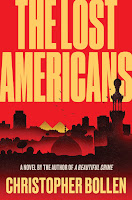
Over the next eight years, Bollen produced an additional trio of standalone crime/thriller novels. The Destroyers (2017) was his first to be set in a foreign country (as all of his subsequent books have been)—in this case on the Greek island of Patmos, in the Aegean Sea. A Beautiful Crime (2020) provided a delicious twist on the heist novel, its action taking place in over-touristed Venice. His Egyptian “debut” came with 2023’s The Lost Americans, about the mysterious death of an American in Cairo, working for the international arms industry.

Now 49, Bollen—reared in Ohio but currently a New York novelist and magazine writer—saw his sixth novel, Havoc, published just last month by HarperCollins. Amazon’s plot précis reads:
Eighty-one-year-old widow Maggie Burkhardt came to the Royal Karnak to escape. But not in quite the same way as most other guests who are relaxing at this threadbare luxury hotel on the banks of the Nile. Maggie, a compulsive fixer of other people’s lives, may have found herself in hot water at her last hotel in Switzerland and just might have needed to get out of there fast ... But here at the Royal Karnak, under the hot Saharan sun, she has a comfortable suite, a loyal confidante in the hotel manager, Ahmed, and a handful of sympathetic friends, similar “long-termers” who understand her still-vivid grief for her late husband, Peter. Here, she is merely the sweet old lady in Room 309.

One morning, however, Maggie notices a new arrival at check-in: a mournful-looking young mother named Tess and her impish eight-year-old, Otto. Eager to help, Maggie invites them into her world. But it isn’t long before Maggie realizes that in her longing to be a part of their family, she has let in an enemy much stronger than she bargained for. In scrawny, homely Otto, Maggie Burkhardt has finally met her match.
The New York Times’ Sarah Lyall called Havoc “a deliciously nasty tale of resentment and revenge,” and she later featured it on her “Best Thrillers of 2024” list. She wasn’t alone in applauding it so. CrimeReads and the South Florida Sun Sentinel’s Oline H. Cogdill also named Havoc among their favorite crime-fiction releases of last year.

In the following conversation with Bollen, he talks about his approach to writing novels, his extensive travels, and how visiting foreign countries inspires his work.

Peter Handel: Your new novel, Havoc, described as a “horror story,” represents somewhat of a departure from the lengthy, complex thrillers you published previously. Tell us a little about Havoc—the essential plot of the story, and how you came to write it.

Christopher Bollen: I never believed in lightning strikes of inspiration—the kind where the entire story comes all at once in a blinding flash—but that’s exactly what happened with Havoc. At the tail end of the [COVID-19] pandemic, as soon as it was possible to escape the U.S., I booked a trip to Egypt that included a boat trip up the Nile. Before embarking, I was staying a few days at the grand Winter Palace Hotel in Luxor, and one afternoon I was sitting in their back garden, and I happened to eavesdrop on a table near mine where an old American woman in a kaftan was berating a young waiter about the way the chef had prepared her lunch. It was clear to me she was a long-staying guest. And the story came to me in an instant: an old American woman living out of grand hotels at the tail end of the pandemic, causing trouble. And of course she needed a nemesis.

(Right) Author Christopher Bollen. (Photograph by Jack Pierson).

PH: And what a nemesis your protagonist, octogenarian Maggie Burkhardt, has in this book: Otto Seeber, an 8-year-old terror with a mind for revenge and mayhem. Did you have any particular inspiration for him? A niece or nephew, by chance? Because that Otto is one pint-sized piece of work! What were you feeling when you wrote about all his sociopathic behavior?

CB: I don’t really have children in my life. No nieces or nephews, and in New York City where I live, my friends with kids mostly divide their lives between family and friends, so my insight into children is somewhat limited. But I vividly remember being a child, and how un-harmless, clever, and mischievous they can be. I really wanted Otto to be an 8-year-old, and therefore not an adult trapped in a child’s body like so many over-precocious children in literature and films. So that meant making him vulnerable as well as conniving—a terror, yes, but also a little boy. In other words, the same human depth I gave Maggie.

So that’s where it all started. Truly, I didn’t immediately think of it as a novel. I really thought, oh, when I have some free time, I’ll write it as a short story, and when I began a few months later, that’s how I envisioned it. But Havoc kept growing and gaining momentum and broke out of its cage. I think it was an opportunity to explore age—the end of life, the fright and resignation that comes with old age, and certainly I didn’t want a character who goes gently into that good night.

PH: Havoc features what I think is your first unreliable narrator, Maggie, who is clearly full of deception as she relates her past family life and alludes to the deaths of her husband and daughter. One gets the impression you had a most enjoyable time creating such a devious personality.

CB: People are always saying, write what you know, which might explain why contemporary literature is filled with so many aimless, lukewarm youngsters. Stepping into the shoes of an 81-year-old Wisconsin widow running from trouble was the most freeing and exciting experience in my writing life. I could get away from myself (an aimless, lukewarm, once-youngster) and dive into a character that, on the surface, doesn’t seem to have a lot in common with me. But more than that, Maggie is fun because, yes, she’s deceptive and ruthless and perhaps psychotic, but she’s also smart, funny, witty, and full of loss and remorse and regret. In other words, a total person.

PH: But she’s also frightened, both overtly and otherwise, and she lies her ass off to everyone, including herself—mostly to herself, it seems to me. Nonetheless, you feel she is also a sympathetic character, don’t you—in spite of her own sociopathic behavior—while Otto is an unrepentant little shit.

CB: Well, it wasn’t just a case of writing a fun villain. She allowed me to find a new perspective to tackle ideas about life and aging that just would have sounded incredulous in a young character in their prime. So it was freeing on all fronts. I really felt for Maggie as I wrote her, even as she was sabotaging people’s lives.

PH: During our previous conversation, for CrimeReads, focusing on your fifth novel, The Lost Americans—much of which is set in Egypt—you mentioned your youth and your obsession with Egypt. When you finally went there, how did it feel?

(Above) The entrance of the Luxor Temple in Luxor, Egypt.


CB: I never intended to write a second Egypt novel. A second Venice novel, sure, count me in. But Egypt? The funny thing is, with The Lost Americans being set in Cairo and Havoc set in Luxor, I almost felt like I was writing about two different countries. Which is partly a testament to the diversity of Egypt. But also, the city of Cairo is geopolitical, it’s international, it has its eyes on the present and future (despite the Pyramids looming in the distance). Luxor is very much a city built around ancient Egypt and the tourism of the Valley of the Kings and the temples. So Havoc really felt like tourist Egypt, an Egypt of the past, the stuff of Tutankhamun and the gilded tombs of the pharaohs. Obviously, the political realities of the country [find their] way in. But this was actually much more the Egypt I dreamt about in my childhood. I have to say, I was as blown away by the tombs in the Valley of the Kings as Maggie is in the novel. They really are these extraordinary, all-encompassing works of art and magic. That’s Egypt. Everything feels touched by wonder.

PH: And I’d say you were touched by wonder as well—you’ve told me that when you were growing up you were a huge Egypt “fan.” Was there some seminal childhood moment, an aha! when some internal quasi-psychic voice said to you, “Egypt will occupy a large part of your consciousness when you grow up”? Or just those dreams?

CB: Actually, I can never really predict what will work for a novel or not. So many times, when traveling to a new country, I’ve thought, this will make a perfect backdrop for a story. And it just doesn’t spark. Two years ago I spent a month in Madrid, certain I’d walk away with a fresh novel idea in my head. Madrid was amazing, I found it alive and interesting, but it just didn’t induce this friction that I need for all the pieces to fit. So, I really never know what will end up speaking to me. I can say, though, that like Egypt, Venice always meant a lot to me, even as a kid before I visited, and it too didn’t fail when it came to generating wildly good ideas for stories.

PH: I do think there is an underlying theme in your books—at least in the ones I’ve read: Your protagonists, in their own unique way(s), all strike me as being, to some extent, on the “outside” of the society they inhabit. In The Lost Americans, I would suggest that both your “shadow” protagonist, the dead Eric Castle—a weapons tech for a U.S. defense contractor, who operates in a realm far from most people’s reality—and Omar—a friendly, gay Egyptian (helping Eric’s sister, who’s come to Cairo to investigate her brother’s death), who is well aware of his limitations in a homophobic society—are outsiders. And in A Beautiful Crime (there’s that first Venice novel!), two American wannabe-con artists, Nick and his boyfriend Clay, surely don’t fit into the decaying palazzo they live in while running their scams. Is this a projection on my part, Chris? In Havoc, besides the misfit aspects of Maggie’s own life as a fugitive of sorts, you include a gay couple, Zachary and Ben, who drive the plot in an unexpected way—again, gay people have (by necessity) often been forced to remain as outsiders in “society,” rather hiding in plain sight.
CB: You’re absolutely right. I’m always purposely coming from an outsider angle. That’s true of my second novel, Orient, too which was about a gay teenage orphan. It’s funny. When I was describing Havoc to a friend long before it was published, he said, “Oh, so you are finally embracing normalcy”—meaning, what can be so outsider about an 81-year-old Wisconsin widow in a ritzy hotel. But that’s just it: I think I wrote Maggie as if she were an outsider, so that colors the entire book. It probably has a lot to do with growing up gay in the time I did, where I felt like an outsider, so I was always rooting for that kind of character. The one who doesn’t fit in. In case anyone is worried I’ve embraced the norm (and I don’t imagine anyone is losing sleep worrying about that), the next novel I’m working on is about a gay American prostitute in Paris, a definite outsider. But really, all foreigners are outsiders, even Americans traveling in Europe. You are instantly the odd person out. It’s an unbalancing, which is the emotional and physical state where I like my characters to be.

PH: Finally, am I correct that you did not anticipate the enormous buzz around this novel? Best-of-the-year lists, the critical acclaim? Has all the attention on Havoc had any effect on what you might do down the road? Is horror a happy place for you now?

CB: For every novel, I always think, there’s an audience out there that will appreciate this—I’m just hoping the book finds them, or vice versa. Sometimes it does and sometimes it doesn’t. But I had a really strong feeling that Havoc would find its way—maybe because the set-up of an old woman vs. a little boy, old vs. young, is so compelling in itself. I’m so happy and grateful [for] the positive response. Sometimes, about a month after you publish a book and you get at most a little faint clapping, you think, oh well, that’s it. But Havoc seems to be taking on a life of its own.

You know what, Peter? Success can be as bad for writers as failure. Because you wonder if you can make the magic again, or if you should just reproduce the winning book in other forms. I’ve had so many debates with writer friends about whether “successful” writers really just keep writing the same book over and over. I don’t want to do that. I hope I keep going in risky unexpected directions, some of them sure to disappoint, but that’s how you keep alive as a writer. I think elements of horror will definitely come into play in future books.

Sunday, December 08, 2024

Misfits, Frenemies, and Glorious Prose

By Peter Handel
If there’s a new John Banville/Benjamin Black title (in any year, really), it’s a good bet that it will be—minimally—in my top-five choices for “best crime novel of the year,” if not the first on said list.

In The Drowned (Hanover Square Press), Banville continues his recent pairing of a newer protagonist, Detective Inspector St. John Strafford—a lone Protestant cop amongst a sea of Catholic members of the Irish Garda, who think he’s merely an outlier (and if he’s not, he is one weird fellow)—with another misfit, the hardly ever working State Pathologist, Quirke (introduced in 2007’s Christine Falls).

Strafford made his debut in a rather odd, too-little-known novel, The Secret Guests (2020), which imagined the lives of the British Royal sisters, Elizabeth and Margaret, while they were safely ensconced in the Irish countryside during the German bombing Blitz of 1940.

Quirke and Strafford, who share an open distaste for one another, made their first joint appearance, tragically, in 2021’s April in Spain. This unhappy collaboration was hinted at in the second Strafford novel, Snow (2020).

The Drowned, released this last October, comes on the heels of 2023’s The Lock-Up, wherein the two frenemies squabbled their way to solving the murder of a Trinity College history scholar found in a car lock-up (or closed garage). While the new book is not an actual sequel, several players from The Lock-Up are involved in its story, too.

The mysterious disappearance of a young woman from an isolated coastal setting in 1950s Ireland, and the strange subsequent behavior of her husband as he claims that she bolted from her Mercedes sports car and ran toward the sea, open The Drowned.

But rather than run through a detailed plot summary of this yarn (always intricate as hell with Banville), it’s much more enjoyable to highlight the glorious prose for which this author is so well-recognized.

The missing woman’s husband, Ronnie Armitage, practically invades a nearby home after his wife’s apparent abandonment. Right away, tensions between the owners of that house and Armitage start to boil beneath the surface.

Armitage has been helped to the isolated home by a man named Denton Wymes, a former prisoner and sex offender. Wymes picks up on a prickly dynamic emerging soon after their arrival.
There was, there was something between these two men ... [he] was certain of it, some angry, bitter, rivalrous thing. He had a sense of the night crouched outside the windows like a sleek dark animal, attending with an animal’s indifference upon the lamplit human scene within.
A recurring series character, Chief Inspector Hackett, is nearing retirement. His cigarette smoking has caught up with him, and as he and Quirke talk, he lights up.
Suddenly, Hackett leaned far forward on the bench and began to cough. Drawn-out, soupy squelching sounds came up from deep within his chest, as if instead of lungs there were a faulty suction pump wheezingly at work in there … he coughed and coughed. Quirke watched him, horribly fascinated. Would there be blood? Would something inside of him sunder, sending purplish slivers of flesh shooting out of the poor man’s open, funnel-shaped mouth?
Later, after Hackett has been hospitalized, Strafford pays him a visit. Here, one of Banville’s most overt themes from all the Quirke novels comes to the fore: the inability of men to be authentic with each other, themselves, and of course, women.
It was all awful, and horribly embarrassing—the shrunken frame, the raggedy woollen jacket, and the deluded interrogation [Hackett mistakes him for a doctor]—and not five minutes had elapsed before Strafford rose, grasped the old man’s tiny, withered hand, and fled … afflicted by shame and ignominy.
It's not just human interaction that Banville effortlessly (or so it seems) conveys, but the physical world of Dublin in the 1950s. For instance, as Quirke and Strafford take a taxi out to get a drink, Banville writes: “Along the quays, the traffic was light. The river was high and fast-running, a rain-stippled surge, tin-coloured, frothing against the slimed, grey-green embankment on either side.”

Quirke and Strafford make an exceedingly odd couple—ying and yang in many ways, yet both share a fear of intimacy, between themselves and with the women in their lives.

One anticipates their collaboration will continue, as Banville is clearly enjoying their fraught, dysfunctional relationship. Readers who want more Quirke, pre-Strafford, can pick up Christine Falls, the start of truly one of the greatest crime-fiction series ever conceived.

(Author photo courtesy of Hanover Square Press/Douglas Banville)

Tuesday, October 01, 2024

Abell’s Sophomore Stumbles

By Peter Handel
Death in a Lonely Place (Harper) is British author-editor Stig Abell’s follow-up to his most enjoyable and engaging debut novel, Death Under a Little Sky. Readers would do well to tackle this developing series in the order of publication, but it’s not essential.

The original cast is back: Jake Jackson, the young but burnt-out London cop who’s inherited a compound in a lovely rural countryside from his late uncle Arthur; his lover, Livia Bennett, the area’s veterinarian and single mother of pre-adolescent Diana; Inspector Gerald Watson, the local law; and “Rose,” a petty criminal whom Jake has unexpectedly befriended (and who will play a significant role in the story’s action).

Also worth noting: this is some compound Jake owns! It includes a huge store of food, thousands of crime novels, a wine cellar, and most helpfully, a large bag of weed. The main house is “set in countless acres of land … a soft pastel expanse of peace, a world entire of tumbling fields and ancient hedges and deep loamy soil.”

But Abell’s sophomore effort occasionally stumbles (as so many second novels do) because he overstuffs his story, and it ultimately feels somewhat less plausible than Little Sky.

That’s not to say there isn’t much to savor here. Some of Abell’s strongest writing comes in his descriptions of the natural world surrounding his mini-estate.

On an early evening walk, “daylight is already slipping away, the mottled greys of the heavy sky bleeding imperceptibly into black. As ever, he basks in the quiet: the breeze lingering in the reeds, the frisky scattering of leaves, the relentless slip-slap of the water on the bank.”

It's a beautiful, small, and isolated village, our Caelum Parvum—Latin for Little Heaven. As Jake leaves for a quick trip to London, “the sky has the pallor of winter, the colours muted like watered-down paint, washed-out umbers and ochres.”

In the first chapter Watson (“long and thin as a poker”) arrives at Jake’s house to ask him about the very recent disappearance of a little local girl, and a clue that simply says, “NO TABOO.” Watson and Jake have both a friendship and a collegial relationship.

For a former cold-case detective like Jake, who encountered the “NO TABOO” assertion in a past child abduction, saying no to helping Watson is impossible. Although he wants to be free of the bonds of investigations, violence, and criminals in general, it’s difficult for Jake to let go of the allure of solving a case, and he again lets himself surrender to that very pull. This set-up, however, feels hurried and contrived, just a way to get the plot rolling.

Two new characters join Abell’s series cast in these pages. The first is Aletheia Campbell, a police officer who can dig deeply into warrens of hard-to-access data, and was Jake’s “searcher” when he was a cop. Also on board is a friend of Aletheia’s, a mystery writer named Martha Kline. A former “security service” officer who is legless after being shot several times in the field, Kline has a brilliant mind with an almost unbelievable ability to make things happen, extra-legal and otherwise.

Aletheia tells Jake that her quest for further information about “NO TABOO” has rattled a few cages farther up the police food chain. “I’m not entirely sure how it works,” she remarks. “But I reckon it is a thing, a well-protected, well-financed thing that looms in the background, that I’ve never even got close to fully identifying. I’ve been pursuing it off the books since you left, nagging at it, and I now know enough to be very wary indeed.”

Meanwhile, Jake struggles to straddle a line he knows Livia does not want him crossing. With her daughter and their quiet rural surroundings, and now with Jake in the picture, Livia feels her life is complete. She seeks to pull Jake in one direction—stop being a cop—as he veers toward another, finding it hard to give up crime-solving. Only eventually does Jake come clean to her about his increasing involvement with Watson’s case. Livia is understandably relieved, then, when the missing child is recovered safely. But things seem a bit pat, and sure enough, it turns out to be a false climax, because “NO TABOO” soon rises to the surface once more.

Livia is hired to take care of horses belonging to the district’s rich, clearly corrupt, yet powerful autocrat, Sam Martinson, a former newspaper publishing titan and now the squire of an estate he has dubbed Purple Prose. He’s another one of those upper-class, sociopathic manipulators who are all too familiar (bordering on clichéd) to readers of English crime novels.

Martinson and his creepy henchmen, or “assistants,” seem likely to have some involvement with “NO TABOO,” which we finally learn is a mysterious “service” that can get one anything, if the price is met.

Behind the scenes, Aletheia and Martha are digging up the details of Martinson’s background. At the same time, a dishonorable former prison guard from Jake’s past reappears. Is he involved with “NO TABOO”? Why, yes!

By this point, were it not for Abel’s frequently gorgeous prose, we would have the disappointing sense of having read such a story before. In more ways than one: Jake and Livia do the same dance as in the previous book—hot sex, arguments about Jake getting back into policing, break up, make up. And our primary villain, Martinson, is a retread variation on the cloistered criminal family from Little Sky; he just has more money.

Abell does a skillful job of keeping the pages turning. A lengthy section set at Martinson’s huge estate, with an amusing group of weekend guests that includes Jake and Livia, is solidly conceived, and Rose has the best one-liners. It must be mentioned, though, that when two people act utterly out of character in the exciting dénouement, the credibility of this story suffers.

Martha’s near-omnipotent ability to make things happen also feels a bit too convenient. The action is exciting—a fight scene involving razor blades truly pops (and bleeds), but the excitement is undermined by Abell’s apparent desire to pile on the twists, the weakest of which is the motivation for evil by a key malefactor.

We’re left with an engaging tale, expertly conveyed local ambiance, some vibrantly drawn players, and the superbly delineated natural world surrounding Jake’s existence, but also with a feeling that the author tried a little too hard to outdo his debut—the kitchen sink is all that’s missing.

Those caveats aside, one can do much worse than Death in a Lonely Place when looking for a classic English country mystery. No doubt Abell will be back with a third installment in his series—and so will this reader, eager to devour it.

Friday, July 12, 2024

The Book You Have to Read:
“The Hit,” by Jere Hoar

(Editor’s note: This is the 185th installment in The Rap Sheet’s continuing series about great but forgotten books.)

By Peter Handel
The Hit is a hard-boiled novel released in 2003 and written by Jere Hoar, a prominent figure in the Mississippi literary and academic world, whose only other published work was a 1997 short-story collection titled Body Parts.

If you have seen some of the classic films noirs of the 1940s, ’50s, and ’60s, or read much noirish fiction, you know the tropes:

1. Protagonist: Male, maybe a psychologically scarred veteran, or an alienated, bitter loner.
2. Protagonist: Female, femme fatale, black widow, who channels desire and is a sizzling, sexual siren ... but unhappily married.
3. Obsession. Plenty of rumination, plenty of caution ... OK, no caution, just blind lust and big dreams of a better, more-monied life.
4. A plan to make it all happen. A plan to get away.
5. A plan that goes awry.
6. Told in flashback, by the loser, of course.
7. Twists … and the one at the end here is quite predictable.

None of these (cherished) devices are “new” and neither are the narrative machinations of The Hit.

So why bother cracking open this surprisingly obscure exercise in a genre beloved by so many talented writers? The Hit reads much of the time like a paint-by-numbers type of endeavor: Let’s write a hard-boiled novel and have some fun. Yet Hoar’s circle certainly approved of his efforts—Barry Hannah, John Grisham, Jim Harrison, and Tom McGuane have all given The Hit fawning blurbs.

And the thing is, while the story line offered here is familiar, the prose is not. Hoar writes dialogue and scenes like few others in the genre. He was a journalism professor at the University of Mississippi for more than 30 years (1956-1992) and a gifted, if sadly under-published, writer who knew how to craft a hell of a sentence. His irreverent sense of humor also shines through at the least expected moments.

Hoar’s tale is broken up into parts with a (meaningless) conceit of being recounted by our anti-hero, Luke Carr, in the form of “Notebooks” he has written at the behest of his psychiatrist at the mental hospital where he’s being treated.

Carr is a Vietnam veteran who’s returned home to his Southern rural roots. He lives with his well-trained dog, Adel, in a cabin next to a national forest. The book begins with Luke and a woman, Kinnerly Morris, parked in a car off a desolate road.
“Come here. I want to stroke you like a cat,” says Luke
to Kinnerly.

“But you’re a dangerous man,” replies Kinnerly.

“All the nicer for you.”

She came to me on her knees, wrapped her arms around my neck, and bent my head back for a kiss. “How’s that, big boy?” she said in a Mae West voice. My hands slid under her fur coat and wool skirt. All she was wearing under there was a garter belt and stockings.
Fifteen minutes later they leave, only to stop again, in order to discuss the elephant in the room: Kinnerly’s husband, Tom Morris. Once he’s out of the picture they figure life will be perfect!
We sat in the dark. It wasn’t safe. None of this was. I sucked in air. Once this thing started there could be no turning back. It was one long plunge into an icy river with treacherous currents.
Luke has an idea: stage an accident along a roadway that Tom will be driving on in the dark. As a skilled hunter and outdoorsman, Luke concocts an elaborate and seemingly foolproof plan, first setting up an alibi, then killing a doe, and on the night of the murder, propping up that doe’s body with two-by-fours in the middle of the road. When Tom’s car comes barreling along, he’ll have to stop when he hits the deer, and then, Luke will nail him—with his chosen weapon: a crossbow.
The car whistled by, spinning gravel. Brakes howled. Dust flew from locked tires. The car slewed left, flashing its lights across foliage, illuminating details of leaves and limbs. It turned sideways and slid into the deer. The deer bounced away. One supporting timber flew through the light beam. The Porsche’s front wheels churned in a ditch. They reversed and churned again. The motor raced and the back wheels spun. Then the motor quit. I nocked the arrow and waited. It would be an easy shot by the overhead light of the car. The driver’s-side door opened. I heard a voice, a jingly tune. On the car radio, Burt Bacharach was singing “Raindrops Keep Falling on My Head.”
Out staggers Tom, disoriented and angry. Suddenly, Luke sees him as a person, a man, unarmed, not simply a target. He says to himself, “I was no William Calley, Jr. It was over. I was getting out.”

As he starts to crawl away, though, a twig snaps and Tom sees him and pulls a pistol, aiming at Luke.
Instinctively I released the arrow. He screamed and kept on screaming, leaning to one side. The high-pitched keening went on and on while Bacharach played piano. … Abruptly, Morris sat down and coughed. A soft bubbly waft of air came out of his mouth as he toppled to the side.
Grimly, Luke deals with the dying, grotesque Tom. He gets his body back in the car, and then breaks his neck, just to make sure he’s gone. Except, Tom’s right-hand man, Angus McKay, drives by, and quickly ascertains what’s going on. That’s when the blackmail begins.

All of this in the novel’s first 28 pages!

A new “Notebook” begins, flashing back to how these two wrought-up former lovers, Luke and Kinnerly, reunited. How they share a past, going back to their days as students at Ole Miss, but the Vietnam War and many years divided them. We’re reminded of that classic noir trope, “I know you’re bad for me, but …,”—when Kinnerly turns up at Luke’s cabin after they’ve been apart for eight years.
There’s always one woman in your life that’s wrong for you, who’s going to get you into trouble. You’d be better off never having met her, but she’s the one you think about and want and can’t get out of your mind—not ever.
The stress of what they’re doing, sneaking around behind Tom Morris’ back, causes hiccups in their revived relationship. But the pair stay united, unable to conceive of any other way to be together.
Making love to the woman I’d fantasized about for as long as I’d been a man and having her come to me with the same desire … laughing with her, telling stories … being together for thirty-six hours when she wasn’t hurried or worried, bonded us in ways I didn’t fully realize at the time.

Could I give her up? Sure, I would have said. But cold biological fact is this: When a scientist taps a platinum wire into the pleasure center of a rat’s brain, tickles it with a charge, and shows the rat how to receive that charge upon demand, he will pleasure himself without ceasing until he dies.
And our boy Luke has got that platinum wire buried deeply in his brain. Or what’s left of it. A hot workout in a car pushes it even deeper:
Her buttons came open and her nipples pricked under my fingers. She pushed me away to get space to swing up her legs, saying words I couldn’t make out. I opened the car door behind me to make more room. In my head that warning bell dinged.

I jerked out her silk blouse, uncoupled the tiny front hook of the lacy brassiere, and released her breasts. She cupped the left one, aiming right at me, and slid her free hand around my neck, prickling the little hairs there. Her lips moved on my ear and I tingled to the rub of words and her warm breath. My hands slid under her skirt. Her panties were too tight to get under. The cloth ripped.

It didn’t matter what the cost. It didn’t matter who got hurt. I was gone way too deep inside myself where caution didn’t exist.
The lovers are soon performining a dance of close encounters punctuated by arguments, worry and anxiety, but stick to their scheme. Luke will steal valuable paintings owned by Tom and then sell them to finance the couple’s getaway. But nothing goes smoothly. Luke is contacted by a mysterious man who wants him to undertake a contract killing. He hangs up—as if that would be the end of such trouble. Later, he’s told that he’s not the only guy Kinnerly’s been in the sack with, not by a longshot. She insists she’s been true to him ever since they reunited. Naturally, he’s not sure what to believe.

(Left) Author Jere Hoar.

It begins to dawn on Luke that maybe Kinnerly is setting him up. But he can’t be sure, and Tom’s cohort Angus is blackmailing him and planning to kill him anyway. The local district attorney thinks Morris’ death was no accident. The lovers’ carefully constructed house of crooked cards is wobbling with fear and threats of more violence. When Luke finds his dog badly wounded, he realizes Angus has to go. He gets his crossbow and sneaks up on the man.
My crossbow sight V’d on his belly. The stiff trigger jerked under my forefinger. A bolt whirred across the distance and nailed Angus to the tree behind him. His rifle flew out of his hands, flipped end over end and hit the ground.

Angus looked down. The crossbow bolt stood in his middle. His face reddened as if he were constipated. He said
ummm … ummm in an angry buzz.
As Angus begs for help, he tells Luke that he’s “had” Kinnerly as well. But c’mon, get me to a doctor and I’ll leave you alone. Luke replies with another arrow to his throat.

Although Jere Hoar’s narrative follows a familiar noir path, he embellishes The Hit with plenty of local Southern color. Luke’s skill as a tracker and hunter who knows dogs, plays a key part in the story. The violence here is rendered with imagination and verve. And even though Luke is not awfully bright, it’s not hard to root for the poor sap—those devious women are hard to handle! (He does his best.)

Late in this tale, we witness an exciting, vibrantly depicted fight. Luke is attacked by three men and a woman—a set-up—and he can only defend himself with an axe handle retrieved from his car. Even as he’s taking the brunt of a metal pipe from one assailant, “a weight landed on my back, scissors locked around my waist, an arm twisted my head, and nails peeled the skin of my face. The raw tracks across my cheeks and nose burned and stung. I felt body heat, and weight, and hot breath and the tickle of long hair, and smelled lilac perfume. She wears perfume to an ambush? I wondered.

He whups the lot of them, but lands in the ER.

As the two lovers carry on with their getaway plan, we know that somehow it will implode or just collapse … after all, this is noir!

To this reader, The Hit is a regrettably “forgotten” book. Despite its rather perfunctory plot, there is much to admire overall; and with plenty of sex and violence, what’s not to like? Jere Hoar, who died in 2021 at age 91, didn’t turn out much fiction in his lifetime. One is left to wonder what he might have accomplished had he written more.