Showing posts with label John Ball. Show all posts

Friday, January 14, 2022

The Book You Have to Read:
“In the Heat of the Night,” by John Ball

(Editor’s note: This is the 175th installment in The Rap Sheet’s continuing series about great but forgotten books.)

By Steven Nester
Things were beginning to look up for the town of Wells, South Carolina. A music festival was in the works and sentiment held it could rejuvenate the sleepy whistle-stop; but murder can halt just about anything dead in its tracks. As this story opens, the festival’s conductor is found bludgeoned to death, and the town’s untrained police department has no clue as to how to investigate the crime. A seasoned homicide detective happens to be passing through and his superiors in Pasadena, California, give Wells Police Chief Bill Gillespie the OK for him to assist. The only problem is that the investigator, Virgil Tibbs, is Black; and in 1965, in the Deep South, that’s trouble. So much so, that Tibbs’ first contact with the Wells Police Department is when he’s arrested as the prime suspect.
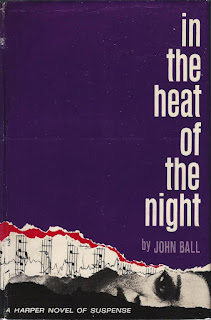
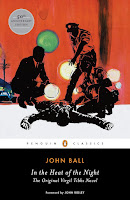
In the Heat of the Night (1965), the first book in Ball’s Inspector Tibbs series, is a hard look at racism in the modern era, in a not-so-modern South, in the country that many believed to be the most just, fair, and principled in the world (a belief that has lately been questioned), and author John Ball pulls no punches. With its ample use of the N-word, its catalogue of racial stereotypes passed off as casual character observations, and its piles of indignity heaped upon African Americans (in addition to slights against Italian Americans and Chinese Americans), just as the Civil Rights Movement was gaining traction, In the Heat of the Night presents something that is the hopeless opposite of the American Dream. However, the book also demonstrates faith that things might change—and it’s up to Virgil Tibbs to set the example.

Tibbs is the first Black man Wells residents have seen who goes against stereotypes. He also gracefully exceeds the behavior that southern whites expect of him (and exceeds their behavior as well), prompting this backhanded compliment from a cop:
“Smartest black I ever saw,” Pete concluded; then he added a remarkable tribute. “He oughta been a white man.”
No one appreciates that type of behavior at all in the South in the ’60s. And there are plenty of other attributes for the residents of Wells to dislike about Tibbs, too. He knows French and martial arts, he “dresses like a white man,” and he has a large vocabulary. But Tibbs doesn’t flaunt his accomplishments; he’s an educated African-American man who defers to his inferiors in the name of professionalism, and with respect and tact, schools an ignorant populace and hapless constabulary on professional crime solving and how to treat one’s fellow man in the face of humiliation and threats of violence. However, Tibbs does bring a bit of fight to the Wells cops, as in this famous exchange most people recognize from the movie version of Ball’s yarn, but which (slightly modified) is also in the book:
“You’re pretty sure of yourself, aren’t you Virgil.” Gillespie retorted. “Incidentally, Virgil is a pretty fancy name for a black boy like you. What do they call you around home where you come from?”

“They call me Mr. Tibbs,” Virgil answered.
Sam Wood is the officer who both discovered the body of festival conductor Enrico Mantoli and arrested Tibbs. He has no formal police training, only a badge and a gun, and less juice than Chief Gillespie, whose previous experience in law enforcement was as a jail guard strong-arming drunks. Wood and Gillespie hide their ineptitude behind condescension toward others who seek to give advice and guidance. The two don’t get along, and Sam hopes Gillespie “makes a public fool of himself and bungles the [Mantoli] case.” He’s also amused to watch Tibbs stand up to Gillespie’s bullying and bluster during the initial interrogation, when no one yet knows Tibbs is a cop. (It seems the contents of Tibbs’ wallet were never checked.) His composure under pressure and lack of deference infuriates Gillespie, who can only intimidate, his “voice trying to pick a fight, and daring anyone to defy it.” Over the course of this novel, Tibbs inspires Wood to start thinking a bit for himself and to rebel against Gillespie in subtle ways. But even though Wood is “beginning to like Tibbs as a person,” he’s not compelled to abandon the department’s party line.

When Tibbs joins the Wells investigative team, Gillespie knows the clock is ticking and his career in law enforcement is in jeopardy. Even worse, Newsweek magazine starts sniffing around the town, and Gillespie gets the sense that the entire country is breathing down his neck—as do men higher up in the pecking order than the chief. There’s no way they’re going to let things get screwed up by an unqualified sheriff, whether his incompetence is revealed by a Black man or not. The good-ol’-boy system, it seems, is against the ropes. Gillespie is in a tight spot, but he’s cagey enough about self-preservation. Virgil Tibbs, he comes to realize, is a convenient “whipping boy.” Gillespie will win if the murderer is found, and Tibbs will receive no credit; on the other hand, if Tibbs can’t find a killer, he’ll take the blame himself for botching the case. Tibbs, however, has already deduced all of this. He knows exactly what he’s doing.
What Virgil Tibbs does, in the hands of author Ball, is bring up white people’s fears, shortcomings, and insecurities about themselves. For instance, Ball writes that Sam Wood “wanted the crime solved, but he wanted it solved by someone he could look up to and respect. The only trouble was he couldn’t think who it might be.” Sam further exhibits his insecurities when he wishes he’d never become a police officer; he pines for his old job as a grease monkey. Meanwhile, Bill Gillespie, too, wants Mantoli’s slaying solved quickly—and he’s willing to leap to conclusions if necessary to bring that about. After Tibbs proves the innocence of the department’s initial prime suspect, and with the clock ticking, Gillespie learns that Officer Wood had paid off his mortgage in cash, roughly the same amount that was taken from Mantoli’s billfold. That’s all the chief needs to arrest his colleague for the murder. But Tibbs figures the answer lies elsewhere, and through his diligent efforts he eventually makes everyone look good.

The majority of Americans are probably more familiar with the 1967 movie version of In the Heat of the Night than they are with John Ball’s original novel. Both are engaging works. The film starred Sidney Poitier, Rod Steiger, and Warren Oates, and was directed by Norman Jewison. Poitier (who passed away earlier this month) refused to shoot the movie in the South, due to threats he and singer-actor Harry Belafonte had received from the Ku Klux Klan. The movie turned out to be a hit, winning five Academy Awards, including Best Actor for Steiger and Best Picture. A TV crime drama, inspired by the 1965 novel and 1967 film, ran from 1988 to 1995. It starred Carroll O’Connor as Chief Bill Gillespie and Howard Rollins as Detective Virgil Tibbs.

There is no happy ending in Ball’s slender book, other than in the fact that justice is done, and that a tenuous truce has been achieved, in a very small way, between Blacks and whites in the South. There’s nothing in-your-face about the conclusion, just the quiet and individual rectitude of two men who are worlds apart. However, there is one other thing worth noting. Gillespie sees Tibbs off at a train station in the middle of the night, and gives Tibbs permission—which the Pasadena detective had requested—to sit on a whites-only bench. The chief then thanks Tibbs, and Tibbs says it was a pleasure helping out. Goodbyes are said, but then Gillespie declines to offer his hand for shaking. Virgil Tibbs is left to sit alone in silence, on the whites-only bench. Metaphorically speaking, he has been left to carry on the fight for racial justice by himself, with no assistance from Gillespie or his ilk, yet he has already won approval of a sort.

READ MORE:Remembering John Ball, the Writer Who Gave Us Virgil Tibbs,” by Kevin Mims (Quillette).

Friday, October 08, 2021

Bullet Points: Success in Excess Edition

• The long-overdue recent premiere of No Time to Die, Daniel Craig’s fifth and final James Bond picture, has provoked a deluge of articles, in print and online, about the actor and whoever will succeed him playing Ian Fleming’s Agent 007. Notable are this piece from Esquire’s Chris Nashawaty, and this other one by Vox’s Alissa Wilkinson. CrimeReads has gone in its own editorial direction, posting Olivia Rutigliano’s rankings of all the Bond movies (to which my sole objections are that Live and Let Die deserves more credit, while The World Is Not Enough deserves less), and Julia Sirmons’ tribute to 1969’s typically maligned On Her Majesty’s Secret Service, which she insists is actually the franchise’s best entry.

• Staking out his own fringe in all this Bond coverage, author-blogger Gary Dobbs showcases “a professional Daniel Craig lookalike who actually looks nothing like Daniel Craig,” and who now—with Craig’s retirement as 007—“fears his work will dry up.”

• Film noir authority and author Eddie Muller isn’t merely a swell guy, he’s also a sterling interviewee. If you missed hearing his half-hour conversation earlier this week with Fresh Air’s Terry Gross, don’t fret, because you can still tune in to the whole thing here. In addition to discussing film noir’s history, some of its landmark productions (including 1944’s Double Indemnity), and Muller’s hosting duties on Turner Classic Movies’ exalted Noir Alley series (shown on Saturdays at midnight), the pair chatted about the new and expanded edition of his book Dark City: The Lost World of Film Noir; his famous boxing-writer father; and his two novels, both set in 1940s San Francisco and starring a sportswriter, Billy Nichols, modeled on his dad.

• Listening to that exchange reminded me of something I wrote about Eddie Muller on this page five years ago. My latest Kirkus Reviews column had then just appeared, its topic being “crime novels worth re-reading,” and Muller contacted me with the surprising information that he was halfway through composing a third Nichols novel, to follow The Distance (2001) and Shadow Boxer (2003). So whatever happened to that book? I e-mailed Muller for an update this week, and received the following reply:
Still working on it. Now I’m glad it’s taken so long. The reissue of Dark City is selling through the roof, #1 movie book on Amazon for over two months. I have two other books in the pipeline, with contracts—not fiction. Since novels are the hardest sell, all this other work will only help when Billy reemerges. And thanks for asking!
I, for one, shall be pleased to welcome Nichols’ return.

• Three weeks ago, I noted the passing of journalist-turned-crime writer Robert Richardson, who died on August 31 at age 80. Only now, however, is The Guardian carrying an obituary by Mike Ripley, in which he commends Richardson for penning both traditional English detective yarns and psychological thrillers, and says he “was heavily involved in organising the annual conventions of the CWA [Crime Writers Association], where members spent a weekend, usually in a seaside hotel, being treated to lectures and talks on criminology. On the social side, [Richardson] would devise and host quizzes on crime fiction, which though popular with members were invariably described as ‘fiendishly difficult.’” One thing I hadn’t known before, but that Ripley mentions: “Following a diagnosis of Lewy Body dementia, in 2017 he moved to Dore, near Sheffield, to be closer to his family.”

• Whilst we’re on the subject of Mr. Ripley, I want to direct your attention to his October “Getting Away with Murder” column for Shots. It includes remarks on the “sumptuous launch party thrown by Felix Francis for his new novel, Iced”; an “accessible and entertaining” new study of Agatha Christie and her knowledge of forensic science; and fresh fiction by Charles Cumming (Box 62), Oliver Bottini (Night Hunters), Peter Papathanasiou (The Stoning), and others.

• Critic Maxim Jakubowski (who now also serves as chair of the British Crime Writers’ Association) is out with his latest “To the Max” column for Crime Time. In it, he briefly reviews 10 new novels, two of which—Toshihiko Yahagi’s The Wrong Goodbye and Anthony Horowitz’s A Line to Kill—are already on my most wanted list, plus one book that I didn’t even realize fell under the crime classification, but that Jakubowski makes sound like a winner: Mrs. March (Liveright), “a slow-burning psychological thriller” by Virginia Feito.

• I have a paperback copy, in storage, of 1974’s Charlie Chan Returns, composed by Dennis Lynds (with splendid cover art by Howard Rogers), that I inherited from my late father-in-law. I’ve never read the yarn, but maybe I should, for the blog Bloody, Spicy, Books calls it a “curious” yet “nice, light fun mystery novel” that translates “the golden-era detective Chan to groovy 70’s New York where he gets tangled up in big case with the help of his son Jimmy, an NYPD detective. There’s a fish-out-of-water quality to the idea of a very old-fashioned man in the land of discos, dirty politics and rock ’n’ roll clubs. So, it’s like Charlie Chan replacing Telly Savalas as Kojak.”

• By the way, this novel should in no way be confused with the unsuccessful 1973 ABC-TV pilot The Return of Charlie Chan, starring The Wild Wild West’s Ross Martin as Earl Derr Biggers’ fictional Chinese-American police detective. For the nonce, at least, that two-hour movie, which imagines a retired Chan “investigat[ing] a murder case aboard the yacht of a wealthy Greek shipping tycoon,” is available on YouTube. One viewer writes: “I won’t say that this is a good Charlie Chan mystery, but it is still a pretty good mystery. Just think of Ross Martin playing an imposter, Artemis Gordon’s grandson in disguise, a ‘Charlie Chang,’ if you will, instead of the actual Charlie Chan.”

R.I.P., Frank Wheeler Jr., the Wisconsin author of Wowzer (2012) and The Good Life (2014), who passed away on September 16, cut down “after a hard-fought battle with cancer” at age 43.

• The Killing Times reminds us that ITV-TV’s new six-part suspense series, Angela Black, starring Downton Abbey’s Joanne Froggatt, is set to debut in the UK this coming Sunday night, October 10. It finds Froggatt playing the title character, “someone who has the perfect life. Or at least it looks like it,” as the site cautions. “Angela’s life appears idyllic: a lovely house in suburban London, days working volunteer shifts at a dogs home, two beautiful sons and a charming, hard-working husband—Olivier [Game of Thrones’ Michiel Huisman]. However, beneath this façade of charmed domesticity, Angela is a victim of domestic violence. Olivier is controlling and brutal; but Angela loves him and he’s the father of her children. She can’t leave him, even though she has threatened to countless times. So, she covers her bruises with makeup and fabricates lies to explain away her missing teeth. Until, one day, Angela is approached by Ed [The Watch’s Samuel Adewunmi]—a private investigator—and he smashes her already strained domestic life to pieces. Ed reveals Olivier’s deepest secrets to Angela, and she is faced with horrifying truths about her husband and his betrayals. But can Angela trust Ed? And what truths will be revealed in the ferocious fight between Angela and her husband?” A trailer for this hour-long series—which apparently has no U.S. release date arranged—is embedded below.


• Count this as good news (if not wholly unexpected): “Helena Bonham Carter,” says Variety, “will rejoin Millie Bobby Brown and Henry Cavill for a new Enola Holmes mystery from Legendary and Netflix”—the sequel to one of Netflix’s biggest 2020 draws. “Bonham Carter plays Eudoria Holmes, the matriarch of the famous sleuthing family, in the series that is based on Nancy Springer’s beloved books. The films tell the story of Enola (Brown), the rebellious teen sister of Sherlock Holmes (Cavill), who is a gifted super-sleuth in her own right and often outsmarts her famous siblings.” As reported earlier on this page, Enola Holmes 2 (and I hope that’s not really going to be the title) is being lensed, at least partially, in the English port city of Hull.

• Season 6 of Shetland, starring Douglas Henshall as Detective Inspector Jimmy Perez and based on Ann Cleeves’ novels, is just around the corner—at least for British viewers. The first of a half-dozen fresh episodes is slated for an October 10 broadcast on the BBC. “The forthcoming new series,” says The Killing Times, “centres on the doorstep murder of a prominent local figure, a case which strikes at the heart of the Shetland Isles and its people. As Perez and his team uncover a kaleidoscope of motives for the murder, their investigation soon takes a shockingly sinister turn.” Radio Times notes that, to make up for time lost to the COVID-19 crisis, the fifth and sixth seasons of this Scottish crime drama are being filmed back to back, so another run can be expected in 2022. There’s no word at this time of when American couch potatoes might see more of Shetland.

• And a final TV morsel: “Mike Flanagan has found another house to haunt for Netflix,” says Tor.com’s Andrew Liptak. “After adapting Shirley Jackson’s The Haunting of Hill House and The Haunting of Bly Manor (based on Henry James’ The Turn of the Screw), he’s turning his sights to Edgar Allan Poe’s classic story, ‘The Fall of the House of Usher.’ … According to Deadline, Netflix has given a series order for the project, which will be ‘based on multiple works from Edgar Allan Poe.’ He’ll direct half of the eight-episode series alongside Michael Fimognari (To All the Boys: P.S. I Still Love You).”

• There appears to be major disagreement over whether the true identity of the “Zodiac Killer,” who taunted police and took the lives of at least five people around San Francisco Bay during the late 1960s, has finally been revealed. From In Reference to Murder:
A team of more than 40 retired and amateur investigators claim they have identified the Zodiac Killer, up to this point an unnamed serial killer that operated in the San Francisco Bay Area in the 1960s. The team, calling themselves The Case Breakers, which consists of former law enforcement officials, DNA experts, and journalists, believe they have identified the Zodiac Killer as Gary Francis Poste, who died in 2018. But the FBI and police in California say, “Not so fast.”
• Killer Covers has posted a new gallery of classic—and very attractive—paperbacks that take their titles from the first names of female protagonists. Feast your eyes here.

• By my calculations (he was born in 1948), Max Allan Collins is now 73 years old and has been publishing books for 45 years. That’s an impressive career, but one that seems to have taken some toll on the Iowa author. In a blog post put up earlier this week, dealing primarily with his new Fancy Anders novella series and the latest installment of his literary memoir in column form, “A Life of Crime,” Collins mentioned that he and collaborator James Traylor are still hard at work on their Mickey Spillane biography for Mysterious Press. Then he wrote: “I have decided I will never write non-fiction again. I haven’t done much, but projects like The History of Mystery, the Elvgren and other pin-up books, the men’s adventure magazine book with George Hagenauer, two previous Spillane non-fiction works with Jim Traylor, and the two Eliot Ness biographies with Brad Schwartz, were just too punishing for me to consider doing non-fiction again at this stage and age. The Spillane bio is going to be something very good, I think, and will make an excellent capper to this niche of my career.”

(Right) Dilys Winn on To Tell the Truth, February 1972.

• New York City’s first independent mystery bookshop, the beloved Murder Ink, shuttered its premises in December 2006 after 34 years of operation. Last week, a Web site called I Love the Upper West Side, which covers news and entertainment happening in one of Manhattan’s tonier districts, delivered a fine remembrance of Murder Ink and its “quirky” founder, Dilys Winn. Enough time has now passed to leave an entire generation of Upper West Side (UWS) residents without knowledge of Winn’s enterprise, so this “history” piece was called for. Contributor Claudie Benjamin introduces her subject thusly:
In a 1972 segment of the popular TV show To Tell the Truth, [Irish-born former advertising copywriter] Dilys Winn wowed the panel who were grilling contestants all claiming to be her. Winn’s deep familiarity with the mystery genre, including the specifics of authors and their heroes and villains, led the panelists to correctly vote her as the real Dilys Winn.

There’s always been so much creativity and innovative impulse on the UWS, and it’s impressive when someone comes up with something that’s totally new and different. That’s just what Ms. Winn did in 1972 when she opened Murder Ink, an independent bookstore entirely devoted to murder mysteries and true crime. …

The impulse to open the shop came from her love of mysteries and hatred of her job (in advertising). Ms. Winn told the
To Tell the Truth panelists, “It was either sell them or commit one.”
Winn sold Murder Ink to her friend Carol Brener in 1976, and died in Asheville, North Carolina, in 2016 at age 76.

Ellery Queen Mystery Magazine’s “Something Is Going to Happen” blog features a thoughtful new essay by Kevin Mims, remembering American author John Ball (In the Heat of the Night) 33 years after his death on October 15, 1988. “He was a writer,” declares Mims, “who was unafraid to veer out of his own lane and explore the lives of others—people whose experiences of the world were vastly different from his own. He left behind a vast body of work, but if more readers don’t seek it out, it may end up being a dead body. And you don’t want to be one of the suspects in that homicide investigation.”

• As The Deighton Dossier observes, Len Deighton (The IPCRESS File, Funeral in Berlin, etc.) “has often eschewed literary prizes and honours, believing his work speaks for itself. But as someone born in London, who lived there during much of his early life until his career as an author really took off, he might appreciate a blue plaque there in his name.” It seems the inner London borough of Southwark plans to salute one individual this year who boasts a significant connection to the area, and to do so by posting a circular blue plaque bearing his or her name and general details. The 92-year-old Deighton, “who is thought to have written the first novel typed on a word processor from his Borough home,” is among the five candidates for said accolade. (More than 50 such plaques already dot the district.) The Southwark News, which co-created this commendation with the Southwark Heritage Association, requests the public’s participation in selecting the 2021 honoree. “To vote, e-mail admin@southwark.org.uk or kit@southwarknews.co.uk, naming the person that you would like to see commemorated with a blue plaque,” the newspaper advises. “Voting closes at midnight on November 30.”