Monday, February 28, 2011
Here in a Flash
At the start of February, blogger-author Patti Abbott presented a new flash-fiction challenge. She tasked writers to develop stories of 800 words or so in length that contained the sentence, “I really don’t mind the scars.” Today, she offers links to the numerous submissions appearing elsewhere on the Web, as well as entries presented in her own blog (see here, here, here, here, here, here, here, here, and here). Abbott’s own submission can be found here. She warns, by the way, that some of these pieces of flash fiction “are not for the faint of heart.”


Ripping Right Along
British critic Mike Ripley’s latest “Getting Away with Murder” column was posted today in the e-zine Shots. In it you’ll find notes about new books by Tom Winship, Roger Smith, and Gordon Ferris, as well as comments on the film Blitz (based on Ken Bruen’s novel) and the launch party for Charles Cummings’ new book, Trinity Six, all presented amidst Ripley’s customary droll prose stylings.
Sunday, February 27, 2011
Piece by Piece
• Yowza! The ever-lovely Ashley Judd is supposedly “close to a deal” that would have her starring as a “highly skilled former CIA agent who heads off to Europe in order to find her missing teenage son” in a possible ABC-TV spy series called Missing. Double O Section offers a bit more information on this subject.
• Critic and Rap Sheet contributor Dick Adler sent me the photo on the left, accompanied by a note reading, “If you remember this, you’re an oldie.” I guess I don’t qualify, because I have absolutely no memory of the Book-O-Mat. I did, though, find a piece in Bill Crider’s Pop Culture Magazine that supplies details about that odd paperback-vending machine, which debuted after World War II. Click on the photograph to fully appreciate the Book-O-Mat. (Hat tip to Boing Boing.)
• By the way, there’s another new installment of Adler’s serial novel, Forget About It: The First Al Zymer Senile Detective Mystery, available here. To catch up with the complete story so far, click here.
• The seventh Jesse Stone TV mystery, Innocents Lost, is scheduled for broadcast on May 22 on CBS. Omnimystery News explains that this teleflick is “not adapted from any of [Robert B.] Parker’s novels, but is an original screenplay co-written by Tom Selleck, who plays Jesse Stone.”
• Classic Film and TV Café celebrates the “timeless dramady” Remington Steele (1982-1987), which starred Stephanie Zimbalist and Pierce Brosnan as mismatched private eyes. You’ll find that post here.
• Another celebration is taking place at Adam Graham’s Great Detectives of Old Time Radio site, only it’s the 1959-1960 series Johnny Staccato receiving all the applause.
• A couple of interviews worth reading: J. Sydney Jones chats up Stuart Pawson, British author of the D.I. Charlie Priest mysteries (Very Private Murder), while Cullen Gallagher talks with Wallace Stroby, who wrote the rewarding recent thriller, Cold Shot to the Heart. (There’s another interview with Stroby at the Violent World of Parker site, in which he talks about Donald E. Westlake, Richard Stark, and his influences.)
• Stroby contributes a piece of his own to the Mulholland Books blog, writing about how he uses organized crime in his fiction.
• Another Mulholland Books post worth checking out: Michael A. Gonzales’ tribute to Ernest Tidyman, who wrote the John Shaft detective novels but isn’t as well remembered these days as he ought to be. “Although he was not on a par with Hammett and Chandler,” author Woody Haut tells Gonzales, “he wasn’t far behind.”
• Gonzales is also the author of this week’s new short story in Beat to a Pulp, “A Different Kind of Blue.”
• And I, for one, can never have too much of Lauren Bacall, so it was with pleasure that I found the actress profiled this month in Vanity Fair. “She’s one of the last of Hollywood’s golden-age stars--the girl who stole Humphrey Bogart’s heart at age 19 and has been grappling with their dual legend ever since,” the magazine teases. “Now 86, Lauren Bacall looks back on a lucky, if often difficult, life as she gives it straight to Matt Tyrnauer, talking about the effect of Bogey’s fame on her and their kids; her very brief engagement to Frank Sinatra; her stormy second union, to Jason Robards; and why she hates the Oscar she received, in 2009.”
• Critic and Rap Sheet contributor Dick Adler sent me the photo on the left, accompanied by a note reading, “If you remember
 this, you’re an oldie.” I guess I don’t qualify, because I have absolutely no memory of the Book-O-Mat. I did, though, find a piece in Bill Crider’s Pop Culture Magazine that supplies details about that odd paperback-vending machine, which debuted after World War II. Click on the photograph to fully appreciate the Book-O-Mat. (Hat tip to Boing Boing.)
• By the way, there’s another new installment of Adler’s serial novel, Forget About It: The First Al Zymer Senile Detective Mystery, available here. To catch up with the complete story so far, click here.
• The seventh Jesse Stone TV mystery, Innocents Lost, is scheduled for broadcast on May 22 on CBS. Omnimystery News explains that this teleflick is “not adapted from any of [Robert B.] Parker’s novels, but is an original screenplay co-written by Tom Selleck, who plays Jesse Stone.”
• Classic Film and TV Café celebrates the “timeless dramady” Remington Steele (1982-1987), which starred Stephanie Zimbalist and Pierce Brosnan as mismatched private eyes. You’ll find that post here.
• Another celebration is taking place at Adam Graham’s Great Detectives of Old Time Radio site, only it’s the 1959-1960 series Johnny Staccato receiving all the applause.
• A couple of interviews worth reading: J. Sydney Jones chats up Stuart Pawson, British author of the D.I. Charlie Priest mysteries (Very Private Murder), while Cullen Gallagher talks with Wallace Stroby, who wrote the rewarding recent thriller, Cold Shot to the Heart. (There’s another interview with Stroby at the Violent World of Parker site, in which he talks about Donald E. Westlake, Richard Stark, and his influences.)
• Stroby contributes a piece of his own to the Mulholland Books blog, writing about how he uses organized crime in his fiction.
• Another Mulholland Books post worth checking out: Michael A. Gonzales’ tribute to Ernest Tidyman, who wrote the John Shaft detective novels but isn’t as well remembered these days as he ought to be. “Although he was not on a par with Hammett and Chandler,” author Woody Haut tells Gonzales, “he wasn’t far behind.”
• Gonzales is also the author of this week’s new short story in Beat to a Pulp, “A Different Kind of Blue.”
• And I, for one, can never have too much of Lauren Bacall, so it was with pleasure that I found the actress profiled this month in Vanity Fair. “She’s one of the last of Hollywood’s golden-age stars--the girl who stole Humphrey Bogart’s heart at age 19 and has been grappling with their dual legend ever since,” the magazine teases. “Now 86, Lauren Bacall looks back on a lucky, if often difficult, life as she gives it straight to Matt Tyrnauer, talking about the effect of Bogey’s fame on her and their kids; her very brief engagement to Frank Sinatra; her stormy second union, to Jason Robards; and why she hates the Oscar she received, in 2009.”
Friday, February 25, 2011
McGavin, Mobsters, and Monsters
Incredibly, it was five years ago today that American actor Darren McGavin--whose television roles included leads in Mickey Spillane’s Mike Hammer (1958-1960), Riverboat (1959-1961), and Kolchak: The Night Stalker (1974-1975)--passed away in Los Angeles at age 83.
I wrote about McGavin’s career the day after he died. Rather than rehash all that information, I’ll simply commemorate this anniversary by posting videos from two of the aforementioned TV series. The first clip is the main title sequence from McGavin’s Hammer, followed by a scene in which McGavin faces off against guest star Steve Inhat.
These next two videos show McGavin in what may be his best-remembered role, as investigative reporter Carl Kolchak, a guy with a frightening tendency to stumble upon mythical and murderous monsters. We start off with a collection of promotional spots and other video clips from both the 1972 teleflick The Night Stalker (which won the highest ratings for any small-screen movie of its time) and the TV series that followed it. Then enjoy a scene from episode five of Kolchak, “The Werewolf,” in which McGavin tries to convince the captain of a cruise ship (played by Henry Jones) that there’s a lycanthrope running loose aboard his vessel.
Rest in peace, Darren McGavin.
READ MORE: “How Kolchak: The Night Stalker Developed an Early Model for TV Horror,” by Phil Dyess-Nugent (A.V. Club).
I wrote about McGavin’s career the day after he died. Rather than rehash all that information, I’ll simply commemorate this anniversary by posting videos from two of the aforementioned TV series. The first clip is the main title sequence from McGavin’s Hammer, followed by a scene in which McGavin faces off against guest star Steve Inhat.
These next two videos show McGavin in what may be his best-remembered role, as investigative reporter Carl Kolchak, a guy with a frightening tendency to stumble upon mythical and murderous monsters. We start off with a collection of promotional spots and other video clips from both the 1972 teleflick The Night Stalker (which won the highest ratings for any small-screen movie of its time) and the TV series that followed it. Then enjoy a scene from episode five of Kolchak, “The Werewolf,” in which McGavin tries to convince the captain of a cruise ship (played by Henry Jones) that there’s a lycanthrope running loose aboard his vessel.
Rest in peace, Darren McGavin.
READ MORE: “How Kolchak: The Night Stalker Developed an Early Model for TV Horror,” by Phil Dyess-Nugent (A.V. Club).
Forget Me Not
Mentioned among today’s Web-wide selection of “forgotten books” are the following works of crime, suspense, and thriller fiction: Final Notice, by Jonathan Valin; Never Live Twice, by Dan J. Marlowe; The Buffalo Box, by Frank Gruber; Shot at Dawn, by John Rhode; Tiger by the Tail, by Lawrence Goldman; Mr. Fairlies Final Journey, by August Derleth; Skeletons, by Glendon Swarthout; The Executioners, by John D. MacDonald; Tough Luck, by Jason Starr; Cruel Cuts, by John Richard Lindermuth; Miami Blues, by Charles Willeford; and the short-story collection Morse’s Greatest Mystery, by Colin Dexter.
More forgotten books posts can be found in Patti Abbott’s blog.
More forgotten books posts can be found in Patti Abbott’s blog.
Authors to the Aid of New Zealand
Even with photographic evidence aplenty, it’s hard to conceive of the damage done to Christchurch, New Zealand, by the 6.3-magnitude earthquake that struck there this last Tuesday, killing many residents and destroying landmarks. One of the people familiar to this page, New Zealand blogger Craig Sisterson, sent me a note with information about the conditions in Christchurch. His note begins:
Kia ora from shaky New Zealand,Sisterson then gives info on how all of us might aid recovery efforts:
As many of you will know, on Tuesday at 12:51 p.m. NZT the city of Christchurch, which suffered a 7.1-magnitude earthquake in September last year, was struck by another massive earthquake--this time much shallower and more violent. This earthquake is completely different to last year’s one, which caused massive property and infrastructure damage, but we were blessed with no loss of life. As of this morning NZT, more than 100 are dead, and another 220+ missing, and hundreds badly injured. There have been no signs of life from under any rubble for more than 36 hours, which is heartbreaking for the more than 1,000 rescuers, from several countries, who are working their way through what is a pretty dangerous environment.
I now live in Auckland, but I went to University in Christchurch, so have many, many friends living in what is/was a wonderful city. Those I have talked to/e-mailed/texted/FB-ed are safe but badly shaken, but there are several I’ve not yet heard about.
As the days go on the people of Christchurch will need a lot of help. There will be months, even years, of rebuilding, and as of today more than half the city is still without power/water. Organisations like the Red Cross and many others are doing some fantastic work, supported by caring people from all over New Zealand, and all around the world.
California mystery writer and professor Margot Kinberg is setting up a charity raffle--“Do the Write Thing”--of signed mystery novels, to raise funds. Several authors have already donated signed copies of their books, and she is looking for more, so she can create the biggest/best raffle possible. People will enter the raffle by donating to the Red Cross. If you are a mystery author willing to help out, please contact Margot at MargotKinberg@gmail.comPerhaps some of the authors who read The Rap Sheet--and I know many do--will consider contacting Kinberg to offer assistance.
You can read more about Do the Write Thing here.
I have also placed on my Web site information about various ways to donate/get involved here.
I know we are all busy with many things in our lives, but I would urge you all to consider helping in any way you can, and feel comfortable doing. The crime- and mystery-writing community--writers, readers, and reviewers, etc.--is a very connected one, with a great sense of community and camaraderie. Christchurch was the home of NZ’s most well-known mystery novelist, Dame Ngaio Marsh, and the current home of several NZ crime writers (the three I have contacted, including Paul Cleave, who some of you met at Harrogate, are all safe, but badly shaken). It would be terrific if we could all pull together and help them out.
Thursday, February 24, 2011
Bullet Points: Too Much on My Plate Edition
Sorry for the shortage of posts in recent days, but in addition to my usual editorial responsibilities, I’ve been trying to complete work on parts of a crime-fiction encyclopedia. I am looking forward to things settling down--at least a bit--within the next couple of weeks. For now, here’s a round-up of news items that don’t necessarily justify posts of their own, but are nonetheless of interest:
• If, like me, you’ve been enjoying episodes of Law & Order: UK (which, with the British accents and everything, seems so much more sophisticated than its U.S. predecessor), then you’ll want to read Robin Jarossi’s preview of series four, which begins its run in March.
• Wednesday brought Part VI of Black Lens, the Ken Bruen and Russell Ackerman story being serialized in the Mulholland Books blog.
• Robert J. Randisi, whose latest Rat Pack Mystery, I’m a Fool to Kill You, just came out in January, is one of several contributors to At the Bijou’s “Rat Pack Revue.” His first post can be found here, but he’s supposed to offer more in the near future. You should be able to find all parts of this miniseries here.
• Meanwhile, Nick Jones--aka Louis XIV, “The Sun King”--is spending this week recalling the five Philip St. Ives novels author Ross Thomas penned under the pseudonym Oliver Bleeck. His posts so far in Existential Ennui can be found here, here, here, and here. Stay tuned for the final installment tomorrow (here).
• Was Richard Diamond the best old-time radio private eye?
• Now, this is a terrific James Bond book cover. To see more, check out Illustrated 007’s file of Bond fronts from UK publisher Pan.
• Thriller writer Daniel O’Shea contributes the latest story to the podcast CrimeWAV.com. Listen here to O’Shea reading “Thin Mints.”
• Day Labor, the Crimefactory blog, has dug out a 1996 interview with James Crumley, who died in 2008. Read it here.
• Arthur Conan Doyle--arctic adventurer?
• Here’s a question I don’t often hear, but that Slate contributor Joe Keohane raises: Whatever happened to pickpocketing? “Pickpocketing in America,” Keohane writes, “was once a proud criminal tradition, rich with drama, celebrated in the culture, singular enough that its practitioners developed a whole lexicon to describe its intricacies. Those days appear to be over. ‘Pickpocketing is more or less dead in this country,’ says Harvard economist Edward Glaeser, whose new book, Triumph of the City, deals at length with urban crime trends. ‘I think these skills have been tragically lost. You’ve got to respect the skill of some pickpocket relative to some thug coming up to you with a knife. A knife takes no skill whatsoever. But to lift someone’s wallet without them knowing ...’”
• While Cara Black recounts the back-story to her new, 11th Aimée Leduc mystery, Murder in Passy, Kelli Stanley looks ahead to a potential film version of her second Roman noir novel, The Curse-Maker.
• I want to acquire this book for its title alone!
• Did Victorian London serial killer Jack the Ripper once live in Rockhampton, Queensland? Or was he another person entirely, who was buried in Brisbane, Queensland? Either way, Australia could lay claim to history’s most notorious murderer.
• New Jersey freelance illustrator Rob Kelly, who I’ve mentioned at least a couple of times in the past, and who I knew was looking to move into book-cover design, has finally started down that path. He’s illustrated the front of an e-book crime thriller called Strip Till Dead, by Mike Gerrard. Read more about the project here.
• L.A. novelist/Rap Sheet contributor Gary Phillips and artist Manoel Magalhães have posted, at FourStory, another episode in their long-running “Bicycle Cop Dave” Webcomic. Catch up on the series here.
• I bid a sad farewell this week to Seattle’s Fremont Place Books.
• A new Web site worth watching: The National Night Stick, which promises to gather together lots of fascinating features about “Crime, Eccentricity, and the Sporting Life in 19th-century America.” (Hat tip to Murder by Gaslight.)
• I can’t forget to mention this week’s addition to Beat to a Pulp. It’s a hard-boiled yarn called “The Death Fantastique,” by John Hornor Jacobs.
• Peter Temple’s novel Truth is set for a film adaptation.
• It’s probably time I saw this movie again.
• And I fondly (but only vaguely) remember seeing the 1973 TV pilot, The Norliss Tapes, which starred Roy Thinnes as an investigative reporter specializing in the supernatural--kind of an early stab at ground soon to be trod by Kolchak: The Night Stalker. However, I’ve never been able to watch Norliss again. Until now. While trolling the contents of YouTube, I happened across that 72-minute picture.
• If, like me, you’ve been enjoying episodes of Law & Order: UK (which, with the British accents and everything, seems so much more sophisticated than its U.S. predecessor), then you’ll want to read Robin Jarossi’s preview of series four, which begins its run in March.
• Wednesday brought Part VI of Black Lens, the Ken Bruen and Russell Ackerman story being serialized in the Mulholland Books blog.
• Robert J. Randisi, whose latest Rat Pack Mystery, I’m a Fool to Kill You, just came out in January, is one of several contributors to At the Bijou’s “Rat Pack Revue.” His first post can be found here, but he’s supposed to offer more in the near future. You should be able to find all parts of this miniseries here.
• Meanwhile, Nick Jones--aka Louis XIV, “The Sun King”--is spending this week recalling the five Philip St. Ives novels author Ross Thomas penned under the pseudonym Oliver Bleeck. His posts so far in Existential Ennui can be found here, here, here, and here. Stay tuned for the final installment tomorrow (here).
• Was Richard Diamond the best old-time radio private eye?
• Now, this is a terrific James Bond book cover. To see more, check out Illustrated 007’s file of Bond fronts from UK publisher Pan.
• Thriller writer Daniel O’Shea contributes the latest story to the podcast CrimeWAV.com. Listen here to O’Shea reading “Thin Mints.”
• Day Labor, the Crimefactory blog, has dug out a 1996 interview with James Crumley, who died in 2008. Read it here.
• Arthur Conan Doyle--arctic adventurer?
• Here’s a question I don’t often hear, but that Slate contributor Joe Keohane raises: Whatever happened to pickpocketing? “Pickpocketing in America,” Keohane writes, “was once a proud criminal tradition, rich with drama, celebrated in the culture, singular enough that its practitioners developed a whole lexicon to describe its intricacies. Those days appear to be over. ‘Pickpocketing is more or less dead in this country,’ says Harvard economist Edward Glaeser, whose new book, Triumph of the City, deals at length with urban crime trends. ‘I think these skills have been tragically lost. You’ve got to respect the skill of some pickpocket relative to some thug coming up to you with a knife. A knife takes no skill whatsoever. But to lift someone’s wallet without them knowing ...’”
• While Cara Black recounts the back-story to her new, 11th Aimée Leduc mystery, Murder in Passy, Kelli Stanley looks ahead to a potential film version of her second Roman noir novel, The Curse-Maker.
• I want to acquire this book for its title alone!
• Did Victorian London serial killer Jack the Ripper once live in Rockhampton, Queensland? Or was he another person entirely, who was buried in Brisbane, Queensland? Either way, Australia could lay claim to history’s most notorious murderer.
• New Jersey freelance illustrator Rob Kelly, who I’ve mentioned at least a couple of times in the past, and who I knew was looking to move into book-cover design, has finally started down that path. He’s illustrated the front of an e-book crime thriller called Strip Till Dead, by Mike Gerrard. Read more about the project here.
• L.A. novelist/Rap Sheet contributor Gary Phillips and artist Manoel Magalhães have posted, at FourStory, another episode in their long-running “Bicycle Cop Dave” Webcomic. Catch up on the series here.
• I bid a sad farewell this week to Seattle’s Fremont Place Books.
• A new Web site worth watching: The National Night Stick, which promises to gather together lots of fascinating features about “Crime, Eccentricity, and the Sporting Life in 19th-century America.” (Hat tip to Murder by Gaslight.)
• I can’t forget to mention this week’s addition to Beat to a Pulp. It’s a hard-boiled yarn called “The Death Fantastique,” by John Hornor Jacobs.
• Peter Temple’s novel Truth is set for a film adaptation.
• It’s probably time I saw this movie again.
• And I fondly (but only vaguely) remember seeing the 1973 TV pilot, The Norliss Tapes, which starred Roy Thinnes as an investigative reporter specializing in the supernatural--kind of an early stab at ground soon to be trod by Kolchak: The Night Stalker. However, I’ve never been able to watch Norliss again. Until now. While trolling the contents of YouTube, I happened across that 72-minute picture.
Shelf Help
Once again, Boing Boing’s Cory Doctorow makes any overloaded book lover’s day, now thanks to this video:
“Organizing the Bookcase” depicts books organizing themselves by color on a bookcase, then marching around and doing synchronized maneuvers. It’s great fun and puts me in mind of the time when my old roommate got a new girlfriend who reorganized all our bookshelves by size. My, that was a day.Watch for yourself here.
Wednesday, February 23, 2011
Marking the End of Marker
Squeezegut Alley’s Nicolas Pillai has alerted me to the recent death, at age 92, of Alfred Burke, who played Frank Marker, the lonely, unglamorous star of Public Eye, a 1965-1975 British TV series. To my recollection, I’ve never seen a single episode of Public Eye--which is a shame, because Pillai calls Marker “as important to the story of British TV detectives as Jim Rockford is to the U.S.” He writes:
The series was conceived as a reaction against the flashy and violent American TV detectives dominating the airwaves at the time. What distinguished Frank Marker from his peers was an old-fashioned professionalism and his pride as a small businessman. He always insisted on the term “enquiry agent” rather than “private detective” when dealing with clients. Frank rarely encountered death--his meat and drink was the small-time case, which called upon his discretion and knowledge of human nature.Burke also starred during his long career in the long-running series The Bill, the excellent teleflick Longitude, episodes of The Saint and The Avengers, the TV mini-series The Borgias and Treasure Island, and the 2002 big-screen feature Harry Potter and the Chamber of Secrets.
Over seven series, the tone remained consistently downbeat, as Frank struggled to pay his bills and keep faith with the often cynical world he encountered. Burke’s engrossing performance was central to the programme; friendly but distant, Frank was a quiet, almost scholarly man, driven by a sense of fairness. Courtly but cautious, polite yet often steely, Marker pounded the mean streets of Chertsey, Brighton and Windsor with nothing but his thoughts for company.
Tuesday, February 22, 2011
Off to Paris, Armchair Style
 One week after announcing The Rap Sheet’s latest book-giveaway contest, we finally have our winners. All four of them. That’s four lucky readers who will soon have copies of Craig McDonald’s new Hector Lassiter historical mystery, One True Sentence, in their hands. This is a fortunate quartet, indeed, for I’ve been reading One True Sentence during the last seven days, and it has pretty much everything I want to see in a work of crime fiction: a vividly presented setting (Paris in the 1920s), memorable characters (including Lassiter, Ernest Hemingway, and the enigmatic Brinke Devlin), and twists enough to twirl your hair.
Without further ado, then, here are the winners:
• Jacqueline Flenner of Asheville, North Carolina
• Michael S. Chong of Toronto, Ontario, Canada
• Peter Hegarty of Alameda, California
• Susan Newby of McMinnville, Tennessee
Congratulations to all of the winners, who can rest assured that copies of One True Sentence will soon be flying out to their snail-mailboxes, courtesy of McDonald’s publisher, Minotaur Books.
And, please, don’t fret if you didn’t win this time. We have another giveaway competition launching very soon.
READ MORE: “Q&A: Craig McDonald,” by Vince Keenan; “How I Came to Write the Book: Craig McDonald” (Pattinase).
Time for the Times Prizes
This morning brings an announcement of the finalists for the 2010 Los Angeles Times Book Prizes. The complete rundown of nominees in 10 categories can be found here, but as Rap Sheet readers are probably most concerned with the Mystery/Thriller contenders, let’s go straight to those. They are:
• Tom Franklin, Crooked Letter, Crooked Letter (Morrow)
• Tana French, Faithful Place (Viking)
• Laura Lippman, I’d Know You Anywhere (Morrow)
• Stuart Neville, Collusion (Soho Press)
• Kelli Stanley, City of Dragons (Thomas Dunne/Minotaur)
Northern Irish writer Neville must be turning cartwheels today. He won this prize last year for The Ghosts of Belfast. A second nomination affirms his literary talents.
One of the four judges in this category, critic Sarah Weinman, recalls that “As in previous years, the judging part was remarkably smooth. There were debates, all good-natured, but consensus on the shortlist came early and without much trouble.”
While I’m happy for all the Mystery/Thriller nominees, I am also pleased to see that one of my favorite suppliers of reading material, Powell’s Books in Portland, Oregon, will receive the 2010 Innovator Award.
Winners in all categories will be announced at the time of Los Angeles Times Festival of Books in late April.
• Tom Franklin, Crooked Letter, Crooked Letter (Morrow)
• Tana French, Faithful Place (Viking)
• Laura Lippman, I’d Know You Anywhere (Morrow)
• Stuart Neville, Collusion (Soho Press)
• Kelli Stanley, City of Dragons (Thomas Dunne/Minotaur)
Northern Irish writer Neville must be turning cartwheels today. He won this prize last year for The Ghosts of Belfast. A second nomination affirms his literary talents.
One of the four judges in this category, critic Sarah Weinman, recalls that “As in previous years, the judging part was remarkably smooth. There were debates, all good-natured, but consensus on the shortlist came early and without much trouble.”
While I’m happy for all the Mystery/Thriller nominees, I am also pleased to see that one of my favorite suppliers of reading material, Powell’s Books in Portland, Oregon, will receive the 2010 Innovator Award.
Winners in all categories will be announced at the time of Los Angeles Times Festival of Books in late April.
Monday, February 21, 2011
It’s a Black Kind of Day
January Magazine this morning features a substantial excerpt from Scottish author Tony Black’s new novel, explaining in its intro:
In Truth Lies Bleeding, readers are introduced to Edinburgh Detective Inspector Rob Brennan, recently returned to work from psychiatric leave after the death of his brother. His superior hesitantly assigns Brennan to probe the case of a dismembered teenage girl found in an alleyway dumpster. It isn’t long before that investigation leads Brennan down a twisted path prominent with drug abuse, child abduction, and professional hit men.Go look for the full and fine extract here.
Sunday, February 20, 2011
Happy Birthday, Alan Furst!
The New York City-born author of almost a dozen historical espionage novels, all of them set around the time of World War II (including his latest, 2010’s Spies of the Balkans), today turns 70 years old. Alan Furst now lives in Sag Harbor, on Long Island, where he is presumably in the midst of composing his next best-seller.
One Last Chance
Lest anyone forget, Monday at midnight will be the cut-off time for entries to The Rap Sheet’s latest book giveaway contest. The prizes this time: four copies of Craig McDonald’s brand-new historical mystery, One True Sentence (Minotaur Books).
All you need to do enter this competition is e-mail your name and snail-mail address to jpwrites@wordcuts.org. And please be sure to write “Craig McDonald Contest” in the subject line. Winners will be chosen at random, and their names listed on this page come Tuesday.
Good luck!
All you need to do enter this competition is e-mail your name and snail-mail address to jpwrites@wordcuts.org. And please be sure to write “Craig McDonald Contest” in the subject line. Winners will be chosen at random, and their names listed on this page come Tuesday.
Good luck!
Bookmaking, the Hard Way
From Cory Doctorow over at Boing Boing comes this hilarious old video showing “what a pain in the ass it was to produce a book in the era before digital typesetting, lo those many years ago.”
I particularly love the announcer’s voice!
Actually, my old college newspaper, The Daily Dartmouth, was--in 1954--printed in this same laborious manner.
I particularly love the announcer’s voice!
Actually, my old college newspaper, The Daily Dartmouth, was--in 1954--printed in this same laborious manner.
Saturday, February 19, 2011
Brothers in Arms
(Editor’s note: The following review comes from Seamus Scanlon, a librarian, professor at The City College of New York, and award-winning writer who last commented in The Rap Sheet on Arthur Nash’s photographic work, New York City Gangland.)
Harold Schechter is a professor of American literature and culture at the City University of New York’s Queen’s College. He’s also the editor of the Library of America’s True Crime: An American Anthology and the author of many popular non-fiction books, such as Deviant: The Shocking True Story of Ed Gein, the Original Psycho, Fatal: The Poisonous Life of a Female Serial Killer, and The Whole Death Catalog: A Lively Guide to the Bitter End. As you can see, Schechter has an aptitude for creating catchy titles and subtitles, potent combinations of information and humor that take a bit of the edge off his yarns’ luridness.
His latest work, last year’s Killer Colt: Murder, Disgrace, and the Making of an American Legend (Ballantine), encompasses not only the history of Colt revolvers as instruments of killing, invented by Samuel Colt, but also the murder committed in 1841 by Colt’s brother, accountant and author John C. Colt. The volume’s subtitle, Murder, Disgrace, and the Making of an American Legend, encapsulates all the elements of this impressive book.
The story recounted in Killer Colt was made to measure for Schechter, who can turn what might have been dry, dusty history into dramatic storytelling. This tale has the added benefit of starring one of the high priests of American entrepreneurship, Samuel Colt, whose fascination with weaponry contributed greatly to the history and legends of America’s Wild West. Colt’s interest in developing guns of his own dated from his early teenage years, though his attention was diverted during the early 19th century toward creating “submarine explosives” to protect U.S. harbors against possible British invasion. He even held a spectacular show-and-tell in New York harbor by blowing up decommissioned ships. There were four such demonstrations in all, and each one surpassed the last in terms of tonnage destroyed.
Meanwhile, Colt’s brother John was a genius in his own professional realm: the science of accounting and double-entry book-keeping. He was a prodigious worker who had penned first-class textbooks and practical workbooks on his obscure area of interest. Couple that small renown with his family’s reputation, and its no wonder that John Colt’s killing on September 17, 1841, of a printer, Samuel Adams, to whom he owed money, became a sensation. The details of that homicide added to its notoriety: Adams was killed with a hammer at Colt’s office, in a fit of rage; Colt then stuffed the man’s corpse into one of the crates he used to send his famous textbooks, and afterward returned home to see his pregnant girlfriend, Caroline Henshaw (another shocking particular, which came to the public’s attention months after the crime). Colt did not happen to mention this murderous encounter to Henshaw, but left for work early the next morning, manhandled Adams’ crated body down the staircase of his office building, loaded it into a horse-drawn cab, and sent it off to the nearest dockyards, with instructions that it should be shipped post haste to New Orleans. Unfortunately for Colt, the steamer that was supposed to take that crate on its long journey was seriously delayed from departing due to a storm. While it languished in the ship’s hold, Adams’ decomposing body started to smell, the police were called in to investigate, and John Colt was consequently arrested.
The oscillating court case that followed, beginning in 1842, is outlined in thrilling detail in Killer Colt, as is John Colt’s surprising fate. I won’t elaborate on the nuances and revelations any further, as you’ll certainly want to buy the book to learn more.
As Schechter recalls, John Colt’s heavily reported trial fed the dark imagination of Edgar Allan Poe and outraged poet Walt Whitman. (It was also immortalized by a mention in Herman Melville’s 1853 novella, Bartleby, the Scrivener.) Samuel Colt’s dash to help his incarcerated sibling is poignant, and there’s plenty of intrigue here revolving around the gun maker’s subsequent adoption of John’s son, Sam Colt Jr. Both Colts come off in these pages as dynamic, intelligent, and driven. And though Samuel Colt’s story lacks the shocking drama of his brother’s, it still boasts plenty of fascinating components, including the fact of his near illiteracy, his showmanship and efforts at self-promotion, and his fleeting business relationship with inventor Samuel Morse (they hoped to provide early ticker-tape information to Wall Street). Samuel Colt’s courage and drive in supplying his new repeater revolvers to Americans fighting Plains Indians and Mexicans in the West cannot be doubted.
Killer Colt is Schechter’s second work of “narrative non-fiction,” following The Devil’s Gentleman: Privilege, Poison, and the Trial That Ushered in the Twentieth Century (2007), a remarkable historical record of a major crime in late-1890s Manhattan and the concomitant rise of the tabloid “yellow journalism” empires founded by William Randolph Hearst and Joseph Pulitzer. (Given some of the antics he pulled in the course of selling newspapers and making a fortune, it’s hardly surprising that Pulitzer should have wished to make amends by using some of his money to establish the Pulitzer Prize for reporting. If you think Fox “News” is bad today, what the early tabloids did will really make you squirm!)
I first encountered Schechter when he read from his work at the Cell Theater in New York City back in 2009. For somebody who turns out such well-researched and witty books--scholarly and populist at the same time--he’s remarkably humble and self-effacing. Killer Colt, with its 50 pages of notes and Schechter’s usual aplomb at delivering a poignant story in a brilliant manner, doesn’t disappoint.
Harold Schechter is a professor of American literature and culture at the City University of New York’s Queen’s College. He’s also the editor of the Library of America’s True Crime: An American Anthology and the author of many popular non-fiction books, such as Deviant: The Shocking True Story of Ed Gein, the Original Psycho,
 Fatal: The Poisonous Life of a Female Serial Killer, and The Whole Death Catalog: A Lively Guide to the Bitter End. As you can see, Schechter has an aptitude for creating catchy titles and subtitles, potent combinations of information and humor that take a bit of the edge off his yarns’ luridness.
His latest work, last year’s Killer Colt: Murder, Disgrace, and the Making of an American Legend (Ballantine), encompasses not only the history of Colt revolvers as instruments of killing, invented by Samuel Colt, but also the murder committed in 1841 by Colt’s brother, accountant and author John C. Colt. The volume’s subtitle, Murder, Disgrace, and the Making of an American Legend, encapsulates all the elements of this impressive book.
The story recounted in Killer Colt was made to measure for Schechter, who can turn what might have been dry, dusty history into dramatic storytelling. This tale has the added benefit of starring one of the high priests of American entrepreneurship, Samuel Colt, whose fascination with weaponry contributed greatly to the history and legends of America’s Wild West. Colt’s interest in developing guns of his own dated from his early teenage years, though his attention was diverted during the early 19th century toward creating “submarine explosives” to protect U.S. harbors against possible British invasion. He even held a spectacular show-and-tell in New York harbor by blowing up decommissioned ships. There were four such demonstrations in all, and each one surpassed the last in terms of tonnage destroyed.
Meanwhile, Colt’s brother John was a genius in his own professional realm: the science of accounting and double-entry book-keeping. He was a prodigious worker who had penned first-class textbooks and practical workbooks on his obscure area of interest. Couple that small renown with his family’s reputation, and its no wonder that John Colt’s killing on September 17, 1841, of a printer, Samuel Adams, to whom he owed money, became a sensation. The details of that homicide added to its notoriety: Adams was killed with a hammer at Colt’s office, in a fit of rage; Colt then stuffed the man’s corpse into one of the crates he used to send his famous textbooks, and afterward returned home to see his pregnant girlfriend, Caroline Henshaw (another shocking particular, which came to the public’s attention months after the crime). Colt did not happen to mention this murderous encounter to Henshaw, but left for work early the next morning, manhandled Adams’ crated body down the staircase of his office building, loaded it into a horse-drawn cab, and sent it off to the nearest dockyards, with instructions that it should be shipped post haste to New Orleans. Unfortunately for Colt, the steamer that was supposed to take that crate on its long journey was seriously delayed from departing due to a storm. While it languished in the ship’s hold, Adams’ decomposing body started to smell, the police were called in to investigate, and John Colt was consequently arrested.
The oscillating court case that followed, beginning in 1842, is outlined in thrilling detail in Killer Colt, as is John Colt’s surprising fate. I won’t elaborate on the nuances and revelations any further, as you’ll certainly want to buy the book to learn more.
As Schechter recalls, John Colt’s heavily reported trial fed the dark imagination of Edgar Allan Poe and outraged poet Walt Whitman. (It was also immortalized by a mention in Herman Melville’s 1853 novella, Bartleby, the Scrivener.) Samuel Colt’s dash to help his incarcerated sibling is poignant, and there’s plenty of intrigue here revolving around the gun maker’s subsequent adoption of John’s son, Sam Colt Jr. Both Colts come off in these pages as dynamic, intelligent, and driven. And though Samuel Colt’s story lacks the shocking drama of his brother’s, it still boasts plenty of fascinating components, including the fact of his near illiteracy, his showmanship and efforts at self-promotion, and his fleeting business relationship with inventor Samuel Morse (they hoped to provide early ticker-tape information to Wall Street). Samuel Colt’s courage and drive in supplying his new repeater revolvers to Americans fighting Plains Indians and Mexicans in the West cannot be doubted.
Killer Colt is Schechter’s second work of “narrative non-fiction,” following The Devil’s Gentleman: Privilege, Poison, and the Trial That Ushered in the Twentieth Century (2007), a remarkable historical record of a major crime in late-1890s Manhattan and the concomitant rise of the tabloid “yellow journalism” empires founded by William Randolph Hearst and Joseph Pulitzer. (Given some of the antics he pulled in the course of selling newspapers and making a fortune, it’s hardly surprising that Pulitzer should have wished to make amends by using some of his money to establish the Pulitzer Prize for reporting. If you think Fox “News” is bad today, what the early tabloids did will really make you squirm!)
I first encountered Schechter when he read from his work at the Cell Theater in New York City back in 2009. For somebody who turns out such well-researched and witty books--scholarly and populist at the same time--he’s remarkably humble and self-effacing. Killer Colt, with its 50 pages of notes and Schechter’s usual aplomb at delivering a poignant story in a brilliant manner, doesn’t disappoint.
“Why Didn’t You Read It Before the Interview?”
Never let it be said that actor Alan Arkin doesn’t know how to plug his new book, An Improvised Life: A Memoir (Da Capo Press). Check out this hilarious video, directed by the Academy Award winner, and use it as a model the next time you have to do a live radio interview.
Thursday, February 17, 2011
Grave Decisions
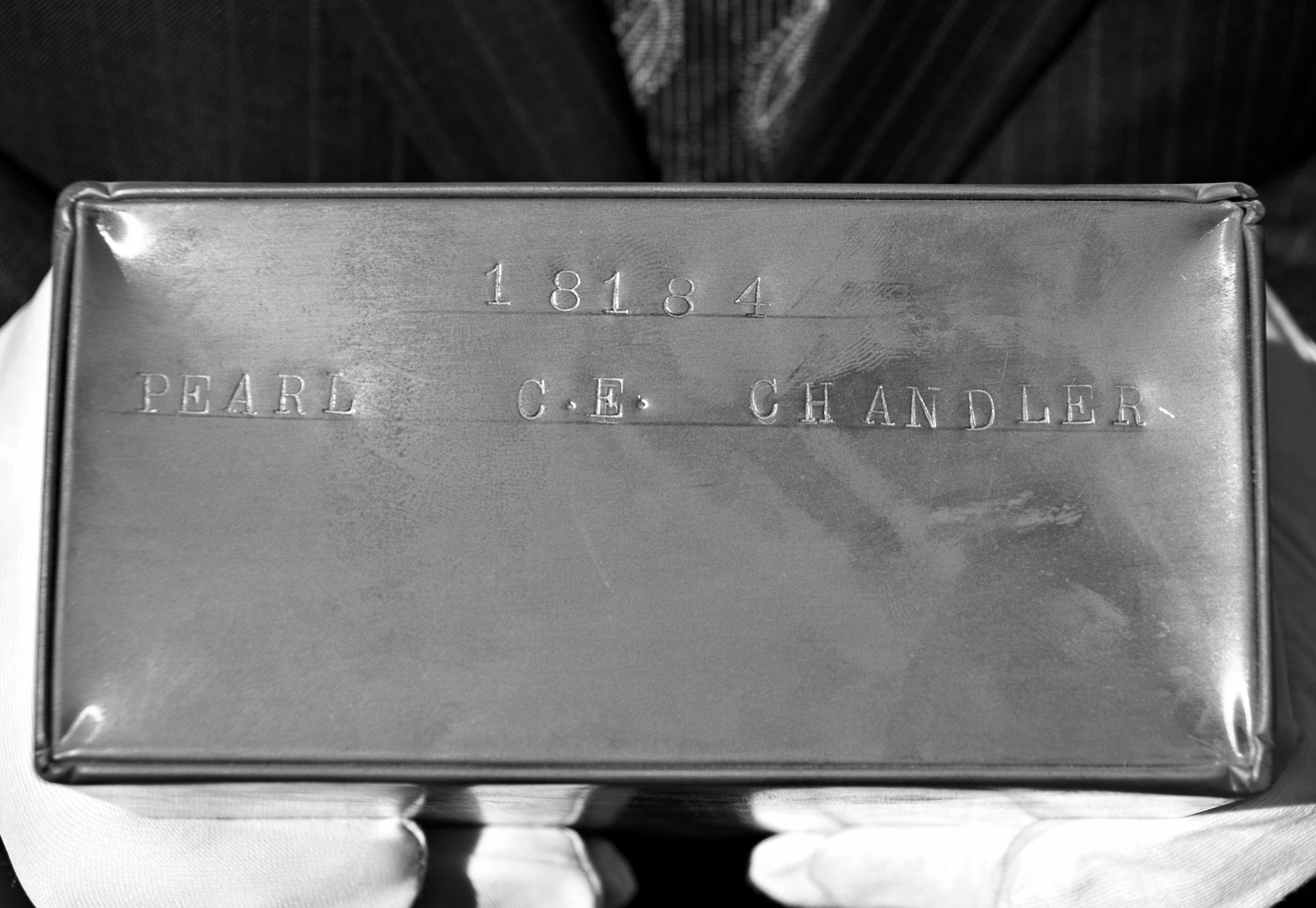 (Above) Close-up of Cissy Chandler’s urn.
Raymond Chandler, who with Dashiell Hammett perfected the American hard-boiled detective novel, died a lonely man in 1959. Buried at the expense of the county at Mount Hope Cemetery in San Diego, California, he was widowed, childless, and isolated at the time of his demise. A mere 17 people attended Chandler’s funeral. None of them prominent. Few of them close to the author.
His wife, the former Cissy Pascal, to whom he had been married for 30 years, predeceased him by almost half a decade. Although they’d had their difficulties--Chandler cheated on her for one thing, and she misrepresented her (much greater) age for another--they were very much in love and their parting undoubtedly shortened his own life. Months after her passing, Chandler tried to kill himself with a revolver and the pace of his already prodigious drinking increased.
Chandler had Cissy cremated, and the urn that held her remains was placed in storage in Cypress View Mausoleum, not far from Mount Hope. He never got around to doing anything more with that urn. There is every reason to believe Chandler intended for her to be buried with him when he died, but his will didn’t address the issue, and no one who knew of his wishes was involved in the funeral arrangements. As a result, the urn sat on a shelf in a storage room at the mausoleum for more than 56 years.
All of that changed this last Monday, Valentine’s Day, when a court order secured at the behest of Chandler aficionado Loren Latker, whose Web site, Shamus Town, documents Chandler locations in Los Angeles, paved the way for them to be reunited at Chandler’s Mount Hope grave.
Although the sentiment behind the inscription on playwright William Shakespeare’s tombstone, “Curst be he that moves my bones,” has informed English common law in the matter of moving remains for centuries, Latker and his attorney, Aissa Wayne (the daughter of actor John Wayne), argued that Cissy’s “cremains” were not interred in a permanent resting place. They noted that the storage room at Cypress View Mausoleum was not open to the public and was also home to prosaic items such as garden tools. Furthermore, the mausoleum was free to dispose of the cremains at any time, as California law stipulates that unclaimed remains need only be held for a year.
Said Superior Court Judge Richard Whitney in ruling to permit the transfer, “I’m not happy with that fact that any person’s remains,
 whether it’s Mrs. Chandler or anyone’s, are sitting in a storage facility.”
(Right) The funeral director holding Cissy Chandler’s remains at Cypress View Mausoleum.
The ceremony Latker and his wife, Dr. Annie Thiel-Latker, arranged to reunite the couple was thoughtful and well planned. It began on Monday with a procession of vintage automobiles, including a 1927 Cadillac, a 1936 Cadillac convertible, and a 1929 Graham Paige limousine. These were used to transport Latker and those people most closely involved with the project, as well as a group of dignitaries and of course Cissy’s urn, the short distance from Cypress View Mausoleum to Chandler’s Mount Hope gravesite.
A crowd of approximately 100 people, plus the Crown Island Jazz Band, waited to received them. Once everyone was assembled at the gravesite, Latker took to a podium and briefly explained the history of the effort to reunite this couple. Other speakers followed, including his wife, Annie, who recited Shakespeare’s Sonnet 116 (on marriage), and Ann Hill, trustee of the San Diego Historical Society, who spoke about Chandler and Cissy’s ties to California and the San Diego area.
Next up was film and television actor Powers Boothe. Boothe is known for his Emmy Award-winning 1980 portrayal of Jim Jones, his role as Cy Tolliver on Deadwood, and for donning a trench coat and fedora to play Chandler’s private-eye protagonist in the 1980s HBO-TV series Philip Marlowe, Private Eye. Boothe gave a spirited reading of excerpts from Chandler’s work, mining such themes as drinking, Hollywood, and women--most particularly blondes. I especially enjoyed his reading of Marlowe’s categorization of the different types of blondes in the world, misogynistic though it may be. (“There are blondes and blondes and it is almost a joke word nowadays …”)
Novelist, essayist, and biographer Judith Freeman spoke after Boothe. As the author of The Long Embrace: Raymond Chandler and the Woman He Loved (2008), Freeman was an appropriate choice. She read several passages from her book, including this quote from a Chandler letter describing his relationship with his then deceased wife:
She was the beat of my heart for thirty years. She was the music heard faintly around the edge of the sound. It was my great and now useless regret that I never wrote anything really worth her attention, no book I could dedicate to her. I planned it. I thought of it, but I never wrote it. Perhaps I couldn’t have written it.Randal Gardner, the rector of St. James by-the-Sea Episcopal Church in La Jolla, then came forward to conduct the burial service. (It’s interesting to note that a previous St. James by-the-Sea Rector performed both of the original services for Chandler and Cissy.)
While Chandler’s original grave marker was not removed, a new marker inscribed with both his and Cissy’s birth and death date information, and the Chandler quotation, “Dead men are heavier than broken hearts,” had been set at the foot
 of the grave. At the conclusion of the service, Reverend Gardner gently placed Cissy’s urn in the earth between those two markers.
(Left) Sybil Davis and Chandler.
Latker hosted a reception following the service and invited several other attendees to say a few words. One such speaker was Sybil Davis, whose mother, Jean Fracasse, worked for Chandler as his secretary during the turbulent time in Chandler’s life after Cissy died. Chandler developed a romantic interest in Fracasse, which was evidently not reciprocated, but which didn’t stop Chandler from lavishing a lot of attention on her and her children, and at one point, making his will out to her.
Davis and her mother were in attendance at Chandler’s 1959 funeral, and she explained that Chandler gave her and her mother (now deceased) a number of his processions, including Cissy’s diamond wedding ring, Chandler’s monogrammed silver cigarette case, and his ostrich-skin wallet. She showed those items to the reception attendees and also displayed a photograph of her as a child with Chandler (see above).
The high point of this reception, though, was a toast drunk with gimlets in Cissy and Chandler’s honor, just as Philip Marlowe toasted the memory of his friend Terry Lennox in Chandler’s best (and appropriately named) novel, The Long Goodbye.
(Photographs by Mark Coggins. Used with permission.)
READ MORE: “Raymond Chandler’s Gift to a Writer, Even in Death,” by Jill Amadio (Promoting Crime Fiction).
Reading Beyond Borders
Sarah Weinman had the first and best piece on the Borders bookstore-chain bankruptcy, in Publishers Marketplace. It’s subscription-only, but here’s the opening:
Borders formally filed for Chapter 11 bankruptcy protection in a Manhattan Federal Court, listing total debt of $1.29 billion and supposed assets of $1.275 billion. Among the top 30 unsecured creditors listed in the filing, book publishers and distributors are owed roughly $230 million (see below for the full list).Then, earlier today, she followed up with some comments in her new blog, Off on a Tangent:
The bookseller says in an announcement that it “has received commitments for $505 million in Debtor-in-Possession (DIP) financing led by GE Capital, Restructuring Finance. This financing should enable Borders to meet its obligations going forward so that our stores continue to be competitive for customers in terms of goods, services and the shopping experience.” For customers, they expect to honor the Borders Rewards program, gift cards and other customer programs and they expect “to make employee payroll and continue its benefits programs for its employees."”
The company says they had 642 stores open as of January 29. In their press release, they say they expect to close “approximately 30 percent” of those stores, or roughly 200 locations, “in the next several weeks.”
I can’t help but think--and I’m sure I’m stealing someone else’s analogy, so apologies in advance--that we’ll look back and realize massive superstore chain bookstores were the subprime loans and credit default swaps of the publishing industry. Was it really possible that a store with comfy couches, magazines, coffee, toys and games would ever be the right venue for the actual buying of books? That a company beholden to shareholders and the stock market could mesh with the art of recommending the right title to the right customer?You can at least read the second piece in its entirety here.
With Malice Toward All
Malice Domestic today announced its contenders for the 2010 Agatha Awards in the following categories:
Best Novel:
• Stork Raving Mad, by Donna Andrews (Minotaur)
• Bury Your Dead, by Louise Penny(Minotaur)
• The Scent of Rain and Lightning, by Nancy Pickard (Ballantine)
• Drive Time, by Hank Phillippi Ryan (Mira)
• Truly, Madly, by Heather Webber (St. Martin’s)
Best First Novel:
• The Long Quiche Goodbye, by Avery Aames (Berkley)
• Murder at the PTA, by Laura Alden (Signet)
• Maid of Murder, by Amanda Flower (Five Star)
• Full Mortality, by Sasscer Hill (Wildside Press)
• Diamonds for the Dead, by Alan Orloff (Midnight Ink)
Best Non-fiction:
• The Poisoner’s Handbook: Murder and the Birth of Forensic Medicine in Jazz Age New York, by Deborah Blum (Penguin Press)
• Agatha Christie’s Secret Notebooks: 50 Years of Mysteries in the Making, by John Curran (Harper)
• Sherlock Holmes for Dummies, by Stephen Doyle and David A. Crowder (For Dummies)
• Have Faith in Your Kitchen, by Katherine Hall Page (Orchises Press)
• Charlie Chan: The Untold Story of the Honorable Detective and His Rendezvous with American History, by Yunte Huang (Norton)
Best Short Story:
• “Swing Shift,” by Dana Cameron (from Crimes by Moonlight, edited by Charlaine Harris; Berkley)
• “Size Matters,” by Sheila Connolly (from Thin Ice, edited by Mark Ammons, Kat Fast, Barbara Ross, and Leslie Wheeler; Level Best Books)
• “Volunteer of the Year,” by Barb Goffman (from Chesapeake Crimes: They Had It Comin’, edited by Marcia Talley; Wildside Press)
• “So Much in Common,” by Mary Jane Maffini (Ellery Queen Mystery Magazine, September/October 2010)
• “The Green Cross,” by Elizabeth Zelvin (Ellery Queen Mystery Magazine, August 2010)
Best Children’s/Young Adult:
• Theodore Boone, Kid Lawyer, by John Grisham (Dutton)
• Theodosia and the Eyes of Horus, by R. L. LaFevers (Houghton Mifflin)
• The Agency: A Spy in the House, by Y. S. Lee (Candlewick)
• Virals, by Kathy Reichs (Razorbill)
• The Other Side of Dark, by Sarah Smith (Atheneum)
Winners will be chosen by attendees at the next Malice Domestic convention, which is scheduled for April 29-May 1 in Bethesda, Maryland. An announcement of those award recipients will be made during a banquet on Saturday, April 30.
In addition, author Sue Grafton is to be given Malice Domestic’s Lifetime Achievement Award, and Mystery Readers Journal editor Janet Rudolph will receive its Poirot Award.
(Hat tip to Mystery Fanfare.)
Best Novel:
• Stork Raving Mad, by Donna Andrews (Minotaur)
• Bury Your Dead, by Louise Penny(Minotaur)
• The Scent of Rain and Lightning, by Nancy Pickard (Ballantine)
• Drive Time, by Hank Phillippi Ryan (Mira)
• Truly, Madly, by Heather Webber (St. Martin’s)
Best First Novel:
• The Long Quiche Goodbye, by Avery Aames (Berkley)
• Murder at the PTA, by Laura Alden (Signet)
• Maid of Murder, by Amanda Flower (Five Star)
• Full Mortality, by Sasscer Hill (Wildside Press)
• Diamonds for the Dead, by Alan Orloff (Midnight Ink)
Best Non-fiction:
• The Poisoner’s Handbook: Murder and the Birth of Forensic Medicine in Jazz Age New York, by Deborah Blum (Penguin Press)
• Agatha Christie’s Secret Notebooks: 50 Years of Mysteries in the Making, by John Curran (Harper)
• Sherlock Holmes for Dummies, by Stephen Doyle and David A. Crowder (For Dummies)
• Have Faith in Your Kitchen, by Katherine Hall Page (Orchises Press)
• Charlie Chan: The Untold Story of the Honorable Detective and His Rendezvous with American History, by Yunte Huang (Norton)
Best Short Story:
• “Swing Shift,” by Dana Cameron (from Crimes by Moonlight, edited by Charlaine Harris; Berkley)
• “Size Matters,” by Sheila Connolly (from Thin Ice, edited by Mark Ammons, Kat Fast, Barbara Ross, and Leslie Wheeler; Level Best Books)
• “Volunteer of the Year,” by Barb Goffman (from Chesapeake Crimes: They Had It Comin’, edited by Marcia Talley; Wildside Press)
• “So Much in Common,” by Mary Jane Maffini (Ellery Queen Mystery Magazine, September/October 2010)
• “The Green Cross,” by Elizabeth Zelvin (Ellery Queen Mystery Magazine, August 2010)
Best Children’s/Young Adult:
• Theodore Boone, Kid Lawyer, by John Grisham (Dutton)
• Theodosia and the Eyes of Horus, by R. L. LaFevers (Houghton Mifflin)
• The Agency: A Spy in the House, by Y. S. Lee (Candlewick)
• Virals, by Kathy Reichs (Razorbill)
• The Other Side of Dark, by Sarah Smith (Atheneum)
Winners will be chosen by attendees at the next Malice Domestic convention, which is scheduled for April 29-May 1 in Bethesda, Maryland. An announcement of those award recipients will be made during a banquet on Saturday, April 30.
In addition, author Sue Grafton is to be given Malice Domestic’s Lifetime Achievement Award, and Mystery Readers Journal editor Janet Rudolph will receive its Poirot Award.
(Hat tip to Mystery Fanfare.)
Tuesday, February 15, 2011
The Story Behind the Story:
“One True Sentence,” by Craig McDonald
(Editor’s note: A year ago, The Rap Sheet hosted Ohio journalist-author Craig McDonald’s essay about his third novel, Print the Legend. Now comes his follow-up, the post below, which looks back at the literary inspirations behind the newest of his delightful Hector Lassiter historical mysteries, One True Sentence [St. Martin’s/Minotaur].)
Although my series centers on 20th-century crime novelist and screenwriter Hector Lassiter, as many critics and readers have noted, the novels sometimes seem nearly as much about Lassiter’s longtime friend, Ernest Hemingway.
But the sun also sets: One True Sentence, the fourth novel in the Lassiter series, represents Hemingway’s last significant appearance across the projected eight-book cycle. Papa is leaving the building with this book.
In the first Lassiter installment, the largely 1957-set Head Games (2007), Hem was a kind of off-camera presence. Yet Hemingway cast such a long shadow in my debut, that considerably more than one reader or critic mistakenly left Head Games believing Hemingway to have been an actual character in the book.
In Lassiter #2, the decades-spanning Toros & Torsos (2008), Hemingway was Hector’s sidekick across years of the story’s action.
Last year brought Print the Legend, a novel turning on the possibility that Hemingway’s death in the summer of 1961 might have been something other than the suicide history records. Hemingway loomed over Print as a kind of restless ghost, and, at key points, he was seen in flashback.
Now we come to One True Sentence. In a more traditionally structured series, this novel would be a series launcher. The novel is set during one week in Paris, in February 1924.
Paris. The 1920s. We all have firm and fixed notions about how it must have been. I’m wagering that most of us have had those notions set for us by at least some of the writings of Ernest Hemingway.
As One True Sentence opens, Hector Lassiter and Ernest Hemingway are in their early 20s. They’ve each had some short stories printed, but neither has yet published--hell, even completed drafting--a proper novel. It’s the youngest we’ll ever see Hector and Hem in the Lassiter series.
Already, the questions are coming my way again from early One True Sentence interviewers and newcomers to the books: Why Hemingway?
Partly it’s because I intended the Lassiter series to be as much about key artistic movements--modernism, surrealism, post-modernism, and so on--as about solving mysteries. Hemingway was a key figure who straddled or helped to define all those -isms.
Blame it, too, on my overlapping reads, as a young man, of The Sun Also Rises and A Moveable Feast. Mostly the latter.
From biographies and letters, I see now how contrived or even disingenuous much of Hemingway’s posthumous memoir truly is. Doesn’t matter. I’m a trust-the-art, not-the-artist kind of guy. I was seduced, early and powerfully, by Hemingway’s portrayal of what it was like to be a young journalist and aspiring fiction writer in Paris in the 1920s; the place, Gertrude Stein famously said, “Where the 20th century was.”
As a new-fledged journalist drafting novels in the evening and on weekends--albeit doing all that writing in Ohio--my life was changed by A Moveable Feast. I wanted to live that book. Hemingway became my master and kind of the literary equivalent of what Elvis represents to rockers--the goal and the cautionary example.
Knowing I couldn’t really live Hem’s memoir, I promised myself to write my own Paris novel that I could live in--to put my own vision of the City of Lights on the page. The question was what would that novel be about? Who would anchor that book? Years passed.
Between January 2005 and December 2007, as a fiction writer, I had what Hemingway used to term “a belle époque.” I wrote most of the Lassiter series, as well as a standalone that’s scheduled to see print later this year, and the non-fiction book, Rogue Males (2009). The pages were piling up. Simultaneously, I was re-reading a lot of Hemingway. I came back to A Moveable Feast with a grown man’s eyes.
I wrote Toros & Torsos between Halloween and Christmas of 2006. On January 1 of the next year, I began to write One True Sentence (then traveling under the working title of City of Lights). My own 1920s Paris novel was unfolding in my head even as I was in the early going of composing Toros.
From the jump, One True Sentence was envisioned to be a noir turn on A Moveable Feast and a kind of post-modern dark comedy about the mystery genre itself.
As Dick Adler wrote in a January post here in The Rap Sheet (“Hem and Gert Talk Mysteries”), Gertrude Stein was an unabashed mystery fan. She called her favorite mystery writers her “mystifiers.” In an early meeting, Stein urged on a young Hemingway a copy of Marie Belloc Lowndes’ Jack the Ripper tale, The Lodger (1913).
I envisioned a series of murders of literary magazine editors along both banks of the Seine--crimes that would hit a commercially inviable writer like Gertrude Stein where she lived. In desperation, Stein--fixed in the Nero Wolfe-like comfort of her favorite chair in her salon--gathers to her a collection of Paris-dwelling mystery writers to stop the killings.
The detectives in One True Sentence include an Agatha Christie-esque British writer of locked-room mysteries who has long been established as Hector’s bête noire. We meet a fetching American female mystery writer named Brinke Devlin, who looks like Louise Brooks and writes like Craig Rice. Representing the hard-boiled school, we have Hector (and, in his way, Hemingway). Bouncing up against this collection of unlikely amateur detectives is a Maigret-like French inspector.
As One True Sentence unfolds, we meet characters and witness events that will inform the early novels of Hector Lassiter and Ernest Hemingway. We’re witnesses to a secret history of events living between the lines of Hemingway’s A Moveable Feast. We’re afforded a glimpse of the portion of the iceberg lurking below the water line, to put it in Hemingway’s own artistic terms.
For Hemingway, particularly, February 1924 was a kind of pivotal moment in time. Intimations of a tipping point being reached for the young writer were just being felt.
Hem was back in Paris after a disastrous return to daily journalism in Toronto, Canada. He came back with one small-press collection of his writings behind him, and another pending in the fall. He became a subeditor to Ford Maddox Ford’s literary magazine, The Transatlantic Review--a plot point in One True Sentence. Despite no novel to support it, Hem’s reputation as a fiction writer to watch was beginning to spread.
All of the key literary and artistic figures who appear in One True Sentence were actually in Paris during that winter--crowding in some last good food and wine before abandoning the city to an expected influx of tourists anticipating Paris’ role as host city to the Summer Olympics.
And then there were the suicides.
Paris always had its share of men and women intent upon killing themselves. The always-suicide-preoccupied Hemingway even wrote an early, undistinguished poem about all that.
Yet as the winter of 1924 unfolded in a haze of snow and freezing rain, the suicide rate in Paris spiked, particularly in artistic circles.
Hand-wringing journalists and the like blamed the young artistic community for the spate of self-inflicted deaths (“Terror Sweeps Latin Quarter” one 1924 French headline read). All those deaths suggested to me the key plot point for One True Sentence. They inspired a Dada-like artistic clique called “Nada”--a dark cult embracing murder and suicide.
This, then, is the milieu of One True Sentence: A single week in Paris in all of its winter 1924 glory. Murder, sex, and all those great writers and painters colliding, many of them treacherously bent upon screwing one another in something other than a carnal sense.
It’s Hector Lassiter and Ernest Hemingway at ground zero. It’s the key romance in Hector’s life with the woman who makes Hector, well, Hector.
It seems appropriate that Papa should have the last word on the time and the place: “But Paris was a very old city and we were young and nothing was simple there, not even poverty, nor sudden money, nor the moonlight, nor right and wrong nor the breathing of someone who lay beside you in the moonlight.”
Winners will be chosen completely at random, and their names listed on this page the following day.
Although my series centers on 20th-century crime novelist and screenwriter Hector Lassiter, as many critics and readers
have noted, the novels sometimes seem nearly as much about Lassiter’s longtime friend, Ernest Hemingway.But the sun also sets: One True Sentence, the fourth novel in the Lassiter series, represents Hemingway’s last significant appearance across the projected eight-book cycle. Papa is leaving the building with this book.
In the first Lassiter installment, the largely 1957-set Head Games (2007), Hem was a kind of off-camera presence. Yet Hemingway cast such a long shadow in my debut, that considerably more than one reader or critic mistakenly left Head Games believing Hemingway to have been an actual character in the book.
In Lassiter #2, the decades-spanning Toros & Torsos (2008), Hemingway was Hector’s sidekick across years of the story’s action.
Last year brought Print the Legend, a novel turning on the possibility that Hemingway’s death in the summer of 1961 might have been something other than the suicide history records. Hemingway loomed over Print as a kind of restless ghost, and, at key points, he was seen in flashback.
Now we come to One True Sentence. In a more traditionally structured series, this novel would be a series launcher. The novel is set during one week in Paris, in February 1924.
Paris. The 1920s. We all have firm and fixed notions about how it must have been. I’m wagering that most of us have had those notions set for us by at least some of the writings of Ernest Hemingway.
As One True Sentence opens, Hector Lassiter and Ernest Hemingway are in their early 20s. They’ve each had some short stories printed, but neither has yet published--hell, even completed drafting--a proper novel. It’s the youngest we’ll ever see Hector and Hem in the Lassiter series.
Already, the questions are coming my way again from early One True Sentence interviewers and newcomers to the books: Why Hemingway?
Partly it’s because I intended the Lassiter series to be as much about key artistic movements--modernism, surrealism, post-modernism, and so on--as about solving mysteries. Hemingway was a key figure who straddled or helped to define all those -isms.
Blame it, too, on my overlapping reads, as a young man, of The Sun Also Rises and A Moveable Feast. Mostly the latter.
From biographies and letters, I see now how contrived or even disingenuous much of Hemingway’s posthumous memoir truly is. Doesn’t matter. I’m a trust-the-art, not-the-artist kind of guy. I was seduced, early and powerfully, by Hemingway’s portrayal of what it was like to be a young journalist and aspiring fiction writer in Paris in the 1920s; the place, Gertrude Stein famously said, “Where the 20th century was.”
As a new-fledged journalist drafting novels in the evening and on weekends--albeit doing all that writing in Ohio--my life was changed by A Moveable Feast. I wanted to live that book. Hemingway became my master and kind of the literary equivalent of what Elvis represents to rockers--the goal and the cautionary example.
Knowing I couldn’t really live Hem’s memoir, I promised myself to write my own Paris novel that I could live in--to put my own vision of the City of Lights on the page. The question was what would that novel be about? Who would anchor that book? Years passed.
Between January 2005 and December 2007, as a fiction writer, I had what Hemingway used to term “a belle époque.” I wrote most of the Lassiter series, as well as a standalone that’s scheduled to see print later this year, and the non-fiction book, Rogue Males (2009). The pages were piling up. Simultaneously, I was re-reading a lot of Hemingway. I came back to A Moveable Feast with a grown man’s eyes.
I wrote Toros & Torsos between Halloween and Christmas of 2006. On January 1 of the next year, I began to write One True Sentence (then traveling under the working title of City of Lights). My own 1920s Paris novel was unfolding in my head even as I was in the early going of composing Toros.
From the jump, One True Sentence was envisioned to be a noir turn on A Moveable Feast and a kind of post-modern dark comedy about the mystery genre itself.
As Dick Adler wrote in a January post here in The Rap Sheet (“Hem and Gert Talk Mysteries”), Gertrude Stein was an unabashed mystery fan. She called her favorite mystery writers her “mystifiers.” In an early meeting, Stein urged on a young Hemingway a copy of Marie Belloc Lowndes’ Jack the Ripper tale, The Lodger (1913).
I envisioned a series of murders of literary magazine editors along both banks of the Seine--crimes that would hit a commercially inviable writer like Gertrude Stein where she lived. In desperation, Stein--fixed in the Nero Wolfe-like comfort of her favorite chair in her salon--gathers to her a collection of Paris-dwelling mystery writers to stop the killings.
The detectives in One True Sentence include an Agatha Christie-esque British writer of locked-room mysteries who has long been established as Hector’s bête noire. We meet a fetching American female mystery writer named Brinke Devlin, who looks like Louise Brooks and writes like Craig Rice. Representing the hard-boiled school, we have Hector (and, in his way, Hemingway). Bouncing up against this collection of unlikely amateur detectives is a Maigret-like French inspector.
As One True Sentence unfolds, we meet characters and witness events that will inform the early novels of Hector Lassiter and Ernest Hemingway. We’re witnesses to a secret history of events living between the lines of Hemingway’s A Moveable Feast. We’re afforded a
 glimpse of the portion of the iceberg lurking below the water line, to put it in Hemingway’s own artistic terms.
For Hemingway, particularly, February 1924 was a kind of pivotal moment in time. Intimations of a tipping point being reached for the young writer were just being felt.
Hem was back in Paris after a disastrous return to daily journalism in Toronto, Canada. He came back with one small-press collection of his writings behind him, and another pending in the fall. He became a subeditor to Ford Maddox Ford’s literary magazine, The Transatlantic Review--a plot point in One True Sentence. Despite no novel to support it, Hem’s reputation as a fiction writer to watch was beginning to spread.
All of the key literary and artistic figures who appear in One True Sentence were actually in Paris during that winter--crowding in some last good food and wine before abandoning the city to an expected influx of tourists anticipating Paris’ role as host city to the Summer Olympics.
And then there were the suicides.
Paris always had its share of men and women intent upon killing themselves. The always-suicide-preoccupied Hemingway even wrote an early, undistinguished poem about all that.
Yet as the winter of 1924 unfolded in a haze of snow and freezing rain, the suicide rate in Paris spiked, particularly in artistic circles.
Hand-wringing journalists and the like blamed the young artistic community for the spate of self-inflicted deaths (“Terror Sweeps Latin Quarter” one 1924 French headline read). All those deaths suggested to me the key plot point for One True Sentence. They inspired a Dada-like artistic clique called “Nada”--a dark cult embracing murder and suicide.
This, then, is the milieu of One True Sentence: A single week in Paris in all of its winter 1924 glory. Murder, sex, and all those great writers and painters colliding, many of them treacherously bent upon screwing one another in something other than a carnal sense.
It’s Hector Lassiter and Ernest Hemingway at ground zero. It’s the key romance in Hector’s life with the woman who makes Hector, well, Hector.
It seems appropriate that Papa should have the last word on the time and the place: “But Paris was a very old city and we were young and nothing was simple there, not even poverty, nor sudden money, nor the moonlight, nor right and wrong nor the breathing of someone who lay beside you in the moonlight.”
* * *
FREE BOOKS, ANYONE?: One True Sentence goes on sale today, but thanks to Minotaur Books, you could win one of four free copies of Craig McDonald’s new novel. To enter this latest Rap Sheet giveaway competition, all you have to do is e-mail your name and snail-mail address to jpwrites@wordcuts.org. And please be sure to write “Craig McDonald Contest” in the subject line. Entries will be accepted between now and midnight next Monday, February 21.Winners will be chosen completely at random, and their names listed on this page the following day.
Come Together, Right Now, Over Me
There was much debate last year about the wisdom and necessity of reuniting detective novelist Raymond Chandler with his wife of 30 years, Cissy, in his San Diego, California, grave. But that debate ended yesterday--Valentine’s Day--when the urn containing Cissy’s remains was buried over her husband’s casket. As the Associated Press reported:
The full AP account can be found here.
More than 100 literary fans watched Cissy Chandler’s ashes arrive at San Diego’s Mount Hope Cemetery in a caravan of 1920s-era cars as a Dixieland band played “When the Saints Go Marching In.” The reverend from the Episcopal church in La Jolla that conducted the author’s funeral in 1959 presided over the ceremony, where a new grave marker commemorating their reunification was unveiled.Among that ceremony’s attendees were Chandler historian Loren Latker; Aissa Wayne, an attorney and daughter of film star John Wayne, who helped make this reburial possible; and actor Powers Boothe, who starred in the mid-1980s HBO-TV series Philip Marlowe, Private Eye, based on Chandler’s short stories.
The full AP account can be found here.
Playing for Keeps
Sheesh, I can’t believe I have never seen this 1973 movie--especially since it stars not just Richard Benjamin, Joan Hackett, and James Mason, but also Raquel Welch, James Coburn, and Ian McShane. Looks like I’ll be exercising that Netflix account of mine once more.
Monday, February 14, 2011
Going That Extra Mile

Beantown best-sellers Chris Mooney and Dennis Lehane.
For me, one of the closing highlights to last October’s Bouchercon in San Francisco came when Rap Sheet editor J. (Jeff) Kingston Pierce passed me an advance reader’s copy of Dennis Lehane’s Moonlight Mile, which was due out in the States in November. It provided great company for me during my long flight(s) back home to London. And it was a real treat to have the novel months before its UK publication.
It wasn’t until last week that Moonlight Mile was finally released in Britain, thanks to Little, Brown UK (which has taken over the reins from Lehane’s former British publisher, Transworld). There are already numerous reviews of Moonlight Mile available in the press on both sides of the Atlantic, many--if not most--of them celebrating the long-awaited return, in this story, of Boston private detectives Patrick Kenzie and Angela Gennaro (last seen in 1999’s Prayers for Rain). Moonlight Mile is a sequel to Lehane’s 1998 novel, Gone, Baby, Gone, which found Kenzie and Gennaro searching for an abducted 4-year-old girl, Amanda McCready. Amanda makes her own return in Moonlight Mile, though she’s now a dozen years older and no longer quite so helpless.
Lehane is scheduled to visit the UK this coming July to participate in the annual Theakstons Harrogate Crime Writing Festival. Until then, he’s busy laboring over a new novel. However, in association with Moonlight Mile’s British release, Little, Brown managed to arrange an interview for me with Lehane. We talked about the film version of Shutter Island, his habit of writing on the “high wire,” his favorite Robert B. Parker novel, the work of Scottish thriller writer Alistair MacLean, and his next book, which will reintroduce another character we’ve seen before.
Ali Karim: Before this month’s excitement over the UK release of Moonlight Mile, you were busy with the U.S. release of the same novel. Can you tell us a little about the American reception both for this book and its returning characters, Patrick Kenzie and Angela Gennaro?
Dennis Lehane: Folks seem to dig it, and we’d had a long break from each other, so it was nice to hang out again. Amanda McCready [from Gone, Baby, Gone] just popped into my head. I’ve always idly wondered what happened to her, so that probably explains why she successfully lobbied for a comeback.
AK: Despite being a family man now, Patrick has not lost any of his “blue-collar” annoyance with the injustices he sees perpetrated around him on a too-frequent basis. Do you find it cathartic in some way to have Patrick provide social context to your fiction?
DL: Patrick has always been my way of looking at the world through a kind of modernized version of my father’s eyes. My father was working class;  I’m the son of a working-class [man], but I’m no longer working class myself. It’s very important to me that Patrick remain working class.
I’m the son of a working-class [man], but I’m no longer working class myself. It’s very important to me that Patrick remain working class.AK: I know in your early work, you stated that you didn’t plot heavily. But did you not have to plot more extensively for Moonlight Mile?
DL: No, it was high wire all the way. I knew where Amanda was and why she was gone, but everything else was made up as I went. Probably shows too!
AK: Considering the success of big-screen versions of your work, including Gone Baby Gone, has there been any interest yet in filming Moonlight Mile?
DL: None that I’ve heard. The characters are 12 years older than their film versions, so Casey [Affleck] and Michelle [Monaghan] would probably have to spend a lot of time in the make-up chair. Plus, the film--as great as it was--was not a commercial success.
AK: Since we’re talking about films, let me ask: Are you at all interested in writing for the screen, after your work on the third season of the HBO-TV series The Wire? Especially as your name is now mentioned reverentially in Hollywood circles?
DL: I’ve written scripts. They just haven’t been produced yet. George Pelecanos and I just wrote one together for HBO that we’ve got high hopes for.
AK: Your 2003 novel, Shutter Island, is one of my all-time favorite gothic thrillers. Tell us your thoughts on that story’s transference to film.
DL: I thought it was terrific, made special when I visited the set and met with [director] Martin Scorsese, Leonardo DiCaprio, Sir Ben Kingsley, and Mark Ruffalo. I also met Max von Sydow; it’s a singular experience to shake the hand of The Exorcist himself, believe me. Too cool for words!
AK: And what did you think about the film’s ending, and the last line Teddy Daniels [DiCaprio] delivers, which perhaps made it more accessible for general movie-going audiences?
DL: It’s an interesting line. My concern was that it be clear that Mark Ruffalo’s character not hear it. As long as that was crystal clear, then I had no problem with the line. It’s an interesting way to go.
AK: And what did you make of Christian De Meter’s eerie graphic novel version of Shutter Island?
DL: Loved it. Gorgeous panels in there. Really well done ...
AK: Returning once more to the subject of detective fiction ... I think I speak for everyone associated with The Rap Sheet when I say we were all devastated by the death last January of Robert B. Parker. Listening to a radio interview you did at the time, I learned that you began reading Parker’s work at an early age. Which of his books would you say made the biggest impression on your young self?
DL: A good half-dozen of the books made huge impressions, and the sense of humor in those books had a watershed impact on me. But the one I loved most was probably Looking for Rachel Wallace [1980].
AK: During last fall’s Bouchercon in San Francisco, you arranged to have fellow Bostonian Chris Mooney read out your, er, F-bomb-filled “Appreciation of Lee Child” speech. Could you tell us why you enjoy the adventures of protagonist Jack Reacher, and why you think Child’s work has been so fondly embraced by readers?
DL: Because Lee does something that looks deceptively easy, but is actually near-impossible to pull off. I sure couldn’t do it. He creates a series super-hero and makes him interesting, book after book. And Lee writes pure suspense better than almost anyone alive.
AK: On the subject of Chris Mooney, why do you think his work is currently more popular in the UK than it is in his native USA?
DL: Beats me. I don’t engage in that kind of thinking. Chris’ publisher should probably figure it out. I love his work, though, so I wish it were different for him, but trying to figure the tastes of an entire country is a recipe for madness.
AK: I know one thing you share with Lee Child is that you both read a lot of Alistair MacLean thrillers in your youth. What was the appeal of Scotsman MacLean’s books to you, and which were your favorite novels among the many he wrote?
DL: Alistair MacLean would always set up his books with a basic foundation in which not a single thing you learned would turn out, in the end, to be true. After you read a few of his books, you’d start to look for the twists, but you could rarely see them coming. For a 12-year-old boy, this was heaven. Plus, a good half of his novels were set during World War II, which I’ve always been fascinated by. Where Eagles Dare is probably my favorite, though I love them all, and he wrote like 30 or 35 of them. Another I loved was called--if memory serves--South by Java Head.
AK: While at the last Bouchercon, I met up with your agent, Ann Rittenberg, and complemented her on her book, Your First Novel, which she wrote with Laura Whitcomb. I really enjoyed your introduction/preface to that work. Can you tell us how Ann reacted to your news that you wanted to take on a new Patrick and Angie novel after finishing your historical thriller, The Given Day?
DL: I told her when we were on a flight to Sweden together. She was very excited, but I’d also just told her my wife was pregnant and she was even more excited about that, which is sweet.
AK: I really enjoyed the political dimensions of The Given Day, which was set in Boston during the early 20th century. Were you surprised that not many readers picked up on the connections between the events in that book and the so-called War on Terror?
DL: I wasn’t surprised, no. Some books just take longer to connect on certain levels than others.
AK: The last time we met was back in 2009 at the Borders bookstore in Charing Cross Road, London. We discussed the worldwide economic crisis and its effects on publishing. Since then, Borders UK went bust and Borders U.S. has now sought Chapter 11 bankruptcy protection. How do you view this situation?
DL: I think globalization is starting to reap what it sowed, which is a terrible result. The problem is that I just write and don’t know what to think. Maybe e-books will help, but I don’t know. It’s a troubling time for the industry.
AK: Finally, I have to ask: What are you working on presently?
Sunday, February 13, 2011
Bullet Points: Pre-Valentine’s Day Edition
• Mystery Scene’s Oline Cogdill reports that the Edgar Allan Poe House in Baltimore “is in danger.” She goes on to explain that the house, where poet/journalist/author Poe lived from 1832 to 1835
• USA Network’s Burn Notice prequel, the made-for-TV movie The Fall of Sam Axe, is scheduled for broadcast on Thursday, April 14.
• This week’s new short story in Beat to a Pulp is a western yarn by Chuck Tyrell (aka Charles Whipple) titled “Line Rider,” about a lonely cowboy and “a beautiful Navajo goddess” who comes calling.
• I never watched Hilarie Burton in the CW drama that first earned the actress acclaim, One Tree Hill, but I’ve certainly enjoyed her performances as determined insurance company investigator Sara Ellis on the con man vs. crime series, White Collar. So I was pleased to read in TV Line that the captivating Virginian will become a regular on USA’s White Collar during its third season, which will begin next fall. In the meantime, Season Two of White Collar concludes on March 8.
• I don’t know why anyone’s surprised to learn this.
• ABC-TV’s Charlie’s Angels reboot has already signed up its three fetching female private eyes, as well as Robert Wagner to provide the voice for their never-seen boss, Charlie Townsend. Now the prospective series has recruited a Bosley, Charlie’s liaison to the ladies, in the form of Puerto Rican actor Ramón Rodríguez.
• The role of love-triangle interest Ophelia in a film version of Don Winslow’s 2010 novel, Savages, has reportedly been offered to Jennifer Lawrence, who was nominated for her performance in Winter’s Bone.
• The Writer’s Almanac reminds us that today would’ve been the 108th birthday of Georges Simenon, “born in Liége, Belgium (1903). He’s one of the most prolific writers of all time, best known for his detective novels featuring Inspector Maigret. He wrote some 400 books, which sold more than 1.4 billion copies from 1935 to 1997. Each book took him on average eight days to write.” Simenon died in 1989.
• Ten U.S. states running out of smart people.
• Retrospace’s list of “The Top 40 Greatest TV Cars” includes Dan Tana’s 1957 Thunderbird from Vega$, the Ferrari from Magnum, P.I., the Sunbeam Tiger from Get Smart, Rooster’s pimpmobile from Baretta, the 1974 Firebird Esprit from The Rockford Files, Emma Peale’s Lotus Elan from The Avengers, Lieutenant Columbo’s 1959 Peugeot convertible, and ... well, you’ll just have to click here to find the rest.
• James Bond gives up his Aston Martin for a Bentley.
• More good news about the future of books.
• While I usually appreciate actress Maria Bello in whatever she does (including the short-lived TV series Mr. and Mrs. Smith), I’m with Salon critic Matt Zoller Seitz on this one: “[T]he news that NBC has ordered a new pilot for an American version of ‘Prime Suspect’ starring Maria Bello gives me pause. The idea of remaking the story of Detective Chief Inspector Jane Tennison (Helen Mirren) for American network TV seems wrongheaded. The problem is the venue. The U.S. broadcast TV model--with its 42-minutes-a-week, 22-weeks-a-year format, frequent commercial interruptions, and still-oppressive content restrictions--is the enemy of every fine quality that the original ‘Prime Suspect’ possessed.” Read Seitz’s full piece here.
• Robin Jarossi previews the new fourth series of Murdoch Mysteries.
• The latest installment of Dick Adler’s serial novel, Forget About It: The First Al Zymer Senile Detective Mystery, have been posted here. You will find a full archive of the developing yarn here.
• Rachel Brady submits her latest mystery, Dead Lift, to Marshall Zeringue’s notorious Page 69 Test. The results are here.
• And R.I.P., Emmy Award-winning TV writer John McGreevey, who died on November 24 of last year. As The Classic TV History Blog’s Stephen Bowie recalls, the prolific McGreevey penned 21 stories for The Waltons, but also wrote episodes of Ironside, Michael Shayne, The Name of the Game, and Sarge.
is no longer receiving city funding to keep the historic landmark going. That amounts to about $80,000 a year to pay for the curator’s salary, a security system, utilities and supplies.You’ll find more of Cogdill’s story here.
Actually, the Poe House hasn’t received any money from the city’s general fund since last summer. It has been operating thanks to money that the curator, Jeff Jerome, has raised through the years. Now Baltimore is saying that the Poe House must be self-sustaining by 2012 or it will close.
• USA Network’s Burn Notice prequel, the made-for-TV movie The Fall of Sam Axe, is scheduled for broadcast on Thursday, April 14.
• This week’s new short story in Beat to a Pulp is a western yarn by Chuck Tyrell (aka Charles Whipple) titled “Line Rider,” about a lonely cowboy and “a beautiful Navajo goddess” who comes calling.
• I never watched Hilarie Burton in the CW drama that first earned the actress acclaim, One Tree Hill, but I’ve certainly enjoyed her performances as determined insurance company investigator Sara Ellis on the con man vs. crime series, White Collar. So I was pleased to read in TV Line that the captivating Virginian will become a regular on USA’s White Collar during its third season, which will begin next fall. In the meantime, Season Two of White Collar concludes on March 8.
• I don’t know why anyone’s surprised to learn this.
• ABC-TV’s Charlie’s Angels reboot has already signed up its three fetching female private eyes, as well as Robert Wagner to provide the voice for their never-seen boss, Charlie Townsend. Now the prospective series has recruited a Bosley, Charlie’s liaison to the ladies, in the form of Puerto Rican actor Ramón Rodríguez.
• The role of love-triangle interest Ophelia in a film version of Don Winslow’s 2010 novel, Savages, has reportedly been offered to Jennifer Lawrence, who was nominated for her performance in Winter’s Bone.
• The Writer’s Almanac reminds us that today would’ve been the 108th birthday of Georges Simenon, “born in Liége, Belgium (1903). He’s one of the most prolific writers of all time, best known for his detective novels featuring Inspector Maigret. He wrote some 400 books, which sold more than 1.4 billion copies from 1935 to 1997. Each book took him on average eight days to write.” Simenon died in 1989.
• Ten U.S. states running out of smart people.
• Retrospace’s list of “The Top 40 Greatest TV Cars” includes Dan Tana’s 1957 Thunderbird from Vega$, the Ferrari from Magnum, P.I., the Sunbeam Tiger from Get Smart, Rooster’s pimpmobile from Baretta, the 1974 Firebird Esprit from The Rockford Files, Emma Peale’s Lotus Elan from The Avengers, Lieutenant Columbo’s 1959 Peugeot convertible, and ... well, you’ll just have to click here to find the rest.
• James Bond gives up his Aston Martin for a Bentley.
• More good news about the future of books.
• While I usually appreciate actress Maria Bello in whatever she does (including the short-lived TV series Mr. and Mrs. Smith), I’m with Salon critic Matt Zoller Seitz on this one: “[T]he news that NBC has ordered a new pilot for an American version of ‘Prime Suspect’ starring Maria Bello gives me pause. The idea of remaking the story of Detective Chief Inspector Jane Tennison (Helen Mirren) for American network TV seems wrongheaded. The problem is the venue. The U.S. broadcast TV model--with its 42-minutes-a-week, 22-weeks-a-year format, frequent commercial interruptions, and still-oppressive content restrictions--is the enemy of every fine quality that the original ‘Prime Suspect’ possessed.” Read Seitz’s full piece here.
• Robin Jarossi previews the new fourth series of Murdoch Mysteries.
• The latest installment of Dick Adler’s serial novel, Forget About It: The First Al Zymer Senile Detective Mystery, have been posted here. You will find a full archive of the developing yarn here.
• Rachel Brady submits her latest mystery, Dead Lift, to Marshall Zeringue’s notorious Page 69 Test. The results are here.
• And R.I.P., Emmy Award-winning TV writer John McGreevey, who died on November 24 of last year. As The Classic TV History Blog’s Stephen Bowie recalls, the prolific McGreevey penned 21 stories for The Waltons, but also wrote episodes of Ironside, Michael Shayne, The Name of the Game, and Sarge.
Subscribe to:
Posts (Atom)