Tuesday, October 31, 2006

Tricks, Treats, Terrors

Here’s just the thing to put you in the right mood on this Halloween eve: Victorian ghost stories. A number of fine examples are available online, in their entirety. So as I worry over last-minute preparations for the trick-or-treaters preparing to descend upon my front door (I had a whole 20 last year--whatever happened to children in my Seattle neighborhood?), I’m also trying to figure out which spooky and forgotten yarn to print out and take with me to the living room couch. Will it be Bram Stoker’s “The Judge’s House,” or maybe H.G. Wells’ “The Story of the Inexperienced Ghost,” or perhaps Wilkie Collins’ “Miss Jéromette and the Clergyman”?

Those prudish Victorians might’ve done everything they could to conceal the human body, lest the baring of skin lead to temptation; but they sure knew how to scare the pants off a reader.

READ MORE:Halloween Historical Horrorama,” by Miriam Burstein (The Little Professor).

Let a Thousand Black Orchids Bloom

Can there ever be enough commendations for crime-fiction writing? Apparently not. As Sarah Weinman reports today:
Word comes over the transom that Alfred Hitchcock’s Mystery Magazine and The Wolfe Pack, the official Nero Wolfe society, will sponsor a new annual writing prize, the Black Orchid Novella Award. The contest will offer a prize of $1,000 and publication in AHMM. Submission guidelines are available here, and the deadline to submit an entry is May 31, 2007.

The contest will honor an unpublished work of mystery fiction written in the tradition of the
Nero Wolfe mystery stories: this tradition emphasizes the deductive skills of the story’s sleuth and eschews overt sex and violence. The contest will not consider stories that use characters from Rex Stout’s Nero Wolfe stories, which are protected by copyright. Entries must be 15,000 to 20,000 words in length. Submissions will be screened by members of The Wolfe Pack, and the winner will be selected by AHMM editor Linda Landrigan and announced at the Wolfe Pack Dinner in December 2007.
With no history of winners to review and learn from, prospective entrants to this novella competition might look to Mr. Wolfe himself for advice on what will best attract the judges. As he told his legman, Archie Goodwin, in In the Best Families (1950): “You are to act in the light of experience as guided by intelligence.”

Making a House a Holmes

We’ve noted previously in The Rap Sheet that the character of Dr. Gregory House, in the popular FOX-TV series House, was inspired in part by his fellow drug user, Sherlock Holmes. But now TV Squad’s Julia Ward has put together a “blow-by-blow on the House-Holmes connection,” which includes these facts: their home addresses are both 221B, they both play musical instruments while contemplating difficult cases, and their nemeses are both named Moriarty. TV Squad readers have taken it upon themselves to add still more connections to Ward’s list.

Not Yet Put Out to Pasture

Today is Halloween, of course, but as Elizabeth Foxwell notes, it’s also the 86th birthday of former Queen’s jockey Richard Stanley Francis, better known as mystery novelist Dick Francis.

It wasn’t so long ago that I finished reading Under Orders, Francis’ 39th novel and the third (after Odds Against and Whip Hand) to feature private detective and ex-jockey Sid Halley. This is also the first novel Francis has produced since the death of his wife, Mary, in 2000--a passing that reignited rumors (made public in an unauthorized 1999 biography, Dick Francis: A Racing Life, by Graham Lord, that Mary had in fact written much if not all of her hubby’s award-winning novels). Hmm. I, for one, didn’t notice any deviation of style or slackening of pace in Under Orders, which finds the increasingly happy Halley trying to solve the murders of a Cheltenham Gold Cup-winning jockey as well as the victorious horse’s owner, at the same time as he probes the potential for abuse of Internet gambling technology. If his wife did, indeed, write his previous books, Francis obviously learned along the way how to do it himself, when that became necessary.

Besides Francis, Inspector Ghote creator H.R.F. Keating, celebrates his 80th birthday today, while Richard S. “Kinky” Friedman--novelist and independent Texas gubernatorial candidate--turns 62 years old. Congratulations to all three.

Signed vs. Unsigned

Over on the increasingly indispensable blog of Chicago crime writers called The Outfit, Michael Dymmoch talks about why authors don’t like--or trust--unsigned reviews. Since I’ve been trying to persuade several staffs of Publishers Weekly editors to let me put my name (or at least my initials) on the reviews I do for them, Dymmoch’s words have a particular resonance.

PW’s rationale for the anonymity is that its reviews are a joint effort--not only the initial reader’s opinion, but also those of various editors who may contribute to the final product. Fine: let those editors have a producer’s credit that runs alongside the writer’s name. Readers, as Dymmoch says, need to be able to get some idea of who is handing out the praise or wielding the hatchet.

The history of book reviewing is marked by critics who went either nameless (it took the London Times many decades to let its reviewers sign their pieces) or under such coy soubriquets as “Our Special Correspondent.”

What do readers, writers and reviewers think? I leave you with two definitely not anonymous recent quotes on the art and business of book reviewing. On his terrific new blog, Book/Daddy, Jerome Weeks talks about telling Irish writer Colm Toibin how much he had enjoyed a recent book of his. “That book sold so few copies that I heard you were reading it,” Toibin replied. And in The New York Times Book Review, novelist William Kennedy said, “I used to do a lot of book reviewing--I almost made a living out of it.”

Monday, October 30, 2006

Scaring Up a Fitting Read

If any holiday seems perfectly paired to crime fiction, it’s Halloween. You don’t see bloody knives used as decorations at Christmas, or gravestones punctuating front yards at Easter. No, Halloween--with its hints of occult-born misdeeds and its celebration of the darker side of human existence--best evokes the traditional elements of this genre: mystery, mayhem, and the restless spirits of the unjustly deceased. Which may be why so many crime novels have been written over the years with Halloween elements and settings, or with features that at least make reading them seem especially appropriate on October 31.

Just consider, for instance, Agatha Christie’s Halloween Party (a Hercule Poirot mystery), or Charles Williams’ All Hallows’ Eve, or David Robbins’ Spook Night. How about Lilian Jackson Braun’s The Cat Who ... Talked to Ghosts, or Ed McBain’s Tricks (an 87th Precinct Mystery), or Susan Wittig Albert’s Witches Bane?

If you’re in the market for an enchanting mystery to match the mood of this centuries-old holiday, look no further than these two lists--from MyShelf.com and the Springfield (Massachusetts) City Library.

READ MORE:The Mystery of the Halloween Jack o’Lantern” (MysteryNet.com).

Once More Unto the Breach

After suffering through Brian De Palma’s recent film adaptation of James Ellroy’s 1987 novel, The Black Dahlia (which I found unbelievably confusing and interesting almost exclusively for the lovely Mia Kirshner’s performance as Elizabeth Short), I’m not so sure that translating another of Ellroy’s books to the silver screen is such a great idea.

But apparently director Joe Carnahan isn’t so reticent as I would be. The man behind Narc and the forthcoming Smokin’ Aces tells the Web site CHUD (Cinematic Happenings Under Development):
“The film I’m doing next is White Jazz, the [1992] sequel to L.A. Confidential … My brother and I wrote the adaptation … That script is one of my favorites. It’s heartbreaking. It’s, to me, what that book always was--the point of departure from the Eisenhower ’50s to the psychedelic freakshow, Manson ’60s. It’s a total combination of the two with a heavy, heavy voice-over narration, this kind of classic noir. I love the script, dude. I’m going to get it out there--once it’s done I’m going to get it on the Internet so people can read it.”
Carnahan adds, “There’s discussion of [my also] potentially doing a remake of the [Otto] Preminger film Bunny Lake Is Missing,” a 1965 thriller adapted from Evelyn Piper’s 1957 novel of the same name.

Read the whole CHUD piece here.

A Hell of a Find

Wow, a very long-lost Jim Thompson film treatment called Lunatic at Large? And plans to finally produce a movie from the script that renowned director Stanley Kubrick failed to use before his death in 1999? Where do I get in line for tickets?

A Mystery No More

Today’s mail brought me the October/November edition of Mystery News, which contains a front-page interview with the increasingly accomplished novelist Reed Farrel Coleman (The James Deans, Hose Monkey), Stephen Miller’s profile of Patrick Quinlan (Smoked), and an article about Sarah Stewart Taylor (Still as Death). Oh, and there’s an “Out of the Past” retrospective on somebody I’d not heard of before: attorney-author Eleazar Lipsky (1911-1993), two of whose novels--Kiss of Death and The People Against O’Hara--were made into movies.

Any day in which you learn something new has to be considered wonderful. So today counts as a winner.

Sunday, October 29, 2006

The Please-Come-Back Kids

So, which long-missing crime novelist would Rap Sheet readers most like to see publishing new books again in the near future?

The answer, according to a recent online survey, is ... Jonathan Valin, the Ohio-born, Shamus Award-winning author of The Lime Pit (1980) and 10 subsequent books featuring Harry Stoner, a tough, brooding, but thoroughly appealing Cincinnati private detective once touted as “the Philip Marlowe of the eighties.” Of the 105 votes cast, Valin received 18. The five closest runners-up were: Stephen Greenleaf (16), Martha C. Lawrence (15), R.D. Wingfield (14), and Karen Kijewski and Arthur Lyons, both of whom secured 12 votes apiece. (To take a gander at the complete Rap Sheet poll results, click here.)

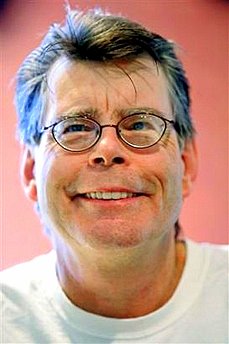
Unfortunately, none of this is likely to convince Valin (shown above, in a photo from the back jacket of The Lime Pit) to re-enter the crime-fiction-writing game. His last Stoner book was Missing, which came out way back in 1995, and caused New York Times crime-fiction critic Marilyn Stasio to coo of Valin: “He is 100 percent dependable. He can plot a story and give it an ironic twist at the end, his characters have a kink or two, and he always tosses in a moral issue to give one pause. The voice of his narrator, a Cincinnati gumshoe named Harry Stoner, can be stern, but never mean or nasty.” The great George V. Higgins was no less effusive in complimenting Valin. “He is the best thing to emerge from Cincinnati since Johnny Bench,” Higgins once remarked. Yet Stoner himself went missing 11 years ago (somehow failing to prompt the usual APBs), and there have been only sporadic reports about his creator during the past decade. One, published in The Cincinnati Enquirer in 2000, found the novelist trying to explain why he needed to get away from his fictional P.I. after almost a dozen books:
“I had a feeling back after I finished Missing ..., that I was starting to repeat myself, that I wasn’t bringing anything new to Harry. All writers write from a mass of experience, and I wasn’t experiencing anything sitting in front of a computer night and day, day in and day out ...

“So, I left Harry with a decent shot at happiness. I had toyed with killing him, but instead I found him a woman and had him thinking about marriage. Then I went on to something else.”
That “something,” explained the paper’s Jim Knippenberg, was a music-criticism magazine Valin helped found, called Fi (“as in Hi-Fi”). “My notion was to put all types of music--classical, jazz, rock--under one tent,” the author told Knippenberg. “We were close to making it work. It was a wonderful magazine but we ran out of money.” Nonetheless, Valin continues to write about music and audio technology; he’s listed on the masthead of The Absolute Sound, an Austin, Texas-based mag, as a senior writer (though his name is misspelled, at least in the online version, “Johnathan Valin.”) And, as he told the Enquirer, he hasn’t completely given up writing novels. “I owe my publishers a novel and I’m sure they’re wondering where it is,” Valin said in 2000. “I started one four years ago, but it’s not even close. I don’t like to talk about it because, like all writers, I hate to talk about works in progress.” Unfortunately, the author explained that this very incomplete book was “a non-Stoner” novel.

So, that’s the last we’ve seen of Harry Stoner, his beat-up Pinto, and his office in Cincinnati’s Riorley Building? Maybe not. In that same Enquirer piece, Valin--who’ll turn 58 next month--said that his detective protagonist remains on his mind:
“I used to pretend he was an invention, but I realize he’s a lot like me. He’s a loner and so am I. Neither of us is particularly social. We both love the city, but it’s a love/hate thing. ...

“If he comes back, and I really think he will, so maybe I should say
when he comes back, maybe in a year or two, he’ll be older, wiser and still the knight errant. But I’ve changed and so has he.”
Change. Goddamned change. It can be a character killer. Sometimes, as with Valin, the decision to leave a popular protagonist behind is the author’s. (That might also have been the case with A.E. Maxwell, the husband-wife team who ceased writing about a Los Angeles-based troubleshooter named Fiddler after their eighth book, Murder Hurts, came out in 1993. The Fiddler novels are now set to be reissued.) At other times, though, abandoning a fictional sleuth midway through a series is the result of publisher disinterest, brought on by low or stagnant book sales. In an interview with Mystery*File, Stephen Greenleaf, a lawyer turned novelist who penned 14 novels starring San Francisco P.I. John Marshall Tanner, beginning with Grave Error (1979), explained that his “retirement” from crime-fiction writing “was more forced than elected. When no publisher was willing to bring Strawberry Sunday [1999] out in softcover, even though it had been nominated for an Edgar, I knew Tanner’s day was done. Luckily I was able to write Ellipsis [2000] as the last chapter in the saga, and allow its subtext to suggest the reason my series had come to an end. I don’t see any need (or much demand) for the Tanner series to continue.”

In a recent posting to the listserv Crime Thru Time, historical mystery writer I.J. Parker (Black Arrow) reiterated the daunting challenges facing non-best-selling fictionists:
The disappearance of series authors just when readers are beginning to catch on is a problem not only for the other sub-genres but for historical mysteries also. Without the sales, the books will not stay in print. Without reader demand, they will disappear. Publishers no longer have the patience to wait out the reading public’s slow response. And publishers do not promote, except in rare cases or for already best-selling authors. These days it’s nearly miraculous for a new series to stay in print for more than 2 books. It takes at least 5 to establish the author’s name so that a new reader will pick up a book in the store.
No wonder Rap Sheet readers, many of whom are novelists themselves, responded so enthusiastically when we asked them to choose their favorite among 10 crime writers who haven’t been heard from in a while (but also haven’t died). Like Parker, they know that you can be gathering an Edgar or Anthony one day, and be denied a future publishing contract only months later. There’s simply no guarantee of success, even if you’re as frequently touted as, say, Arthur Lyons (creator of the Jacob Asch series), or show as much promise as Martha Lawrence, who managed to produce five books featuring San Diego private eye and parapsychologist Elizabeth Chase before suddenly disappearing from bookstores.

The uplifting thing about The Rap Sheet’s first online survey was to see how many readers continue to care about these missing mysterymakers. What was discouraging was to be reminded of how many other authors weren’t included on our original list of 10. We had forgotten, for instance, about Jerome Doolittle, who turned out half a dozen books (beginning with Body Scissors, 1990) featuring a quirky, unlicensed Cambridge, Massachusetts, P.I. named Tom Bethany before hanging it up. And what of Robert Irvine, who wrote about an ex-Mormon gumshoe in Salt Lake City, Utah, by the name of Moroni Traveler (Called Home, Pillar of Fire)? Or the Shamus-winning Lia Matera, who concocted seven books around a young San Francisco attorney named Willa Jansson (the last being 1998’s Havana Twist) before falling out of sight? Or Seattle’s Frederick Huebner, who turned out five books starring attorney Matthew Riordan (the last being 1994’s Methods of Execution), plus a non-series novel called Shades of Justice (2001), before joining Matera, Irvine, and the rest on mystery’s MIA list?

Rare are the novelists, such as Timothy Harris, creator of Los Angeles private eye Thomas Kyd, who return after a decade or more to pick up with their protagonists where they left off. (In 2004, Harris introduced his third Kyd novel, Unfaithful Servant, 25 years after its predecessor had been published.) But small miracles do happen. We’ve been hearing, for instance, that R.D. Wingfield, whose last novel about grumpy British Detective Chief Superintendent Jack Frost was Winter Frost (1999), has another Frost foray in the works, in which the aging cop might finally sever his association with the police. Such stories give us hope that other absent sleuths will also someday come out of hiding.

Are you listening, Mr. Valin?

Keeping It in the Family

It’s been yet another eventful week in the London (and Paris) literary scenes, which gave me my latest theme: family ties and the links they form within the crime/mystery/thriller genre.

• Last Wednesday, I was fortunate to be invited by editor Beverley Cousins to Penguin UK’s launch party celebrating the paperback release of Mr. Clarinet, by Nick Stone. This affair was held at The Blue Posts just off Oxford Street, London, and buzzed with authors ranging from Dreda Say Mitchell, David Harrison, and Jim Kelly to Maxim Jakubowski and Mark Timlin, along with a cabal of journalists, literary editors, and the usual crack Penguin team. It was made particularly interesting by the attendance of Nick’s father, the historian Norman Stone. (When Mr. Clarinet was first released, there was a fascinating article published in the London Times about father and son, which provided a backdrop to their various works.) After the festivities, a group of us went out for supper, and the conversation continued long into the night. I found a kindred spirit in Beverley’s husband, Gavin (formerly a guitarist with the rock band Jamiroquai), who turns out to be another conspiracy-theory enthusiast. And I picked up a whisper from Left Coast Crime 2006 organizer Myles Allfrey, to the effect that he’s working with critic/author Adrian Muller to schedule another crime/thriller convention in the UK. More details when I have them.

• It wasn’t long after I received a copy of Scott Frost’s new Never Fear (Headline), that I had polished it off. The story’s easygoing and beguiling style makes it a one-sitting wonder. Later, I dug around to find out more about Frost, who has television-writing credits from Twin Peaks and Babylon 5, and whose book is being released in a UK mass-market edition in January 2007. I quickly discovered that Never Fear is the second novel (after 2005’s Run the Risk) to feature Lieutenant Alex Delillo of the Pasadena, California, police department, but the first to be published in Britain. Once again, family ties play a part, for this sophomore outing finds Alex reeling from the discovery that she has a half-brother. And not only that, but he’s just been murdered. Compelled to find out why he tried to contact her on the night of his death, Alex hits upon an unexpected connection to the notorious “River Killer.” Seventeen years ago, three young women were found dead, their bodies dumped by the side of the Los Angeles River, their killer never apprehended. As Alex investigates, she learns--to her utter horror--that her absent father was the prime suspect in the River Killer slayings. Could dear old dad really have been responsible? And if so, how far will he go now to cover his tracks? Never Fear is an exceptional read, and received a rather memorable review in The Independent from Mark Timlin, who wrote: “Never Fear is as tough a crime novel as I’ve read, with a plot that twists and turns like a snake on crack.” I’m off now to devour Run the Risk.

• Incidentally, publisher Headline has begun publishing a newsletter called Crime Files. If you haven’t seen it yet, download Issue #2 here (PDF).

• I was amused and intrigued to find in my mail a review copy of No Exit Press’ forthcoming Gangster Wives, by “Lee Martin.” Yeah, right … I was tipped off several weeks ago about this “debut” sex-thriller, which I have on good authority is not a debut novel at all, but instead the pseudonymous work of a renowned British crime writer. However, I hadn’t expected the fast-paced results to be quite so much fun. I polished off Gangster Wives in just a couple of hours--one sitting. Imagine a cross between Jackie Collins and Mario Puzo, and what you end up with is this story about four women married to hardened East London bank robbers, who decide to take on their husbands as well as the police in an audacious, vengeful heist. It’s filled with witty dialogue, some laugh-out-loud scenarios, and brutal action, as well as graphic language and hardcore sex scenes. The most interesting aspect, to me, is that Lee Martin, whoever he or she is, has played a very witty early April Fool’s gag on yours truly. It seems that the undercover cop penetrating (pun intended) the gang in this novel is a Detective Sergeant Ali S. Karim, with the S standing (apparently) for “Sex God.” I almost spat out my tea, when I saw the name Ali S. Karim, and then roared with laughter. No Exit Press’ Ion Mills won’t reveal Lee Martin’s true identity, but he admitted to being amused by Martin’s protagonist, and couldn’t help but ask whether my own sex life mirrored the fictional Karim’s. I declined, tactfully, to comment. Anyway, Mills notes that Martin is diligently at work on a sequel, and there’s been strong interest in adapting Gangster Wives for television. During the Nick Stone launch, I confronted erotic-crime supremo Maxim Jakubowski on whether--as rumors have had it--he’s behind Gangster Wives, but he said that it couldn’t be him, because the sex in the story is far too restrained! Well, let me disagree: the sex is far from restrained, although its certainly pivotal to the plot. If I wasn’t already a man of color, I’d have blushed severely while reading about the exploits of DS Ali S. Karim. There’s no release date yet for Gangster Wives, but I strongly encourage you to track it down, once it does arrive in bookstores. And if anyone out there knows who Lee Martin really is, please e-mail me. I have my own suspicions. And as Detective Ali S. Karim would say, “We’re continuing our investigation.”

• On the subject of Jakubowski, he mentioned that he plans to open his bookstore, Murder One (76-78 Charing Cross Road, London), at midnight on Monday, December 4, in order to begin selling Thomas Harris’ latest novel, Hannibal Rising. If you’re in town, be sure to get to Murder One early. There’s bound to be a giant queue, as Hannibal Rising’s release is embargoed until December 5. A huge Harris fan myself, I’ll be writing something soon in anticipation of this author’s new book.

• The Rap Sheet reported recently that thriller writer Robert Littell’s son, Jonathan, has been getting considerable attention in France with his epic debut literary novel, Les Bienveillantes, written in French. We heard this week that Chatto & Windus won the auction for publishing the 900-page novel in the UK. Chatto’s publishing director, Alison Samuel, acquired the British rights from agent Andrew Nurnberg and is due to release an English translation in 2008. More information is available from the ever-dependable Times of London, which reports that as Paris enters its latest round of autumn book prizes, its cozy publishing world is struggling to cope with the runaway success of Les Bienveillantes. The 39-year-old Littell made history this week by becoming the first native English speaker to win the Grand prix du roman de l’Académie française, an annual award given out by the Académie Française, the guardian of the French language. Littell’s novel, favorably compared by critics to the works of Tolstoy, Proust, and Flaubert, has bulldozed the minimalist tomes by usual Left Bank stars to become the favorite to win the Prix Goncourt, the most coveted commendation in French literature, on November 6.

• Meanwhile, great interest is still being generated in the U.S. release of Robert Littell’s latest espionage opus, Vicious Circle. That follow-up to the award-winning Legends (2005) delves into the murky waters of Middle Eastern politics and deceptions. I find it amusing that both father and son were first published by the legendary French house Gallimard, and listening to the elder Littell last year talk about his slam-bam adoption by Gallimard was among the funniest anecdotes from his colorful life.

• Finally, thudding onto my doorstep last week came issue #14 of Crimespree Magazine. I say “thudded,” because this issue is chock-full of articles, reviews, interviews, and commentary from the Jordan family (Jon, Ruth, and Jennifer), as well as their many contributors. Highlights include the famous photograph of Deadly Pleasures editor George Easter and Mystery Mike having lunch with Clive Cussler, a guest editorial by Kevin Wignall, a “chat” between authors Martyn Waites and Ray Banks, and a superb piece about Greg Rucka, written by Jon Jordan. Crimespree is a labor of love, and it shows. Updates are available from Jon Jordan’s blog, which is always a hoot.

To finish off my theme for the week, let me leave you with this quote from Nathaniel Hawthorne, which sums up the hierarchy of an author’s needs: “The only sensible ends of literature are, first, the pleasurable toil of writing; second, the gratification of one’s family and friends; and lastly, the solid cash.”

Warm Ocean Breezes, Ominous Wind Chimes

If you can remember where you were when you saw a particular film, then for you it must be a classic. I can recall very clearly a Saturday night at Indiana University, sitting in a crowded theater in the student union building, watching a new film starring actors I didn’t know, and written and directed by an unfamiliar name. This film has stayed with me ever since.

All of this was brought back to my attention recently when I read on The New Republic’s Web site that Body Heat is now 25 years old.

For the uninitiated, Body Heat tells the story of Ned Racine, the ultimate slacker lawyer, with a moribund practice in Miami. He coasts along with his personal-injury cases and plea-bargain criminal defense work. One night at a band concert, he catches a glimpse of a stunning woman with chestnut hair in a tight skirt that hugs a lean and mean body, and a “back off, pal” demeanor--the classic femme fatale. It’s Matty Walker, the unhappy wife of a very rich and older man. To say that Racine is obsessed with Matty is an understatement; rather, he consumes every ounce of her being until he decides to sacrifice everything in a plot to kill her husband. Racine is not so much a stupid guy as he is criminally gullible. Even the dimmest member of the audience knows that Racine is being set up to take a fall, and that he’s out of his depth with this black widow. The beauty of the film is the surprise ending and how it arrives.

Body Heat introduced us to various artists who went on to bigger careers (although, writing for The New Republic, Christopher Orr points out that those careers have had their highs and lows). Lawrence Kasdan, fresh from writing Raiders of the Lost Ark, used his original script as his directorial debut. In a television interview with Bob Costas years ago, Kasdan told the story of his first day on the set--when he was preparing to direct relative unknown William Hurt (Racine) and TV soap actress Kathleen Turner (Matty) in what is probably the most erotic scene of the film. Racine follows Matty to her huge home, only to find himself locked outside on the wraparound porch, unable to access her, even though he can see her through the numerous windows. After a minute of furiously pacing (the camera tracking his every step), he gives in to the mounting lust and heaves a chair through the French doors, then bounding through the wreckage and taking her. The camera doesn’t pull away and does not shy away from the nudity that follows, which was bold for its time.

In addition to the director and the two leads, this film was our first glimpse of Ted Danson, playing a local prosecutor who tries to save Racine from himself, and Mickey Rourke, playing Teddy the arsonist, who helps Racine concoct the explosive booby trap for Matty’s husband, who was played by that great acting workhorse Richard Crenna. It is Rourke who delivers the best line of the film as he tries to talk Racine out of his murderous plot:
I got a serious question for you: What the fuck are you doing? This is not shit for you to be messin’ with. Are you ready to hear something? I want you to see if this sounds familiar: Any time you try a decent crime, you got fifty ways you’re gonna fuck it up. If you think of twenty-five of them, then you’re a genius … and you ain’t no genius.
It’s a film well worth screening again. The South Florida setting, the highly charged dialogue, and the unblinking depiction of pure and desperate lust all complement the plot as it rolls, abruptly turns on a dime, and then begins to roll again, even faster.

Body Heat is a keeper, and it certainly makes me wish Kasdan would someday return to crime films.

Read Christopher Orr’s entire essay here.

Oh, Those Tangled Hollywood Deals

Lee Goldberg makes a good observation in an item posted on his blog this morning, related to a potential big-screen remake of the old Tony Curtis/Roger Moore TV series, The Persuaders! In a Variety article from early last week, revealing that David Dorfman has been hired to write the film, there was no mention of either Ben Stiller or British comic Steve Coogan being involved with the project, as had been previously reported.

“If Stiller, in particular, was still attached, you’d think they would have trumpeted that,” Goldberg remarks. “So I’m assuming he’s gone, which makes the reasoning behind mounting this TV revival a real head-scratcher.”

Saturday, October 28, 2006

Junior Littell Wins Big

Reuters reports that the Académie Française has awarded its top literary prize to Jonathan Littell, son of celebrated American crime fictionist Robert Littell. This is the first time the commendation has been given to an American author. The winning work, Les Bienveillantes, is the 39-year-old Littell’s debut literary novel and was written in French. According to Reuters:
The 900-page tome tackles the Holocaust through the eyes of Nazi Maximilien Aue, following the activities of the SS death squads responsible for exterminating Jews and communists in areas conquered by German forces in World War Two.
The article goes on to observe that Les Bienveillantes “is on the short-list for several other literary prizes this autumn.”

The Rap Sheet has reported previously on the six-figure sum announced for the purchase of U.S. rights to Les Bienveillantes during the recent Frankfurt Book Fair. The English translation will apparently be published as The Furies.

Neither Strange nor Norrell

Though not strictly speaking a mystery, many crime-fiction enthusiasts were enchanted by Susanna Clarke’s 2004 debut novel, Jonathan Strange & Mr. Norrell. If you were one of those who loved the book, you might want to look for Clarke’s freshly published collection of short stories. Or not.

The Washington Post’s Graham Joyce was underwhelmed by the Clarke’s new The Ladies of Grace Adieu:
With all that goodwill and high profile, the only thing the publisher has to worry about is the follow-up, and while they wait for that next book, there’s the scramble to publish, well, pretty much anything by the author to capitalize on what has gone before. And that’s the problem with The Ladies of Grace Adieu.
Still, he didn’t entirely loathe the book:
The prose, though, is consistently flawless and beautiful. Reading Clarke is like inspecting some wonderful antiquated craft, such as marquetry or fine hand embroidery.
Joyce’s Washington Post review can be found here.

Terror in the Aisles

During the two national election cycles following the September 11, 2001, terrorist attacks, the U.S. Republican Party’s strategy was simple: scare Americans with suggestions of increased terrorism from abroad--and convince them that only the party of George W. Bush and Tom DeLay could possibly protect them in the future. That plan isn’t working quite so well anymore, as Bush’s approval ratings decline, the Iraq war turns even deadlier for U.S. soldiers, and GOP scandals--not limited to the corruption probe that brought down DeLay, or even the cover-up of Florida Congressman Mark Foley’s sexual advances toward male pages--have dominated the headlines and increased the odds of a Capitol Hill power shift. Yet in the run-up to the November 7 midterm elections, terrorism remains a fertile topic, at least in crime-fiction circles.

Gerald Seymour, the British journalist-author renowned for his international espionage thrillers (Harry’s Game, A Line in the Sand, Rat Run), today offers a list in The Wall Street Journal of five novels that “depict terrorism with riveting authority”:

1. Black Sunday, by Thomas Harris (1975)
2. Most Secret, by Nevil Shute (1945)
3. The Whore-Mother, by Shaun Herron (1973)
4. The Little Drummer Girl, by John le Carré (1983)
5. The Day of the Jackal, by Frederick Forsyth (1971)

You’ll find Seymour’s comments about each of his picks here.

(Hat tip to Campaign for the American Reader.)

In Praise of Older Women

Not only does today mark the 120th anniversary of the Statue of Liberty’s dedication in New York Harbor, but it also happens to be the 68th birthday of Anne Perry--historical detective novelist and convicted murderer.

Friday, October 27, 2006

The Art that Dreams Are Made of

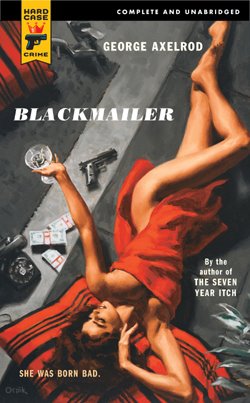
I’m not too proud to admit this: I envy the folks at paperback publisher Hard Case Crime for the quality of their book jackets. These aren’t your typically innocuous, mood-inducing, but generally meaningless covers. Instead, they’re get-your-motor-runnin’ jackets, revisiting a formula most familiar from the mid-20th century: give men sexy paperback fronts and suggestive come-on lines, and they’re likely to judge a book by its cover with fondness. And--ka-ching!--you have another sale.

Now, I understand that this approach doesn’t work for all men, and I’m quite sure it won’t work for scores of women. But from my perspective, it’s difficult not to look forward to covers like these two showing up in bookstores come next year:

Blackmailer, by George Axelrod (“the Academy Award-nominated screenwriter of Breakfast at Tiffany’s and The Manchurian Candidate”) is due out in June 2007, with Songs of Innocence, the sequel to 2004’s Little Girl Lost, by Richard Aleas (the pseudonym of Hard Case publisher Charles Ardai), scheduled for release in July of next year. In both cases, the cover art comes from California illustrator Glen Orbik, who also did the front for Stephen King’s 2005 crime novel, The Colorado Kid.

You’ve gotta love ’em!

* * *
Speaking of Hard Case, author Christa Faust reports that she will be “the first woman ... included [in] the Hard Case line up.” Her novel, Money Shot, is scheduled for release in February 2008. As Faust reports on her blog: “Everyone who reads this blog knows Hard Case is like my ultimate dream date. I still can’t quite wrap my brain around the idea that one of my books will be underneath one of those knockout covers. Never mind the fact that I’ll be on the same shelf as Shell Scott creator Richard S. Prather. Excuse me while I do a really embarrassing little dance.”

READ MORE:I Can Die Now,” by Christa Faust (Deadlier Than the Male).

The Skinny on Connelly

Stacy Alesi, aka The Book Bitch, has posted an interesting blog item about her recent encounter with author Michael Connelly at a bookstore in Delray Beach, Florida. Two things stand out:

The news that Connelly is planning to write another story featuring Mickey Haller, the protagonist from The Lincoln Lawyer (2005). “However,” Alesi notes, “when I asked if the two series--Harry Bosch & Mickey Haller--would at some point be merged into one, Connelly was quick to point out that Haller is not a series, and Bosch is the only series he writes. He did concede that since they are half brothers, at some point there will undoubtedly be a book where they come together.”

And Alesi’s question to the author regarding a New York Times piece from October 16, in which books critic Janet Maslin stated, “And Mr. Connelly now does some of his writing in Mr. [Raymond] Chandler’s old apartment, a place he uses for inspiration. No living crime writer has a better right to be there.” The Book Bitch writes: “Connelly was quick to point out that it was a mistake--yes, in the NY Times. He does rent an apartment in Los Angeles but it isn’t Chandler’s apartment. However, there is a connection--the apartment is at the address of Chandler’s famous fictional character, Philip Marlowe. Connelly said he didn’t think that Chandler had ever stepped foot in it.”

Paper Plus Art Plus Murder

Taylor Holden’s first novel, The Sense of Paper, is an elegant, edible paperback original from Bantam. Here’s what I wrote (and had to remove, for lack of space) from my last Chicago Tribune column:
If the idea of beautiful, handmade paper or a painting by the famed 19th-century British landscape artist J.M.W. Turner gets you as excited as reading a sharp and sad mystery, this new novel--her first--from a British journalist who specializes in covering wars should satisfy all your cravings.

Charlotte “Charlie” Hudson, recovering slowly from the physical and psychological wounds of her coverage of the war in Kosovo, becomes fascinated with handmade art papers--especially the ones used by Turner. This leads to a romantic connection with another British painter--whose daughter’s suicide is beginning to look much more like murder. Holden manages to be as interesting about the history of paper as she is about modern crime.

The Pumpkin Patch Kids

This has absolutely nothing to do with crime fiction. However, I suspect it will appeal to a broad selection of this genre’s readers, who grew up watching Peanuts TV specials.

Tonight marks the 40th-anniversary U.S. broadcast of It’s the Great Pumpkin, Charlie Brown, based on Charles M. Schultz’s immensely popular comic strip. Without harping on my age, let me just say that I was around for the premiere showing of It’s the Great Pumpkin, on October 27, 1966, and have made watching this half-hour special a Halloween tradition ever since. Together with A Charlie Brown Christmas, which first hit the airwaves in 1965 (and was also animated by Bill Melendez), it has become a fond, if melancholy, reminder that yet another twelvemonth is coming to a close--and that I’d better revisit my last list of New Year’s resolutions to see if any of them can be crossed off.

It’s the Great Pumpkin, Charlie Brown is scheduled to show tonight at 8 p.m. ET/PT on ABC-TV.

Thursday, October 26, 2006

The Shots Heard Round the West

I’m stumped on how to make this into a crime-fiction-related item, but I can’t let the anniversary simply pass by, unremarked upon: It was 125 years ago today--October 26, 1881--that Wyatt Earp, Morgan Earp, Virgil Earp, and Doc Holliday faced down Frank McLaury, Tom McLaury, Billy Clanton, Ike Clanton, and Billy Claiborne in a dusty vacant lot behind the O.K. Corral in Tombstone, Arizona Territory. The resulting “Gunfight at the O.K. Corral” lasted--at best--30 seconds, but resulted in three deaths, the same number of woundings, and a mythologizing of the Earp brothers and Holliday that has grown ever since, abetted greatly by novels and re-enactments of the gunfight in movies.

Another Good One Gone

The Gumshoe Site’s Jiro Kimura notes the passing yesterday of Robert Rosenberg, an Israeli journalist who had also composed four well-regarded detective novels.

Born in Boston, Massachusetts, Rosenberg had worked for the United Press International news agency in Tel Aviv and been a reporter with The Jerusalem Post, but also served as Israel correspondent for Time magazine and, subsequently, for U.S. News and World Report. After freelancing for Playboy, Penthouse, Reader’s Digest, and other noteworthy publications, in 1995 he founded Ariga, a Web-based “source of news from Israel, emphasizing the peace process, but also including poetry, painting and other subjects of interest ...” A year later, he saw published his non-fiction book Secret Soldier, “the autobiography of Muki Betser, the man [former Prime Minister] Ehud Barak called Israel’s greatest commando.”

On top of his other literary and journalistic labors, Rosenberg managed to pen a quartet of novels featuring Jerusalem detective Avram Cohen: Crimes of the City (a New York Times Notable Thriller of 1991), The Cutting Room (1993), House of Guilt (1996), and An Accidental Murder. The Thrilling Detective Web Site describes Cohen as “Israel’s most hard-boiled detective ... [O]nce one of that country’s top cops and a high-ranking police official, [he] is forced into retirement, and subsequently finds himself put in the position of investigation privately. ‘True, he doesn’t hang out a shingle or call himself a P.I.,’ admits his creator, Robert Rosenberg, ‘but he definitely behaves like one.’”

The author was only 54 years old at the time he died from cancer in Tel Aviv on Wednesday.

Case Closed

Arthur Hill, the Saskatchewan, Canada-born actor who played a small-town California lawyer in the ABC-TV series Owen Marshall: Counselor at Law (1971-1974), died last Sunday at a care facility in Pacific Palisades, California, after a long battle with Alzheimer’s disease. He was 84 years old.

Memories are short, so many Rap Sheet readers who actually saw the show will probably have forgotten Owen Marshall by now. But it found the avuncular Hill playing a defense attorney who took on cases ranging from civil suits to
murder, with the assistance of several different younger lawyers, one of whom was Lee Majors, later to star in The Six Million Dollar Man. A write-up at the International Movie Database (IMDb) describes attorney Marshall as “the courtroom equivalent of medicine’s kindly Marcus Welby [Robert Young], and in fact the two series sometimes had joint episodes. Since Owen Marshall: Counselor at Law and Marcus Welby, M.D. were both produced under the executive producer and creator David Victor, as well as University of Wisconsin law professor Jerry McNeely.”

Other than Owen Marshall, Hill appeared in the films The Ugly American, Harper, Rabbit, Run, The Andromeda Strain, and A Bridge Too Far. He also showed up frequently on television, both in series (Route 66, Voyage to the Bottom of the Sea, The F.B.I., The Bold Ones, Little House on the Prairie, and Columbo) and in teleflicks (The Other Man, The Return of Frank Cannon, etc.). His final dramatic role, according to IMDb, was in a 1990 episode of Murder, She Wrote.

READ MORE:Owen Marshall: Counselor at Law Promotional Spots” (Television Obscurities); “Underrated Performer of the Week: Arthur Hill,” by Robert Ryan (Classic Film and TV Café).

Beating, Knifing, Bludgeoning a Dead Horse

As Gilda Radner’s character, Roseanne Roseannadanna, might say, “What’s all this fuss about cereal killers?”

Sarah Weinman points out Jerome Weeks’ new Book/Daddy blog. One of the new entries there is about the serial killer myth vs. reality--a topic of interest to me and I’m sure to numerous other readers.
Many readers will note (or “violently object to the fact”) that on my Top 10 Favorite Literary Thrillers ..., there’s a passel of writers normally on such lists who don’t appear here: Dennis Lehane, James Ellroy, James Lee Burke, George Pelecanos, Robert Parker, Michael Connelly.

A chief reason I have trouble with individual examples from these writers is their reliance on the exotic mastermind serial killer, a device to maintain suspense that is so overused, the killer’s knife hand must be tired by now from murdering every nubile young thing in sight. Even Thomas Harris should have retired Hannibal Lecter after
Silence of the Lambs. His follow-up, Hannibal, was a complete botch, a dreadful book.

And the fact is that such serial killers are extremely rare; most are just pathetic screw-ups unable to relate to others without resorting to violence. What makes the serial killer novel worse is its reliance on that other cliché: the profiler or the brilliant detective who must steep himself in violence and madness to understand the killer’s thinking and thus risk his own sanity. Again, a writer has to do something with style and voice or upending these conventions to keep me interested.
What does anyone else think about calling a moratorium on serial killers?--Dick Adler

There Ain’t No Justice? Don’t Bet On It

Lisa Scottoline, the author to date of 13 legal thrillers (including this year’s Dirty Blonde), serves up in The Guardian her top-10 list of books about justice--seven novels, one compilation of novels, a single play, and a work of non-fiction.

“I write novels about justice,” Scottoline explains in her brief introduction, “a rich and compelling subject because it always involves the great themes--the struggle between right and wrong, good and evil, and love and hate. I also teach a course I developed called Justice and Fiction at my alma mater, the University of Pennsylvania Law School, in which I trace views of justice in fiction. Here are some of the books I teach. If you read them, you’ll get the short course--without the tuition!”

1. The Merchant of Venice, by William Shakespeare
2. The Murder of Roger Ackroyd, by Agatha Christie
3. Anatomy of a Murder, by Robert Traver
4. The Talented Mr. Ripley, Ripley Under Ground, Ripley’s Game, and The Boy Who Followed Ripley, by Patricia Highsmith
5. To Kill A Mockingbird, by Harper Lee
6. The Godfather, by Mario Puzo
7. The Firm, by John Grisham
8. A Civil Action, Jonathan Harr
9. A Certain Justice, by P.D. James
10. Rumpole and the Penge Bungalow Murders, by John Mortimer

The full Guardian piece includes Scottoline’s justifications for her selections. You can read it here.

(Hat tip to Campaign for the American Reader.)

Wednesday, October 25, 2006

King’s Stand

By now, most folks have heard about the criticism actor Michael J. Fox received from right-wing radio blowhard Rush Limbaugh for appearing in TV campaign commercials that back Democratic U.S. Senate candidates who support stem-cell research. “He is exaggerating the effects of the disease,” the talk-show host told his listeners earlier this week. “He’s moving all around and shaking and it’s purely an act. ... This is really shameless of Michael J. Fox. Either he didn’t take his medication or he’s acting.” Of course, Limbaugh knows all about taking meds, doesn’t he? And he doesn’t seem to care that he’s been condemned, both in the traditional media and the blogosphere, for attacking one of Middle America’s most admired entertainers, whose Parkinson’s disease is certainly no laughing matter. (Slate’s Timothy Noah contends that Limbaugh’s dumb-as-a-fence-post behavior is deliberate, “a con job.”)

Interestingly, Stephen King’s own unexpected entry into America’s November 7 midterm election fray hasn’t generated nearly the same level of attention. Yet the novelist’s message, e-mailed this last Monday by the liberal group MoveOn.org, was more overtly political than Fox’s. It began (emphasis King’s):

If I know anything, I know scary. And giving this president and this out-of-control Congress two more years to screw up our future is downright terrifying. Thankfully, this national nightmare is one we can end with--literally--a wake up call.

My friends at MoveOn.org Political Action are organizing pre-Halloween phone parties this weekend, Oct. 28th & 29th. We’ll be calling progressive voters in key districts who may not turn out unless they get a friendly reminder or two.And since it’s almost Halloween, we’ll celebrate with an optional costume contest, some pumpkin carving (I’ll be making a Jack-Abramoff-O’-Lantern) and--of course--plenty of candy. ...

If you’re concerned about the future of this country, this is the time to get involved. The polls are telling us that this November is
our best shot in over a decade to turn things around, and we’ve got to make the most of it.

The note included a link to a Web site where interested people can find out about phone parties within easy driving distance.

Thus far, Limbaugh hasn’t taken the long knives to King. But then, we’re still almost two weeks out from a national election that seems destined to turn on George W. Bush’s disastrous Iraq war and Republican sex and corruption scandals, rather than on GOP-preferred issues such as national defense or “family values.” That’s plenty of time yet for Limbaugh to help turn the increasingly desperate Republican smear machine on the author of Lisey’s Story.

Consider Me Unpersuaded

I have to confess that I don’t have strong memories of The Persuaders!, a 1971-1972 British TV series starring Tony Curtis and Roger Moore as a pair of millionaire international playboys from opposite sides of “the pond,” who are coerced into fighting crime, in order to stay out of jail for trashing a restaurant. (If that sounds to you rather like the premise for both Alias Smith and Jones and It Takes a Thief, you’re not alone.)

Apparently, though, the muckety-mucks at DreamWorks recall this short-lived series (which also showed in the States on ABC-TV) with greater fondness than I. More than a year ago, that U.S. movie studio announced its intention to remake The Persuaders! as a feature film, starring--of all people--Ben Stiller. Now, Variety is reporting that Dan Dorfman, whose credits include scripting the comedies Anger Management and My Boss’s Daughter, has been signed to write the Persuaders flick. British actor Steve Coogan has been recruited to fill Roger Moore’s shoes.

Given what a dreadful job the twitchy Stiller did with the 2004 Starsky & Hutch cinematic remake, and the generally poor track record American studios have when it comes to turning once-popular TV series into big-screen hits, I’ll be surprised if this Persuaders doesn’t go straight to video. The only thing that could make the project more unpromising than it already is, would be if DreamWorks chose to stick with the original series’ dirge-like theme music.

The film is scheduled for release in 2007.

The Librarian Did It

A 44-year-old library assistant from Manchester, England, was sentenced Wednesday for the crime of ... stealing books. As The Guardian reported the story:
Norman Buckley, 44, took more than 455 ancient books, posters and other documents while working at Manchester’s Central Library.

He was sentenced on Wednesday to 65 weeks imprisonment, suspended for two years, and told to perform 250 hours of community service. His haul included a 16th-century edition of the works of Geoffrey Chaucer worth £35,000 and a 1654 publication of romantic poet John Donne’s Elegies that he sold for £1,800.

Really: you might well suspect the butler. But the librarian? That’s a whole new plot twist.

The Guardian piece can be found here.

Faces in a Crowd

Everybody likes to think that he or she is one of a kind. But apparently that’s true of few people, save for editor-novelist Duane Swierczynski. Thanks to a Web site called HowManyofMe.com (which bases its information on U.S. Census Bureau statistics), he determined that he’s the only person in the United States walking around with his name.

I can’t say as much for my own moniker. As it turns out, there are 497 U.S. residents named Jeffrey Pierce. (Unfortunately, the software doesn’t allow you to enter your middle name, as well.) At least that makes me rarer than James Bond (1,048), George Bush (503), and John Smith (49,535). But not so rare as Amos Walker (66), Perry Mason (52), John Cuddy (33), Alex McKnight (28), Mike Hammer (20), Elvis Cole (12), James Rockford (10), Derek Strange (10), Philip Marlowe (9), Harry Bosch (7), Jane Marple (3), Samuel Spade (3), Agatha Christie (1), Matt Scudder (1), Carlotta Carlyle (0), or Dashiell Hammett (0).

And believe it or not, there are 249 Raymond Chandlers living in the United States!

Try out your own name here.

A ‘Honey’ of a Tale

Here’s some exciting news for Elmore Leonard lovers: the now 81-year-old is due out next May with his 41st novel, Up in Honey’s Room. The site explains:
The novel is part of what could be called, “The Webster Saga.” The Webster in question is of course Carl Webster, the Hot Kid of the Marshal Service, who in the novel, The Hot Kid, becomes a legendary lawman going after Depression era bandits and the like.

Carl’s legend continued in
Comfort to the Enemy, a serial novel published by the New York Times in 2005. In this story, Carl helped the government find escaped German POWs in Oklahoma, particularly at Deep Fork near his family home.

Now, in
Up in Honey’s Room, Carl comes to Detroit to find a couple [of] escaped German POWs and finds first a degenerate Nazi spy ring and some hot women who are as dangerous as they are fun. Plenty of surprises in this book.
There’s a bit information to be found in the catalogue copy promoting Leonard’s forthcoming novel. You’ll find that here.

(Hat tip to Campaign for the American Reader.)

The Evil Within

Today in the Toronto Star’s “Criminal Minds” column, Louise Penny (Still Life, Dead Cold) offers up some thoughts on the nature of evil:
Evil is unspectacular and always human, as Auden wrote. It’s not some angry spirit, not Satan, not a natural disaster--it’s us. The evil in most of our lives isn’t the huge events, the wars and genocides, the tortures and murders. Most evil shares our bed and our clothing.
The paper is currently plugging the Toronto Harbourfront reading series. Penny will be appearing this coming Saturday.

(Hat tip to Miss Sarah.)

Monday, October 23, 2006

Voices Fresh from the Grassy Knoll

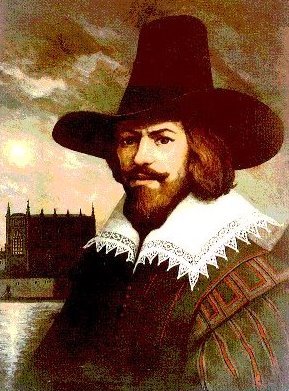
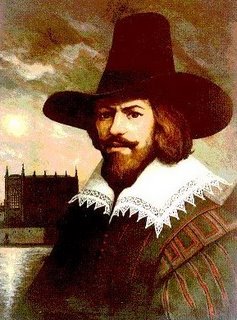
We’re a little more than a week away from Halloween, which is then followed--at least in the United Kingdom--by Guy Fawkes Night, an annual celebration of the failed Gunpowder Plot of 1605, in which Roman Catholic conspirators, one of whom was English soldier Fawkes (pictured at right), sought to blow up London’s Houses of Parliament and kill Protestant King James I, who was inside. This sets me to thinking about conspiracies and conspiracy theories, which of course are the lifeblood of many thrillers and crime novels.

Take, for example, Christopher Reich’s The Patriots Club (2005), which in July of this year received the International Thriller Writers’ first Best Thriller Novel Award. That novel features at its core a conspiracy involving right-wing politics and American foreign policy. One of the biggest-selling novels of all time is Dan Brown’s The Da Vinci Code (2003), which builds around an intricate religious conspiracy. And of course, films are rife with conspiracies, whether in The Manchurian Candidate, Chinatown, Syriana, The Constant Gardener, or the more recent Hollywoodland.

So, my theme this week is conspiracy theories. Believe it or not.

• It wasn’t only Guy Fawkes Night that inspired this, though. It was also my dinner last week with a pair of writers I greatly admire: Martyn Waites (because of his social conscience and hard-hitting plots; I think of him as a British George Pelecanos) and Zöe Sharp (creator of the Charlie Fox series). It was at that meal, served during the Off the Shelf Literary Festival in Sheffield, that the Crime Writers’ Association (CWA) presented its 2006 Short Story Dagger Award. In between bites, Zöe and Andy Sharp told me of their recent exploits at Bouchercon, in Madison, Wisconsin (about which Zöe has written some in her blog). However, the part that fascinated me, was their side trip to Dallas, Texas, and their visits to the notorious Texas School Book Depository and the nearby Grassy Knoll, both of which feature significantly in the November 1963 assassination of one of my heroes, U.S. President John F. Kennedy. We had a terrific discussion of those long-ago events and the conspiracy theories that have been generated by them; and even Danuta Reah (aka Carla Banks, author of The Forest of Souls) became fascinated by the myriad ideas we’ve all heard floating around the world regarding Kennedy’s killing. I, naturally, was happy to fuel the talk of Orwellian nightmares and the role played by the modern media in misdirecting public attention from large conspiratorial crimes.

• All this reminded me of the time, a few years back, when I interviewed Michael Marshall, author of The Straw Men, The Lonely Dead (U.S. title: The Upright Man), and Blood of Angels. All three of those novels center around a huge conspiracy involving a cabal of genetically linked serial killers who--get this--date from the dawn of man, and continue to ply their devious talents even today. Pretty incredible, sure, but also terrifically imaginative and involving. I was concerned, after the release of Angels in 2005, that Marshall might return to his roots in horror and science fiction (where he’s known by his full name, Michael Marshall Smith). But the good folks over at HarperCollins UK have reassured me that Marshall will be releasing another left-of-field crime novel next spring, this one titled The Intruders. Let me just say that I’m looking forward to that book as if it were a missing lottery ticket.
• Britain is still going King crazy, in anticipation of Stephen King’s visit here on November 7. The Times of London produced a fabulous supplement about the author and his work, most of which--fortunately--is available online. I finished King’s latest, Lisey’s Story, a couple of weeks back and found it to be not only winningly complex, but probably his most personal piece of fiction yet. And that opinion was mirrored by Peter Millar of The Times (see his review here). Tickets to hear King speak at London’s Royal Albert Hall are nearly sold out, so if you’re planning to be in London on the 7th, grab one while you still can. (They go for £15 each; call 08708 303 488.) Remember, this is King’s first visit to the UK in 10 years. Who knows when he’ll be back?

• I don’t watch much television nowadays, due to the amount of reading and writing I must do. And, besides, I find most of what’s available on the tube sheer drivel. Apparently, Barry Eisler (The Last Assassin) feels exactly the same. In a recent post at his blog, he addressed the topic of switching off the telly and how one might use his or her extra free time:

Think of what you can do with an hour a day for, say, four years. Become a black belt in a martial art. Acquire a foreign language. Learn a musical instrument.

Write a novel.

Or you can have watched many award-winning prime time television shows, all of which are no doubt excellent entertainment and thoroughly enjoyable.

What you can’t do is both. You have to choose. There’s no right answer; it’s a question of what’s important to you. But you should choose knowingly. Don’t delude yourself into thinking, as you plop down on the Barcolounger and fire up the remote, that one day you’re going to rent that isolated cabin and write that novel you’ve always been thinking about. It won’t happen. That one day is today. It’s right now. It’s every day to come, however many you have.

I’m a big fan of Eisler’s thrillers, and I enjoy his blogging, overall; when he sticks to subjects such as books, writing, and life, the blog really sings. (One of his finest posts related to an e-mail exchange with a bookseller.) I am less interested in his commentary about politics, as his viewpoints occasionally conflict with my liberal values system. But I’ll defend freedom of speech--his and mine--with my dying breath. And there’s entertainment to be found in some of the reader responses to Eisler’s political remarks.

• While we’re on the subject of speech freedoms and liberal convictions, I want to mention how sad I was to learn about the death on October 8 of Pulitzer Prize winner Ira B. Harkey Jr., the onetime editor and publisher of the Pascagoula Chronicle. He was 88 years old. Harkey, you might remember, was pretty much the only white editor in Mississippi who supported racial desegregation of the University of Mississippi (“Ole Miss”) in 1962. His courage won him a Pulitzer, but led to his being ostracized in his hometown. He suffered death threats, but stood firmly upon his principals. In an interview many years later, Harkey recalled his idealism as a young editor: “I had the feeling--and I hate to say this because I sound like a jerk--I had the feeling I could make a difference. That I could really teach these people that the black man was a human being and not an animal. That he deserved the same rights as everyone else.” Tonight, I’ll open a special bottle of wine from my cellar and toast his life, for Ira Harkey did, indeed, make a difference. Click here to learn more about the man and his mission.
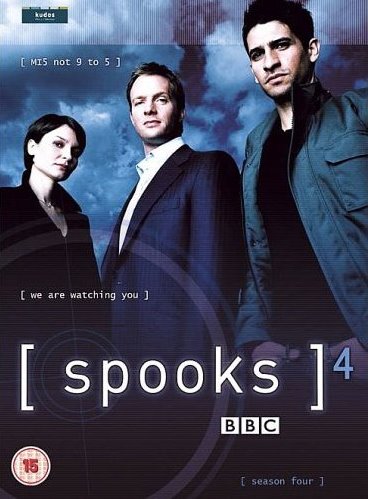
• Remember how I just got through saying that television these days isn’t worth watching? Well, one programming exception--which reminds me both of why conspiracies are so very enthralling, and why the BBC has such a fine reputation-- is the espionage series Spooks (called MI5 in the States). The show is now midway through its fifth season, and on Monday will feature the second part of a two-part episode. I had the chance this weekend to preview both parts of that episode, and I must admit that at the end, I wept with joy, such was the brilliance of the show’s writing, acting, pace, production values, humanity, and topicality. Interestingly, I didn’t get hooked on Spooks until its third series; but thanks to the wonders of DVDs, I could catch up. I am now officially a Spooks geek. The elements I find most appealing about this show are (a) that its security-service managers aren’t your typical right-wing guns-and-ammo junkies, and (b) that the stories put Spooks’ top-notch cast of characters through some very anxiety-inducing moral dilemmas. (Players have got to stay sharp on this series: even major characters are in the habit of meeting violent ends.) I was delighted to find in my mail this week two new book releases related to the show: Spooks: The Personnel Files (Headline), which both Shots editor Mike Stotter and I found to be a fast and fascinating read; and Spooks: Behind the Scenes (Orion), a perfect companion for the series. By the way, the creator of this series is David Wolstencroft, who started out by penning espionage fiction. Though I didn’t care for his debut novel, Good News, Bad News (2005), I’ve heard favorable things said of his second book, Contact Zero, released earlier this year by Hodder Headline.

• The other TV series that’s caught my eye, and which ended its second season in Britain last week, is Extras, which stars Ricky Gervais, Stephen Merchant, and a host of A-list celebrities willing to lampoon themselves. The comedy in Extras is intelligent, thought-provoking and completely cringe-making. The series ended on a high note with a very funny cameo appearance by Robert De Niro. For my money, Extras is the funniest thing on television lately, beating its precursor, The Office, hands-down.

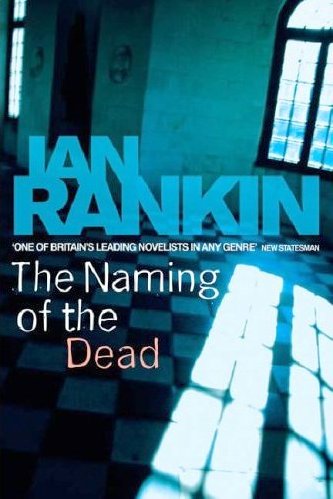
• Back to the subject of conspiracies: Shots columnist and author Mike Ripley, along with reviewer Ayo Onatade, both speak highly of Ian Rankin’s latest release, The Naming of the Dead (Orion). This 16th Inspector John Rebus tale turns on a conspiracy of sorts unfolding during the Group of 8 (G8) Summit held in Scotland in 2005. The release of a Rankin novel is a certifiable event, and one that I look forward to with immense pleasure, having been present when the author was awarded the CWA Diamond Dagger back in 2005. The Independent on Sunday boasts a splendid interview with and profile of Rankin, which points out in part that The Naming of the Dead is the series’ third overtly political book. (He’s previously tackled the issues of immigration, asylum seekers, and racism.) By focusing on the G8 protests and the Make Poverty History campaign, the book tackles the question of whether the individual can effect change. The conclusion is not optimistic. As protesters take to the streets of Edinburgh and surround Gleneagles, it becomes apparent to Rebus that the decisions they wish to influence have already been made. Worse, he discovers that instead of tackling poverty, aid is tied to arms and, yet again, big business triumphs over the needs of the poor.

• A related note: Rankin will appear next week at Sheffield’s Off the Shelf Literature Festival to discuss the fate of his man Rebus. If you have a ticket (or can somehow scrounge one up at this late date), you won’t want to miss what he has to say.

• Finally, in the spirit of conspiracy theorizing, I decided to revisit the 2002 film version of Philip K. Dick’s short story “Imposter,” directed by Gary Fleder and starring Gary Sinise. This wonderful science-fiction yarn has Earth under attack from an alien race, which sends down to the planet a humanoid robot (in disguise), armed with a nuclear-type device. Problem is that the robot suicide bomber thinks it’s human. Once more, fiction and reality blur in this tale of identity and reality, and once again life (and death) imitate fiction. Or is it the other way around? Sometimes I feel I just don’t know Dick. If you feel the same way about Philip K., treat yourself to a night of director Richard Linklater’s A Scanner Darkly (2006), one of the best cinematic interpretations of Dick’s work.

More next week. In the meantime--and staying with our theme--ponder this quote from William S. Burroughs: “Sometimes paranoia’s just having all the facts.”

Charm City, You Say?

As part of its delightful “Literary Guide to the World” series, Salon today hosts none other than Laura Lippman on the subject of her hometown--Baltimore, Maryland--as seen through the authorial eyes of Robert Ward (Red Baker), John Waters (Shock Value), Anne Tyler (The Accidental Tourist), and others. In her introduction to the piece, though, Lippman shows she can be as adoring and skeptical about Baltimore as anyone else:
To understand Baltimore, it’s helpful to get a grip on its geography. Baltimore is one of those odd American cities that lies in no county; instead, it dangles in the water, surrounded by a ragged blob of land. It has been said that Baltimore County looks like a monkey wrench hanging from the Mason-Dixon Line, which makes Baltimore City the bolt--one that has been tightened a hair too much. Incapable of expanding, the city has been losing population and political clout since the 1960s, when white residents began to flee for the suburbs. Fittingly, all quintessentially Baltimore stories have a “Wizard of Oz” quality: Characters dream of escaping to someplace new, only to yearn for home. Or, as we say in Bawlmer: Hooooooohme.
You’ll find the full write-up here.